
From Return to Recovery: What Happens to High-Value Products Coming Back?

When a high-value product is returned, the logistics process is far from over. Whether it's a server rack being replaced during a data center upgrade, a medical device requiring inspection, or a piece of industrial equipment coming back for repair, the return creates a new set of operational challenges.
Unlike standard consumer returns, high-value products often require specialized transportation, careful handling, secure storage, and a clear plan for what happens next. Some items can be repaired and redeployed. Others may need to be refurbished, returned to the manufacturer, or prepared for responsible disposal.
The challenge is not simply getting the product back. It's recovering as much value as possible while minimizing downtime, unnecessary handling, and operational disruption.
Reverse Logistics Starts Before the Return Shipment
For high-value products, the return process should begin before equipment is picked up.
Teams need to understand what is being returned, why it's coming back, and what needs to happen when it arrives. A defective component may need to go directly to a repair facility, while a functioning server rack removed during an upgrade may require temporary storage before redeployment.
These decisions influence transportation requirements, packaging, receiving procedures, and the destination itself.
Without a clear return plan, valuable equipment can end up sitting in a warehouse while teams determine who owns it, what condition it's in, or where it needs to go next.
Establishing the next step early helps prevent unnecessary moves and keeps the recovery process organized.
High-Value Returns Require the Same Care as Outbound Shipments
A product doesn't become less valuable simply because it's moving in the opposite direction.
Sensitive electronics, medical equipment, and industrial machinery may still require specialized packaging, secure transportation, and careful loading and unloading. In some cases, returned equipment is more vulnerable than it was during the original shipment because its protective packaging has been removed or discarded.
For example, a server rack being removed from an active facility may need to be disconnected, secured, moved through restricted areas, and prepared for transportation. The same handling considerations that applied during installation can apply during removal.
Damage during the return journey can turn repairable equipment into a total loss.
That's why reverse logistics should account for the physical characteristics of the freight, not just its destination.
Receiving Is Where Recovery Begins
Once returned equipment reaches a warehouse or processing facility, accurate receiving becomes critical.
The first step is confirming that the correct product has arrived and documenting its condition. Depending on the equipment, this may include serial number verification, photographs, inspection records, and reconciliation against the return authorization.
For manufacturers and technology companies, this documentation helps answer several important questions:
- Was the correct equipment returned?
- Did it arrive in the expected condition?
- Is anything missing or visibly damaged?
- Does it require inspection, repair, or further testing?
- Where should it go next?
An inaccurate receiving process can create problems well beyond the warehouse. Equipment may be assigned to the wrong customer, sent for unnecessary repairs, or marked as available before it's ready for use.
Accurate documentation creates the foundation for every decision that follows.
Not Every Return Follows the Same Path
One of the biggest differences between standard returns and high-value reverse logistics is what happens after receiving.
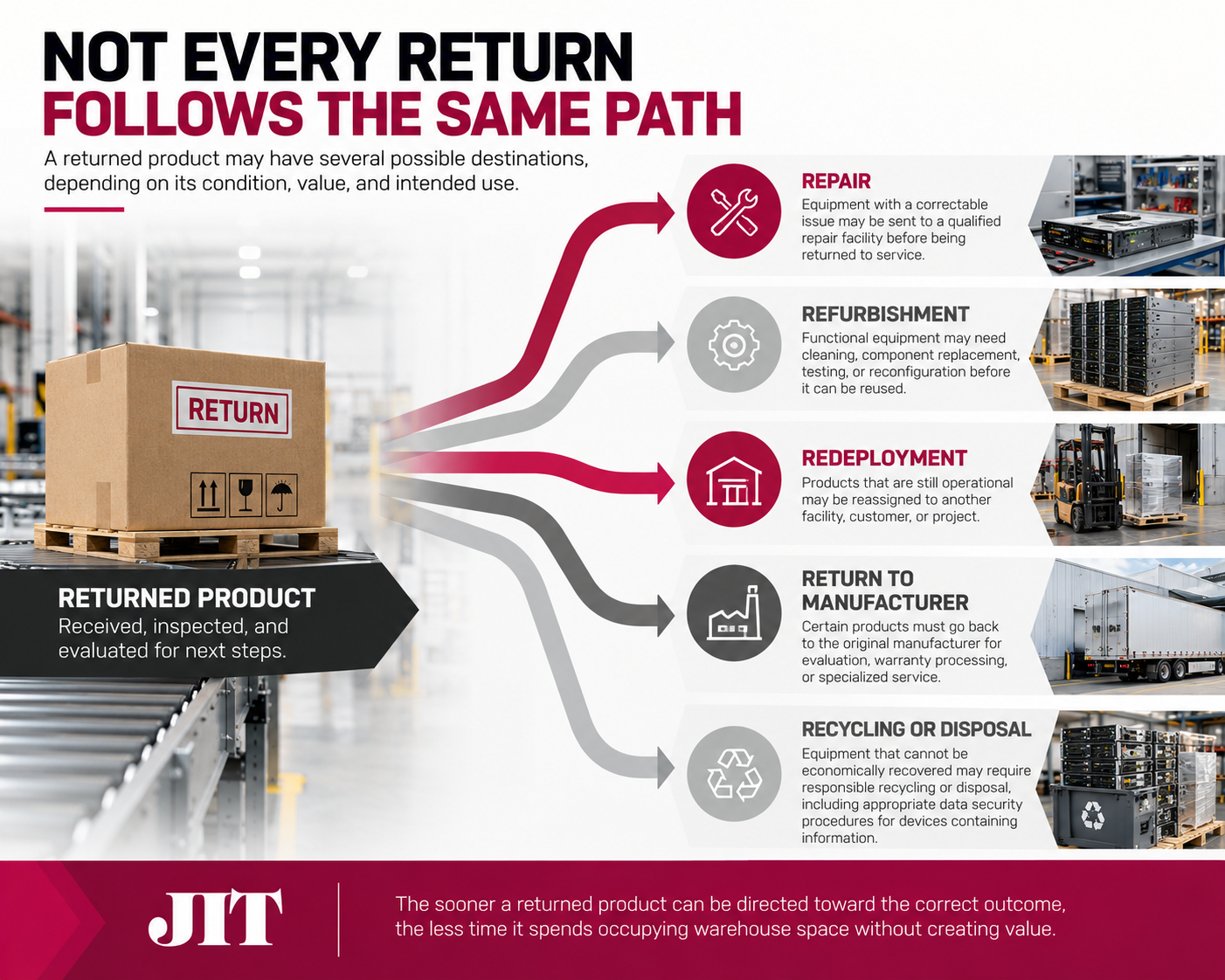
A returned product may have several possible destinations, depending on its condition, value, and intended use.
Repair: Equipment with a correctable issue may be sent to a qualified repair facility before being returned to service.
Refurbishment: Functional equipment may need cleaning, component replacement, testing, or reconfiguration before it can be reused.
Redeployment: Products that are still operational may be reassigned to another facility, customer, or project.
Return to manufacturer: Certain products must go back to the original manufacturer for evaluation, warranty processing, or specialized service.
Recycling or disposal: Equipment that cannot be economically recovered may require responsible recycling or disposal, including appropriate data security procedures for devices containing information.
Each path has different transportation, storage, documentation, and handling requirements.
The sooner a returned product can be directed toward the correct outcome, the less time it spends occupying warehouse space without creating value.
Inventory Visibility Matters in Reverse Logistics, Too
Returned products can create a complicated inventory picture.
A warehouse may physically contain dozens of returned devices, but that doesn't mean those devices are available for use. Some may be awaiting inspection, others may be approved for repair, and others may be ready for redeployment.
If inventory systems don't distinguish between those conditions, teams can make decisions based on equipment that isn't actually available.
For high-value technology, tracking individual assets is especially important. Serial numbers, condition codes, storage locations, and disposition status help teams maintain control over equipment throughout the return process.
This visibility supports more accurate planning and reduces the risk of assets being misplaced, overlooked, or redeployed prematurely.
It also helps organizations understand how much value is tied up in returned inventory and how quickly that value is being recovered.
Delays in Reverse Logistics Can Become Operational Delays
The cost of a slow return isn't always limited to storage or transportation.
Consider a manufacturer waiting for a critical component to be repaired and returned to production. Or a data center operator that needs replacement equipment recovered, tested, and redeployed to another location.
In both cases, delays can affect project schedules, equipment availability, and operating costs.
Even when the returned product isn't urgently needed, extended processing times can tie up valuable assets that could otherwise be repaired, resold, or reused.
A coordinated reverse logistics process helps reduce the time between return initiation and the product's next productive use.
That means aligning transportation, receiving, inspection, inventory management, and outbound movement rather than treating each step as a separate transaction.
Decommissioning Adds Another Layer of Complexity
For technology companies and data center operators, reverse logistics increasingly includes equipment being removed from service as part of upgrades, relocations, and infrastructure changes.
Decommissioning may involve removing server racks, networking equipment, power components, and other infrastructure from active facilities.
These projects require more than arranging a truck.
Equipment may need to be removed in a specific sequence, handled within secure environments, inventoried at the asset level, and transported to different destinations based on its condition and intended use.
Devices containing sensitive information may also require documented data sanitization or destruction performed by qualified providers.
Some equipment may be redeployed elsewhere. Other assets may be sold, refurbished, returned to manufacturers, or recycled.
Coordinating these activities helps organizations recover usable equipment while maintaining control over valuable and potentially sensitive assets.
The Goal Is Recovery, Not Just Return
Traditional transportation focuses on moving freight from origin to destination. Reverse logistics adds another question: What happens to the product after it arrives?
For high-value products, that question can have significant financial and operational consequences.
A successful return process should help organizations recover usable assets, reduce unnecessary handling, maintain accurate inventory records, and move equipment toward its next destination as efficiently as possible.
The most effective reverse logistics operations treat returns as part of the broader supply chain rather than an exception to it.
Build a Better Return Process for High-Value Freight
Returning high-value equipment requires the same attention to detail as delivering it. From specialized transportation and secure warehousing to inventory tracking and coordinated movement, every step can affect how quickly an asset returns to productive use.
JIT Transportation supports high-value and time-sensitive supply chains with transportation, warehousing, inventory management, and specialized handling services.
Contact JIT to discuss how a more coordinated logistics strategy can help your business manage high-value returns and keep critical equipment moving.
Ready to optimize your supply chain?
Contact us today to discover how JIT Transportation can take your business to the next level.
Related Articles
The Logistics Lifecycle of a Server Rack: From Components to Decommissioning
The logistics lifecycle of a server rack spans inbound components, manufacturing, warehousing, staging, transportation, final delivery, operational support, and decommissioning, with each stage requiring careful coordination to protect equipment and keep data center operations moving.

More SKUs, More Problems: Managing Inventory as Manufacturers Scale
As manufacturers add more SKUs, accurate inventory tracking, efficient warehouse organization, kitting, and coordinated logistics become increasingly important to keeping production on schedule.

When Should You Use Dedicated Transportation?
Dedicated transportation can provide greater control over timing, handling, security, and capacity when a shipment's operational requirements outweigh the benefits of shared transportation.