
The Logistics Lifecycle of a Server Rack: From Components to Decommissioning
A server rack may spend years supporting critical data center operations, but its logistics journey begins long before it reaches the facility.
Before a rack is installed, individual components must move through manufacturing, warehousing, assembly, configuration, staging, and transportation. Once it reaches the data center, specialized handling and careful coordination are required to move the equipment into its final position.
And when the rack reaches the end of its useful life, the logistics process begins again.
For hyperscalers, technology manufacturers, and data center operators, managing this entire lifecycle requires more than traditional freight transportation. It demands accurate inventory management, secure handling, precise scheduling, and coordination across multiple facilities and teams.
Understanding how these stages connect can help organizations reduce delays, protect high-value equipment, and keep infrastructure projects moving.
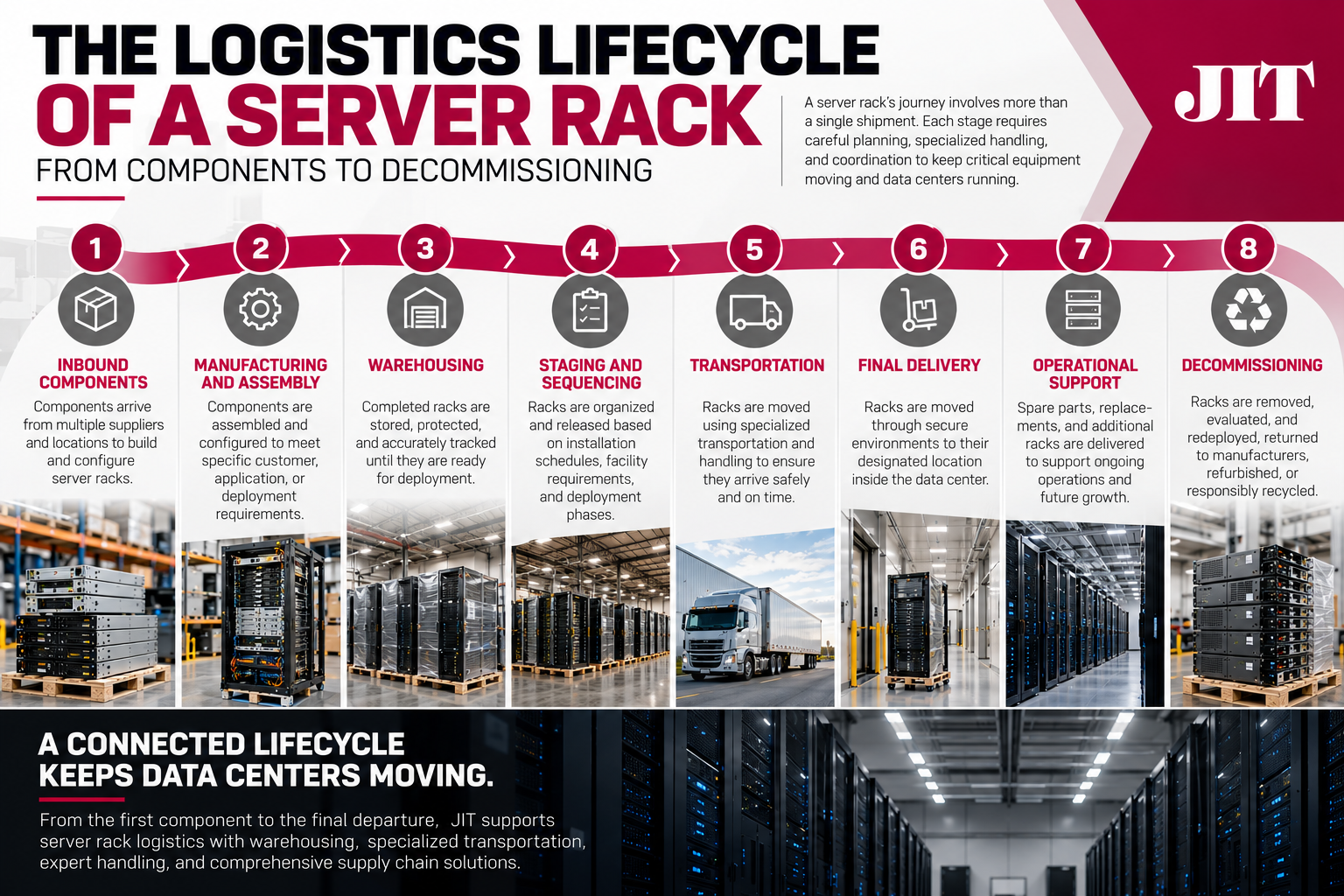
1. Inbound Components: Where the Lifecycle Begins
The logistics journey of a server rack starts with the components required to build and configure it.
Depending on the application, these may include server chassis, processors, memory, storage devices, networking equipment, power distribution units, cabling, and the physical rack enclosure.
These components often arrive from different suppliers, manufacturing facilities, and geographic locations. Each may have its own lead time, transportation requirements, and production schedule.
For manufacturers assembling server racks at scale, coordinating inbound shipments is critical. A rack cannot be completed if one required component is missing, even when everything else has arrived.
That makes inventory accuracy especially important.
Warehouse and manufacturing teams need to know which components have arrived, where they're stored, and whether sufficient quantities are available to support upcoming builds.
The goal is not simply to receive materials. It's to ensure the correct components are available when production needs them.
2. Manufacturing and Assembly: Keeping Production Supplied
Once components arrive, logistics shifts toward supporting the manufacturing and assembly process.
Server racks may be assembled and configured for specific customers, applications, or deployment environments. Some are built around standardized configurations, while others require specialized hardware, networking components, or power arrangements.
For manufacturers operating on just-in-time production schedules, component availability directly affects output.
If production teams have to search for parts, wait for replenishment, or resolve inventory discrepancies, assembly schedules can quickly fall behind.
This is where organized inventory management and kitting can make a difference.
Rather than moving individual components to production as they're requested, warehouse teams can prepare kits containing the parts required for specific builds.
Kitting helps ensure the right materials reach the production floor together, reducing unnecessary picking activity and making it easier to identify shortages before assembly begins.
As manufacturing volumes increase, these processes become increasingly important. Small inefficiencies that are manageable during limited production can become significant bottlenecks when hundreds of racks are moving through the operation.
3. Warehousing: Protecting Equipment Between Production and Deployment
A completed server rack isn't always ready to move directly to a data center.
Manufacturing schedules and deployment schedules rarely align perfectly. Equipment may be finished weeks before a facility is ready to receive it, or a large project may require racks to be delivered in phases.
Warehousing creates a controlled environment between those stages.
For high-value technology, storage requirements extend beyond available square footage. Equipment must be protected from damage, accurately tracked, and organized so it can be retrieved when needed.
Depending on the equipment and its packaging, handling considerations may include weight, dimensions, stability, security, and environmental requirements.
Inventory visibility is particularly important when multiple customer projects or rack configurations are stored in the same facility.
Teams need to distinguish between equipment that has arrived, equipment awaiting configuration or inspection, and equipment approved for deployment.
Without accurate tracking, a warehouse may physically contain the necessary equipment while still being unable to locate or release the correct rack for an upcoming installation.
Effective warehousing keeps finished equipment protected and ready for its next move.
4. Staging and Sequencing: Preparing for Deployment
Data center deployments rarely happen all at once.
Large projects may involve hundreds or thousands of server racks, along with networking equipment, power infrastructure, and other critical components.
Even when equipment is available, the destination may not have the space, personnel, or infrastructure ready to receive everything simultaneously.
Staging helps bridge that gap.
Rather than shipping equipment as soon as it's manufactured, logistics teams can organize racks according to installation schedules, facility requirements, and deployment phases.
For example, a data center may need equipment for one server hall before another. Sending every rack at once could overwhelm receiving areas and create unnecessary congestion.
A staged approach allows equipment to be released in the sequence installation teams need it.
This process may involve coordinating several factors:
- Deployment schedules: Matching shipments to installation milestones.
- Equipment configurations: Ensuring the correct racks are assigned to each location.
- Site readiness: Confirming that receiving and installation areas are prepared.
- Transportation availability: Securing appropriate equipment and delivery windows.
- Inventory accuracy: Verifying that staged shipments contain the correct assets.
Staging turns stored inventory into an organized deployment plan.
When handled effectively, it reduces unnecessary movements and helps prevent equipment from arriving before it can be installed.
5. Transportation: Moving High-Value Equipment Safely
Transporting server racks presents challenges that differ from moving standard palletized freight.
Depending on the configuration, racks may be heavy, tall, sensitive to vibration, or vulnerable to damage if handled improperly.
Some racks are transported empty, while others may contain installed and configured equipment. These differences influence packaging, loading, securement, and handling requirements.
For populated racks, even minor damage can affect valuable hardware or delay deployment while equipment is inspected and repaired.
Transportation planning must account for the physical characteristics of the shipment as well as the delivery requirements.
This can include selecting appropriate vehicles, minimizing unnecessary handling, coordinating secure loading and unloading, and maintaining visibility throughout transit.
Timing is equally important.
A rack arriving late may leave installation crews waiting. Arriving too early can create congestion at a facility with limited receiving or staging space.
For time-sensitive deployments, transportation needs to align with the broader project schedule rather than operate as an isolated shipment.
6. Final Delivery: The Last 500 Feet
Reaching the data center doesn't necessarily mean the server rack has reached its destination.
The final stage may require moving equipment from the receiving dock through secure entrances, corridors, elevators, and designated installation areas.
This portion of the journey can be particularly challenging.
Data centers often have strict access procedures, limited receiving windows, and specific requirements for moving equipment within the facility.
A rack may need to pass through tight spaces or be moved using specialized handling equipment. Installation areas may also have limited room for maneuvering.
Successful final delivery depends on understanding these requirements before the truck arrives.
Logistics teams may need to coordinate with facility managers, security personnel, installation crews, and other contractors to ensure equipment can move safely to its intended location.
For example, a delivery appointment may be scheduled for 9:00 a.m., but if the installation area isn't accessible until noon, the shipment can still create delays.
The final 500 feet should be treated as part of the transportation plan, not an afterthought.
For high-value technology, delivery is only successful when equipment reaches the location where it's needed in the expected condition.
7. Operational Support: Keeping Infrastructure Moving
Once a server rack is installed and operational, its logistics requirements don't disappear.
Data centers continually replace, upgrade, and expand equipment to support changing workloads and infrastructure needs.
Replacement components may need to arrive quickly to minimize downtime. Additional racks may be introduced as capacity grows. Equipment may be moved between facilities as operations change.
These activities create ongoing logistics requirements beyond the initial deployment.
For hyperscalers and large data center operators, managing spare parts and replacement hardware can be particularly important.
Critical components must be accurately inventoried and positioned so they can be delivered when needed.
Warehousing and transportation networks can help support these requirements by keeping replacement equipment available and coordinating time-sensitive deliveries.
The same principles that support the original deployment, including inventory accuracy, secure handling, and precise scheduling, remain important throughout the rack's operational life.
8. Decommissioning: When the Lifecycle Starts Moving in Reverse
Eventually, server racks reach the end of their useful life or are removed as part of an infrastructure upgrade.
That doesn't necessarily mean the equipment has no remaining value.
Some racks and components may be suitable for refurbishment, resale, or redeployment. Others may need to be returned to manufacturers or directed toward responsible recycling.
Decommissioning introduces a new set of logistics challenges.
Equipment must be removed from active environments, documented, handled safely, and transported to the appropriate destination.
For populated racks and other technology assets, data security is an additional consideration. Storage devices and equipment containing sensitive information may require documented sanitization or destruction by qualified providers before reuse or disposal.
Asset tracking also remains important.
Teams need to know which equipment has been removed, its condition, where it has been sent, and whether it is awaiting inspection, refurbishment, or final disposition.
For large data center projects, decommissioning may involve significant volumes of equipment moving out of a facility while replacement infrastructure is being installed.
Coordinating these activities can help reduce site congestion, maintain accountability, and recover value from usable assets.
Decommissioning is not simply the end of the logistics lifecycle. In many cases, it's the beginning of another one.
One Connected Lifecycle, Not Eight Separate Processes
The biggest logistics challenge in managing server racks isn't necessarily any single stage. It's keeping the stages connected.
A manufacturing delay affects staging. Inaccurate inventory affects deployment. Transportation problems affect installation schedules. Poor decommissioning planning can create congestion and complicate new equipment deliveries.
When each activity is managed independently, those dependencies can be overlooked.
A more coordinated logistics strategy connects inbound materials, manufacturing support, warehousing, staging, transportation, final delivery, and reverse logistics.
That visibility helps organizations anticipate problems before they affect the next stage.
For hyperscalers and technology manufacturers managing equipment across multiple facilities, coordination becomes increasingly important as deployment volumes grow.
The goal is to keep the right equipment moving to the right location at the right time throughout its useful life.
Support the Entire Technology Logistics Lifecycle
From the first inbound component to the final movement of decommissioned equipment, server rack logistics requires precision at every stage.
JIT Transportation supports technology manufacturers, hyperscalers, and data center operators with warehousing, inventory management, kitting, staging, specialized transportation, and final delivery services.
Whether you're preparing equipment for manufacturing, coordinating a large-scale deployment, or moving high-value assets between facilities, a connected logistics strategy can help reduce delays and protect critical equipment.
Contact JIT to discuss how our logistics capabilities can support your technology supply chain from components through deployment and beyond.
Ready to optimize your supply chain?
Contact us today to discover how JIT Transportation can take your business to the next level.
Related Articles

More SKUs, More Problems: Managing Inventory as Manufacturers Scale
As manufacturers add more SKUs, accurate inventory tracking, efficient warehouse organization, kitting, and coordinated logistics become increasingly important to keeping production on schedule.

From Return to Recovery: What Happens to High-Value Products Coming Back?
Reverse logistics for high-value products requires careful transportation, receiving, inventory tracking, and coordinated recovery to protect valuable assets and return equipment to productive use.

When Should You Use Dedicated Transportation?
Dedicated transportation can provide greater control over timing, handling, security, and capacity when a shipment's operational requirements outweigh the benefits of shared transportation.