How 3PLs Handle Cross-Border Supply Chain Disruptions

Cross-border supply chains are increasingly complex, with businesses losing an average of $22 million per major disruption. Customs delays, regulatory changes, and geopolitical events create challenges that can lead to revenue loss, strained customer relationships, and increased costs. Third-party logistics (3PL) providers are critical in addressing these issues by offering:
- Customs expertise: Managing documentation, compliance with regulations like CBAM and UFLPA, and reducing delays caused by errors.
- Dynamic routing: Using AI to optimize routes and minimize disruptions from geopolitical or infrastructure issues.
- Distributed fulfillment: Spreading inventory across multiple warehouses to maintain delivery timelines and reduce risks.
- Advanced technology: Tools like predictive analytics and digital control towers improve visibility, reduce delays, and cut costs.
For example, 3PLs helped brands like Sola Skincare and THRIVE Essentials overcome customs challenges and tariff costs. With 74% of U.S. businesses increasing reliance on 3PLs, these strategies are essential for maintaining resilient supply chains in a fast-paced global market.

Cross-Border Supply Chain Disruption Statistics and 3PL Solutions
CBS25: How to Deal with Delays and other Disruptions at the Border with Averitt
sbb-itb-eafa320
Types of Cross-Border Supply Chain Disruptions
Cross-border logistics often encounters two major types of disruptions that can derail operations and drive up costs. Grasping these challenges is crucial for strengthening supply chain resilience. While documentation mistakes are a frequent issue, external factors like political and infrastructure challenges add further complexity.
Customs Delays and Regulatory Issues
Did you know that documentation errors account for nearly 80% of customs delays at the border? Common mistakes - like incorrect Harmonized System (HS) codes, vague product descriptions, or mismatched weights and values - can trigger inspections, prolong clearance times, and add around 2.5% to global manufacturers' supply chain costs.
Regulatory changes are another hurdle. For instance, new environmental rules like the Carbon Border Adjustment Mechanism (CBAM) and forced labor laws such as the Uyghur Forced Labor Prevention Act (UFLPA) have introduced significant compliance challenges. By late 2025, forced labor enforcement expanded to industries like copper, lithium, and steel, causing a surge in detentions. On top of that, customs authorities are now using AI-powered systems to spot transshipment fraud and other violations.
"Ultimately, all three trends can be distilled to a common concern: the fear of non-compliance risks. Such concerns underscore the vital role of customs knowledge and expertise - what we call Real Intelligence." – John Wegman, CEO, Customs Support Group
The financial toll is massive. Preventable documentation and classification errors are responsible for 20% to 40% of shipment delays. Meanwhile, customs authorities collected between $600 billion and $900 billion in tariffs in 2024, which equates to nearly 1% of global GDP. For businesses operating on tight margins, these delays often lead to extra warehousing fees, demurrage charges, and audit penalties.
Geopolitical Events and Border Congestion
Beyond regulatory challenges, geopolitical events and border congestion create external disruptions that can wreak havoc on supply chains. For example, when the United States imposed a 25% tariff on Mexican imports in early 2025, shippers rushed to move goods before the deadline. This sudden surge overwhelmed capacity, leading to severe congestion at border crossings. At the Ysleta–Zaragoza International Bridge, wait times ballooned from one hour to over eight hours due to enhanced state inspections.
"Wait times have increased from one hour to more than eight hours at the bridge. Long delays are not only slowing product deliveries and increasing logistics costs, but creating unsafe conditions for drivers." – Redwood Logistics
Retaliatory tariffs and boycotts from trading partners can further destabilize long-standing contracts, causing unpredictable spikes in landed costs. Immigration policies also play a role; with 35% of cross-border trucking relying on B1 visa holders, any shift in visa regulations can disrupt the flow of goods.
Infrastructure issues only add to the chaos. For instance, warehouse occupancy in key regions like Laredo and California has hit 98%, leaving little space for emergency stock. A 2023 thunderstorm that disabled customs platforms at the Laredo port delayed over 12,000 trucks daily. Such bottlenecks force businesses to increase safety stock and extend lead times from 10–14 days to 14–21 days. On top of that, shippers often have to find alternative routes, which can add hundreds of miles and significantly increase fuel costs.
These challenges highlight the need for proactive strategies from 3PL providers to keep supply chains running smoothly and meet customer demands.
How 3PLs Manage Cross-Border Disruptions
To tackle the challenges of cross-border logistics, 3PLs employ a mix of strategic planning, regulatory expertise, and advanced technology. These measures help them navigate disruptions and keep supply chains running smoothly.
Customs Brokerage and Compliance Support
Customs regulations can be a nightmare for businesses, but 3PLs step in as your border representative to handle the paperwork and processes that determine whether shipments move forward or get stuck. They manage everything from filing entry documents and assigning accurate HS codes to calculating duties for legal entry. Beyond customs, they liaise with agencies like the FDA, USDA, and EPA to meet product-specific requirements.
"Every international shipment has two deadlines: when it needs to arrive, and when customs decides it's allowed to move." – Kyle Krug, Marketing & Communications, LEGACY Supply Chain Services
Top-tier providers go a step further by participating in security programs like the Customs-Trade Partnership Against Terrorism (C-TPAT). This involvement grants access to perks like FAST lanes, reducing inspection times and delays. They also stay ahead of trade policy changes - like those under USMCA - by updating procedures before these shifts affect shipments. When documentation is accurate and submitted early, customs clearance typically takes just a few hours.
For U.S.-Mexico trade, dual-domiciled brokers are a must. Mexican imports require both a U.S. and Mexican broker, with the latter needing specific port authorization. Bilingual teams and in-house specialists ensure smooth coordination, even during high-pressure situations.
But customs compliance is just one piece of the puzzle. 3PLs also adapt transportation plans to sidestep delays.
Shipment Rerouting and Route Optimization
When physical routes are disrupted, 3PLs turn to dynamic routing solutions. Equipped with AI-powered transportation management systems (TMS), they analyze historical data, weather forecasts, and labor conditions to predict potential delays and recommend alternative routes or transportation modes - such as shifting from road to rail or air - before bottlenecks form.
Take 2025, for example, when conflict in the Red Sea forced 12% of global shipping to reroute. 3PLs devised alternative paths around the Cape of Good Hope, extending delivery times by 10–14 days but ensuring goods kept moving. For smaller shipments, they relied on cross-docking and transloading networks to consolidate loads, optimizing both space and cost.
"Reliance on a single-route plan often doesn't provide retailers with sufficient supply chain flexibility and agility." – Andrew Welling, Director of Cross-Border Services, TA Services
Another critical strategy is geographic diversification. By supporting manufacturing shifts to regions like Mexico (under USMCA), Vietnam, or India, 3PLs help businesses reduce their dependency on high-risk trade corridors. This flexibility is vital, especially when 41% of business leaders identify geopolitical instability as a major concern.
Distributed Fulfillment and Multiple Warehouse Locations
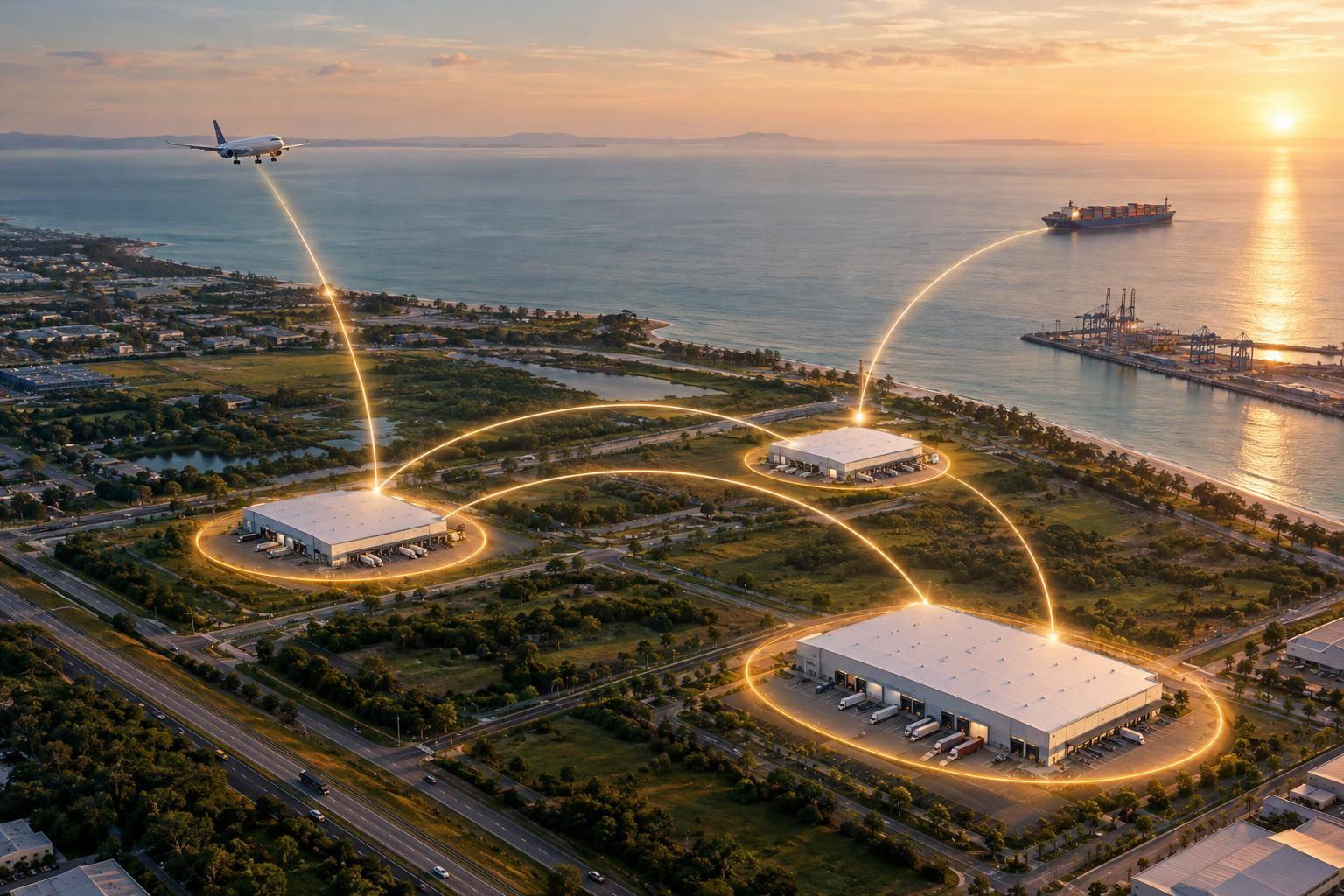
Distributed inventory networks provide a safety net against single-point failures. By spreading goods across regional hubs, 3PLs ensure that if one border crossing or port faces delays, stock from other locations can still reach customers on time. This setup also shortens the distance goods need to travel, speeding up last-mile delivery.
When combined with efficient customs handling and optimized routing, distributed fulfillment significantly reduces risks of delays. For example, in June 2025, wellness brand THRIVE Essentials faced a 22% cost increase due to Chinese tariffs. By partnering with a 3PL offering warehouses in Texas, Ontario, Mexico, and Germany, the company split its inventory strategically. Using tariff forecasting tools, they cut landed costs by 12% and improved delivery times by six months.
Bonded warehousing adds even more flexibility. These facilities allow businesses to store imported goods while deferring duty payments until the products enter the local market or are re-exported. This approach helps improve cash flow during tariff fluctuations. Additionally, multi-node networks let companies ship from hubs with more favorable trade terms or shorter distances, potentially reducing duties.
"Distributed warehousing... results in faster delivery, less customs exposure, and the ability to shift sales focus depending on which region is less impacted by trade friction." – Logos Logistics
With 74% of U.S. businesses planning to increase their reliance on 3PLs through 2026, these distributed strategies are becoming a cornerstone of resilient supply chains.
Technology Solutions for Supply Chain Resilience
Risk Monitoring and Predictive Analytics
Predictive analytics helps 3PLs spot potential issues early by analyzing both historical and real-time data, like weather patterns, geopolitical events, port congestion, and labor strikes. These insights allow systems to recommend alternative routes before disruptions escalate. When issues arise, the technology can automatically suggest rerouting shipments or diverting them to minimize delays.
But it’s not just about tracking cargo. AI-powered tools are transforming customs compliance, automating tasks like verifying HS codes, monitoring changes in trade regulations, and flagging documentation errors. Meanwhile, sensors in trucks and warehouses feed data into predictive maintenance systems, alerting teams to possible equipment failures. This proactive approach avoids unplanned transit delays that could ripple through the supply chain.
A great example of this tech in action comes from UPS. During Hurricane Ida in September 2021, UPS used its digital control tower to reroute 1,200 critical medical device shipments in just 11 minutes. By leveraging live traffic camera feeds and predictive flooding models, they ensured ventilators reached 47 hospitals without stockouts. Similarly, IBM reduced disruption management time from 18–21 days to just a few hours, achieving over 95% serviceability while slashing expedite costs by 52%.
The results speak for themselves. AI-driven tools have reduced inventory levels by 35% and cut logistics costs by 15%. For businesses prioritizing sustainability, predictive systems now account for carbon footprints, aiding compliance with regulations like the EU's Carbon Border Adjustment Mechanism (CBAM). By 2025, CBAM expanded to include consumer electronics, textiles, and household goods.
To complement predictive analytics, digital control towers provide a real-time command center for managing the entire supply chain.
Digital Control Towers for Supply Chain Visibility
Digital control towers (DCTs) act as a centralized intelligence hub, turning raw logistics data into actionable insights. These platforms integrate data from IoT sensors, carrier APIs, satellite imagery, and customs systems, creating a single, unified view of inventory and transit updates - all accessible through a single dashboard.
The system operates on four key layers: connectivity (using 5G and IoT), integration (standardizing data from various sources), analytics (leveraging machine learning for risk prediction), and visualization (user-friendly dashboards). This structure allows 3PLs to move from merely reacting to issues to proactively managing them. For instance, if a primary carrier is delayed by more than 20 minutes, advanced systems can automatically assign the load to a backup carrier - no human intervention required.
In Q3 2024, Ryder introduced an AI platform named "Eva" to oversee 45,000 daily shipments. Eva identified 3,200 potential late deliveries and reassigned loads to prevent delays, saving the company $2.1 million in chargebacks. Companies using real-time visibility tools experience 15% lower inventory carrying costs and resolve exceptions 73% faster than those relying on manual methods.
"Digital control towers enable companies to collect and analyze data in real-time across the supply chain and identify developments that might affect their operations." – DCL Logistics
Visibility remains a major challenge, with 62% of shippers citing poor supply chain transparency as their biggest frustration with 3PL providers. Looking ahead, 40% of control towers are expected to incorporate spatial computing by 2027. This advancement will let analysts virtually "walk" through warehouses or redirect pallets with hand gestures. And with 5G now covering 85% of global port acreage, tracking assets in even the most remote locations happens almost instantly.
How JIT Transportation Handles Cross-Border Logistics
Nationwide Network and Scalable Infrastructure
JIT Transportation has built a robust logistics network designed to overcome cross-border challenges. With 14 strategically positioned warehouses across the U.S. and over 2.5 million square feet of warehouse space, JIT ensures inventory is staged closer to production sites or end markets. Key locations like Los Angeles (LAX), Houston (IAH), Austin (AUS), and Memphis (MEM) serve as major hubs, minimizing transit times and reducing the likelihood of delays caused by border congestion or customs issues.
When border disruptions occur, JIT's expansive network allows for quick freight adjustments. Their network includes over 500 carriers, a dedicated fleet of more than 200 trucks, and 24/7 operations to ensure time-sensitive shipments stay on track.
"Flexibility has become the true currency of logistics. The ability to pivot - to scale up or down, to reroute, to repurpose capacity - is what separates resilient supply chains from reactive ones." – JIT Transportation
JIT's scalability is another key advantage. They offer both fixed and flexible capacity models, enabling businesses to scale resources up or down as needed without being tied to rigid infrastructure. Additionally, their certifications, including CTPAT and Bonded Carrier and CFS Bonded certificates, make it possible to transport and store goods that haven’t cleared customs - an essential capability during cross-border delays.
This extensive network is further supported by specialized services that ensure smooth transitions from transportation to final delivery.
Value-Added Services for Complete Solutions
Beyond its core infrastructure, JIT provides integrated services that help businesses navigate supply chain disruptions. For example, their transload services allow for quick mode shifts, such as transferring freight from international containers to domestic trailers at key hubs. This approach helps bypass port bottlenecks and cuts down on detention fees.
Their kitting and assembly services give businesses the flexibility to delay final product configurations until closer to delivery, reducing the impact of customs delays or geopolitical challenges. JIT also offers specialized handling solutions like white-glove delivery and real-time tracking, ensuring product integrity through every stage. Their API integrations with platforms like Shopify, WooCommerce, Magento, and Amazon FBA provide constant visibility, enabling logistics teams to respond quickly to changes.
JIT’s commitment to quality and compliance is evident in their adherence to ISO standards, including ISO 9001:2015 for quality management and ISO 13485:2016 for medical devices. For high-value shipments, such as AI hardware and semiconductors, they employ advanced measures like digital audit trails, tamper-evident packaging, and geofencing-enabled tracking to ensure secure and efficient delivery.
"After 35 years in global logistics, I can confidently say JIT is the best team I've ever worked with. Their professionalism, problem-solving skills, and unwavering commitment to excellence stand out, even in the most challenging situations." – Mandy Findlator, Senior Manager Global Logistics, Harmonic
Conclusion
Cross-border supply chain disruptions remain a persistent challenge. Factors like shifting tariff policies, border congestion, and complex regulations push businesses to deliver faster while managing shrinking margins. As a result, the global 3PL market has surpassed $1 trillion, as companies increasingly recognize the need for expert partners to handle these hurdles.
Partnering with a 3PL transforms disruption management from reactive problem-solving into a proactive strategy. A reliable provider offers essential capabilities, including regulatory expertise for customs classifications and trade compliance, multimodal options to bypass bottlenecks, and advanced tools like predictive analytics and digital control towers for real-time visibility. Additionally, services like bonded warehousing and Free Trade Zones help defer duty payments, easing cash flow challenges.
"An experienced 3PL can help shippers navigate supply chain complexities, manage unforeseen circumstances and deliver the expedited shipping experience that today's consumer demands." – Andrew Welling, Director of Cross-Border Services, TA Services
JIT Transportation serves as a prime example of how a 3PL can execute these strategies effectively. With a vast nationwide network and strong industry certifications, they provide the infrastructure necessary to handle cross-border complexities. Their value-added services - such as pick & pack, kitting & assembly, testing, and white glove handling - ensure operations continue smoothly, even during border delays.
The approaches outlined in this article - customs expertise, dynamic rerouting, distributed fulfillment, and technological visibility - are the cornerstones of a resilient supply chain. These capabilities thrive on seamless partnerships where expertise, technology, and infrastructure come together. With 41% of consumers now expecting delivery in under 24 hours, having a flexible 3PL partner is no longer optional - it’s essential for staying competitive in an unpredictable environment.
FAQs
What should I give a 3PL to prevent customs delays?
To avoid customs delays, make sure your documentation is accurate and thorough. Include a commercial invoice with details like the value, origin, and description of the goods. Add a packing list that outlines the contents and their weights, along with any necessary export or import licenses. Proper classification is also key - use the correct HS codes and provide detailed descriptions of the items. These steps help customs officials process shipments smoothly, minimizing the chances of delays due to inspections or misclassifications.
How can a 3PL choose new routes when borders get congested?
When borders get jammed, 3PLs step up with smart strategies to keep things moving. They tap into real-time visibility tools, work with diverse carrier networks, and use multimodal transportation to navigate around bottlenecks. On top of that, they lean on predictive analytics and demand forecasting to map out alternative routes ahead of time. This proactive approach helps maintain supply chain flow and ensures deliveries stay on schedule, even when disruptions hit.
When does distributed warehousing make sense for my business?
Distributed warehousing offers a smart way to boost delivery speed, cut shipping costs, and strengthen your supply chain. By spreading inventory across several regional warehouses, you can ensure faster deliveries, reduce last-mile shipping expenses, and minimize risks from issues like natural disasters or capacity constraints. This approach becomes especially handy during peak seasons or in cross-border trade, making it easier to serve high-demand areas and international markets while staying adaptable to changing needs.
Related Blog Posts
Related Articles
Demand-Driven Replenishment for Multi-Node 3PL

3PL Models Compared for Reverse Logistics Carbon