
How 3PLs Support Circular Supply Chain Models

Circular supply chains are reshaping how businesses handle products by reusing, refurbishing, and recycling instead of discarding. This approach reduces waste, cuts costs, and helps businesses meet growing regulatory and consumer demands for sustainability. Third-party logistics providers (3PLs) play a vital role in making this possible by managing reverse logistics, refurbishing products, and recovering materials efficiently.
Key Points:
- Circular Model Benefits: Reduces waste, saves costs on raw materials, and lowers greenhouse gas emissions by up to 39%.
- 3PL Role: Handles returns, repairs, recycling, and resale with specialized workflows and infrastructure.
- Efficiency Gains: Advanced systems process 37% of returns in a day and improve material recovery by 40–50%.
- Consumer Trends: 54% of buyers prefer brands prioritizing sustainability, driving demand for circular practices.
3PLs not only streamline reverse logistics but also provide the technology, infrastructure, and expertise businesses need to profitably transition to circular supply chains. This ensures products and materials are reused effectively, reducing environmental impact and aligning with consumer expectations.
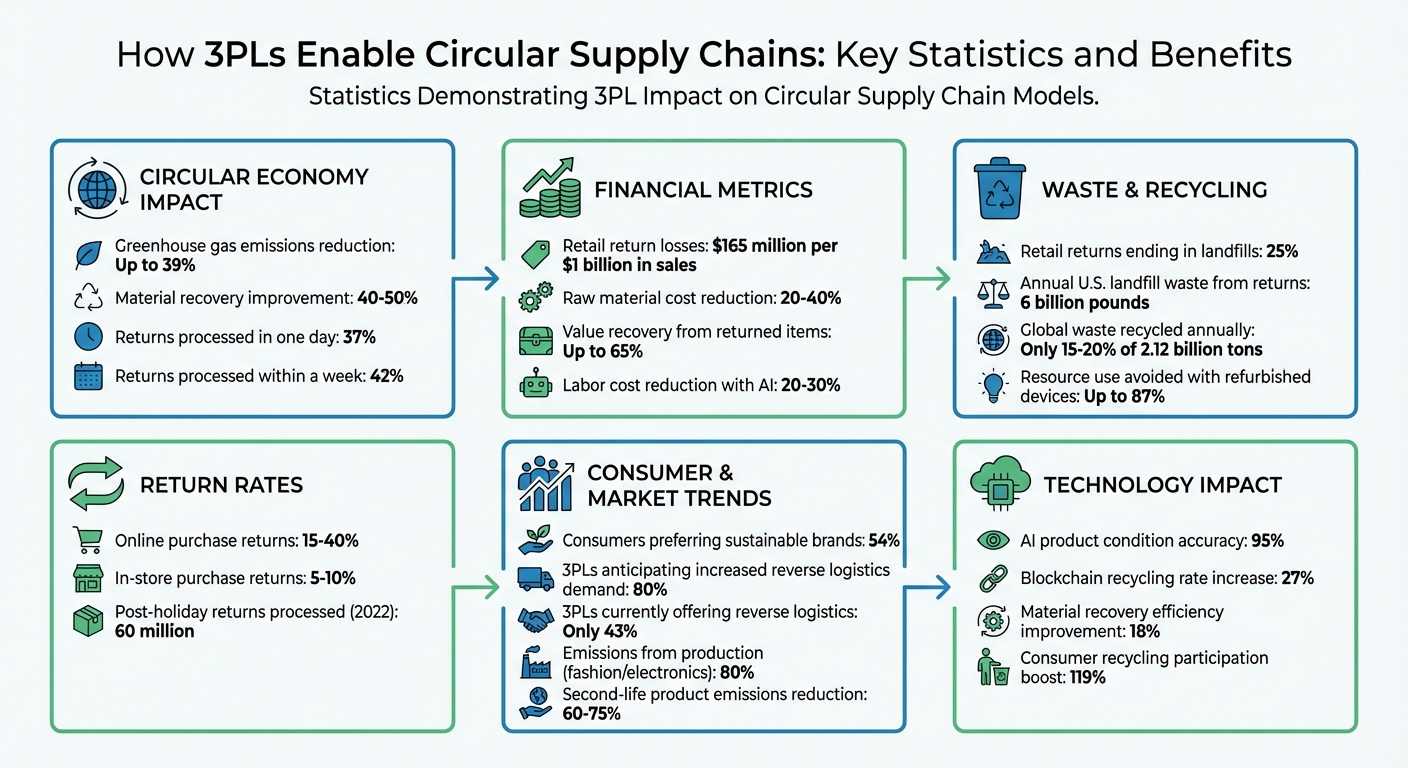
How 3PLs Enable Circular Supply Chains: Key Statistics and Benefits
Insights from our new white paper: Building a circular supply chain
sbb-itb-eafa320
How 3PLs Enable Circular Supply Chains
Third-party logistics providers (3PLs) play a critical role in building the framework for circular supply chains. By integrating logistics processes, they make it possible for products to return for inspection, repair, or redistribution. This approach creates visibility across the entire product lifecycle - something that many businesses struggle to achieve independently.
One major hurdle is balancing the demands for transport capacity, warehouse space, and labor between outbound shipments and returned products. 3PLs address this by setting up dedicated areas for returns, including inspection stations and technical centers. These facilities keep reverse logistics separate from forward operations, paving the way for efficient management of returned goods.
Combining Forward and Reverse Logistics
For most businesses, returns are treated as exceptions rather than a core process. But 3PLs take a different approach, routing returned products through specialized workflows. These workflows assess and categorize items for resale, refurbishment, recycling, or responsible disposal. This step, known as disposition routing, is crucial. Consider this: retail returns result in $165 million in losses for every $1 billion in sales, and about 25% of retail returns end up in landfills, contributing nearly 6 billion pounds of waste annually in the U.S..
With advanced warehouse management systems (WMS), 3PLs can process 37% of returns in just one day and 42% within a week. This efficiency ensures that returned products quickly re-enter the market, reducing the risk of value loss. The speed of processing is essential - it can mean the difference between restocking a product for resale or letting it sit idle. Additionally, 3PLs provide businesses with data-driven insights into return trends, helping them refine product designs and improve logistics to minimize future waste. As Gaurav Saran, CEO of ReverseLogix, puts it:
"Circular returns focus on reuse, not waste... your reverse supply chain becomes shorter, smarter, and more profitable".
Nationwide Scalability and Custom Solutions
Handling the ever-growing volume of returns requires infrastructure that many businesses simply don’t have. This is where 3PLs step in, offering the scale and coverage needed to support growth. They have the flexibility to mobilize quickly, consolidating returns at regional hubs and using less-than-truckload (LTL) shipping to reduce both costs and emissions.
The scale of their operations is evident in the numbers. For example, during the 2022 post-holiday season, one major 3PL processed 60 million returns. Online purchases see return rates of 15% to 40%, compared to just 5% to 10% for in-store purchases. Managing this volume often involves additional services like kitting, device configuration, and brand customization before products are reintroduced into the circular system. Despite the growing demand - 80% of 3PLs anticipate increased need for reverse logistics - only 43% currently offer these services. This gap highlights the competitive edge for businesses that collaborate with 3PLs already prepared for circular supply chain models.
3PL Services That Support Circular Supply Chains
Circular supply chains require more than just standard logistics solutions. They depend on specialized services that cover every phase of product recovery, from handling returns to recycling materials. 3PLs (third-party logistics providers) have stepped up with offerings that integrate seamlessly into both forward and reverse logistics, ensuring these processes work together efficiently.
Reverse Logistics Management
At the core of circular supply chains is returns management. 3PLs oversee the entire lifecycle of returned goods, starting with return merchandise authorization (RMA), collection, transportation, and processing at dedicated facilities. Once items arrive, they are screened, tested, and graded to determine the best course of action - whether that’s resale, refurbishment, parts recovery, recycling, or, as a last resort, disposal.
The speed of this process is crucial. Quick turnarounds help preserve the value of returned items, especially for products like electronics and fashion, which lose value rapidly.
3PLs also handle refurbishment and remanufacturing, restoring items to near-new condition. This can involve anything from minor cosmetic fixes to full-scale repairs, helping businesses recover as much value as possible. For products that can’t be repaired, 3PLs focus on parts harvesting, extracting usable components to either support future repairs or sell as spare parts. This reduces the need for new manufacturing.
In the case of electronics, data security is a key concern. 3PLs offer certified data wiping and sanitization services to ensure sensitive information is removed before products are resold or recycled. This step is vital for compliance with privacy regulations and for safeguarding brand reputation.
Recycling and Materials Recovery Programs
When refurbishment isn’t an option, 3PLs shift their focus to recovering materials through specialized recycling programs. They work with facilities that can disassemble products into raw materials like metals, plastics, and electronic components, which are then reintroduced into manufacturing processes. This approach not only increases the value of recovered materials but also makes transportation more efficient.
The environmental benefits are notable. Opting for a refurbished device can avoid up to 87% of the resource use and emissions tied to producing a new one. Additionally, 3PLs help recycle secondary packaging materials like cardboard, plastic wrap, and pallets, further reducing landfill waste.
Using AI and data analytics, 3PLs sort returned items into categories such as resale, refurbishment, donation, or recycling. Recycling is treated as a last resort, only used when no other value can be recovered. As Cathy Roberson, an NRF contributor, puts it:
"Materials like plastics, metals and textiles can often be collected, sorted and sold for use in manufacturing processes".
Value-Added Services for Product Recovery
3PLs go beyond basic returns processing by offering value-added services that prepare items for their next use. For instance, they provide kitting and customization services, bundling products with new accessories, pre-installing software, or creating custom packaging for redeployment. They also offer branding and personalization options, such as engraving logos or custom text on refurbished devices.
These services play a key role in recommerce and remarketing, where refurbished goods are resold through secondary markets, dealer networks, or online platforms. This approach helps businesses recapture up to 65% of the original value of returned items. By contrast, retail returns often result in significant losses - up to $165 million per $1 billion in sales.
For high-value or fragile returns, 3PLs provide white glove handling, ensuring these items are treated with care to avoid further damage. This is particularly important for premium products, where condition directly impacts resale value and customer perception.
Technology That Powers 3PL Circular Supply Chains
Circular supply chains thrive on advanced systems that can effectively track, sort, and manage returned materials. These technologies allow 3PLs to navigate the complexities of reverse logistics, ensuring that returned items are directed to the best recovery or refurbishment process.
Tracking and Forecasting Systems
Warehouse Management Systems (WMS) and specialized Returns Management Systems (RMS), such as ReverseLogix and Blue Yonder, play a central role in real-time tracking. These systems integrate seamlessly with 3PL operations, offering a unified view of inventory across multiple facilities. IoT devices and sensors further enhance this process by monitoring product usage, location, and wear in real time. This allows returns processing to shift from being reactive to predictive. Advanced AI algorithms take it a step further by grading returned items and determining their next steps - whether resale, repair, parts harvesting, or recycling.
For instance, computer vision systems can evaluate product conditions with an impressive 95% accuracy. These AI-driven tools not only improve material recovery rates by 40–50% but also cut labor costs by 20–30%. IKEA provides a compelling example: in October 2025, the company reported that its AI-powered reverse logistics systems increased refurbishment rates by 35%, saving approximately $11 million annually. Digital twins, virtual models of supply chain operations, add another layer of optimization by allowing 3PLs to simulate and refine circular strategies before implementing them in the real world.
To complement these tracking advancements, blockchain technology ensures transparency and accountability throughout the supply chain.
Blockchain for Supply Chain Transparency
Blockchain technology addresses major challenges in circular supply chains by creating secure, time-stamped records of material flows across industries like electronics, fashion, and aerospace. Smart contracts add another layer of efficiency by automating tasks - such as verifying that a product has been properly recycled before releasing payments to recycling partners.
The impact of blockchain is evident. For example, when paired with IoT sensors, blockchain systems for e-waste recycling have increased recycling rates by 27% and improved material recovery efficiency by 18%. Token-based incentives on blockchain platforms have also proven effective, boosting consumer participation in recycling programs by 119%.
Abdelghani Bekrar highlights the importance of blockchain in supply chains:
"Blockchain technology represents an integrative solution to ensure the immutability, security, integrity, and traceability of data across the supply chain."
For 3PLs, blockchain not only enhances operational transparency but also provides the verifiable documentation needed for ESG reporting and compliance with Extended Producer Responsibility (EPR) regulations. Together, these technologies strengthen the circular supply chain model, making it more efficient and accountable.
Benefits of Using 3PLs for Circular Supply Chain Models
Working with a 3PL can turn reverse logistics into a revenue-driving process while enhancing sustainability efforts and building trust with consumers. These advantages go beyond just cutting costs - they help create a stronger position in the market by aligning economic goals with environmental responsibility.
Cost Savings and Efficiency Gains
3PLs excel at managing the 5Rs (reduce, reuse, recycle, refurbish, and recover), transforming reverse logistics into a system that recovers value instead of draining resources. This approach not only prevents financial losses but also opens up new revenue opportunities, such as selling in secondary markets or harvesting parts. Companies that adopt 3PL-managed circular models can see raw material costs drop by 20% to 40%. By reintroducing recovered materials into production, businesses can reduce their reliance on expensive virgin resources. A real-world example: DHL Supply Chain reported a 40% increase in equipment repairs within just two years, showcasing the potential for significant cost recovery.
Separating reverse logistics from regular operations is another key advantage. Without this distinction, returns can clog up transportation, warehouse space, and labor resources that are critical for handling new sales. Additionally, the data gathered during returns processing can reveal patterns in product defects and customer preferences, helping companies make smarter design choices and minimize waste. These efficiency improvements not only save money but also support long-term sustainability efforts, which can further enhance brand credibility.
Improved Sustainability and Brand Reputation
Sustainability isn’t just a buzzword - it’s a powerful way to strengthen a brand. Refurbished or second-life products produce far fewer emissions compared to manufacturing new items. For example, about 80% of emissions tied to fashion and consumer electronics come from production. By extending product lifecycles through refurbishment and resale programs managed by 3PLs, companies can bypass the carbon-heavy manufacturing stage.
The environmental benefits are measurable. Recycling and recovery programs run by 3PLs help businesses comply with Extended Producer Responsibility (EPR) laws, diverting waste from landfills. When forward and reverse logistics are integrated under one 3PL, emissions can drop by as much as 39% due to more efficient transportation routes.
As Chuck Fuerst from ReverseLogix puts it:
"Reverse logistics is the foundation of circular economy sustainability because it enables every loop that keeps materials in circulation."
Consumers are increasingly drawn to brands that prioritize sustainability. Programs like 3PL-powered take-back systems and refurbished product offerings demonstrate a company’s commitment to reducing environmental impact. This not only builds trust with eco-conscious shoppers but also enhances brand reputation. The result? A win-win scenario where cost savings align with stronger market positioning and customer loyalty.
Implementing Circular Supply Chains with JIT Transportation
Custom 3PL Solutions for Circular Models
In circular supply chains, JIT Transportation plays a key role by turning returns into opportunities through tailored reverse logistics. The process begins with a structured approach to managing returns - this includes unpacking, inspecting, photographing, and testing items to determine whether they should be repaired, resold, or recycled. This ensures every product is assessed for its best possible recovery option.
Services like kitting, pick and pack, cleaning, repackaging, and relabeling prepare returned products for resale, while parts harvesting focuses on recovering components for remanufacturing. By integrating with ERP systems, JIT automates return authorizations (RMAs) and synchronizes shipments with Warehouse Management Systems. This automation provides real-time inventory updates, eliminates manual data entry, and speeds up processing. With these efficient recovery processes in place, JIT Transportation uses its national network to scale operations effectively.
Scalable Infrastructure and Nationwide Network
JIT Transportation’s strategically located warehouses across the U.S. make circular supply chains scalable and cost-efficient. These locations enable the collection of returned products from consumers over large areas, while the scalable infrastructure allows businesses to consolidate returns until they reach cost-effective volumes for recycling, refurbishing, or repair. This approach helps offset the financial strain that product returns can place on businesses.
With an extensive carrier network and facilities designed specifically for returns processing, JIT ensures inventory is positioned closer to consumers. This reduces transportation-related CO₂ emissions and shortens pickup times. As companies expand their circular operations, JIT’s infrastructure provides the flexibility to adapt quickly to changing demands, offering the manpower and capacity needed to support growth. By combining this infrastructure with advanced technology, JIT enhances efficiency across the board.
Technology and Sustainability Focus
JIT Transportation employs advanced tracking systems and real-time visibility tools to improve decision-making throughout circular supply chains. Its Transportation Management System enables load consolidation and route optimization, reducing both transportation costs and emissions. This is crucial, as transportation accounts for nearly 28% of greenhouse gas emissions in the U.S..
Beyond logistics, JIT focuses on sustainability by integrating technology that supports verifiable carbon reporting to meet regulatory standards, such as California’s SB253. By emphasizing reverse logistics and materials recovery, JIT helps businesses divert reusable materials from landfills - a critical effort, given that only 15% to 20% of the 2.12 billion tons of global waste is recycled annually. With 54% of consumers preferring companies that prioritize environmental and social responsibility, JIT’s circular supply chain solutions align business objectives with consumer expectations.
Conclusion
The concept of circular supply chains offers a compelling alternative to the traditional "take, make, dispose" approach, focusing instead on maximizing the value and lifespan of products. As Garima Singh aptly states:
"In circular business models, reverse logistics isn't a support function. It is the business model".
This shift demands specialized infrastructure, advanced technology, and deep expertise - areas where third-party logistics (3PL) providers play a crucial role.
By adopting circular supply chain models, businesses can cut production costs, tap into secondary markets for new revenue streams, and significantly reduce their environmental footprint. For example, second-life products generate 60% to 75% fewer emissions compared to manufacturing new items.
JIT Transportation illustrates how a 3PL can transform reverse logistics into a strategic advantage. Their tailored solutions include a nationwide infrastructure for consolidating returns, custom reverse logistics strategies, and technology that delivers real-time insights throughout the product lifecycle. This ensures that returned products are directed toward their highest-value outcomes, turning what might be seen as a challenge into a source of value.
As consumer expectations lean increasingly toward sustainability, adopting circular supply chains isn't just a smart move - it’s becoming essential. However, execution remains a significant hurdle. This is where partnering with a 3PL that excels in both forward and reverse logistics becomes indispensable. Ilari Puputti from Posti emphasizes this point:
"You can make logistics complex - especially if you treat it purely as a cost factor rather than a source of business value".
For businesses aiming to embrace circular models, integrating reverse logistics into their operations from the start is critical. JIT Transportation’s example shows how the right 3PL partner can provide the necessary infrastructure, technology, and expertise to align sustainability goals with financial objectives. With such support, companies can meet the rising demand for responsible practices while gaining a competitive edge in the marketplace.
FAQs
What should I look for in a 3PL to support a circular supply chain?
When selecting a 3PL partner for a circular supply chain, it’s essential to focus on providers skilled in reverse logistics, sustainability practices, and offering additional value-added services. Look for companies that can effectively manage returns, repairs, recycling, and refurbishing processes. Providers should also offer technology-powered solutions, such as real-time tracking and automation, to streamline operations.
Another key factor is their ability to leverage strong data analytics. This helps in predicting trends, optimizing delivery routes, and reducing waste - ensuring your supply chain remains both efficient and environmentally conscious.
How do 3PLs decide whether a return should be resold, repaired, or recycled?
3PLs handle returns by assessing the item's condition and determining its potential value. They carefully inspect and grade each product to decide whether it can be resold, repaired, or recycled. Products in good shape are often resold, while those that are damaged or outdated might be refurbished or recycled. These decisions also factor in repair expenses, market demand, and regulatory requirements, aiming to recover value while contributing to circular supply chains.
How can I measure ROI and emissions savings from a circular returns program?
To gauge the success of a circular returns program, it’s essential to evaluate both the financial and environmental outcomes. Start by analyzing key areas like return processing costs, resale percentages, and waste reduction metrics. These give a clear picture of operational efficiency and sustainability efforts.
Track important KPIs such as:
- Return processing time: How quickly items are handled and prepared for resale or reuse.
- Processing costs: The expenses tied to managing returns.
- Resale rates: The percentage of returned items successfully resold.
On the environmental side, assess the program's impact by monitoring reduced landfill waste and lower carbon emissions. These metrics highlight the broader ecological benefits of your initiative.
By focusing on these data points, you can draw meaningful insights into how the program contributes to both financial performance and sustainability goals.
Related Blog Posts
Related Articles

8 Ways 3PLs Handle Seasonal Workforce Swings

Marketplace API vs EDI for Fulfillment
