Blockchain for Returns: Reducing Fraud in Reverse Logistics
Fraudulent returns are costing retailers billions annually, with U.S. retailers losing $103 billion in 2024 alone. Common scams like wardrobing, bricking, and empty box fraud are driving up costs, disrupting inventory, and eroding trust. Traditional solutions, like stricter policies and manual inspections, often alienate customers without solving the problem.
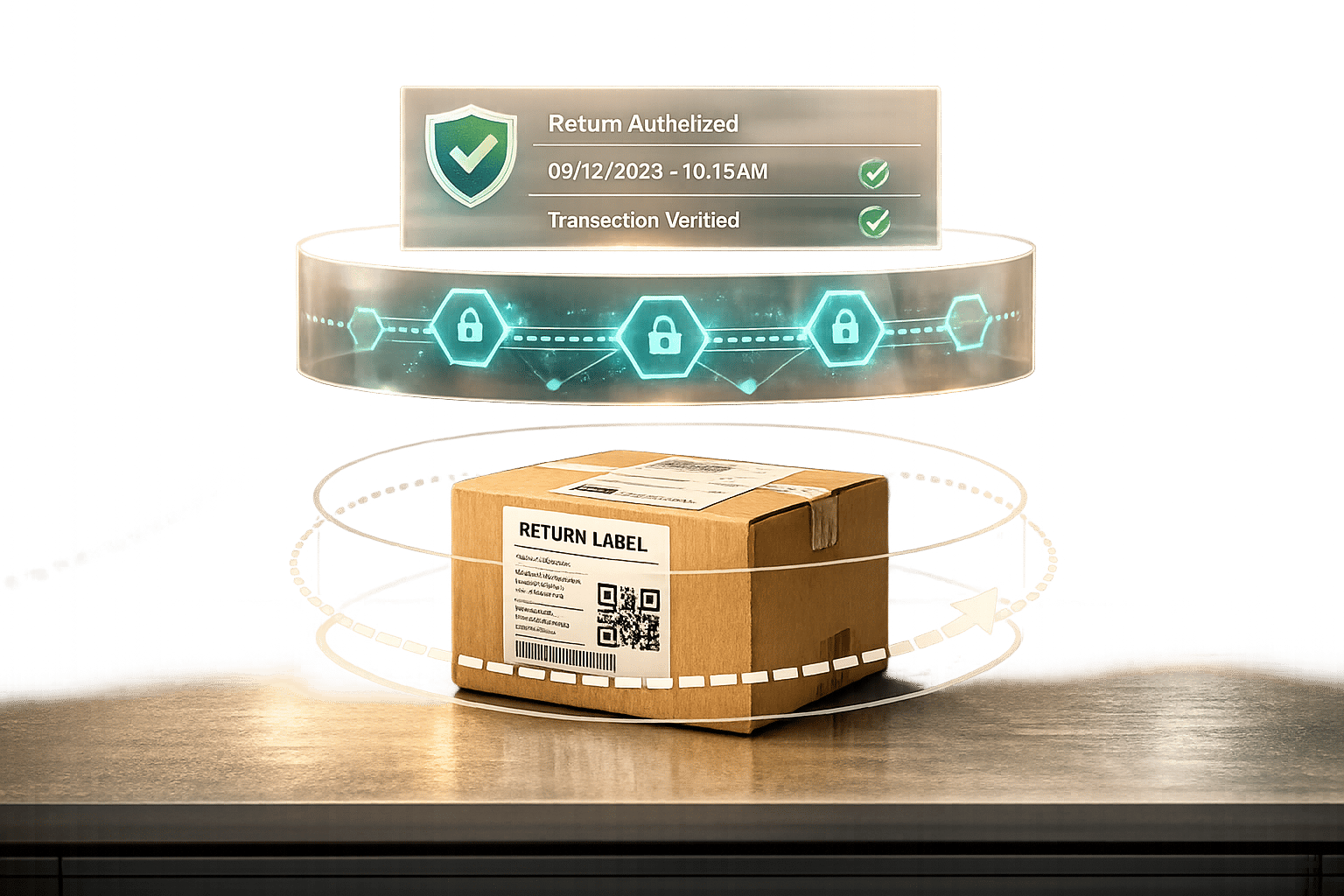
Blockchain offers a secure, tamper-proof system to track returns, verify authenticity, and automate processes using smart contracts. By recording every transaction in an immutable ledger, blockchain prevents fraud, cuts costs, and improves transparency for both businesses and customers.
Key takeaways:
- Blockchain reduces fraudulent returns by tracking product history and verifying ownership.
- Smart contracts automate return approvals, saving time and labor.
- Real-time tracking ensures transparency, boosting customer trust.
Retailers adopting blockchain are already seeing results, with fraud reductions of up to 40% in just months. As return fraud continues to grow, blockchain could reshape reverse logistics by ensuring accuracy, security, and efficiency.
Return Fraud in Reverse Logistics

Return Fraud Statistics and Blockchain Impact on Retail Losses
Types of Return Fraud
Return fraud is a complex problem with many faces. One of the most common schemes is wardrobing, where people buy items like clothing, use them briefly (often for events or social media appearances), and then return them. This trend has grown with the rise of influencers who avoid repeating outfits on camera.
Another frequent tactic is bracketing, which affects nearly half (47%) of retailers. This involves purchasing multiple sizes or colors of an item, intending to keep only one and send the rest back. While some shoppers see this as harmless, it drives up costs for processing and disrupts inventory flow.
More deliberate fraud schemes include bricking, where valuable components, such as graphics cards, are removed from devices like gaming PCs before returning the empty shell. Then there's switch fraud, where scammers return an entirely different, often used or broken, product instead of the original purchase. Another tactic, empty box fraud, occurs when packages are returned containing nothing or filled with cheap items, triggering refunds. This accounts for 31% of online fraud cases.
Adding to the problem is organized retail crime, including "Return-as-a-Service" (RaaS), where criminal groups offer services to exploit retailers' return systems on a large scale. Meanwhile, INR fraud (Item Not Received) involves falsely claiming a package was never delivered, even when tracking data confirms receipt. Surveys reveal 42% of men and 15% of women have admitted to using this tactic.
These varied schemes create enormous challenges for retailers, impacting both their financial stability and operational efficiency.
Financial and Operational Impact
The cost of return fraud is staggering. In 2023 alone, U.S. retailers lost $101 billion, and that figure rose to $103 billion in 2024. For every $100 in returned merchandise, $10.40 is lost to fraud. But the real cost goes deeper - when factoring in product loss, shipping, and labor, every $1 in fraudulent returns costs retailers around $3.75.
Processing these returns adds another layer of expense. Each return costs $25–$30 for shipping, handling, and inspection. Fraudulent returns also force warehouse teams into time-consuming manual inspections, such as unpacking boxes, verifying serial numbers, and weighing items. This slows down legitimate returns and clogs fulfillment operations.
"The challenge is enormous: for every US$100 in returned merchandise, retailers lose US$10.40 to return fraud." - Jonathan Poma, CEO, Loop
Beyond direct financial losses, fraud disrupts inventory accuracy. For example, when an empty box or swapped item is mistakenly processed as a valid return, systems reflect stock that doesn't actually exist. This can lead to selling items that aren’t available, eroding customer trust and creating more headaches for service teams. The ripple effects extend throughout the supply chain, from flawed demand forecasting to unnecessary reverse shipping, which also contributes to higher carbon emissions.
sbb-itb-eafa320
How Blockchain Prevents Return Fraud
Blockchain addresses security vulnerabilities by using an unchangeable ledger that tracks every movement, inspection, and transaction, making manipulation virtually impossible. Unlike traditional systems that rely on separate databases prone to errors or tampering, blockchain ensures that all parties - retailers, warehouses, and customers - share the same accurate record of events. Once information is recorded in a block, it cannot be altered or erased, exposing any attempts at unauthorized changes immediately.
The system uses advanced encryption and consensus-based validation to verify each entry. When combined with IoT devices like smart sensors and RFID tags, blockchain captures real-time data about an item's condition during its return journey. This includes tracking factors like temperature changes, humidity, and physical impacts, creating a secure and traceable digital record that fraudsters can't manipulate. Here's how these features protect each stage of the return process.
Permanent Records for Return Tracking
Each return generates an unalterable record that tracks the product's purchase, ownership, and condition throughout its lifecycle. When a customer initiates a return, blockchain logs the request alongside a unique identifier, such as a serial number, QR code, or RFID tag. As the item moves through the return process, sensors automatically document its condition, creating a detailed and tamper-proof audit trail.
For instance, in February 2026, a mid-sized electronics retailer adopted a blockchain solution to combat fraud involving damaged products. By recording each device's condition and history on an immutable ledger, the company cut fraudulent returns by 40% within three months. This system also boosted consumer confidence by allowing buyers to verify the full history of second-hand items.
Blockchain's encrypted records also tackle counterfeiting, a problem affecting 3.3% of global trade. If a returned item's digital record doesn't match its original transaction, the system flags it for review, preventing fraudsters from swapping items, falsely claiming damage, or attempting to return fake goods.
Smart Contracts for Automated Verification
In addition to permanent records, smart contracts simplify the process by enforcing return conditions automatically. These self-executing agreements, embedded within blockchain code, trigger refunds, replacements, or rejections when specific criteria are met, reducing the need for manual checks.
For example, a smart contract might approve a refund only if the RFID tag, return window, and sensor data confirm the product's original condition. If any requirement isn't met, the contract halts the process and notifies the relevant parties.
"By adopting blockchain technology, a great amount of manpower used on determining whether each return or exchange is fraudulent can be reduced since merchants can check the product ownership." - Dong-Her Shih et al.
One example is the ESPRES system, which uses Ethereum-based smart contracts to validate a product's "footprint" during the return process. By linking warranty details, purchase history, and condition data, it prevents counterfeit returns and ensures the item matches its original transaction. This is especially crucial in e-commerce, where roughly 30% of all products ordered online are returned.
Real-Time Tracking and Transparency
Blockchain enables live monitoring of every stage of the return journey, closing the information gaps that fraudsters often exploit. As returns are shipped, all parties can track the package's location, handling conditions, and estimated delivery times via the shared ledger. If a package shows signs of tampering or if sensitive items exceed safe temperature limits during transit, blockchain logs the sensor data immediately. Smart contracts can then adjust the refund amount or reject the return entirely based on these verified conditions.
| Feature | Traditional Returns Tracking | Blockchain-Enabled Returns |
|---|---|---|
| Data Storage | Centralized, siloed databases | Decentralized, shared ledger |
| Transparency | Delayed updates | Real-time visibility for all parties |
| Security | Records can be altered | Immutable; tamper-resistant |
| Verification | Manual inspection and entry | Automated via smart contracts |
| Accountability | Difficult to trace errors | Full audit trail with timestamps |
This level of transparency increases trust among consumers. Over 60% of shoppers are more likely to buy when they know the return process is clear and reliable. By granting customers access to the same tracking data as retailers, blockchain reduces disputes and chargebacks, fostering a stronger and more honest relationship between buyers and sellers.
"By providing a secure, immutable record of every transaction, blockchain makes it extremely difficult for anyone to alter information regarding the condition or history of returned items, thus drastically reducing opportunities for fraud." - Skynera Team
Benefits of Blockchain in Reverse Logistics
Integrating blockchain into reverse logistics makes processes more secure, cost-effective, and customer-friendly. It enhances fraud prevention, builds trust, and speeds up returns management.
Fraud Reduction and Cost Savings
Fraud prevention powered by blockchain technology can save businesses a significant amount of money. For instance, retailers lose an average of $10.40 for every $100 in returned merchandise due to fraud. On top of that, processing a single return can cost anywhere from 20% to 65% of the product's original price. Blockchain creates tamper-proof records for products, eliminating the need for manual verification and reducing labor costs.
The numbers are striking: in 2023, the UK retail sector lost £11.3 billion ($14.6 billion) to fraudulent returns, while in the U.S., fraudulent returns accounted for 9% to 15% of all returns during 2024 and 2025. Blockchain combats these losses with encrypted codes and lifecycle tracking, preventing counterfeit returns and ineligible item submissions - issues that affect 51% of retailers.
"Blockchain with enhanced reverse logistics practices... can help recover product costs by enabling counterfeit management and sustainable supply chains."
– Innover Digital
Beyond fraud prevention, blockchain reduces operational costs by improving inventory accuracy and speeding up dispute resolution. With real-time tracking, resellable goods can be reintegrated into inventory faster, lowering holding costs. Additionally, the technology simplifies regulatory validation by providing a verifiable data trail for government agencies and authorized suppliers. These efficiencies not only cut costs but also build stronger consumer confidence.
Better Customer Trust
Blockchain's transparency fosters customer trust by offering verifiable data that’s easy to access. Take, for example, the partnership between Olam Food Ingredients and Melitta Coffee. In 2022, they used the blockchain-integrated platform AtSource to track data from farmers and link it to Melitta's SAP software. Customers could scan a QR code to see detailed information about the beans’ origin and processing, boosting trust. Similarly, in 2019, Nestlé piloted a program with OpenSC to track milk from New Zealand farms to Middle Eastern warehouses, allowing consumers to verify sustainability claims independently.
"Open blockchain technology might allow us to share reliable information with consumers in an accessible way."
– Head of Operations, Nestlé
When customers know their return history is tracked and verifiable through an audit trail visible to both merchants and shoppers, it encourages honest behavior and strengthens trust.
Faster Returns Processing
Smart contracts automate the verification process, eliminating delays caused by manual inspections or data entry errors. Refunds are triggered automatically once predefined criteria are met.
"Blockchain solves one of the most persistent pain points in reverse logistics by ensuring end-to-end tracking of returns, reducing lost items, and improving accountability."
– Anil Kumar Shivram Singh, Associate Director and Head of WMS Design, Ramco Systems
Real-time visibility ensures items don’t get lost or delayed in the reverse supply chain, leading to quicker refunds and restocking. Because all stakeholders - retailers, 3PLs, and carriers - share a unified ledger, coordination improves significantly compared to traditional systems that rely on isolated databases and manual processes. This streamlined approach minimizes losses, holds all parties accountable, and ensures honest customers receive faster service, while suspicious returns are flagged for review.
Adding Blockchain to 3PL Returns Management
Integrating blockchain into your returns process can enhance efficiency and security without disrupting daily operations.
Identifying Gaps in Current Return Processes
Start by assessing your current returns workflow for weak points. Common issues include opportunistic returns, which can stem from lenient policies, price drops after purchase, or insufficient deterrents for fraudulent behavior. These vulnerabilities can lead to increased costs tied to return fraud.
Blockchain technology offers a way to address these challenges. By automating the detection of suspicious returns, it reduces the manual labor required for fraud prevention. The next step is to connect blockchain technology with your existing ERP and RMA systems to streamline operations further.
Connecting Blockchain with ERP and RMA Systems
To tackle vulnerabilities effectively, integrate blockchain into your ERP and RMA systems. This can be achieved through API-driven processes that handle transaction initiation, consensus validation, and synchronized updates.
A synchronization layer - commonly referred to as a "blocker" - ensures that your ERP database and blockchain ledger remain consistent. To keep the blockchain ledger efficient, store only essential metadata. Artificial intelligence tools can be employed at the ERP level to filter out inaccurate data before it reaches the blockchain, helping to maintain ledger accuracy. Since blockchain records are permanent, it's crucial to design your system to handle errors using "inverse transactions." These transactions correct mistakes while preserving the integrity of the audit trail.
For instance, in 2021, researchers introduced the ESPRES system, an Ethereum-based blockchain solution aimed at curbing fraudulent returns and exchanges. This system utilized smart contracts and multi-attribute decision-support methods to verify product ownership and prevent counterfeit returns. Merchants using ESPRES were able to significantly cut down on the manpower needed for manual inspections, relying instead on the blockchain's secure digital footprint of goods.
JIT Transportation's Support for Blockchain Integration
JIT Transportation builds on these strategies by offering infrastructure that supports blockchain adoption in reverse logistics. With integrated ERP systems and real-time capabilities, JIT Transportation ensures smooth blockchain implementation, making returns management more efficient and coordinated.
Measuring Results in Fraud Reduction
After integrating blockchain into your returns process, it's crucial to evaluate its effectiveness. The right metrics can show whether the technology is living up to its potential for reducing fraud and streamlining operations.
Performance Metrics
To gauge blockchain's impact, focus on three key performance indicators (KPIs):
- Fraudulent return rate: Measure the percentage of returns flagged as fraudulent before and after adopting blockchain. This includes issues like wardrobing (wearing items and returning them), counterfeit product swaps, and empty box returns. Even slight reductions in these areas can lead to major savings.
- Returns processing time: Blockchain simplifies verification, speeding up the "return-to-credit" cycle. Faster refunds improve customer satisfaction, while quicker restocking boosts inventory turnover.
- Dispute resolution rates: Freight contracts often face disputes in about 70% of cases. Blockchain's immutable ledger offers a single source of truth, drastically cutting down these conflicts.
You can also track administrative overhead. Manual reconciliation and dispute management can consume up to 20% of transportation costs. By monitoring reductions in labor hours for returns verification and dispute resolution, you can directly measure cost savings. Additionally, customer satisfaction scores tied to returns are telling - over 60% of shoppers are more likely to buy when they trust the return process to be simple and transparent.
Improvements in these areas not only enhance efficiency but also lead to measurable financial savings.
Case Study: Cost Savings Through Fraud Prevention
The numbers speak for themselves. In November 2020, Walmart Canada Corp. rolled out the DL Freight blockchain platform to handle freight audit and payment processes for 70 independent carriers and 500,000 annual shipments. Using smart contracts, the system calculated costs and processed invoices in real time. The results? Walmart Canada saved $30 million and reduced invoice disputes from over 70% to less than 2% - a staggering 97% drop.
This example highlights blockchain's ability to tackle fraud and cut administrative costs simultaneously. The technology quickly paid for itself, creating a more efficient and reliable returns process.
Conclusion
Blockchain transforms reverse logistics by creating a tamper-proof record for every transaction, making it nearly impossible to introduce counterfeit goods or manipulate return histories. With fraudulent returns accounting for 9% to 15% of total returns in the United States during 2024 and 2025, and counterfeit products making up 3.3% of global trade, having a reliable verification system is more important than ever.
On top of its secure record-keeping, blockchain's smart contracts take verification to the next level. These contracts automate processes and ensure traceability from start to finish. By integrating data from RFID tags, sensors, and QR codes into secure, encrypted systems, blockchain eliminates the risk of duplicating codes used to distribute counterfeit items.
The benefits don’t stop there. Blockchain simplifies administrative tasks, speeds up the returns process, and provides clear, actionable data to optimize asset use. It also aligns with circular economy goals by helping identify products that can be resold or recycled.
However, successful blockchain adoption in reverse logistics requires smooth integration with existing systems like ERP and RMA while safeguarding sensitive consumer information. As Innover Digital highlights, "Blockchain promises so much for the reverse logistics space as it ensures a secured trail of information". This collaborative and secure approach paves the way for a fraud-resistant, trustworthy reverse logistics ecosystem.
With autonomous operations and verified authenticity gaining traction by 2026, companies that implement blockchain early will see reduced fraud costs, stronger customer confidence, and more resilient reverse logistics systems.
FAQs
What data should be written to the blockchain vs kept in my ERP/RMA?
When adding data to the blockchain, the focus should be on elements that enhance fraud prevention, verification, and security. This includes details like transaction hashes, return authorization specifics, and verification procedures.
On the other hand, operational data - such as return requests, inventory updates, inspection outcomes, and financial transactions - should be kept within your ERP or RMA system. These systems are better suited for managing returns, processing refunds, and handling logistics efficiently.
How do RFID tags and sensors prove a returned item wasn’t swapped or tampered with?
RFID tags and sensors play a key role in ensuring returned items are genuine and untampered with. RFID tags hold unique identifiers that align with the original product details, confirming the item's authenticity. Meanwhile, sensors keep track of factors like temperature changes or physical impacts, helping to detect any signs of tampering or mishandling. By working together, these technologies provide a clear, tamper-proof record, cutting down on fraud risks during the return process.
How can blockchain reduce fraud without making returns harder for honest customers?
Blockchain helps cut down on fraud in reverse logistics by offering a secure and transparent way to track products. With features like smart contracts and tamper-proof records, it ensures that returns are legitimate, streamlining the process and building trust. This system minimizes fraudulent activities while keeping things hassle-free for honest customers, as automation drives both transparency and reliability. On top of that, AI and data analytics boost fraud detection, allowing valid returns to move forward without unnecessary delays.
Related Blog Posts
Related Articles

Demand-Driven Replenishment for Multi-Node 3PL

3PL Models Compared for Reverse Logistics Carbon