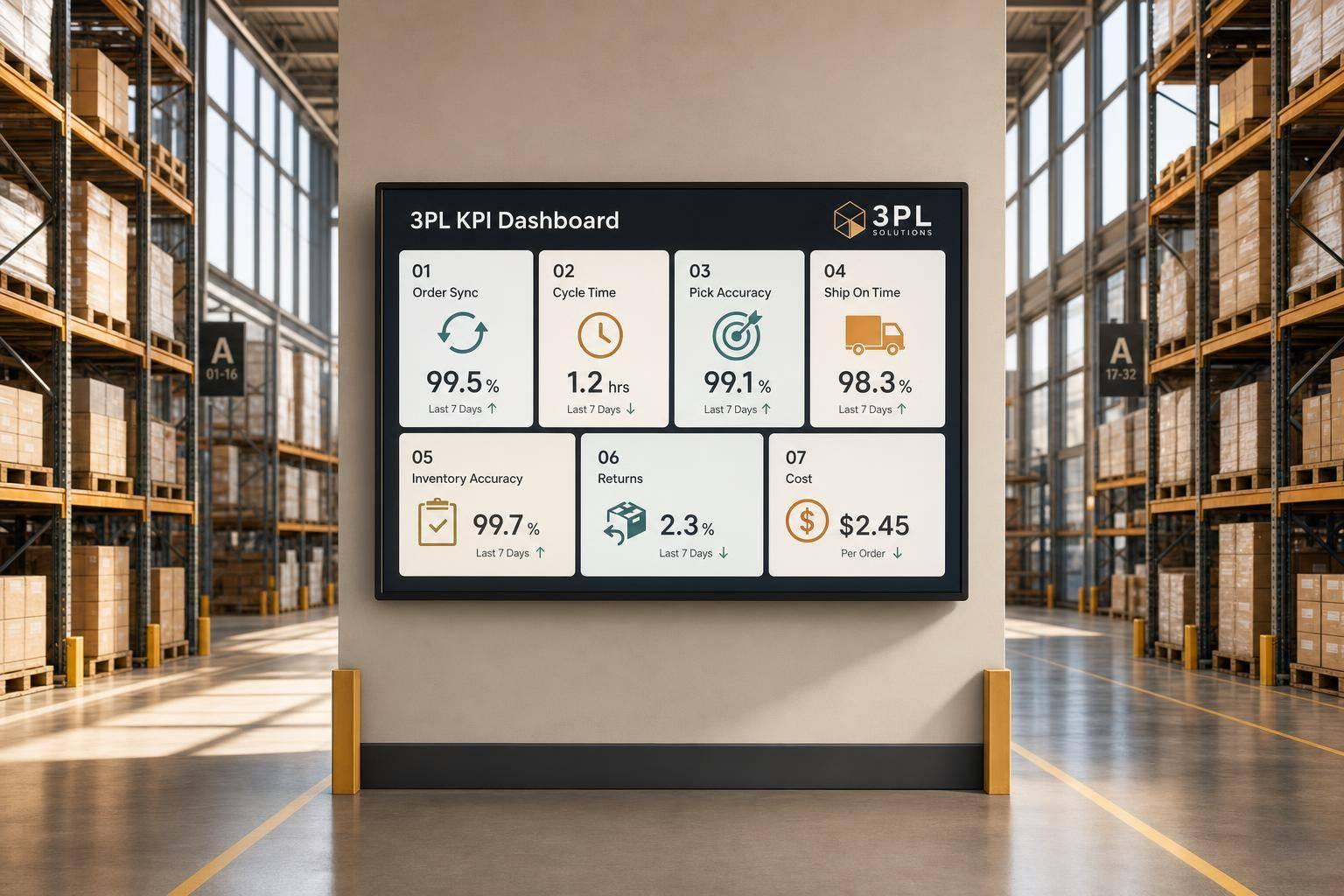
How 3PLs Cut Last-Mile Costs for DTC Brands

Lower shipping rates don’t always mean lower costs. For DTC brands shipping 3,000+ orders a month, I recommend starting with 90 days of shipping records and invoices to measure cost per delivered order - not just cost per label.
Then, work with your 3PL to:
- Match service to the delivery promise: Choose the lowest-cost carrier service that can meet the deadline.
- Shorten shipping distances: Test inventory placement and zone skipping against their added costs.
- Send fewer, smaller parcels: Reduce split shipments, right-size cartons, and combine orders when deadlines allow.
- Plan for handling and capacity: Price oversized deliveries fully and match warehouse workloads to pickup cutoffs.
- Check the bills: Correct billing errors and track posted credits separately from repeat savings.
My rule: <u>test before expanding</u>. Count added storage, handling, packaging, and technology costs, and scale only when total cost per delivered order falls without missing your service targets.

How 3PLs Reduce DTC Last-Mile Costs
Last-Mile Delivery Explained | The Most Expensive Part of Logistics
sbb-itb-eafa320
Match Carrier Services to Delivery Promises
Once you’ve set your baseline, route each order to the lowest-cost service that can meet the delivery promise.
Apply Routing Rules Before Printing Labels
Before printing a label, rule out services that don’t fit the shipment. Check weight, dimensions, destination type - residential, commercial, rural, or remote - zone, handling needs, and deadline.
Routing helps cut spending by avoiding unnecessary surcharges. Check lightweight parcels for minimum charges, oversized cartons for dimensional-weight and handling fees, and rural addresses for delivery-area surcharges. Use expedited shipping only when the deadline calls for it. Apply signature or declared-value requirements to high-value orders.
A 3PL’s shipping volume can help secure negotiated rates, but a discount doesn’t guarantee a lower delivered cost. Request the full rate card, including minimum charges, fuel formulas, dimensional-weight rules, and peak fees. Compare the landed shipping cost, not just the base rate: transportation, fuel, minimums, dimensional weight, and accessorials.
With routing rules in place, base promise dates only on services that can meet them.
Set Delivery Dates You Can Meet
Build the displayed delivery date from inventory position, order cutoffs, pickup timing, and transit time. Keep handling time separate from transit time instead of making blanket two-day promises. Choose the lowest-cost eligible service that can meet the date, and add a buffer for lanes with less reliable performance.
Review routing results by shipment profile and destination. Check cost per parcel, surcharge frequency, and the on-time-to-promise rate. Track refunds, reships, and support costs separately. Cheap freight doesn’t save money if delivery failures drive those costs up.
Orders that exceed parcel limits need a different service class - not a forced parcel quote.
Plan Transportation for Special Handling
Oversized products may need palletization, LTL transportation, liftgates, or delivery appointments. White-glove orders need clear steps for handling, placement, inspection, and proof of delivery.
These orders often need transportation, fulfillment, and white-glove handling in one plan. Define those requirements before pricing the order. Include accessorials, appointments, equipment, labor, and customer communication in the quote so last-mile costs don’t eat into the margin.
Reduce Shipping Distance With Inventory Placement
Once you’ve optimized carrier routing, shorten shipping distances by placing inventory closer to demand.
Weigh the Costs of More Fulfillment Nodes
Map at least 90 days of orders by ZIP code. Look at weekly and seasonal patterns, SKU velocity, and basket analysis to spot recurring regional demand. Then assess whether a second fulfillment node would lower landed cost enough to cover the added inventory and handling.
Place fast-selling SKUs with predictable demand near those customers, and keep complementary SKUs together. Keep slow movers centralized unless shipping-zone savings cover the extra inventory costs. Set regional reorder points based on demand and replenishment lead times to limit duplicated safety stock.
Compare single-node and multi-node scenarios over at least 90 days. Track average shipping zone, delivered cost per order, transit time, on-time delivery rate, split-shipment rate, and all-in network cost.
Parcel savings need to cover more than storage. Include receiving, handling, interfacility transfers, inventory carrying costs, technology, and minimum monthly fees. Factor in onboarding costs and split-shipment risk, too. Before committing, test conservative, expected, and peak-demand cases.
If demand is concentrated in a region but inventory is still too far from customers, test zone skipping next.
Check Whether Zone Skipping Pays Off
Zone skipping combines parcels into a larger shipment, moves them closer to their destination regions, and hands them off to a local carrier network.
Compare your current parcel costs with the full cost of zone skipping: consolidated line-haul cost per parcel, origin handling, destination injection fees, destination-zone parcel rates, technology, and exception costs.
Confirm regional volume density, departure frequency, parcel injection arrangements, eligible destinations, carrier acceptance requirements, fees, and cutoffs. Waiting to fill a load can wipe out the savings.
Pilot one lane with concentrated volume against a matched baseline. Measure all-in cost per parcel, delivery-date compliance, damage and loss, and missed cutoffs.
Ship Fewer Parcels With Less Empty Space
Once you’ve shortened transit distance, focus on fewer parcels and smaller packages.
Batch Orders Within Delivery Deadlines
Batch picking and packing, not labels. Group orders by region, node, and handling needs only when they can ship in one package and still meet the delivery promise. Subscription releases and same-customer orders may fit this approach.
Batching alone won’t lower postage. Savings come from fewer parcels, less expedited shipping, or better use of labor and pickup capacity.
Ship Complete Orders From One Node
Choose the node that can fulfill the entire order at the lowest landed cost. Compare shipping, packaging, and handling costs with the cost of a split shipment. Before allocating the order, check item size, weight, carton fit, and the delivery promise.
Split shipments when items require separate handling or when combining them would delay delivery.
Right-Size Packaging and Prepare Kits
Set carton rules based on finished-package dimensions in inches, actual weight in pounds, fragility, and required cushioning. Carriers bill whichever is greater: actual weight or dimensional weight. Use the smallest carton that protects the contents.
Test packaging choices against billed weight, pack time, damage, and returns. For recurring bundles, define the components, labels, quality control (QC) checks, and replenishment triggers. Ship each bundle as one packed unit whenever possible. JIT Transportation’s pick & pack and kitting services can support these workflows.
Match Order Waves to Peak Capacity
Match each wave to available labor, cartons, pack stations, staging space, and dock capacity. This helps reduce cutoff misses, expedited shipping, and idle labor.
When capacity runs short, hold only orders that can still meet the delivery promise. Move work to an approved node when it lowers costs, and upgrade shipping only for orders at risk of missing that promise.
After peak periods, compare parcels per order, split shipments, billed weight, damage, cutoff misses, and expedited spend against the baseline. Measure success by total cost per delivered order, not postage alone, and use invoice audits to verify the savings.
Audit Parcel Bills and Confirm Savings
Check Invoices Against Shipment Records
Once routing, batching, and placement changes go live, audit invoices to verify landed-cost savings.
Require the 3PL to match every invoice line to the order, label, tracking record, node, and rate card. Review weight, zone, fuel, and accessorial charges, along with service class, duplicate charges, and unused labels the carrier still lets you void or adjust. Request late-delivery refunds only when the service guarantee and contract permit them. A delivery promise made to the customer does not, by itself, qualify a shipment for a refund.
Manage Disputes, Claims, and Credits
Keep one-time recoveries separate from recurring savings. Track invoice corrections, service refunds, and loss/damage claims separately, since each requires different evidence and follows different timelines. Claims seek reimbursement for eligible merchandise value or shipping charges. They require tracking evidence, proof of value, and any required damage or packaging records.
Assign owners to file requests, gather evidence, meet deadlines, and reconcile credits with finance. Track the requested amount, status, credit, and root cause. Follow each carrier’s filing windows. USPS domestic damage or missing-content claims must be filed within 60 days of mailing.
For damage claims, keep the mailing container, packaging, damaged articles, and all contents received. Look for repeated billing adjustments that point to carton, address, or packing errors, then fix those issues.
Separate Recovered Credits From Recurring Savings
Count credits only after they post. Report invoice adjustments, service refunds, and claim recoveries separately from recurring savings. Track submitted amounts, approvals, resolution time, missed deadlines, and audit costs.
Compare net recurring savings per delivered order against the baseline. First, subtract added fulfillment, technology, audit, packaging, storage, transportation, and node costs. Review results monthly and after peak periods, packaging changes, rate updates, or node launches.
Conclusion: Test Changes Before Expanding
Once routing, placement, batching, and audits are in place, test whether the savings hold in day-to-day shipping. Lower label rates don’t always mean lower total costs. Routing, inventory placement, shipment consolidation, packaging, and invoice control all need to work against the same baseline.
Start with one region or product family. Set cost and service targets, assign owners across transportation, inventory, packaging, warehouse execution, and finance, and review results weekly. Expand only when total cost per delivered order drops, service stays within target, and savings hold across multiple billing cycles.
For brands shipping 3,000+ orders a month, review lane performance, delivery promises, node coverage, and parcel audit findings with JIT Transportation to define a pilot and verify savings with data.
FAQs
Which cost-saving changes should I test first at 3,000 monthly orders?
At 3,000 monthly orders, focus on four changes:
- Move inventory closer to demand. This lets you use more ground shipping and cross fewer shipping zones.
- Compare national and regional carrier rates for each order. Doing so could cut parcel spending by 5–20%.
- Automate order allocation. Route each order to the lowest-cost fulfillment location that can meet the promised delivery date.
- Make standard ground the default. Reserve expedited shipping for high-value or urgent orders.
How can I compare shipping savings when my order mix changes?
Compare total landed cost per order, not just base rates. Include fuel surcharges, residential fees, and dimensional weight charges. Use a transportation management system or automated rate-shopping tool to compare carriers based on each shipment’s weight, dimensions, and ZIP code.
Track Weighted Average Zone (WAZ) to assess inventory placement. As your order mix changes, watch shipping costs as a share of average order value. If they exceed 12%, consider adjusting fulfillment nodes to move inventory closer to customers.
How long should I test changes before expanding?
Test process changes or new integrations thoroughly in a sandbox before go-live. For the first two weeks after launch, check exceptions, synchronization timing, and queue volumes daily to confirm the system is stable.
Larger performance adjustments, such as those guided by automated shipping analytics, often produce measurable savings within 4 to 6 weeks. Review incremental rule changes monthly to check their impact against your key performance indicators.
Related Blog Posts
Related Articles

AI Inventory Integration for Multi-Warehouse 3PL

Cross-Border Customs Forms: Checklist