Lifecycle Assessment in Reverse Logistics: A Guide
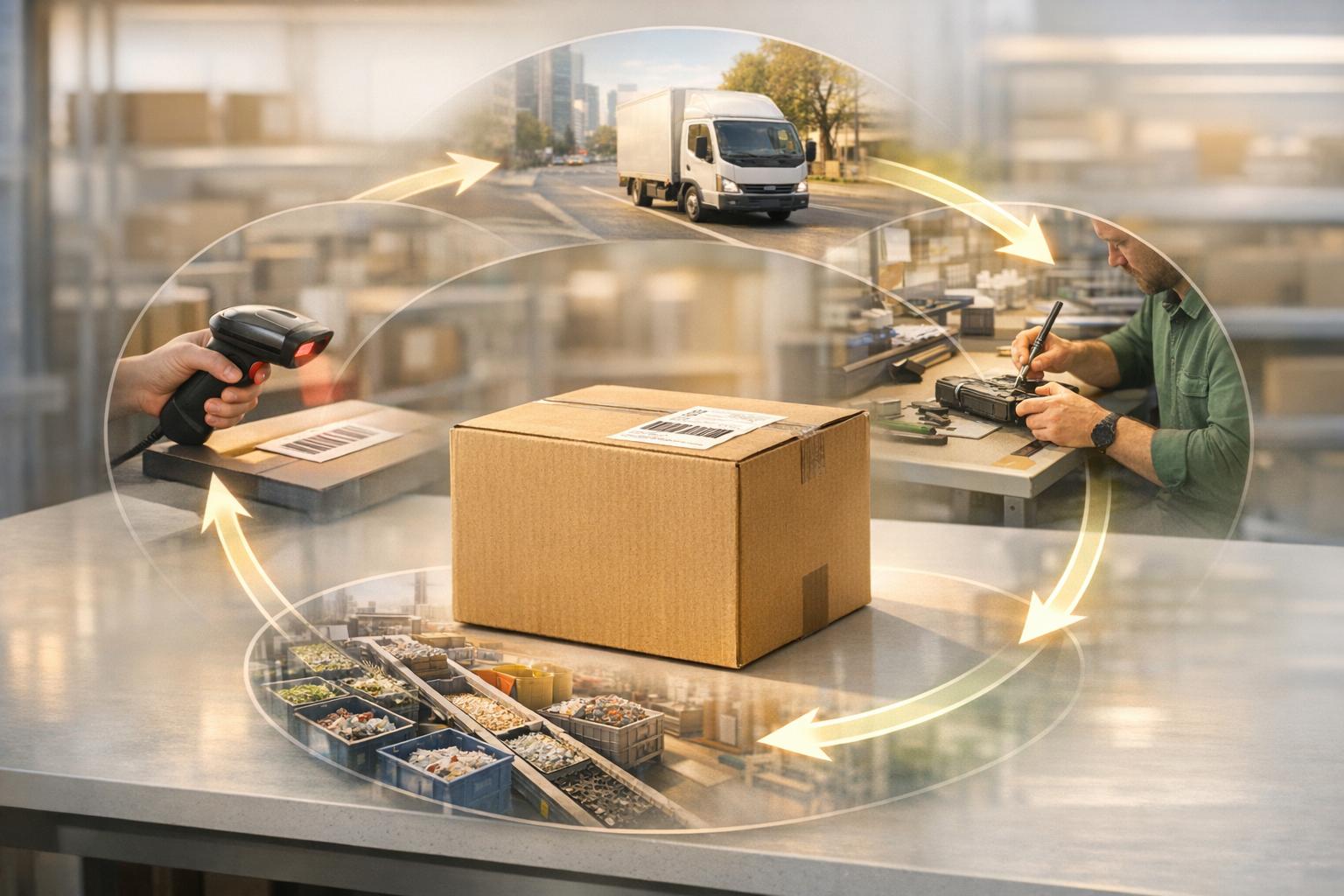
Reverse logistics is more than just handling returns - it’s about reducing waste, cutting emissions, and recovering value. Lifecycle Assessment (LCA) is the framework that helps businesses measure the impact of their reverse logistics processes and make informed decisions. By analyzing product returns, transportation, refurbishment, and recycling, LCA identifies opportunities to improve efficiency and reduce costs.
Key Takeaways:
- LCA in Reverse Logistics: Tracks the environmental and economic impact of returns, repairs, recycling, and disposal.
- Stages Analyzed:
- Product Intake: Assess returned items for resale, repair, or recycling.
- Transportation: Optimize routes and reduce emissions through consolidation and technology.
- Refurbishment/Recycling: Extend product lifecycles and recover materials.
- Benefits:
- Up to 40% cost savings via refurbishment.
- Emission reductions of 39% by optimizing transport.
- Reduced landfill waste through recycling and remanufacturing.
- Tools and Compliance: Software like SimaPro and standards like ISO 14040 streamline LCA implementation.
With reverse logistics expected to grow to $947.36 billion by 2032, adopting LCA ensures smarter decisions for businesses managing returns while addressing sustainability goals.
Lecture 3: Reverse Logistics and Closing the Loop
sbb-itb-eafa320
Main Components of Lifecycle Assessment in Reverse Logistics

Lifecycle Assessment Stages in Reverse Logistics: From Product Intake to Recycling
Looking deeper into the role of Lifecycle Assessment (LCA) in reverse logistics, we can identify three key stages where both environmental and economic impacts are most pronounced. These stages require careful data collection and evaluation to guide decisions about returned products effectively.
Product Intake and Condition Evaluation
The reverse logistics process begins with a thorough assessment of each returned product. This involves visual inspections to spot physical damage or missing parts, alongside functional testing to determine whether the item meets basic performance criteria. These evaluations are the foundation of a grading system that categorizes products into different tiers:
- A-grade products: Like-new items ready for immediate resale.
- B-grade products: Items with minor wear, suitable for secondary markets.
- Lower-grade products: Items requiring repair, parts recovery, or recycling.
As Close the Loop USA notes:
"A clear grading system eliminates guesswork, streamlines decision-making, and reduces waste".
Understanding why a product was returned - whether due to defects, customer dissatisfaction, or reaching the end of its lifecycle - is crucial. This insight helps determine the next steps, from light refurbishment to full remanufacturing. For non-functional items, assessing the presence of valuable materials like lithium or rare earth metals can guide whether to recycle or dispose of the product.
Once the condition of a product is clear, the next challenge is to manage its movement through the supply chain efficiently.
Transportation and Emissions
Transportation in reverse logistics is a major factor in both costs and environmental impact. Unlike the streamlined routes of forward logistics, reverse logistics deals with unpredictable timing, quality, and volume of returns. This often leads to "empty miles" as products move between customers, retailers, centralized returns centers (CRCs), and recovery facilities. Notably, online sales drive return rates as high as 30%, compared to just 8% for traditional retail.
To reduce emissions and costs, companies are consolidating shipments and integrating forward and reverse logistics, which can cut transportation emissions by up to 39%. Locating recovery and refurbishment facilities closer to CRCs or densely populated customer areas also helps minimize transport time and emissions. Tools like barcodes, RFID, and GPS enable real-time tracking, optimizing routes and reducing unnecessary mileage.
Once products reach their destination, they move into the critical phase of refurbishment or recycling.
Refurbishment and Recycling Processes
After transportation, products enter the processing stage, where their remaining value is recovered. A-grade products are restocked with minimal environmental impact, while B-grade items go through refurbishment. This process involves minor repairs, cleaning, and repackaging to extend the product's lifecycle. Items that require more extensive work undergo remanufacturing, where they are rebuilt to meet original standards.
For products that are beyond repair, recycling becomes essential. This process extracts raw materials, reducing landfill waste and the need for new material extraction. Electronics recycling is particularly important, as less than 25% of global e-waste is currently collected and processed, leaving billions of dollars in valuable metals untapped. Disposal is the last resort, reserved for hazardous or unusable items and conducted under strict environmental regulations.
Each processing method has distinct environmental and economic effects. Resale maximizes the product's lifecycle with minimal impact. Refurbishment extends use while reducing the demand for new materials. Remanufacturing aligns with circular economy principles by recovering high value. Recycling reclaims raw materials but involves energy-intensive processes. Disposal, however, carries the highest environmental risk.
These stages play a critical role in LCA, offering insights into where reverse logistics operations can be improved for better sustainability and economic efficiency. By analyzing each step, companies can align their strategies with both environmental goals and financial outcomes.
Measuring Environmental and Economic Impact
This section dives into how Life Cycle Assessment (LCA) evaluates both environmental and economic impacts within a reverse logistics framework. By assessing performance at each stage of reverse logistics, LCA transforms operational data into actionable insights that can enhance profitability while addressing environmental concerns.
Environmental Metrics to Track
When it comes to reverse logistics, several key environmental indicators are worth monitoring:
- Emissions Tracking: Keep an eye on carbon footprints and greenhouse gas (GHG) emissions to assess global warming potential.
- Waste Management: Measure landfill diversion and recycling rates to understand material recovery and recirculation.
- Resource Consumption: Analyze the use of renewable versus non-renewable energy, water withdrawal during processing, and chemicals involved in refurbishment or recycling.
- Specialized Recycling Quotas: Metrics like the Collection Quota (CQ) and the Technical Recycling Quota (RQ) help gauge the efficiency of material recovery and recycling processes.
Additional indicators, such as acidification and eutrophication potentials, provide insight into broader ecological effects on soil and water quality. For instance, Raufoss Technology's reverse logistics initiative for the GM Opel Insignia's Front Lower Control Arm offers a compelling example. As part of the European SuPLight project in October 2014, the company used SimaPro LCA software to compare scenarios with and without recycled aluminum. Their findings revealed that incorporating recycled scrap reduced climate change impact, resource use, and water withdrawal by over 20%.
Economic Benefits of LCA
LCA doesn't just shed light on environmental impacts - it also uncovers the economic advantages of reverse logistics. For example, Life-Cycle Costing (LCC) studies show that reverse logistics can make up 71.34% to 82.12% of total waste management costs, with labor often being the largest expense. This cost breakdown supports the use of Activity-Based Costing (ABC), which assigns costs to specific activities like inspection, repacking, and refurbishment, rather than relying on flat fees.
In the U.S. alone, product returns account for $761 billion in lost sales annually. However, LCA can help recover value from returns. Refurbishment processes can recapture up to 40% of a product's value and reduce material costs by 20% to 40% and labor costs by 20% to 30% through circular models and AI-driven automation. A great example is Repsol's reverse logistics system, which extends the lifecycle of containers and packaging by reusing materials and sourcing pellets from sustainably managed forests. As Ismael Pereda, Sr. Manager at Repsol, explained:
The goal is to recover 100% of waste, providing circular solutions throughout the value chain.
These insights pave the way for more efficient strategies in refurbishment, recycling, and transportation, making reverse logistics a win-win for both the environment and the bottom line.
How to Implement Lifecycle Assessment
Lifecycle assessment (LCA) plays a crucial role in evaluating both the environmental and economic impacts of reverse logistics. To implement LCA effectively, follow the structured ISO 14040/14044 framework, which divides the process into four key phases: Goal and Scope Definition, Inventory Analysis, Impact Assessment, and Interpretation. Begin by defining your functional unit - such as "one unit of packaging returned and refurbished" - and establish clear system boundaries. You can choose between a "cradle-to-grave" model that tracks the entire lifecycle or a "cradle-to-cradle" approach that focuses on circularity. This structured foundation ensures consistency and comparability across various product lines, making your assessment more actionable.
Data Collection Tools and Methods
Accurate data collection is essential to translate these phases into meaningful insights. A variety of software tools can simplify this process, ranging from advanced suites like SimaPro and GaBi (costing $5,000–$25,000 per year) to more affordable cloud platforms like Ecochain ($500–$5,000 per month) and AI-driven tools like ClickLCA ($200–$1,000 per month). These tools can reduce data collection time by up to 60%. As ESG Consultant Johannes Fiegenbaum explains:
Life cycle assessment software has evolved from an academic tool into a critical compliance infrastructure for market access in 2025.
Primary data should be extracted from existing ERP or PLM systems to track key metrics such as return rates, refurbishment success, and recycling volumes. To enhance this data, use reputable databases like Ecoinvent (v3.11) for general data, Agribalyse for food-related products, and Plastics Europe for material-specific insights. Additionally, obtain Environmental Product Declarations (EPDs) from suppliers to simplify inventory analysis. Integrating this data into your systems enables real-time monitoring and more informed decision-making.
Connecting LCA with Current Systems
For seamless integration, connect your LCA efforts with existing ERP or PLM systems. This allows for real-time tracking and ensures decision-making is based on up-to-date information. Transitioning to Activity-Based Costing (ABC) can also improve cost allocation by assigning specific expenses to return activities like inspection, repacking, and refurbishment. To refine your process, start by piloting 3–5 representative products. This helps identify data gaps and ensures smoother scaling later. Mapping your data flows is equally important, as it prevents bottlenecks and eliminates the need for manual data re-entry.
Meeting Environmental Standards
To ensure compliance, U.S. businesses must align their LCA processes with several key regulations. ISO 14040 outlines the principles and framework, while ISO 14044 provides detailed technical guidelines to make your results defensible and reproducible. Federal operations should adhere to 10 CFR Part 436, which emphasizes cost-effective investments in energy and water systems, and FAR Part 23, which governs sustainability in federal procurement. The EPA's "Guidelines for Assessing the Quality of Life-Cycle Inventory Analysis" offers additional standards for ensuring data reliability.
For public sustainability claims or ecolabels, consider third-party verification to enhance credibility. Additionally, prepare for upcoming requirements like Digital Product Passports (DPP), which will become mandatory for batteries in 2026. These passports will require integrated LCA data accessible via QR codes or RFID tags. By following these steps, you can ensure your LCA meets regulatory requirements while advancing sustainability within your reverse logistics operations.
Ways to Improve Reverse Logistics for Longer Product Lifecycles
Using insights from Life Cycle Assessment (LCA), businesses can adopt strategies to extend product lifecycles while cutting down on waste and emissions. These strategies not only reduce environmental impact but also bring financial benefits. For instance, refurbishment can lower a product’s environmental footprint by up to 40%, and remanufacturing often saves 80% of raw materials and 60% of energy compared to creating new products. The goal? Maximize value recovery while keeping waste and emissions to a minimum.
Repair and Refurbishment Methods
Repair and refurbishment are key players in extending product lifecycles, though they serve different purposes. Refurbishment focuses on fixing specific faults to restore functionality, while remanufacturing involves dismantling and rebuilding a product to an "as-new" condition. The latter can save 30% to 40% of the costs compared to manufacturing new products, making it ideal for items that need extensive restoration.
Repairs typically follow a structured hierarchy, from basic tasks like firmware updates (Level 0) to advanced repairs like Main Logic Board fixes (Level 4). For items deemed irreparable, salvaging usable parts can breathe new life into other units, ensuring that nothing goes to waste. This approach is especially relevant when considering that about 75% of returned products aren’t defective - they just need proper evaluation and minor fixes.
A great example of this in action is Dell Technologies. By 2017, Dell had incorporated 50 million pounds of recycled materials into its closed-loop supply chain. This initiative, combined with remanufacturing, boosted profit margins from 15% to 25% and cut landfill waste by 75%. To replicate such success, companies can use automated grading systems to quickly sort returns for resale or refurbishment, reducing both labor costs and waste. These methods align with LCA insights, helping to reduce resource demands while extending product usability.
Reducing Transportation Impact
Transportation often contributes significantly to emissions in reverse logistics, but smart strategies can mitigate this. Consolidating shipments and employing backhauling - where delivery vehicles pick up returns on their way back - can improve efficiency and cut emissions by up to 39%, according to Chuck Fuerst of ReverseLogix.
Another effective solution is using Pick-up/Drop-off (PUDO) points and lockers. These local collection spots reduce the need for individual home pickups, lowering carbon footprints and improving driver productivity. Regional refurbishment hubs can further minimize transit distances, speeding up processing for heavier items that generate higher emissions per mile. Additionally, auditing carriers for their use of electric fleets, sustainable fuels, or carbon-offset programs can slash transportation emissions by another 20%. These strategies, supported by LCA data, ensure that environmental benefits are factored into every step of the reverse logistics process.
Technology for Better Operations
Advanced technologies are revolutionizing reverse logistics, turning it into a strategic advantage. AI-powered systems can instantly determine whether items should be restocked, refurbished, or recycled, improving material recovery by 40%-50% and cutting labor costs by 20%-30%. Real-time tracking via IoT tools like RFID tags and barcodes prevents inventory loss and ensures accurate monitoring throughout the return journey.
Returns Management Systems (RMS) take this further by centralizing workflows - from return authorization to refund processing - while integrating with warehouse and transportation systems. Lauren Tillman, Director of Omnichannel Operations at At Home, shared how Manhattan Active Omni’s self-service tool empowers customers:
This feature really gives customers a sense of control over their post-purchase journey. They can do things like initiate returns and print labels... It's really great to have a tool that evolves with our customers.
For businesses handling complex return flows, solutions like JIT Transportation offer scalable infrastructure and advanced technology to optimize operations. Their nationwide network supports efficient returns processing, while services like testing and kitting extend product lifecycles through proper assessment and refurbishment. By using data analytics within these systems, companies can identify recurring issues - like frequent defects - and address them at the source, reducing future returns.
Conclusion: The Future of Lifecycle Assessment in Reverse Logistics
Main Points from This Guide
This guide has highlighted how integrating Lifecycle Assessment (LCA) into reverse logistics can achieve both environmental and economic benefits. By analyzing the environmental impact of product returns, refurbishment, and recycling, LCA transforms reverse logistics into a strategic tool for reducing waste while recovering value. For instance, data shows that refurbishment and remanufacturing processes significantly cut down on environmental harm.
On the economic side, the advantages are equally striking. Companies using LCA in reverse logistics report operational cost savings of up to 15% and reductions in material costs by as much as 30% through circular economy practices. Additionally, LCA can pinpoint product flaws, driving redesigns that extend product lifecycles and reduce return rates. Moving from flat restocking fees to Activity-Based Costing (ABC) also provides clearer insights into where resources are consumed in the returns process.
Consumer preferences are shifting, too. Over 70% of shoppers now lean toward brands offering sustainable return options. This makes LCA-driven reverse logistics more than just a compliance measure - it’s a competitive edge. Companies like Dell have embraced this approach. Since 2007, Dell's Asset Recovery Services have recovered billions of pounds of electronics through refurbishment and recycling, with a goal to recycle or reuse an equivalent product for every one sold by 2030. Similarly, Xerox generates over $1 billion annually by recovering and remanufacturing used equipment, offering performance-guaranteed products.
With these insights, it’s clear that emerging trends will continue to reshape reverse logistics.
Future Trends and Developments
The reverse logistics market is on the rise, driven by technological advances and stricter regulations. It’s projected to grow from $768.59 billion in 2023 to $1,166.81 billion by 2032. This growth underscores the increasing importance of integrating LCA into reverse logistics processes.
Cutting-edge technologies are playing a key role. Artificial intelligence and machine learning are automating tasks like return authorization and asset valuation, while blockchain ensures transparency by tracking product history and condition. Digital supply chain twins are another game-changer, enabling businesses to simulate potential disruptions and optimize networks for handling returns. The rise of Product-as-a-Service (PaaS) models also demands robust reverse logistics infrastructure, as companies retain ownership of products throughout their lifecycles.
Innovative examples like Apple’s "Daisy" robot show what’s possible. Daisy disassembles returned iPhones to recover valuable materials, such as tungsten and rare earth elements, that traditional recycling methods often miss.
Regulatory pressure is also reshaping the landscape. Laws like Extended Producer Responsibility (EPR) and "Right-to-Repair" mandates are pushing companies to design products with modular components for easier disassembly and refurbishment. Non-compliance can result in hefty fines - up to 5% of annual revenue - making adherence not just a legal requirement but a financial necessity. As noted by SCMR:
Reverse logistics is no longer an afterthought. It is a space for innovation.
By leveraging LCA insights, companies can build resilient and sustainable supply chains, positioning themselves as leaders in tomorrow’s markets.
For U.S. logistics professionals, partnering with experts like JIT Transportation can help turn reverse logistics into a strategic and sustainable advantage.
FAQs
What data is needed to start an LCA for returns?
To start a lifecycle assessment (LCA) for returns, you’ll need to gather essential data about the reverse logistics process. This includes:
- Return rates and reasons: Understand why products are returned - whether due to defects, dissatisfaction, or other causes.
- Volumes of returned products: Track how many items are sent back for refurbishment, recycling, or disposal.
- Logistics costs: Include transportation, labor, and processing expenses associated with handling returns.
- Waste and recycling data: Collect information on recycling rates and disposal methods.
- Product lifecycle details: Map out the lifecycle of the product to better understand its overall impact.
This information is crucial for evaluating the environmental footprint, costs, and resource efficiency of your returns process.
How do I set LCA boundaries for reverse logistics?
When conducting a Lifecycle Assessment (LCA) in reverse logistics, it's crucial to clearly define the scope of processes and stages involved. This helps ensure that the analysis captures all relevant factors. Here's how to approach it:
- Define the functional unit: Choose a unit that aligns with the purpose of reverse logistics, such as the number of items refurbished or recycled.
- Identify life cycle stages: Pinpoint the key stages and processes to include, such as collection, transportation, refurbishment, recycling, and final disposal.
- Account for critical activities: Incorporate significant elements like transportation methods, energy consumption, and waste management practices.
By carefully setting these boundaries, you can create an LCA that provides accurate insights into the environmental impacts of reverse logistics processes.
How can LCA results change my returns decisions?
Lifecycle Assessment (LCA) results provide valuable insights into the environmental and economic effects of a product throughout its lifecycle. These findings can guide businesses in making smarter returns decisions. For example, they might pinpoint opportunities to redesign products, making them easier to recycle or refurbish.
When LCA is integrated into reverse logistics, companies can cut down on waste, streamline inventory management, and boost profitability. At the same time, this approach supports sustainability efforts and helps improve the overall customer experience.
Related Blog Posts
Related Articles

Demand-Driven Replenishment for Multi-Node 3PL

3PL Models Compared for Reverse Logistics Carbon