
Top 3PL KPIs for Scaling E-commerce Brands

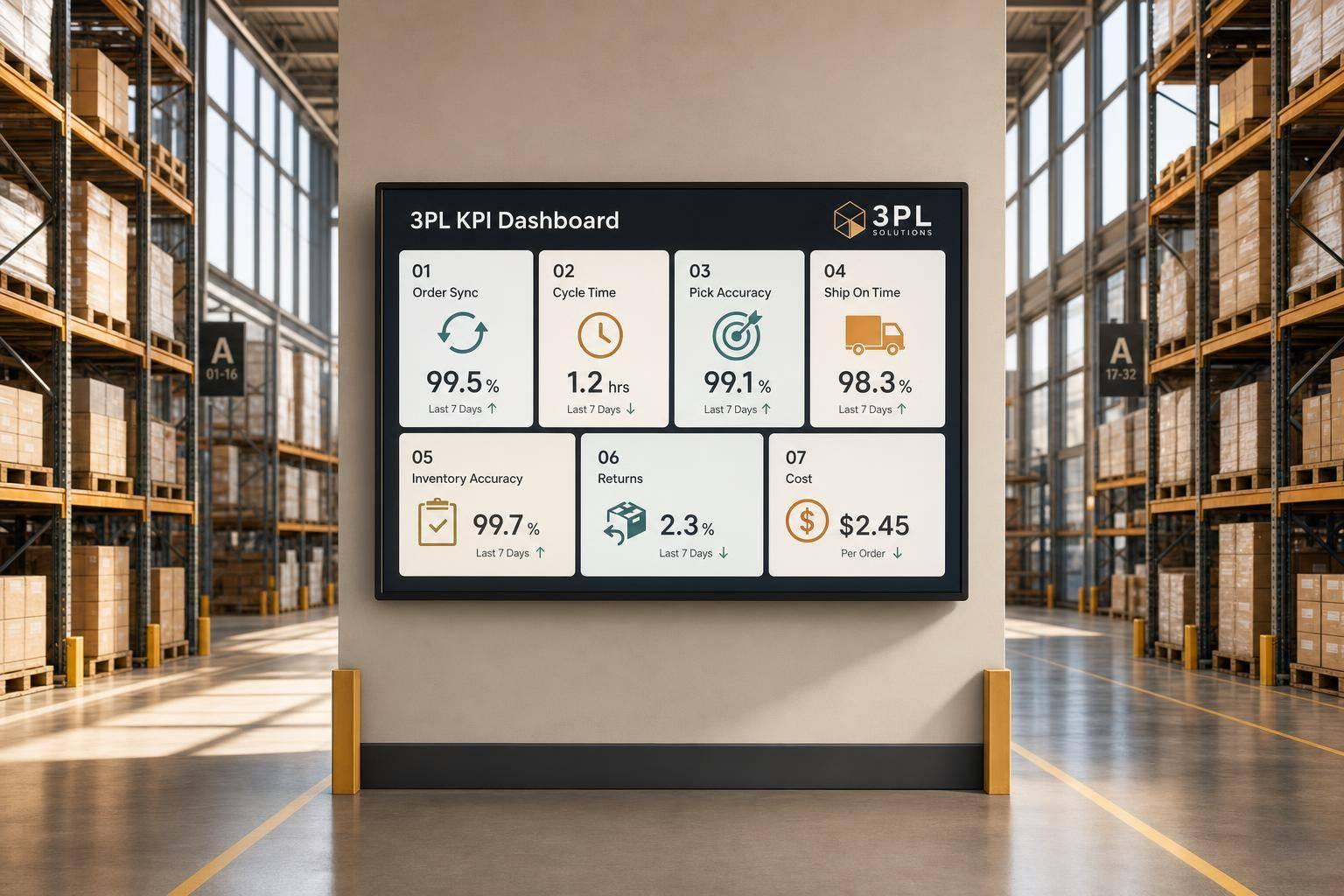
Managing e-commerce logistics without tracking the right KPIs is like flying blind. Here are seven KPIs every e-commerce brand should monitor when working with a 3PL to ensure growth, efficiency, and customer satisfaction:
- On-Time Delivery Rate: Measures the percentage of orders delivered within the promised timeframe. Aim for 97–99% to retain customers and control costs.
- Order Fulfillment Accuracy: Tracks how often orders are picked, packed, and shipped without errors. Top providers achieve 99%+ accuracy.
- Inventory Accuracy: Compares recorded stock levels to actual counts. High accuracy (99%+) prevents stockouts, overselling, and canceled orders.
- Order Cycle Time: Measures the time from order picking to shipping. Faster cycle times support same-day/next-day delivery.
- Shipping Accuracy: Ensures orders are shipped using the correct method, carrier, and address. A 99%+ rate avoids costly errors and customer dissatisfaction.
- Dock-to-Stock Time: Tracks how quickly inventory is processed and ready for use after arriving. Under 24 hours is ideal for fast-moving e-commerce.
- Inventory Turnover: Measures how often inventory is sold and restocked. Higher turnover improves cash flow and reduces storage costs.
Key takeaway: Tracking these KPIs helps identify inefficiencies, improve customer satisfaction, and scale your business effectively. A reliable 3PL partner with advanced tools and nationwide reach, like JIT Transportation, can help you meet these benchmarks and grow without compromising service quality.
Fulfilment Centre KPIs of Order Fulfilment Centre
1. On-Time Delivery Rate
The on-time delivery rate tracks the percentage of orders that arrive within the promised delivery timeframe. It’s calculated using the formula: (orders delivered on or before the promised date ÷ total orders delivered) × 100. For instance, if you guarantee delivery within "2–3 business days" at checkout, this metric evaluates whether packages meet that expectation.
For U.S. e-commerce brands working with third-party logistics (3PL) providers, this rate should aim for near perfection - ideally close to 100%. Industry standards suggest that anything below 95% indicates deeper operational issues, while top-performing businesses often achieve rates of 97–99% for standard deliveries, with even higher targets for premium services. This KPI not only measures your logistics partner’s ability to meet delivery promises but also plays a key role in customer satisfaction and cost management.
Impact on Customer Satisfaction and Retention
Late deliveries can erode customer trust. Delivering orders on time reinforces reliability, encouraging repeat purchases and positive feedback. On the flip side, missed delivery windows often result in refund requests, discounts, negative reviews, and a spike in "Where is my order?" inquiries.
In the U.S., where fast and predictable delivery has become the standard, maintaining a high on-time rate strengthens Net Promoter Scores and boosts customer lifetime value.
Operational Efficiency and Cost Savings
A solid on-time delivery rate doesn’t just enhance customer experience - it also reduces operational expenses. Late deliveries often lead to costly issues like re-shipments, partial refunds, and appeasement discounts. Predictable delivery timelines mean fewer customer service inquiries and lower appeasement costs.
"JIT sets the bar high in logistics. Their on-time performance, ability to handle last-minute requests, and expertise in material handling are game-changers for us. Add to that their competitive pricing and professional service, and it's clear why they're one of our most valued partners." - Curtis Martin, Senior Operations Manager, Synnex
Additionally, high performance minimizes carrier penalty fees tied to service-level agreements and reduces the need for extra "safety stock" inventory. Efficient planning and optimized routes lower costs per order, ensuring more predictable margins as your business scales.
Scalability for Growth
Hitting on-time delivery targets during regular business periods is important, but the real test comes during peak seasons like Black Friday, Cyber Monday, and the December holidays. During these high-demand times, maintaining a 95%+ on-time rate signals strong processes, sufficient staffing, and scalable systems.
"JIT has been a trusted logistics partner for Seagate for years, and their reliability is unmatched. Day in and day out, they prove their commitment to seamless operations, ensuring our supply chain stays on track. We know we can count on JIT to deliver, every time." - Hal Shapiro, Seagate Technology
This reliability allows you to confidently launch aggressive promotions, expand into new regions, and introduce more SKUs without sacrificing the customer experience. Reviewing on-time delivery data over time also helps with forecasting staffing needs and planning carrier capacity.
Meeting E-commerce Expectations
U.S. shoppers now expect rapid delivery options like 2-day or same-day shipping. A strong on-time delivery rate is essential for offering competitive shipping promises, such as "2–3 business days nationwide" or "next-day shipping", without incurring steep rush fees.
To meet these expectations, your 3PL must focus on operational efficiency. This includes tightening order cutoff times, streamlining warehouse processes, and strategically positioning inventory across multiple fulfillment centers to reduce transit times. By tracking on-time delivery, you can refine your shipping promises and stay competitive.
Working with a partner like JIT Transportation, which provides nationwide coverage, advanced technology, and scalable 3PL solutions - including transportation, distribution, and specialized services like pick & pack and white glove handling - ensures you can maintain high on-time delivery rates even as your business grows. Their robust infrastructure and real-time tracking capabilities enable the fast and reliable fulfillment that today’s U.S. e-commerce customers expect. While this metric is critical, the next KPI provides even more insight into operational performance.
2. Order Fulfillment Accuracy
Order fulfillment accuracy tracks the percentage of orders that are correctly picked, packed, and shipped without errors like wrong items or incorrect quantities. To calculate this, divide the number of error-free orders by the total number of orders, then multiply by 100. It's a simple but critical measure of operational reliability.
For e-commerce companies partnering with 3PL providers, accuracy is everything. Even one mistake can lead to returns, refund requests, or worse - losing a customer permanently. Top-tier 3PLs often boast accuracy rates exceeding 99%, with 99.9% being a common benchmark in contracts. This metric directly influences profitability, customer satisfaction, and the ability to scale operations effectively.
Impact on Customer Satisfaction and Retention
When customers receive exactly what they ordered, trust and loyalty grow - key drivers of repeat business. On the flip side, fulfillment mistakes can result in negative reviews, damage to your reputation, and lost customers. Keeping accuracy rates above 99% not only minimizes returns but also reduces the flood of "wrong item" complaints to your customer service team. In this way, fulfillment accuracy strengthens every link in your supply chain.
Operational Efficiency and Cost Savings
High accuracy in order fulfillment cuts costs across the board by reducing returns, refund expenses, and the workload on customer service teams. Leading 3PLs employ strategies like barcode scanning, optimized warehouse layouts, ongoing staff training, and real-time monitoring to minimize human error.
"JIT sets the bar high in logistics. Their on-time performance, ability to handle last-minute requests, and expertise in material handling are game-changers for us. Add to that their competitive pricing and professional service, and it's clear why they're one of our most valued partners." - Curtis Martin, Senior Operations Manager, Synnex
These measures not only prevent errors but also streamline return processes and lower customer service costs, boosting overall efficiency.
Scalability for Growth
Maintaining high order accuracy is essential for scaling your business, as it ensures consistent service quality even as order volumes rise. This complements on-time delivery performance, discussed earlier. Even a small error rate can have a big impact - 1% errors in 10,000 orders mean 100 dissatisfied customers.
JIT Transportation offers the infrastructure to sustain high accuracy rates as your business grows. With expertise in material handling, JIT ensures precision even during peak demand periods. Reliable fulfillment also supports smarter, data-driven decisions about inventory and other operations.
Meeting the Demands of Fast-Paced E-commerce
Speed and accuracy go hand in hand when it comes to meeting fast delivery promises. In today’s e-commerce landscape, even small errors can snowball into big problems, damaging customer satisfaction. Leading 3PLs design their warehouse systems with optimized pick routes, multiple courier partnerships, and real-time monitoring to process orders quickly while keeping accuracy rates above 99%.
For growing e-commerce brands, delivering both speed and accuracy is a critical advantage. Look for a 3PL provider that offers real-time dashboards and transparent reporting. Features like regular performance reviews, proactive communication about issues, and benchmarking against industry standards can help you make smarter decisions and refine your operations. This focus on precision sets the stage for other key performance metrics, like inventory accuracy, which will be covered next.
3. Inventory Accuracy
Inventory accuracy reflects how closely a 3PL's recorded stock levels align with what's physically on the warehouse shelves. You can calculate this by comparing recorded counts to actual physical counts. For example, if the system shows 1,000 units but only 995 are found, the accuracy rate is 99.5%.
In the U.S., top-performing 3PL providers generally maintain inventory accuracy rates above 99%, with the best operators often reaching 99.5% or higher. This isn’t just a metric to admire - it’s the backbone of essential processes like website stock updates and demand forecasting. High accuracy ensures smooth inventory management and reliable order fulfillment, which we’ll dive into next.
Impact on Customer Satisfaction and Retention
When recorded inventory doesn’t match what’s actually available - known as phantom inventory - it can lead to canceled orders and erode customer trust. Accurate inventory is critical to ensuring on-time delivery and precise order fulfillment.
With reliable inventory data, you can avoid overselling and stockouts, making it possible to confidently promise product availability. When customers receive exactly what they ordered on time, it naturally builds trust, leading to repeat purchases and glowing reviews. Additionally, platforms like Amazon penalize sellers for order cancellations due to stock issues, so maintaining accurate inventory isn’t just good for customer service - it’s a compliance requirement.
Operational Efficiency and Cost Reduction
Inaccurate inventory doesn’t just cause headaches - it drives up costs. A well-run 3PL relies on regular cycle counting to catch discrepancies early, instead of waiting for disruptive annual physical counts.
Accurate inventory data also supports better demand forecasting and automated reorder points. With trustworthy numbers, you can set precise triggers for replenishment, avoiding both stockouts and the extra costs of holding too much safety stock. This kind of efficiency becomes even more important as your order volumes increase.
Scalability for Growth
As your e-commerce business grows, accurate inventory becomes a cornerstone of smart decision-making. Whether you’re adding new sales channels, launching a subscription service, or expanding into wholesale, you’ll need reliable stock visibility across all touchpoints. During busy periods like Black Friday, precise inventory data ensures stock is allocated effectively across channels and warehouses, preventing overselling and keeping promotions running smoothly.
Even small error rates can snowball at scale. For instance, a 2% inaccuracy across 10,000 orders could lead to 200 issues, and at 50,000 orders, that number jumps to 1,000. Maintaining a 99.5% accuracy rate keeps these problems manageable, even as your business scales.
JIT Transportation achieves high inventory accuracy through advanced warehouse management systems, real-time tracking, barcode scanning, and regular cycle counts. Their infrastructure is designed to handle peak demand periods without compromising data precision, supporting your growth seamlessly.
Alignment with Fast-Paced E-commerce Demands
In today’s U.S. e-commerce market, fast delivery - same-day or next-day - is the norm. Meeting these expectations requires not just rapid fulfillment but also real-time inventory visibility across your network.
Poor inventory accuracy can create bottlenecks that slow down operations. If a picker can’t find an item the system says is in stock, valuable time is wasted searching or substituting items, delaying entire orders.
Leading 3PLs tackle these challenges with strict receiving and put-away processes, barcode or RFID scanning at every stage, and robust warehouse management systems that provide continuous real-time updates. They also handle damaged goods, returns, and expired stock efficiently to ensure these issues don’t distort inventory accuracy.
When choosing a 3PL partner, prioritize those offering real-time dashboards with SKU-level inventory visibility, cycle count results, and variance alerts. Regular performance reviews covering metrics like stock accuracy, damage identification, and expiry tracking (if applicable) are essential for transparency. This helps ensure your 3PL is meeting the high accuracy standards required for fast-paced e-commerce operations.
It’s also wise to include specific inventory accuracy targets in your service level agreement, typically setting the bar at 99% or higher. Monthly reporting and corrective action plans for performance dips below 98.5% provide the accountability needed to maintain data integrity as your business scales. Next, let’s explore how order cycle time can further enhance e-commerce fulfillment.
4. Order Cycle Time
Order cycle time - sometimes called pick-to-ship time - measures the duration between when an order is picked in your warehouse and when it’s packaged and ready to ship. Unlike the on-time delivery rate, which tracks whether orders arrive within the promised timeframe, this metric focuses entirely on the speed of internal processing by your third-party logistics provider (3PL).
If you're aiming to offer next-day or same-day delivery, a shorter order cycle time is a must. Faster processing translates to shorter wait times and happier customers. Top-tier 3PLs often aim to process standard orders in under 24 hours, with same-day processing for orders received before a designated cutoff. In some cases, pick-to-ship times for simple orders can be as short as four hours, enabling next-day delivery across much of the contiguous U.S.
Several factors at the warehouse level can influence cycle time. A well-designed layout and optimized pick routes can cut down the time it takes for staff to locate items. Skilled employees can also pick and pack orders more efficiently and with greater accuracy. Seamless integration between sales platforms and warehouse management systems ensures that orders flow into the fulfillment process without unnecessary delays. Additionally, having an effective receiving and put-away process ensures that new inventory is available for picking as quickly as possible. All of these elements work together to enhance customer satisfaction, which we’ll explore next.
Impact on Customer Satisfaction and Retention
Quick order cycle times are key to keeping your delivery promises, which directly impacts customer satisfaction and loyalty. When orders are processed swiftly, they reach customers faster, reducing frustration and encouraging repeat business.
Shorter cycle times also mean fewer orders are stuck in transit, which helps mitigate delays caused by unforeseen issues. For brands operating in competitive markets, keeping cycle times in check is crucial for retaining customers and generating positive word-of-mouth.
For instance, in 2023, a U.S.-based apparel brand revamped its warehouse layout and improved carrier integrations, cutting its average order cycle time from 36 hours to under 12 hours. This adjustment allowed the company to offer next-day delivery to 85% of the U.S. population and improved customer satisfaction by 22% during the holiday season.
These operational improvements not only enhance customer experiences but also help reduce costs and support long-term growth.
Operational Efficiency and Cost Reduction
Streamlining order cycle time boosts efficiency by reducing the amount of time inventory sits in the warehouse. Faster inventory turnover helps lower carrying costs, cut labor expenses per order, and reduce risks like product damage or obsolescence. It also minimizes the need for costly emergency restocking or expedited shipping.
Many modern 3PLs rely on real-time warehouse management systems to guide staff effectively. Features like optimized layouts and, in some cases, automated picking systems, further speed up the pick-to-pack process, saving both time and money.
Scalability for Growth
Order cycle time is a critical indicator of whether a 3PL can maintain high service standards as order volumes grow. With streamlined processes and well-organized layouts, a 3PL can handle peak demand without compromising cycle times.
When setting goals, it’s important to consider industry benchmarks, regional factors, and courier capabilities. Establish clear service-level agreements, such as processing 95% of standard orders within 24 hours, and continuously work to refine your processes.
Alignment with Fast-Paced E-commerce Demands
In today’s e-commerce landscape, customers expect fast delivery - often within 2-3 days or even on the same day. Meeting these demands requires more than just on-time delivery; it depends on minimizing cycle time to ensure orders are processed quickly enough to meet tight delivery windows. This speed not only builds trust and loyalty but also reduces the strain on customer service teams by decreasing delays and complaints.
Monitoring performance is critical. A real-time dashboard from your 3PL can track pick, pack, and dispatch times for individual orders, helping you identify and address bottlenecks. Detailed performance reports broken down by product category, order size, or sales channel can provide even deeper insights, allowing you to plan effectively for peak periods.
JIT Transportation supports fast order cycle times with scalable infrastructure, advanced technology, and a nationwide distribution network. Their strategically located warehouses and extensive carrier partnerships make it easier for e-commerce brands to meet tight delivery windows - even during high-demand periods.
sbb-itb-eafa320
5. Shipping Accuracy
While Order Fulfillment Accuracy focuses on ensuring the correct items and quantities are picked and packed, Shipping Accuracy measures how well the outbound process is executed. This includes using the correct shipping method, carrier, service level, and delivery address. For example, an order requiring 2-day shipping but sent via standard ground would count as a Shipping Accuracy failure, even if the items themselves were correct. These mistakes can affect customer satisfaction and profitability.
Shipping Accuracy is just as critical as on-time delivery and fulfillment accuracy. Leading third-party logistics providers (3PLs) in the U.S. typically achieve Shipping Accuracy rates of 99% or higher, with top performers aiming for 99–99.9%. For e-commerce brands offering a variety of shipping options - like standard, expedited, or same-day delivery - this level of precision is key. When customers receive their orders as promised, trust grows, and so does repeat business.
Impact on Customer Satisfaction and Retention
Imagine paying extra for expedited shipping, only to receive your order via standard ground. Even if the error stems from your 3PL, customers will see your brand as unreliable. Similarly, shipping to the wrong address or using a carrier that doesn’t serve the customer’s location can result in delays, frustration, and negative reviews.
These errors don’t just hurt customer relationships - they also increase costs. Customer service inquiries, refund requests, and reshipments all add up. A brand that consistently fails to meet its shipping promises risks higher churn rates and lower Net Promoter Scores. On the flip side, maintaining high Shipping Accuracy strengthens your brand’s reliability, supports on-time delivery, and builds the loyalty needed to compete on speed and service.
"In logistics, consistency is everything - and that's exactly what JIT delivers. Their transportation services are dependable, seamless, and backed by a team that truly understands our business needs. Working with JIT has made a tangible difference in our efficiency and customer satisfaction." - Armando Otiz, Manager 3pl/Inventory, exclusive networks
Even a single mistake - like sending an order to the wrong address - can lead to returns, refunds, and lost customers. By prioritizing Shipping Accuracy, you protect your reputation and foster stronger customer relationships.
Operational Efficiency and Cost Reduction
High Shipping Accuracy doesn’t just keep customers happy - it also saves money. Fixing shipping errors, like correcting an address or upgrading a service level after a package has been dispatched, is expensive and time-consuming. Frequent mistakes can also lead to costly carrier penalties and billing disputes, while reducing your leverage in future rate negotiations.
Accurate shipping streamlines your 3PL’s processes, minimizing rework and exceptions. This efficiency translates into lower fulfillment costs, fewer chargebacks, and more predictable logistics expenses. Additionally, it prevents overselling and reduces the need for emergency restocking, which can tie up working capital and increase operational costs.
JIT Transportation supports high Shipping Accuracy with advanced technology, a wide carrier network, and strategically located warehouses. Their value-added services, like pick-and-pack and kitting, enhance order preparation, while their transportation solutions focus on speed, reliability, and precision to reduce errors.
Scalability for Growth
As your business scales, maintaining high Shipping Accuracy becomes even more important. A reliable 3PL can handle complex shipping rules - like multi-carrier strategies, regional service levels, and special handling requirements - without increasing errors or costs. This is especially crucial during peak seasons like Black Friday or the holidays.
For brands expanding into new regions or offering faster delivery options in major U.S. cities, a 3PL with strong Shipping Accuracy ensures that every order is shipped correctly. This reliability allows you to confidently promote faster shipping options, enter new markets, and increase order values without worrying about widespread errors. With real-time performance dashboards, you can track shipping metrics and adjust strategies as needed, ensuring smooth operations even as you grow.
Alignment with Fast-Paced E-commerce Demands
In today’s e-commerce landscape, where customers expect same-day, next-day, and free shipping, Shipping Accuracy is non-negotiable. A single mistake - like using a slow carrier for an express order - can break delivery promises and damage your brand’s reputation.
A reliable 3PL ensures that every order is shipped using the right carrier, service level, and routing based on the customer’s choice, location, and cost considerations. This is especially important for brands using dynamic shipping rules, such as free shipping thresholds or premium services, and those selling across multiple platforms like Amazon, Shopify, and Walmart.
To meet these demands, a strong 3PL employs tools like automated carrier selection and address validation, which help maintain speed and accuracy. Real-time reporting on Shipping Accuracy - including breakdowns of errors by type and region - enables you to monitor performance and make data-driven improvements. Setting clear service-level agreements (SLAs) for Shipping Accuracy, such as 99% or higher, ensures accountability and helps catch issues early.
6. Dock-to-Stock Time
Dock-to-Stock Time measures how long it takes for inventory to go from arriving at the dock to being stored and ready for use. Essentially, it’s the time from when a shipment arrives to when it’s processed and available for picking. For instance, if a shipment reaches the dock at 9:00 AM and is fully processed by 11:30 AM, the Dock-to-Stock Time is 2.5 hours. This metric plays a key role in ensuring timely order fulfillment and keeping warehouse operations running smoothly.
Many top-tier 3PLs in the U.S. aim to keep Dock-to-Stock Times under 24 hours for standard shipments, while the best providers often achieve same-day or next-day processing. This focus is essential because Dock-to-Stock Time serves as the backbone for all other warehouse activities.
Impact on Customer Satisfaction and Retention
Fast Dock-to-Stock Time directly influences how quickly orders can be fulfilled and how accurate inventory levels are - two factors that significantly affect customer satisfaction. Quick processing means products are available for picking sooner, reducing the chances of stockouts and speeding up delivery times. On the flip side, if inventory sits on the dock for days, delays can lead to canceled orders, unhappy customers, and missed sales opportunities.
Take the example of a U.S.-based apparel brand. They struggled with stockouts during peak seasons because new inventory often stayed on the dock for 2–3 days. After switching to a 3PL that prioritized faster receiving times, they cut their average Dock-to-Stock Time from 48 hours to under 12 hours. This change reduced stockouts by 30% and improved on-time order fulfillment by 15%.
Operational Efficiency and Cost Reduction
Reducing Dock-to-Stock Time doesn’t just benefit customers - it also streamlines operations and cuts costs. Faster processing minimizes labor expenses, prevents dock congestion, and reduces the risk of damage or loss while goods are waiting to be stored. It also allows for quicker replenishment of high-demand items, which helps lower safety stock levels, storage fees, and the need for expedited shipping, all while improving cash flow.
Modern 3PLs often rely on tools like real-time barcode or RFID tracking to monitor Dock-to-Stock Time. To achieve faster processing, they implement standardized receiving workflows, train staff effectively, use technology for rapid check-ins, and follow clear slotting guidelines for efficient storage. This approach not only avoids delays but also ensures high inventory accuracy and faster cycle times.
Companies like JIT Transportation enhance Dock-to-Stock processes with advanced technology, scalable infrastructure, and strategically located warehouses across the U.S. Their additional services, such as pick-and-pack and kitting, are specifically designed to speed up inbound processing, making inventory quickly available for fulfillment.
Scalability for Growth
As brands grow, they face larger and more frequent inbound shipments, especially during peak periods like Black Friday or the holiday season. A 3PL with consistently low Dock-to-Stock Times can handle these increased volumes without creating bottlenecks, ensuring that new inventory is ready to meet rising demand.
When launching new products or running major promotions, rapid processing becomes even more critical. Brands should ask their 3PL how they manage staffing during peak times and whether they prioritize high-demand items. Providing accurate Advanced Shipping Notices (ASNs) can also help by allowing 3PLs to pre-allocate space and streamline receiving operations.
Alignment with Fast-Paced E-commerce Demands
In today’s e-commerce world, U.S. consumers expect fast delivery - often within 1–2 days. Meeting these expectations requires up-to-date inventory that’s immediately ready for picking and shipping. Any delays in Dock-to-Stock Time can disrupt order fulfillment and lead to missed sales or overselling.
A 3PL that prioritizes quick Dock-to-Stock Time, supported by efficient workflows, real-time updates through its WMS, and sufficient staffing, ensures that inventory is promptly integrated into the supply chain. This capability is crucial for staying competitive in the fast-moving e-commerce market.
"JIT sets the bar high in logistics. Their on-time performance, ability to handle last-minute requests, and expertise in material handling are game-changers for us. Add to that their competitive pricing and professional service, and it's clear why they're one of our most valued partners." - Curtis Martin, Senior Operations Manager, Synnex
Dock-to-Stock Time also connects to other essential 3PL metrics like Inventory Accuracy and Order Cycle Time. Faster receiving reduces the chances of miscounts or mislabeling, supporting accurate inventory levels. Conversely, delays in receiving can lengthen the entire order cycle. For instance, a 24-hour delay in Dock-to-Stock Time might add an extra day to order processing. To get a full picture of warehouse performance, brands should evaluate this KPI alongside metrics like Inventory Accuracy and On-Time Delivery.
To manage Dock-to-Stock Time effectively, ask your 3PL to provide regular reports detailing average processing times by shipment type or priority level, along with insights on any delays. Their system should also offer real-time status updates (e.g., "arrived", "in receiving", "put away") so you can track progress. Establish clear service level agreements (SLAs) - such as processing 95% of standard shipments within 24 hours - and regularly review these metrics to address any recurring issues.
7. Inventory Turnover
Inventory turnover shows how frequently you sell and restock inventory within a specific time frame. Calculating it is simple: divide your Cost of Goods Sold (COGS) by your Average Inventory Value. For instance, if your U.S.-based e-commerce business has an annual COGS of $2,000,000 and maintains an average inventory of $400,000, your turnover rate is 5 - indicating that your entire stock cycles through five times a year.
A reliable 3PL partner can provide detailed turnover insights by SKU, category, or fulfillment center. This data helps you pinpoint which items are flying off the shelves and which are stagnating. This becomes especially important as your business grows, as different product categories naturally move at varying speeds. Categories like apparel, beauty products, and consumer electronics accessories often aim for double-digit annual turnover rates (8–12+), while larger items like furniture or seasonal gear may perform well with lower rates.
Impact on Customer Satisfaction and Retention
High inventory turnover reduces the chances of products being out of stock, which directly enhances customer satisfaction and loyalty. When popular SKUs are replenished based on real-time demand, customers encounter fewer "out of stock" issues and receive their orders promptly.
On the flip side, low turnover can be costly. It often means your capital is tied up in slow-moving or outdated products, taking up valuable warehouse space. Meanwhile, your bestsellers might run out of stock due to poor resource allocation. This imbalance frustrates customers, harms retention, and negatively impacts your bottom line.
By tracking turnover at the SKU level, you can quickly identify which products are gaining traction and which are underperforming. This allows you to adjust purchase orders and safety stock levels, ensuring your top-selling items remain available while avoiding excess inventory that won’t sell.
Operational Efficiency and Cost Reduction
Faster turnover offers tangible cost benefits. Reduced storage times mean lower warehousing fees, whether you’re paying for pallet storage, bin space, or square footage. It also improves cash flow and minimizes costs tied to insurance, shrinkage, and markdowns.
Operationally, better turnover simplifies warehouse processes. When slow-moving items are minimized and fast-selling products are strategically placed in easily accessible locations, your 3PL’s team can pick and pack orders more efficiently. Shorter pick paths, increased productivity, and reduced labor costs per order are just a few of the benefits. Combined with fewer emergency restocks and better demand alignment, these efficiencies can significantly lower your cost per unit shipped.
To fully capitalize on these advantages, request detailed data from your 3PL. This should include SKU-level inventory details, inbound shipment schedules, historical demand by sales channel, and carrying costs for each product. Real-time dashboards make monitoring turnover much easier.
Scalability for Growth
Efficient inventory turnover lays the groundwork for sustainable growth. By cycling through inventory quickly, you free up both working capital and warehouse space, enabling you to introduce new SKUs, expand into new product categories, or grow into additional U.S. regions without proportionally increasing your inventory investment.
As your order volumes rise, maintaining a healthy turnover rate ensures your 3PL can keep up during peak seasons. Instead of wasting resources on slow-moving stock, the warehouse can focus on high-demand items that drive revenue. This is especially critical during busy periods.
3PLs with robust infrastructure - like nationwide networks and advanced inventory systems - can use turnover data to optimize SKU placement, redistribute inventory across fulfillment centers, and manage seasonal demand surges without disrupting operations. For example, companies like JIT Transportation leverage advanced technology and strategically located warehouses to improve inventory positioning. They also offer value-added services like kitting and assembly, which can turn slow-moving items into more appealing bundled deals that boost sell-through rates.
Alignment with Fast-Paced E-commerce Demands
The fast-changing nature of e-commerce requires high inventory turnover to stay competitive. Quick cycles keep your products fresh and limit storage time, which is critical when dealing with influencer-driven demand spikes, rapid product updates, and seasonal trends in the U.S. market.
By monitoring turnover by SKU and time period, you can identify which products are gaining traction and which are losing momentum. This insight allows you to tweak purchase orders, adjust safety stock, and refine your product mix before excess inventory becomes a problem. When combined with other key metrics, turnover becomes a cornerstone of a responsive fulfillment strategy.
Some practical ways to improve turnover without risking stockouts include:
- Conducting ABC analysis to prioritize high-turn SKUs for prime storage spots
- Using real-time sales data for demand-driven replenishment
- Optimizing safety stock levels by SKU and fulfillment center based on historical trends
- Regularly reviewing SKUs with your 3PL to identify dead stock and decide on markdowns or liquidation
Inventory turnover works best when evaluated alongside other metrics like inventory accuracy, order accuracy, on-time delivery rates, carrying costs, and return rates. For example, if turnover improves but stockouts or late deliveries increase, your strategy may be overly aggressive. Monthly SKU-level reviews and quarterly strategy sessions with your 3PL help you fine-tune your approach while spotting meaningful trends. Including turnover targets in your 3PL scorecards ensures this metric aligns with service quality and overall customer experience.
Conclusion
Key performance indicators (KPIs) like on-time delivery and inventory turnover are the backbone of a scalable fulfillment operation. By keeping an eye on these seven metrics, e-commerce brands can maintain control and grow with confidence. These KPIs act as an early alert system, helping you address operational hiccups before they impact customers, all while creating a system that scales efficiently without inflating costs.
The benefits extend directly to your bottom line. Higher on-time delivery rates and improved order accuracy lead to repeat purchases and better Net Promoter Scores, reducing acquisition costs and boosting customer lifetime value. Accurate inventory management minimizes dead stock, write-offs, and expensive emergency shipping. Better shipping and order accuracy lower return rates and reshipment expenses, protecting your margins. Over time, consistently tracking these KPIs allows U.S. brands to test new channels while maintaining reliable service levels and predictable costs. This kind of operational discipline opens the door to meaningful improvements.
To make these KPIs actionable, work with your 3PL to create a unified scorecard with clear goals - like 99.5%+ order accuracy, 95–98%+ on-time delivery, and 99%+ inventory accuracy. Use dashboards to flag issues, such as spikes in mispicks or delays in dock-to-stock times, and collaborate on root-cause analyses to address problems like staffing shortages, slotting inefficiencies, or carrier delays. As your business grows, adjust these targets and analyze metrics by SKU, customer segment, or region to make informed decisions, like when to add a new fulfillment center.
By focusing on these metrics, brands can leverage a tech-driven 3PL to support seamless growth. For example, partnering with a provider like JIT Transportation offers access to infrastructure, systems, and expertise that many brands may not have in-house. Their nationwide network and carrier partnerships improve on-time delivery and shorten order cycle times by positioning inventory closer to customers. Advanced warehouse management tools and scanning technologies ensure fulfillment and shipping accuracy by validating SKUs, quantities, and addresses at every step. Efficient receiving processes speed up dock-to-stock times, turning inbound inventory into sellable stock quickly. Real-time analytics and dashboards provide visibility into KPIs, allowing brands to address exceptions and forecast needs more effectively - boosting inventory turnover and making peak-season planning more reliable.
"In logistics, consistency is everything - and that's exactly what JIT delivers. Their transportation services are dependable, seamless, and backed by a team that truly understands our business needs. Working with JIT has made a tangible difference in our efficiency and customer satisfaction."
- Armando Otiz, Manager 3PL/Inventory, Exclusive Networks
During peak times in the U.S., such as Black Friday/Cyber Monday and the December holidays, order volumes often surge far beyond normal levels, exposing weak points in your processes. A 3PL like JIT Transportation can adapt by scaling staffing, reconfiguring pick paths, and adding packing stations to maintain accuracy and cycle times under pressure. Their nationwide network and carrier relationships enable dynamic load balancing, rerouting shipments to less congested facilities to keep delivery times on track. By monitoring KPIs in real time, potential issues can be identified and resolved quickly, ensuring customer satisfaction even during high-demand periods.
The right 3PL partner should provide real-time visibility through a warehouse management system (WMS), offering details down to the SKU and lot level. Features like scan-based validation for shipping accuracy and order tracking from receipt to delivery are essential. A cloud-based portal or API integration with major U.S. e-commerce platforms lets brands view orders, inventory, and exceptions in one place. Dashboards formatted in U.S. number and currency styles (USD) should display key KPIs with filters for date ranges, facilities, and sales channels. Tools like predictive analytics - showing projected stockout dates or seasonal volume trends - help brands proactively adjust inventory and service commitments.
Embedding these KPIs into your strategy allows for confident growth and faster shipping options. Consistently strong on-time delivery and order cycle times let you offer expedited shipping or guaranteed delivery windows, supporting premium pricing and strict service promises. Reliable inventory accuracy and shorter dock-to-stock times enable quicker product launches and limited-edition drops, while improved inventory turnover can justify expanding your product range or entering new markets. On the flip side, if KPIs start to slip as volumes rise, it’s a clear signal to pause expansion, add another fulfillment center, or upgrade your 3PL capabilities before scaling further.
With a solid KPI framework and a tech-enabled partner like JIT Transportation - offering nationwide reach, advanced tools, and scalable infrastructure - you can build a logistics operation that grows alongside your ambitions while maintaining the service levels that keep customers coming back.
FAQs
What are the most important KPIs to track when partnering with a 3PL to grow my e-commerce business?
The key performance indicators (KPIs) you prioritize should align with your business objectives. For e-commerce brands partnering with a 3PL, here are a few critical metrics to monitor:
- Order Accuracy Rate: This tracks how often orders are fulfilled correctly. A high accuracy rate is essential for keeping customers happy and avoiding the expense of returns or replacements.
- On-Time Shipping Rate: This measures the percentage of orders shipped on schedule. Timely shipping is crucial for building customer trust and meeting delivery expectations.
- Inventory Turnover Rate: This shows how efficiently inventory is being managed by calculating how frequently stock is sold and replenished within a specific period.
Regularly reviewing these KPIs gives you valuable insight into the success of your 3PL partnership and highlights areas where your logistics strategy might need adjustment. Working with a dependable provider equipped with advanced technology - like JIT Transportation - can help ensure your supply chain is ready to support your growth ambitions.
How can e-commerce brands improve order accuracy and inventory turnover with a 3PL partner?
To improve order accuracy and keep inventory moving efficiently, e-commerce brands should prioritize open communication and make the most of their 3PL partner's expertise. Start by sharing precise sales forecasts and up-to-date inventory data. This helps your 3PL fine-tune stock levels and ensure smoother fulfillment processes. Regularly reviewing performance metrics - like order accuracy rates and inventory turnover ratios - can also highlight areas that need attention.
On top of that, consider using advanced tech solutions your 3PL might offer, such as real-time inventory tracking and automated order management systems. These tools can cut down on mistakes, prevent stockouts, and speed up order processing. A dependable 3PL partner, such as JIT Transportation, can deliver customized solutions to support your growth, keeping fulfillment efficient and accurate throughout the supply chain.
How can I make sure my 3PL provider delivers on time during busy seasons like Black Friday and the holidays?
To keep delivery rates high during peak seasons, partnering with a 3PL provider that offers a dependable network, flexible infrastructure, and cutting-edge technology is key. These elements are crucial for handling demand spikes and ensuring deliveries stay on schedule.
JIT Transportation focuses on delivering both efficiency and dependability. With a nationwide network and smart logistics tools, they ensure your supply chain operates seamlessly, even during the busiest periods. Their customized solutions are designed to meet your unique requirements, so your customers get their orders promptly, every time.
Related Blog Posts
Related Articles
7 WooCommerce 3PL KPIs Teams Track

Centralized vs Decentralized Replenishment
