
Best Practices for 3PL Warehouse Audits

Warehouse audits are essential for improving efficiency, reducing errors, and ensuring compliance. They help identify costly issues like inventory mismatches, process inefficiencies, and safety risks. Regular audits, combined with structured checklists, can improve inventory accuracy, optimize workflows, and refine warehouse layouts. Key areas to focus on include inventory management, operational workflows, safety, equipment maintenance, and technology systems. Using tools like cycle counting, ABC analysis, and real-time data integration ensures accuracy without major disruptions. Engaging employees and conducting regular reviews help maintain high performance and customer satisfaction.
Key Takeaways:
- Inventory Accuracy: Aim for at least 98% accuracy.
- Structured Checklists: Cover inventory, workflows, safety, and technology.
- Cycle Counting: More efficient than full inventory counts.
- Warehouse Layout: Optimize for flow, accessibility, and space use.
- Employee Insights: Staff feedback often reveals hidden inefficiencies.
- Technology: Ensure seamless WMS integration and use real-time analytics.
- Regular Audits: Monthly or quarterly reviews prevent small issues from escalating.
Stop Failing Inventory Audits: The Step-By-Step Warehouse Process That Actually Works
sbb-itb-eafa320
Creating a Structured Audit Checklist
A good checklist transforms an otherwise vague audit into a clear and organized evaluation that touches on every critical point. Without one, it’s easy to overlook operational gaps that can drain profits or even lead to compliance issues. As Tim Branch aptly states, "Running a warehouse without a clear warehouse audit checklist is like flying blind".
The stats underline its importance. Around 34% of businesses have shipped orders late because they sold items that weren’t actually in stock, a direct hit to profitability. On the flip side, regular audits using a structured checklist can cut inventory costs by about 10%, proving these efforts pay off.
A robust checklist should address both the obvious and the less visible aspects of operations. For example, MacMillan Supply Chain Group maintains an impressive 0.01% error rate by using detailed checklists that cover everything from receiving accuracy to technology integration. Achieving this level of precision requires a comprehensive and deliberate approach.
Let’s break down the key operational zones your checklist should cover.
Key Areas to Audit
Your checklist should focus on eight main operational zones, each critical to efficiency and compliance. Start with inventory management. Check that physical counts match your warehouse management system (WMS) data, ensure hazardous materials are labeled correctly, and confirm heavy items are stored safely on lower shelves. This single category alone can help avoid costly overselling issues, which affect nearly one-third of warehouses.
Next, assess the operational workflow. Look at receiving speed, put-away accuracy, picking processes, and packing organization. Then move to your warehouse layout - are walkways clear, lighting functional, storage density optimized, and workflows efficient? Poor layouts can add unnecessary travel time, which quickly adds up across thousands of daily picks.
Safety and compliance are non-negotiable. Warehousing ranks as the third most dangerous job, with a danger score of 25. Your checklist should ensure OSHA requirements are met, fire extinguishers are in place, spill kits are maintained, and personal protective equipment (PPE) is used properly. Don’t forget equipment maintenance - check preventive schedules and inspection logs for forklifts, conveyors, storage racks, and loading bay doors.
Technology systems also need thorough review. Verify WMS integration, barcode scanning accuracy, and IoT solutions for real-time tracking. Finally, measure employee performance. Conduct staff interviews to identify bottlenecks that only front-line workers might notice.
Customizing the Checklist for Your Business
While standard areas provide a solid foundation, your checklist should also reflect the unique needs of your operation. For instance, if you handle perishable goods, temperature logs and expiration tracking should be top priorities. Warehouses managing bulky items, on the other hand, might focus more on forklift safety and optimizing storage density. The stakes are high - OSHA reported 5,333 workplace fatalities in the United States in 2019, many of which could have been avoided with better safety protocols.
Your business model also plays a role. Public companies often prioritize inventory valuation and financial accuracy to meet disclosure requirements, while private businesses may focus more on productivity and resource use. An e-commerce fulfillment center with high-speed picking needs will have different audit criteria than a cross-docking facility focused on fast transfers.
To create a truly effective checklist, involve cross-functional teams. Bring in representatives from IT, customer service, production, and purchasing. Each department offers valuable insights into operational gaps. As Thill Inc. puts it, "A warehouse audit should answer the most prioritized questions: 'Do our procedures meet current operating requirements?' and 'What can we improve on?'".
For example, at JIT Transportation, custom audit checklists are at the heart of our continuous improvement strategy, helping us uphold our commitment to both safety and operational excellence.
Conducting Physical Inventory Counts
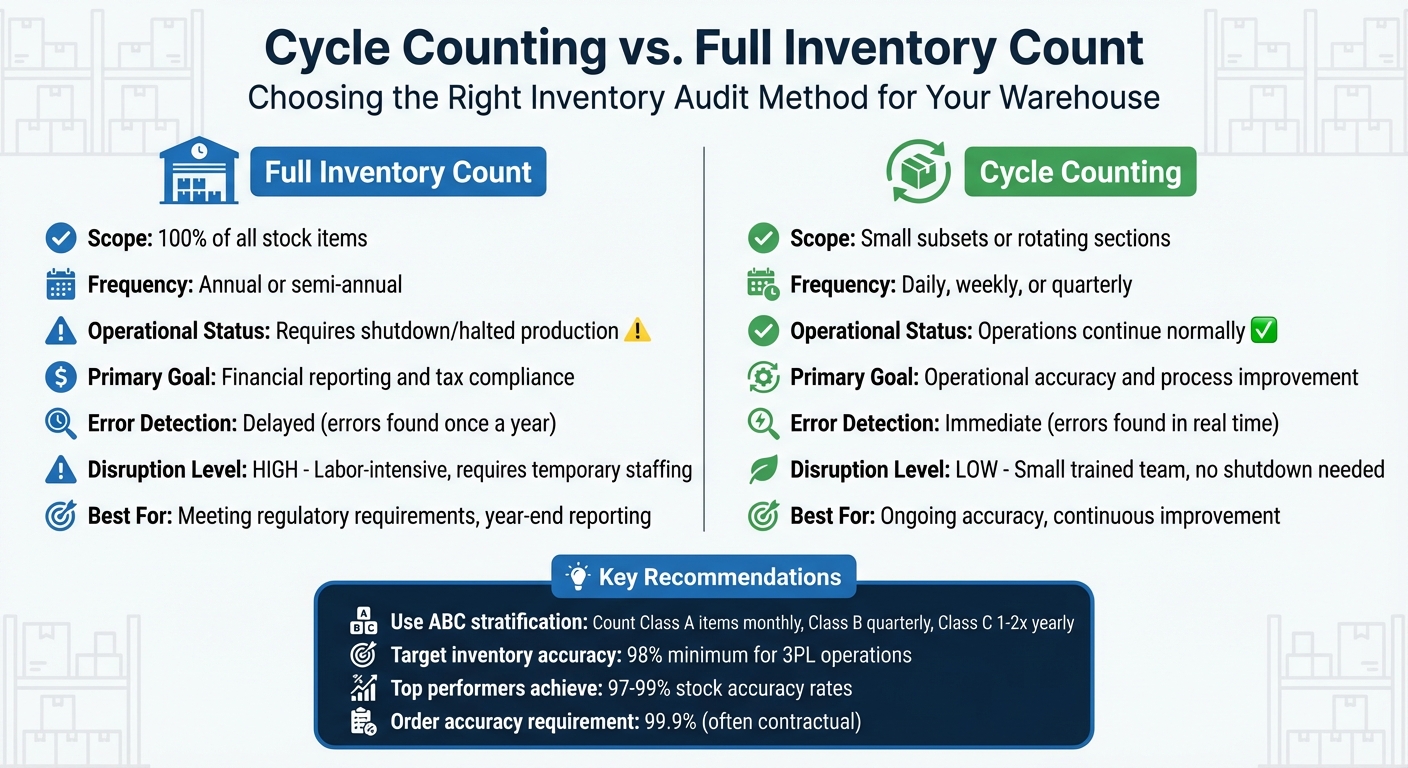
Cycle Counting vs Full Inventory Count Comparison for 3PL Warehouses
Physical inventory counts are essential for maintaining accurate stock records in any 3PL operation. Without these checks, system data can drift from reality, leading to costly errors.
Accuracy matters - a lot. For 3PL companies, inventory accuracy needs to hit at least 98% to avoid revenue forecast disruptions. Top-performing warehouses routinely achieve stock accuracy rates between 97% and 99%, with order accuracy often contractually required to reach 99.9%.
The challenge? Striking a balance between thoroughness and operational efficiency. As Brian Barry from FCBCO points out:
"Physical inventory counting once or twice per year is tedious, time consuming, expensive and disruptive because it generally halts all production through the distribution center".
This is why selecting the right counting method is a game-changer.
Cycle Counting vs. Full Inventory Counts
There are two main approaches to inventory counting: cycle counting and full inventory counts. Each serves a different purpose and comes with its own set of trade-offs.
Full inventory counts involve tallying every single stock item, typically once or twice a year, often to meet financial reporting or tax requirements. However, these counts usually require a complete operational shutdown to "freeze" data, making them labor-intensive and disruptive. They often call for temporary staffing or reassigning current employees to focus solely on the count.
Cycle counting, on the other hand, breaks the task into smaller, more manageable portions. Conducted daily, weekly, or quarterly, this method allows operations to continue uninterrupted. A small, well-trained team handles these counts, ensuring ongoing accuracy without major disruptions.
| Feature | Full Inventory Count | Cycle Counting |
|---|---|---|
| Scope | 100% of all stock items | Small subsets or rotating sections |
| Frequency | Annual or semi-annual | Daily, weekly, or quarterly |
| Operational Status | Requires shutdown/halted production | Operations continue normally |
| Primary Goal | Financial reporting and tax compliance | Operational accuracy and process improvement |
| Error Detection | Delayed (errors found once a year) | Immediate (errors found in real time) |
The efficiency of cycle counting is hard to ignore. Hadleigh Reid from DCL Logistics explains:
"Instead of doing physical counts, you can delegate small portions of your inventory to certain employees on a predetermined schedule. This allows you to go over all of your stock a little at a time in a focused manner, lowering the risk for inaccuracies".
A smart approach is to use ABC stratification: count high-value "Class A" items monthly, "Class B" items quarterly, and "Class C" items once or twice a year. Leading companies achieve an impressive raw material inventory turnover ratio of about 16.5 times per year, while the benchmark for inventory accuracy in maintenance, repair, and operations (MRO) stands at roughly 95%.
To ensure accuracy, consider using blind counts, where system quantities and dollar values are hidden to encourage unbiased physical tallies. Pairing experienced employees with newer staff can enhance both accuracy and on-the-job training. Before starting, remove damaged goods and "Return to Vendor" (RTV) items to avoid wasting time on unsaleable stock.
Once the counts are completed, reconciling discrepancies promptly is crucial for keeping your system data reliable.
Reconciling Inventory Variances
After completing inventory counts, addressing variances quickly is key to maintaining operational flow and data integrity. Reconciliation isn’t just about adjusting numbers - it’s a diagnostic tool to uncover process failures, data issues, or execution gaps. As EasyReplenish puts it:
"An effective inventory audit isn't about 'counting stock.' It's about controlling the environment in which counting happens".
Effective reconciliation starts with matching physical stock to system stock at the most detailed level: SKU × Location × Unit of Measure (UOM). Variances can then be categorized - whether it’s shrinkage, misplaced items, unposted movements, UOM errors, or master data issues.
To avoid timing mismatches, freeze all movements at least 1–2 hours before the audit begins. During this time, halt receiving, picking, and transfers. Clear pending transactions, ensuring all Goods Received Notes (GRNs), RTVs, and inter-warehouse transfers are posted or voided before starting the count. Physically separate damaged, expired, or QC-hold items into clearly marked zones to prevent artificial variances.
When discrepancies arise, investigate immediately. Use a third, independent counter for final checks on mismatches, and require supervisor approval for any system adjustments. Focus on high-value SKUs or items with a history of discrepancies first, as these carry the greatest financial impact. System adjustments should only happen after confirming physical and process accuracy, backed by evidence like photos or recount notes.
Quickly identifying and resolving variances has financial benefits. At JIT Transportation, robust reconciliation protocols help us catch root causes early, preventing small issues from snowballing into major operational problems. This ensures the accuracy our clients rely on.
Evaluating Warehouse Layout and Processes
Taking a close look at your warehouse layout is a vital step after conducting inventory and process audits. The way your space is designed has a direct impact on how quickly orders are fulfilled, how much you spend on labor, and how effectively you use available space. Surprisingly, surveys show that 50% of companies don’t regularly review their layouts, missing out on opportunities to fine-tune their operations. For example, one facility managed to avoid spending $1 million annually on expansion by simply optimizing their current square footage and making better use of vertical space.
The goal of a layout audit is to determine whether your current setup supports smooth workflows or creates unnecessary obstacles. As Cody Adams, Production Manager at Formaspace, explains:
"there's not one perfect warehouse layout design for everyone because every industry and warehouse is unique".
This highlights the importance of tailoring your evaluation to your specific needs rather than relying on a generic blueprint.
Assessing Layout and Space Utilization
A helpful way to evaluate your warehouse design is by using the FAST framework - Flow, Accessibility, Space, Throughput. These four pillars are the backbone of effective warehouse layouts:
- Flow: How efficiently goods move through your facility.
- Accessibility: How easily staff can reach inventory without barriers.
- Space: How well both floor and vertical areas are utilized.
- Throughput: How quickly products move from receiving to shipping.
The Pareto Principle can also guide your layout strategy. Typically, 80% of warehouse activity comes from just 20% of products, while the bottom 50% of inventory accounts for only 5% of activity. This means your most frequently picked items - your "A" items - should be stored closest to shipping areas to cut down on travel time. The next 15% of activity usually comes from 30% of your SKUs, which should be placed strategically as well.
When evaluating space, consider both the floor and vertical dimensions. Use masking tape to outline work areas and simulate tasks to identify bottlenecks before investing in new shelving or racks. If space is tight, adopting a 5S program can help clear out clutter, and adding vertical pallet racking can increase storage density.
Dock areas often experience the most congestion, so keeping put-away zones clear daily and using just-in-time cross-docking for fast-moving items can make a big difference. Don’t overlook environmental factors, either. Proper lighting ensures labels are easy to read, and flat, durable flooring supports modern material handling equipment. As Darryl Eddy, Director at Twintec Industrial Flooring, puts it:
"With many warehouse and logistics operators now taking full advantage of new technology that often requires bigger and taller buildings, the demand for a flatter floor is significantly higher".
These layout adjustments naturally lead to smoother workflows and better process efficiency.
Improving Workflow from Receiving to Shipping
A well-optimized layout sets the stage for streamlined workflows. Efficiency improves when products are handled fewer times and departments are arranged logically to minimize travel between receiving, put-away, and replenishment areas. Creating detailed flow charts that map out how products move through your warehouse can help uncover inefficiencies.
One approach to boost productivity is one-touch picking, where routes are designed so items for multiple orders are collected in a single pass. This reduces labor time and enhances efficiency. The stakes for getting this right are high - 17% of shoppers will switch retailers after just one late delivery, and 55% will move on if it happens two or three times. Additionally, undetected warehouse errors can cost anywhere from $25 to $50 per mistake, making it essential to catch workflow issues early.
Keep workstations stocked with essentials like cartons, tape, and dunnage to avoid unnecessary delays. Implementing the 5S methodology - Sort, Straighten, Shine, Standardize, and Sustain - can help maintain a clean, organized environment that naturally boosts productivity. As Warehouse Whisper notes:
"A clean, organized warehouse is always more productive".
Lastly, don’t underestimate the value of your employees’ insights. Speak directly with floor workers - they often have firsthand knowledge of bottlenecks or inefficiencies that might not show up in the data. For example, they can point out poor pick paths or even interpersonal issues between departments that slow down operations. Conducting a SWOT analysis can also help identify hidden inefficiencies and prepare your warehouse for future growth or economic changes.
At JIT Transportation, regular layout audits are a cornerstone of our focus on operational efficiency. By applying these methods, 3PL operations can uncover overlooked opportunities and cut down on costly inefficiencies.
Reviewing Technology and Inventory Systems
Once you've fine-tuned your warehouse layout and workflows, it's time to take a closer look at the technology driving your operations. At the heart of it all is your Warehouse Management System (WMS), which orchestrates everything from inventory tracking to order fulfillment. As Jim Kitts from Warehouse Whisper aptly puts it:
"Your WMS is the nervous system of operations".
The numbers back this up. In 2023, the global WMS market was valued at $3.94 billion and is expected to skyrocket to $9.11 billion by 2032, with an impressive annual growth rate of 19.5%. Much of this growth is fueled by cloud-based solutions, which are expanding at a rate of 20.1% due to their scalability and lower upfront costs. For third-party logistics (3PL) providers, a robust WMS is essential. It must handle multi-client management - juggling unique billing schedules and processes for multiple customers - while offering real-time inventory tracking through tools like RFID, barcode scanning, and IoT sensors. Advanced systems can boost order preparation efficiency by 30% and achieve picking accuracy rates of over 99%. This technology forms the backbone of your operations, connecting audits, tracking, and continuous improvement efforts.
Evaluating System Integration and Accuracy
Having the right technology is only half the battle; the real challenge lies in ensuring that all your systems work together seamlessly. Your WMS should integrate smoothly with your Enterprise Resource Planning (ERP), Transportation Management System (TMS), and ecommerce platforms to eliminate data silos and prevent inventory mismatches. It's critical to audit these connections to ensure real-time synchronization across all fulfillment centers. For example, MacMillan Supply Chain Group achieved an impressive 0.01% error rate by ensuring their systems were fully integrated and working in harmony.
Data flow is another key consideration. Your WMS should use real-time demand data to optimize pick and putaway paths while analyzing historical trends to identify bottlenecks. Regularly verify that physical inventory counts match the numbers in your WMS and online stores. Just as a well-organized warehouse layout enhances workflows, integrated systems ensure data accuracy and operational efficiency.
Using Reporting and Analytics
Your WMS continually generates a wealth of data - knowing how to act on it is where the value lies. Track hourly order volumes and compare key metrics like picks per hour, cycle times, and error rates against industry standards. Apply ABC analysis to categorize inventory: prioritize fast-moving "A" items in prime locations, while slower-moving "C" items can be stored further away. Labor Management Systems can also help by monitoring employee performance, identifying training needs, and fine-tuning picking zones.
Take a close look at your delivery history and last-mile analytics to identify whether warehouse delays are contributing to late deliveries. Comprehensive visibility - from the moment inventory enters your warehouse to when it reaches the customer - can set great operations apart from the merely good.
At JIT Transportation, we rely on cutting-edge WMS technology and real-time analytics to maintain precision and efficiency across our nationwide fulfillment centers.
Observing Operations and Employee Interviews
A Warehouse Management System (WMS) provides valuable data, but nothing beats a firsthand look at your operations to spot gaps that reports can't capture. Scott Stone, Vice President of Marketing at Cisco‐Eagle, puts it best:
"A deep dive into your operation will help you understand what's wrong, what's going well - and most importantly - why."
By observing the day-to-day flow, you can uncover the reasons behind performance metrics. For instance, if your WMS flags a drop in pick rates, a walkthrough might reveal obstructed aisles, malfunctioning equipment, or insufficient lighting. This on-the-ground approach complements system audits and highlights opportunities for improvement. It also sheds light on less tangible factors like employee morale, the pace of work, and cleanliness - elements that significantly influence long-term productivity.
Monitoring Fulfillment and Safety Practices
After reviewing layouts and systems, observing operations in action ensures that processes align with expectations. Watch how orders are picked, packed, and shipped. Are workers following the "one-touch" picking method? Are packing materials used efficiently? Are shipping labels applied correctly?. Pay attention to bottlenecks - areas where employees lose time moving between zones or waiting for equipment.
Safety practices deserve particular focus. Are forklifts being operated correctly? Do workers consistently wear Personal Protective Equipment (PPE)?. As Warehouse Whisper notes:
"Safety isn't compliance - it's culture. When workers feel safe, productivity rises."
Check equipment for hazards like frayed power cords, broken outlets, or precariously stacked pallets. Top-performing third-party logistics providers (3PLs) achieve error rates as low as 0.01% in receiving and put-away processes by staying vigilant about these details. Applying the 5S framework - Sort, Straighten, Shine, Standardize, Sustain - can help you evaluate whether the warehouse is organized and running efficiently. Additionally, ask your IT team for hourly order volume data to confirm that staffing levels match peak demand periods.
Gathering Feedback from Employees
While observations are critical, your employees can offer insights that no system or report can provide. As F. Curtis Barry & Company emphasizes:
"If anyone knows where problems and opportunities lie, it is the people who live with the issues day in and day out. Do not miss this vital resource; they are often the best information source."
Structured interviews with staff across various departments - receiving, picking, packing, and IT - can provide a holistic view of operational challenges. Ask questions like: "Do you feel safe at work?", "Have you encountered issues with the inventory system?", or "What wastes your time the most during the day?".
These conversations often reveal problems that automated systems can't detect. For example, employees might explain why certain policies are ignored or point out that they lack the right tools for their tasks. They might even uncover "shadow inventory" - unused supplies or extra stock that doesn't show up in counts. Considering that a single undetected warehouse error can cost between $25 and $50, these insights are invaluable. Incorporating this feedback into your audit strategy can lead to more effective operational adjustments.
Analyzing Results and Creating an Action Plan
After conducting detailed audits of inventory, layout, technology, and operations, the next step is turning those findings into actionable strategies. The data collected during audits becomes useful when it's benchmarked and transformed into specific actions. This process involves reviewing your historical performance internally and comparing it against industry standards to see where your operation stands. By doing this, you can identify gaps and areas for improvement.
Benchmarking Performance Metrics
Start by comparing your audit results to established industry benchmarks. For example, inventory accuracy should ideally fall between 97% and 98%. If it drops below 94%, it may indicate issues with operations or replenishment processes. Dock-to-stock time is another critical metric; best-in-class operations achieve under 24 hours, though 48 hours is still considered acceptable. Similarly, order accuracy should range from 99.5% to 99.9%, and on-time delivery rates should exceed 95%. Inventory turnover rates of 6 to 8 times per year are typical for many operations. When it comes to picking productivity, average workers handle 120 to 175 picks per hour, while top performers exceed 250.
Dave Jesse, COO at Bonded Logistics, highlights the importance of real-time visibility in improving operations:
"Cadence WMS provides us real time data to allow us to monitor our daily activities in all of our warehouses. It has provided us the visibility to flex our staff across our network and also provides our clients the transparency they want into our daily operations."
Use these benchmarks to identify trends and pinpoint operational gaps. External resources, like those from the Warehousing Education and Research Council (WERC) or the Council of Supply Chain Management Professionals (CSCMP), can provide additional context for your analysis.
Developing SMART Action Plans
Once you've identified key benchmarks and problem areas, it's time to create specific and measurable action plans. Rather than setting vague goals like "improve picking speed", aim for something more concrete, such as: "Increase average picks per hour from 130 to 160 by June 30, 2026, by reorganizing high-velocity SKUs and providing staff training on zone picking."
Focus on the issues that will deliver the biggest impact. Often, addressing 20% of the problems can lead to 80% of the improvements. If your audit uncovers multiple challenges, prioritize three or four key areas to keep your team focused and effective.
Each action item should have a clear owner - someone or a specific department accountable for its execution. Set deadlines to maintain momentum, and break larger goals into smaller, manageable steps. A two-phase approach can be helpful: first, analyze and prioritize the major issues with input from stakeholders; second, implement the solutions.
Introducing change gradually is often the most effective approach. As F. Curtis Barry & Company advises:
"Manageable changes introduced gradually will be more effective and readily accepted by your workforce than one massive overhaul."
Engage floor-level staff in the planning process - they often have the most practical insights into what will work on the ground. Finally, track progress using specific KPIs, such as units per person-hour, order turnaround time, or cost per unit. This ensures your action plans contribute to ongoing improvement efforts.
Implementing Changes and Scheduling Regular Audits
Once your action plans are set, the real work begins: putting those plans into action and setting up a routine for regular audits. These steps are essential for keeping warehouse operations running smoothly and staying compliant. To make implementation manageable, a structured and prioritized approach is key. Shannon Callarman from ShipBob suggests breaking the process into two phases:
"Phase one can be the analysis phase where your team finds major issues that need to be fixed. Phase two can be the implementation phase where you begin to fix the issues with input from key stakeholders."
This phased approach avoids overwhelming your team and ensures that changes address the root problems rather than just surface-level symptoms.
Training Staff on New Processes
Rolling out changes successfully depends on how well your team is trained. A generic, one-size-fits-all training won't cut it. As Jim Kitts, also known as the Warehouse Whisperer, puts it:
"Invest in real training, not just a check-the-box module."
Your training should focus on the specific updates being implemented - whether it’s a new picking route, revised inventory procedures, or updated safety guidelines. Detailed standard operating procedures (SOPs) are crucial for providing clear instructions on these changes.
Cross-training your employees across different warehouse functions is another smart move. It boosts flexibility and reduces reliance on any single individual. Communication is also key. Engage your floor staff in the process - they often have valuable insights into operational inefficiencies. As Shannon Callarman notes:
"The employees involved in the day-to-day operations of the warehouse most likely know where the inefficiencies are more than anyone else. Use this as an opportunity to speak to them."
When workers feel their input is valued, they’re more likely to embrace new procedures. Tools like visual aids, updated signage, and labeling systems can help ease the transition. Assigning specific individuals to oversee and implement each change ensures accountability and keeps the process on track.
Establishing a Regular Audit Schedule
After implementing changes, keeping them effective requires consistent oversight through regular audits. These audits shouldn’t be one-off events. The frequency of your audits will depend on your warehouse’s size, activity level, and resources. For example:
- Large facilities with high turnover may need monthly or even weekly audits to quickly identify bottlenecks and safety risks.
- Many third-party logistics providers (3PLs) find quarterly audits strike the right balance between oversight and operational flow.
- Smaller or more stable warehouses might opt for semi-annual or annual audits to focus on long-term strategies.
Instead of conducting a massive audit once or twice a year, consider breaking it into smaller, more frequent checks. For instance, spot-check high-traffic areas monthly to catch inventory issues early and maintain quality control. This incremental approach keeps operations running smoothly while ensuring continuous oversight.
Plan comprehensive audits during significant transitions, such as periods of growth, the introduction of new technology, or other major operational changes. Regardless of the frequency, health and safety protocols should always be the top priority in every audit cycle. As Scott Stone, Vice President of Marketing at Cisco-Eagle, emphasizes:
"Sustained progress is key. Many of the issues will not be solved quickly."
Regular audits create a culture where improvement is ongoing, and efficiency and compliance become second nature in daily operations.
At JIT Transportation, we follow these practices to ensure our warehouse operations remain efficient, compliant, and prepared for any challenges ahead.
Conclusion
Warehouse audits are more than just a routine checklist - they're a critical tool for safeguarding your profits and avoiding costly mistakes, wasted resources, and compliance violations. The key to success lies in making audits a consistent part of your operations, not just an annual event. Conducting audits monthly or quarterly helps catch small issues before they spiral into major disruptions.
These regular checks also have a direct impact on customer satisfaction. Consider this: 17% of shoppers will switch retailers after just one late delivery, and that number skyrockets to 55% if delays occur two or three times. As Shannon Callarman from ShipBob wisely points out:
"Continuous improvement is key and it's a never-ending process."
Using the insights gained from audits, top-performing warehouses create SMART action plans to systematically address operational shortcomings. They involve floor employees - who are often the first to spot inefficiencies - leverage real-time data from warehouse management systems (WMS), and strictly adhere to OSHA regulations to protect both workers and the bottom line. For example, some high-performing third-party logistics (3PL) providers have achieved error rates as low as 0.01%, thanks to rigorous auditing and advanced technology integration.
At JIT Transportation, we embed these practices into our 3PL solutions, combining cutting-edge technology with a nationwide infrastructure. This approach ensures compliance, operational efficiency, and the flexibility to meet evolving needs. Our commitment to constant improvement is at the heart of everything we do.
FAQs
How frequently should a 3PL warehouse conduct audits to ensure efficiency?
Regular audits play a key role in keeping 3PL warehouse operations running smoothly and in line with regulations. The ideal frequency of these audits often depends on factors like the warehouse's size, the complexity of its operations, and its specific requirements. However, a good rule of thumb is to conduct audits either quarterly or semi-annually.
For warehouses handling high volumes or sensitive goods, stepping up the frequency to monthly audits might be necessary. This allows for quicker identification and resolution of any problems. Sticking to a consistent audit schedule helps keep processes efficient and reduces potential risks before they escalate.
What makes cycle counting a better option than full inventory counts?
Cycle counting offers a smarter, less disruptive alternative to full inventory counts. Instead of halting operations to count everything at once, this approach targets smaller, more manageable sections of inventory on a regular schedule. The result? Improved accuracy without needing to shut down the entire warehouse.
This method not only cuts labor costs but also keeps downtime to a minimum, allowing day-to-day operations to continue smoothly. Over time, cycle counting makes it easier to spot and fix discrepancies faster, leading to better inventory management and smoother overall operations.
How does employee feedback enhance warehouse audit processes?
Employee feedback plays a crucial role in enhancing warehouse audits because it taps into the firsthand knowledge of those managing day-to-day operations. Frontline workers often spot issues that standard checklists might miss - like hidden bottlenecks, unsafe practices, or inconsistencies in tasks such as picking, packing, and inventory management. Including employees in the audit process brings practical insights that help fine-tune focus areas and ensure documented procedures match what actually happens on the floor.
When feedback is collected and analyzed systematically, it creates a cycle of continuous improvement. Audit findings lead to actionable recommendations, employees test and implement these changes, and their observations confirm whether the updates address the core problems. This not only improves efficiency and compliance but also boosts morale, as employees see their input driving safer and more effective workflows. At JIT Transportation, incorporating frontline feedback into audits has been key to maintaining high-quality fulfillment and operational excellence.
Related Blog Posts
Related Articles
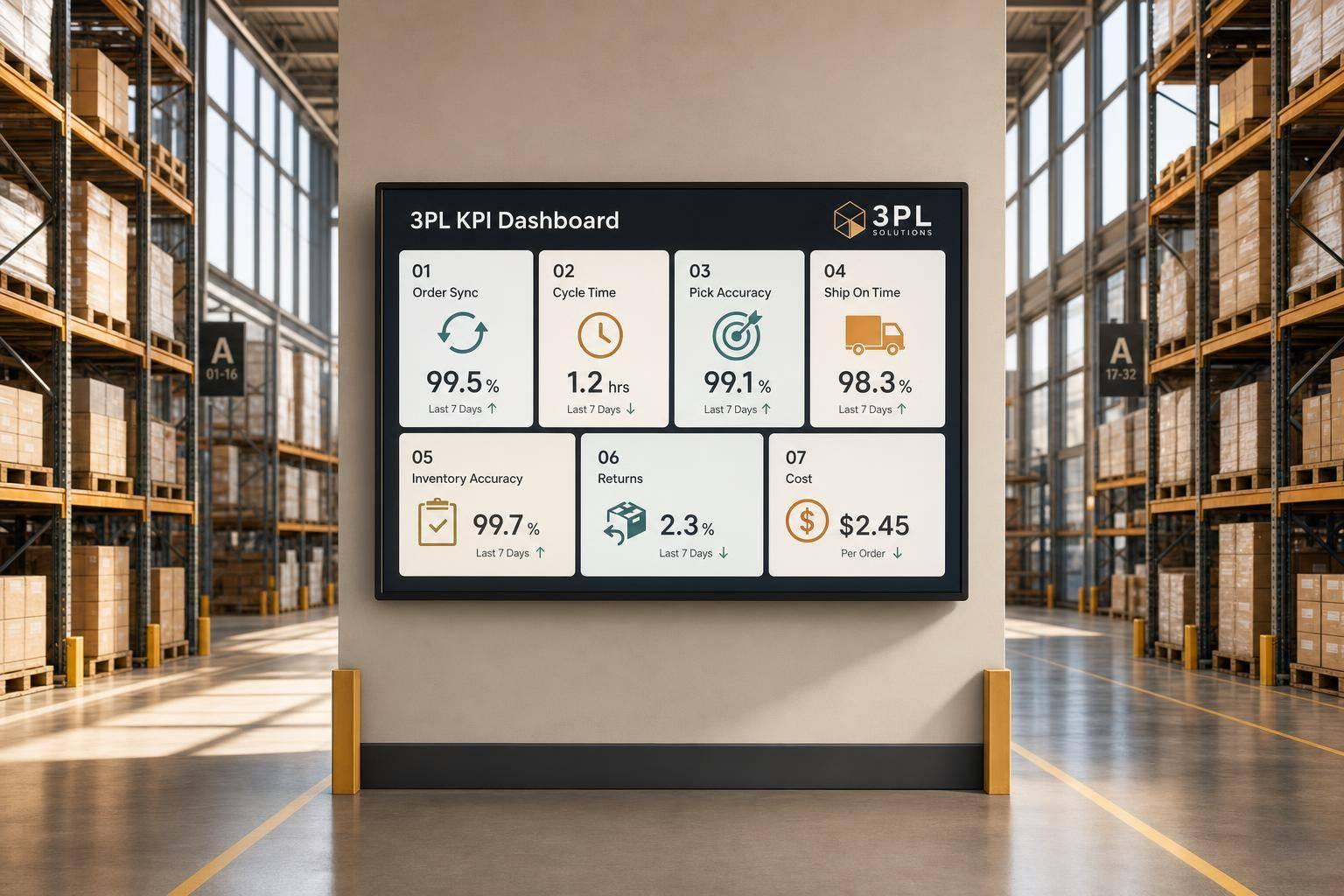
7 WooCommerce 3PL KPIs Teams Track

Centralized vs Decentralized Replenishment
