
How to Blend Automation with Human Labor in Warehouses
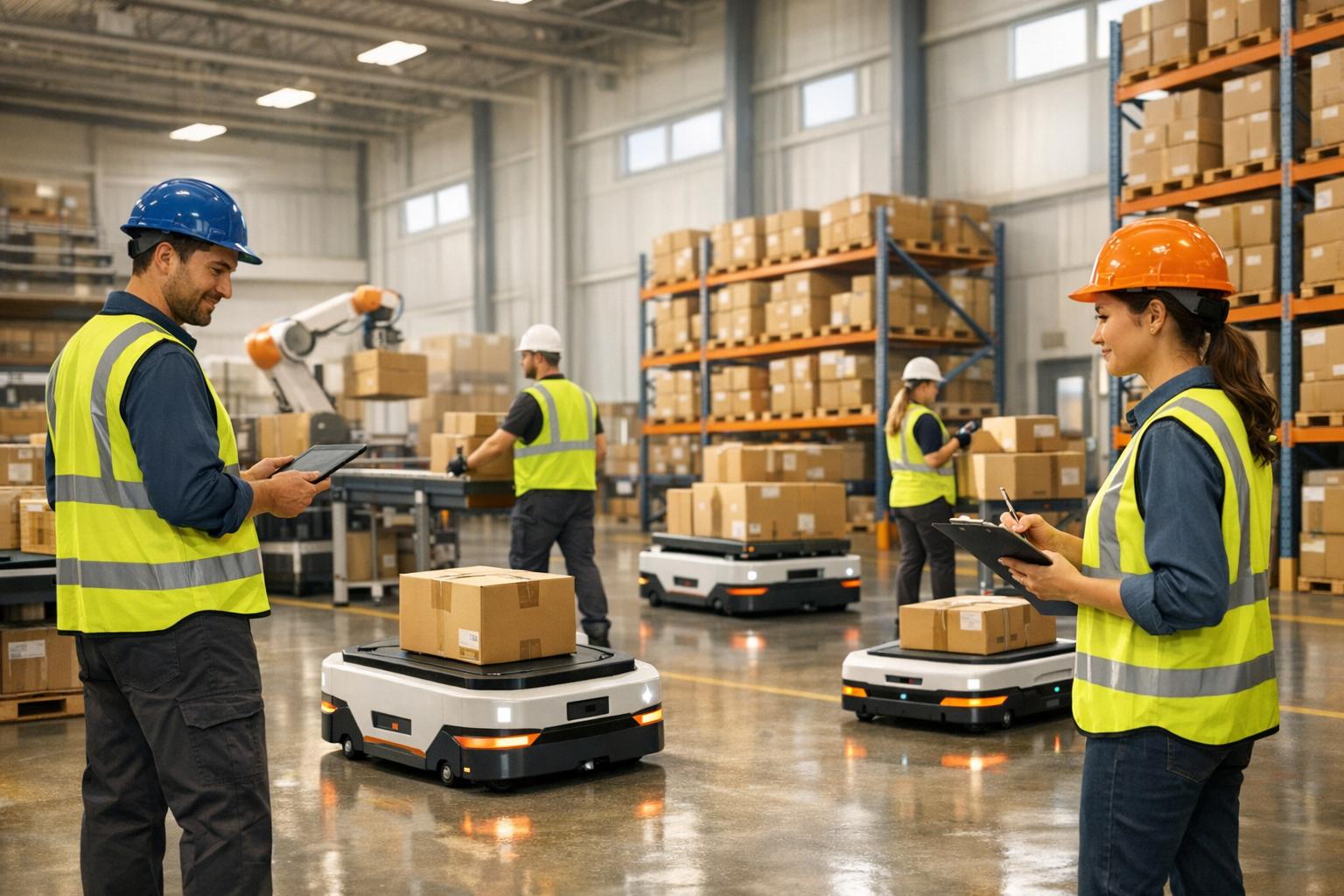
Automation in warehouses is no longer a question of "if", but "how." By combining human skills - like judgment and adaptability - with the speed and precision of robots, warehouses can improve efficiency and address challenges like labor shortages and high turnover. Here's the key takeaway: automation doesn't replace workers; it optimizes their efforts.
Key Points:
- Why it Matters: The U.S. faces a projected shortage of 400,000 warehouse workers by 2028, while turnover rates hover around 49%. E-commerce growth demands faster, more efficient operations.
- What Robots Do Best: Repetitive, physically taxing tasks like picking, packing, and transporting goods.
- What Humans Do Best: Quality control, problem-solving, and managing exceptions.
- Benefits: Automation can cut labor costs by 20–50% and improve working conditions by reducing physical strain.
- Steps to Start:
- Map workflows to identify bottlenecks.
- Automate repetitive tasks first (e.g., inventory tracking, heavy lifting).
- Train workers to collaborate with robots and manage automated systems.
Quick Tip:
Start small. Focus on simple, high-impact automation projects and scale gradually. For example, use Autonomous Mobile Robots (AMRs) for transport or automated storage systems to reduce travel time within warehouses.
This article outlines practical steps to evaluate operations, select the right technologies, and train workers for a hybrid workforce. The goal? A balanced system where humans and robots work together for better results.
Warehouse Orchestration: The Human & The Robot, Working Together in the Next-Generation Warehouse
sbb-itb-eafa320
Evaluating Your Current Warehouse Operations
Start by mapping out your current workflows, from receiving goods to shipping them out. Pay close attention to where things run smoothly and where delays or errors tend to occur. Track metrics like cycle times, picking error rates, and order processing speeds to identify bottlenecks. For instance, if your manual picking system struggles during peak hours or inventory discrepancies keep cropping up, these are clear signs that automation could help. This kind of analysis highlights areas where processes can be streamlined.
Dive deeper into your order profiles. Look at details like order volume, SKU variability, handling units, and picking methods. This information will help you determine which technologies align with your specific needs. Also, evaluate your facility's physical layout - can it support systems like automated storage and retrieval systems (AS/RS) or autonomous mobile robots (AMRs)? Check if your Warehouse Management System (WMS) is capable of integrating with robotic systems in real time. Many businesses find that taking these steps leads to a return on investment in as little as 18 months.
Finding Tasks That Can Be Automated
Focus on repetitive tasks that consume time and energy. Manual data entry, as well as continuous picking, packing, and shipping, are prime examples of resource-draining activities. Tasks that involve heavy lifting, repetitive motions, or long-distance walking (like picker-to-part systems) should be prioritized for automation. Automating these tasks not only boosts efficiency but also reduces worker fatigue and the risk of injuries. If inventory tracking or order fulfillment processes are prone to high error rates, consider solutions like real-time tracking systems to address these issues. As Prime Robotics puts it:
Automation isn't about replacing workers, it's about optimizing worker efforts.
By automating repetitive tasks, you free up your workforce to focus on roles that require judgment and specialized skills.
Understanding Where Human Workers Excel
After identifying tasks suitable for automation, it’s important to recognize where human workers are indispensable. Complex processes, such as quality control and exception management, still benefit greatly from human involvement. Humans excel in tasks requiring critical thinking, creative problem-solving, and nuanced decision-making. For example, quality control often involves verifying product conditions, managing returns, and handling unique workflows like specialized kitting - areas where human judgment is invaluable.
Additionally, humans are better at adapting to unexpected scenarios and interpreting complex data. They’re crucial for tasks like strategic planning, managing exceptions, and overseeing automated systems. Skilled workers also play a key role in maintaining and troubleshooting automated equipment. Even as automation becomes more widespread, having a capable team to deploy and manage these systems remains essential. The goal is to assign the right resource - whether it's a machine or a person - to the task that suits it best, ensuring an efficient and balanced operation.
Choosing the Right Automation Technology

AGVs vs AMRs: Choosing the Right Warehouse Automation Technology
When selecting automation technology, focus on solving specific operational issues rather than chasing the latest trends. Pinpoint inefficiencies - like picking accuracy, order cycle time, or labor dependency - and evaluate your needs through the lens of "people, process, and technology". As the Connors Group aptly notes:
Automation adoption does not guarantee performance success, as exemplified by the numerous automation projects that failed to meet business objectives.
Opt for systems with modular scalability to adapt as your operation grows. This adaptability is especially critical since labor accounts for 55–70% of costs, with picking and packing alone making up 55–60% of labor expenses. Aligning technology with your specific needs also streamlines worker training and helps redefine roles effectively.
Ensure your chosen tools integrate seamlessly with existing software to avoid creating isolated systems. Look beyond the initial price tag - factor in installation, IT support, training, maintenance, and whether Robots-as-a-Service (RaaS) could lower upfront costs. With 73% of warehouse operators struggling to find enough workers and annual turnover exceeding 30%, the right technology can address both efficiency and workforce stability challenges.
Common Warehouse Automation Systems
Autonomous Mobile Robots (AMRs) are equipped with sensors, cameras, and mapping technology, enabling them to navigate your warehouse independently. They can dynamically reroute around obstacles or people, making them ideal for environments where humans and machines work together. These robots are particularly effective for transporting goods, assisting with order picking, and cutting down the time workers spend walking - an activity that can consume up to 60% of their shifts in traditional setups.
Automated Storage and Retrieval Systems (AS/RS) are designed for high-density storage and retrieval. Using a "goods-to-person" approach, they deliver products directly to workers, significantly reducing travel time. Pick-to-light systems further enhance efficiency with digital displays and light indicators that guide workers to the right items and quantities, minimizing errors and shortening training time. These systems are especially useful for operations with a wide range of SKUs where human oversight is still needed for quality checks.
If you're looking for a low-risk entry point into automation, consider end-of-line systems like packaging, labeling, and palletizing. These tasks are high-volume and repetitive, allowing you to improve efficiency without overhauling your core picking workflows. Focus on automating tasks that fall under the "4 Ds" framework: Dull (repetitive), Dirty (hazardous), Dangerous (high injury risk), or Dear (labor-intensive and costly). This targeted approach ensures you're addressing your biggest operational challenges while keeping humans focused on more complex decision-making.
AMRs vs. AGVs: Which Works Better with Human Workers
Choosing between AMRs and AGVs depends on your facility's layout and the level of flexibility you require. Automated Guided Vehicles (AGVs) follow fixed paths using magnets, wires, or floor markers. These are best for repetitive tasks like moving heavy loads along predetermined routes or replenishing assembly lines. However, they stop when encountering obstacles and require significant effort to reconfigure if your layout changes.
Autonomous Mobile Robots (AMRs), on the other hand, offer far greater flexibility. They use LiDAR, sensors, and AI to navigate without fixed infrastructure. This makes them ideal for dynamic environments where layouts may change frequently or where robots need to work closely with human associates. AMRs come equipped with safety features to detect and avoid obstacles, enabling seamless collaboration with workers.
| Feature | Automated Guided Vehicles (AGVs) | Autonomous Mobile Robots (AMRs) |
|---|---|---|
| Navigation | Fixed paths via wires, magnets, or floor markers | Autonomous using LiDAR, cameras, and sensors |
| Adaptability | Requires fixed paths and significant reconfiguration when obstacles appear | Dynamically reroutes around obstacles |
| Setup Requirements | High infrastructure needs; often require facility modifications | Low infrastructure requirements; quick to deploy in existing layouts |
| Human Collaboration | Limited; typically operate in segregated zones for safety | High; designed to work safely alongside human associates |
| Cost Structure | Higher initial investment due to physical infrastructure | Often available via RaaS; lower upfront infrastructure cost |
| Best Use Case | Heavy loads, fixed repetitive transport in stable layouts | Picking, sorting, dynamic fulfillment in changing environments |
Use AGVs for stable, repetitive workflows and AMRs for environments requiring flexibility and adaptability. This choice directly impacts how you prepare your workforce for human–robot collaboration, which is the next critical step in your automation journey.
Adding Automation in Stages
Taking a phased approach to automation can help businesses reduce risks, manage costs, and start generating revenue sooner. For small and medium-sized businesses, this strategy often results in 20% to 30% higher ROI compared to full-scale automation rollouts. The reason? It allows companies to learn from early feedback and adjust without committing to large-scale changes right away.
The process typically follows three steps: assess and prioritize, implement and optimize, and finally, scale and sustain. This method ensures your warehouse stays operational throughout the transition. Start by analyzing hard data - order volumes, labor hours, and error rates - to pinpoint problem areas. Then, focus on "low-hanging fruit", or simple, high-impact fixes that don’t require major infrastructure changes. The idea is to refine your current processes before introducing robots.
One essential rule: don’t automate broken workflows. Fix inefficiencies first. Once your manual operations are running smoothly, you can layer in automation to handle repetitive tasks. Use software to ensure seamless coordination between human workers and machines.
Stage 1: Improving Current Human Workflows
The first step is to fine-tune your manual processes. This includes improving route planning, task assignments, and traffic control. Small changes can make a big difference.
For example, upgrading to RFID or barcode systems can enhance data accuracy and provide real-time visibility into inventory levels and locations. Outdoor gear retailer PeakPulse adopted RFID tracking in 2024 and saw a 30% reduction in stock discrepancies within just three months. Clean, reliable data is a critical foundation for future automation efforts.
Standardizing equipment and workflows is another key step. Use consistent tools - like plastic pallets with RFID chips - so automated systems can easily read and process data without interruptions. Also, identify small manual tasks that automation might overlook, such as smoothing out wrinkled labels. Address these issues through process tweaks or AI vision systems before robots are introduced.
Set clear investment triggers to decide when to move to the next stage. For instance, you could advance once throughput increases by 20%. This ensures your automation efforts align with actual growth rather than assumptions. Once human workflows are optimized and your data is reliable, you’re ready to integrate robotic assistance.
Stage 2: Bringing in Robots to Work with Humans
With manual processes running efficiently, you can begin introducing robots for routine tasks like packaging, labeling, and palletizing. Food supplier FreshFlow used this approach, starting with a put-to-light sorting wall that doubled their order throughput capacity. In the next phase, they added Autonomous Mobile Robots (AMRs), which cut transport time in half during picking operations. This gradual rollout also helps workers adapt to the changes.
To coordinate human and robotic efforts, implement System-Directed Labor (SDL) software. SDL assigns tasks dynamically based on location and immediate needs, reducing downtime and increasing productivity. Robots can handle repetitive tasks like transport and retrieval, while humans focus on quality control, handling exceptions, and making decisions.
Before scaling up, pilot new automation in a controlled environment. Test various SKU types and throughput scenarios under real-world conditions to uncover any integration issues. Involve your frontline workers in creating standard operating procedures (SOPs) and troubleshooting protocols - they often spot challenges engineers might miss. Regular drills and clear escalation paths can prepare your team to handle system failures effectively.
Finally, ensure your new automation integrates smoothly with your existing Warehouse Management System (WMS) and manual packing stations. Avoid creating silos by building a human-in-the-loop ecosystem, where workers guide and complement AI-driven systems rather than compete with them. This collaboration ensures a balanced and efficient operation.
Training Workers for Automation
With robots now working side by side with humans, proper training becomes the key to unlocking their full potential. After streamlining workflows and installing robots, the next step is to ensure your team knows how to operate and troubleshoot these systems effectively. While 77% of organizations are pursuing warehouse automation, relying on technology alone won’t deliver results. Workers need to be equipped with the skills to operate, troubleshoot, and collaborate with automated systems. Companies that invest in structured training programs see a 218% increase in income per employee compared to those without formal training.
The focus of training should be on building digital literacy, safety awareness, and teamwork. Employees need to understand how to interact with robots, resolve common problems, and use warehouse management software to coordinate tasks. Once the basics are covered, advanced sessions can dive deeper into troubleshooting and optimizing workflows. This foundation leads to effective hands-on training, which is essential for fostering smooth human-robot collaboration.
Teaching Workers to Collaborate with Robots
Modern collaborative robots, or cobots, have simplified the learning curve. Workers no longer need traditional coding skills; instead, they can use lead-through teaching - physically guiding the robot or providing instructions through a tablet interface. This hands-on method not only makes training more approachable but also helps workers see how their actions directly impact the robot’s performance.
Cross-training, where workers switch roles with robots, is another effective strategy. This practice increases concurrent motion by 71% and reduces waiting time by 41%. By stepping into the robot’s role, employees can better anticipate the machine’s next move and adjust their own actions for smoother collaboration. As MIT Assistant Professor Julie Shah points out:
"People aren't robots, they don't do things the same way every single time. And so there is a mismatch between the way we program robots to perform tasks in exactly the same way each time and what we need them to do if they are going to work in concert with people."
It’s also vital to train workers on OSHA protocols, such as lockout/tagout procedures, proper use of personal protective equipment (PPE), and resolving workstation blockages. To reinforce these practices, provide laminated guides or digital videos at workstations, and schedule refresher training whenever new equipment is introduced. Designating team champions - employees who act as go-to resources - can further smooth the transition to automation.
Training on Warehouse Management Systems (WMS)
Beyond learning to work alongside robots, employees must master the warehouse’s digital infrastructure. Training on the Warehouse Management System (WMS) is just as important as robot training. A well-designed WMS simplifies tasks by offering step-by-step instructions for picking, packing, and routing, reducing cognitive strain on workers. Following these system-optimized workflows helps minimize errors and fatigue.
Training should cover key areas like real-time data tracking, inventory management, and task coordination. Workers need to understand how the WMS integrates with automated picking systems and why accurate data entry is crucial for seamless operations. When employees grasp how clean data drives efficient inbound and outbound workflows, it strengthens the overall system.
Virtual reality (VR) training is also gaining traction as a tool for WMS education. VR provides a safe, simulated environment for workers to practice using software and interacting with robots without disrupting live operations. This approach helps build trust in the technology - an essential factor for successful human-machine collaboration. As Professor Alexander Hübner from the Technical University of Munich explains:
"It's imperative to understand and account for workers' human factors in operational activities to establish efficient automated and robotized warehouse systems."
Finally, establish feedback loops where employees can share best practices and highlight friction points. This continuous feedback helps refine processes over time. Considering that replacing a single warehouse employee costs between $3,500 and $5,000 when factoring in recruitment and training, investing in ongoing coaching and support is a smart move. Companies with highly engaged employees report 43% lower turnover rates and 23% higher profitability. Comprehensive training ensures that your workforce is prepared to thrive in an automated environment, creating a balanced and efficient operation.
Adjusting Job Roles and Tracking Performance
After training, it’s time to rethink job roles and redefine how performance is measured. As automation becomes more widespread, human roles will shift toward tasks that require judgment, creativity, and problem-solving. At the same time, performance evaluation will focus less on individual speed and more on how effectively humans and robots collaborate as a team. With 80% of warehouses projected to adopt some form of automation by 2028, adapting to these changes is essential to remain competitive. This evolution builds on earlier training efforts, ensuring each role plays to its strengths.
Redesigning Jobs
The aim here is straightforward: move workers away from repetitive, physically demanding tasks - like walking miles to pick items - and into roles that make the most of human abilities. Humans excel at handling exceptions, such as resolving equipment issues, managing unique customer requests, or inspecting returns that require special attention. Meanwhile, robots can take on hazardous or monotonous tasks that don’t need human decision-making.
Using an AI-driven framework is key to reshaping these roles. This approach ensures that human skills and robot capabilities are aligned effectively. McKinsey & Company highlights the importance of this shift:
Automation needs highly skilled teams to deploy, run, and maintain advanced systems. For employees who do repetitive tasks, automation helps to redesign positions and provide faster ramp-up opportunities.
Start by mapping out current roles and comparing them to future needs, such as managing robot fleets or analyzing data. This will help identify skill gaps that require targeted training. This focused strategy reinforces the collaboration between workers and robots that was developed during training.
To keep things organized, create a control tower that includes teams from finance, operations, IT, and HR. This centralized group ensures that role redesign aligns with business objectives and helps everyone understand the impact of automation on their teams. A "pilot-then-scale" approach works well here, with clear benchmarks to determine when to expand investments based on business needs.
Using Labor Management Software (LMS) to Monitor Work
As roles evolve, tracking their effectiveness becomes a priority. Labor Management Software (LMS) offers a clear way to monitor how well humans and robots are working together. Interlake Mecalux explains:
Labor Management System (LMS) objectively measures your warehouse productivity and detects improvement opportunities... The software records the optimal time to carry out each task and compares it with actual performance.
Instead of focusing solely on speed, the emphasis shifts to throughput capacity - the total volume processed by human-robot teams. This provides a more accurate measure of overall efficiency.
Modern LMS platforms bring real-time visibility through web-based dashboards accessible via smartphones and tablets. Supervisors can track tasks and performance as they happen, rather than waiting for end-of-week reports. These systems also uncover inefficiencies that traditional time clocks miss, such as delays caused by waiting for pick tickets or completing safety checks. With tools for multi-department tracking, supervisors can adjust workflows on the fly and allocate resources more effectively. Plus, integration with existing devices like RF scanners and wireless networks minimizes downtime.
It’s also important that your LMS can handle non-standard workflows, like verifying returns or managing kitting for e-commerce orders. As warehouses move from static metrics like rent per square foot to dynamic ones like productivity per unit of throughput, LMS becomes a critical tool for showing value. With an estimated 40% of warehouse worker skills set to change or become obsolete between 2025 and 2030, having clear performance data helps identify who needs additional support and who’s ready to take on more advanced responsibilities.
Conclusion
A hybrid workforce combines the flexibility of human workers with the precision of robots to address challenges like labor shortages and repetitive strain. This approach not only helps resolve pressing labor issues but also improves worker well-being by minimizing physical strain and repetitive stress injuries.
By letting robots handle repetitive tasks, operations become more efficient, freeing workers to focus on quality control and managing exceptions. Tools like autonomous mobile robots (AMRs) also provide the flexibility to scale operations during peak seasons without the need for expensive reconfigurations.
Regular evaluations are key to ensuring that automation efforts remain effective and adapt to changing demands. As Alan Davies, Associate Partner at McKinsey, explains:
Automation needs highly skilled teams to deploy, run, and maintain advanced systems.
This highlights the importance of ongoing monitoring through labor management systems, safety audits, and adjustments to job roles as technology evolves.
The benefits of automation are clear. The warehouse automation market is expanding at a rate of over 10% annually, with many companies achieving ROI within 12 to 24 months. Success depends on maintaining system interoperability and ensuring accurate data as operations grow. With nearly 40% of warehouse worker skills expected to shift between 2025 and 2030, continuous training and updates to technology are critical.
The key to successful integration lies in blending technology with workforce development. By setting clear investment priorities, fostering collaboration across teams, and focusing on real-time monitoring, warehouses can create operations that adapt and thrive in the face of future demands.
FAQs
How can warehouses transition to automation without impacting employee morale?
To make the shift to automation as seamless as possible while keeping morale high, start with employee training that integrates them into the new processes. Cross-training can help workers understand how human tasks and robotic workflows align, encouraging teamwork and minimizing resistance. By offering clear instruction on programming, monitoring, and troubleshooting the new equipment, you can turn automation into an opportunity for skill development rather than a perceived threat.
Open and honest communication is critical. Bring employees into the conversation early, explaining the benefits - like safer working conditions and potential career growth - and introduce automation gradually to showcase quick successes. Recognize employees who embrace the changes, provide opportunities for upskilling, and establish open forums for feedback to maintain trust and confidence.
JIT Transportation, with its expertise in services like pick-and-pack, kitting, and white-glove handling, can assist warehouses in harmonizing automation with human capabilities. By prioritizing continuous learning and celebrating milestones, warehouses can modernize efficiently while keeping their workforce engaged and motivated.
What’s the difference between Autonomous Mobile Robots (AMRs) and Automated Guided Vehicles (AGVs) in warehouses?
AMRs (Autonomous Mobile Robots) and AGVs (Automated Guided Vehicles) are both designed to transport goods within warehouses, but the way they navigate and function sets them apart. AGVs rely on fixed paths, guided by physical elements like wires, magnetic strips, or floor-mounted sensors. If the warehouse layout changes, these guiding systems need to be updated, which makes AGVs best suited for repetitive tasks on static routes.
On the other hand, AMRs leverage advanced sensors and mapping software to navigate dynamically. They can adjust to layout changes, avoid obstacles, and take on new tasks without requiring physical modifications to the facility. This flexibility allows AMRs to integrate seamlessly into existing warehouses and collaborate with human workers on tasks like picking and placing items. For operations that demand adaptability and teamwork, AMRs are often the better choice.
How can companies train employees to work effectively with warehouse robots?
To make collaboration between humans and robots as smooth as possible, companies need to prioritize structured training programs that emphasize both understanding and teamwork. A great starting point is cross-training, where employees get familiar with how robots function and how their own actions influence the automated system. This approach not only fosters understanding but also bridges the gap between human adaptability and robotic precision.
Training should also cover essential topics like robot safety, basic logic, and operational principles. Incorporating hands-on techniques, such as teaching employees to program robots through demonstration, makes the learning process more engaging and practical. Regular feedback sessions are another key element, allowing both workers and robots to refine their processes and improve collaboration over time.
For logistics companies like JIT Transportation, combining these training strategies with continuous upskilling ensures that tasks like pick-and-pack, kitting, and assembly are carried out with greater efficiency and flexibility. This approach helps build a workforce that's not only resilient but also highly efficient.
Related Blog Posts
Related Articles
7 WooCommerce 3PL KPIs Teams Track

Centralized vs Decentralized Replenishment
