
10 Common Supply Chain Risks and How 3PLs Solve Them
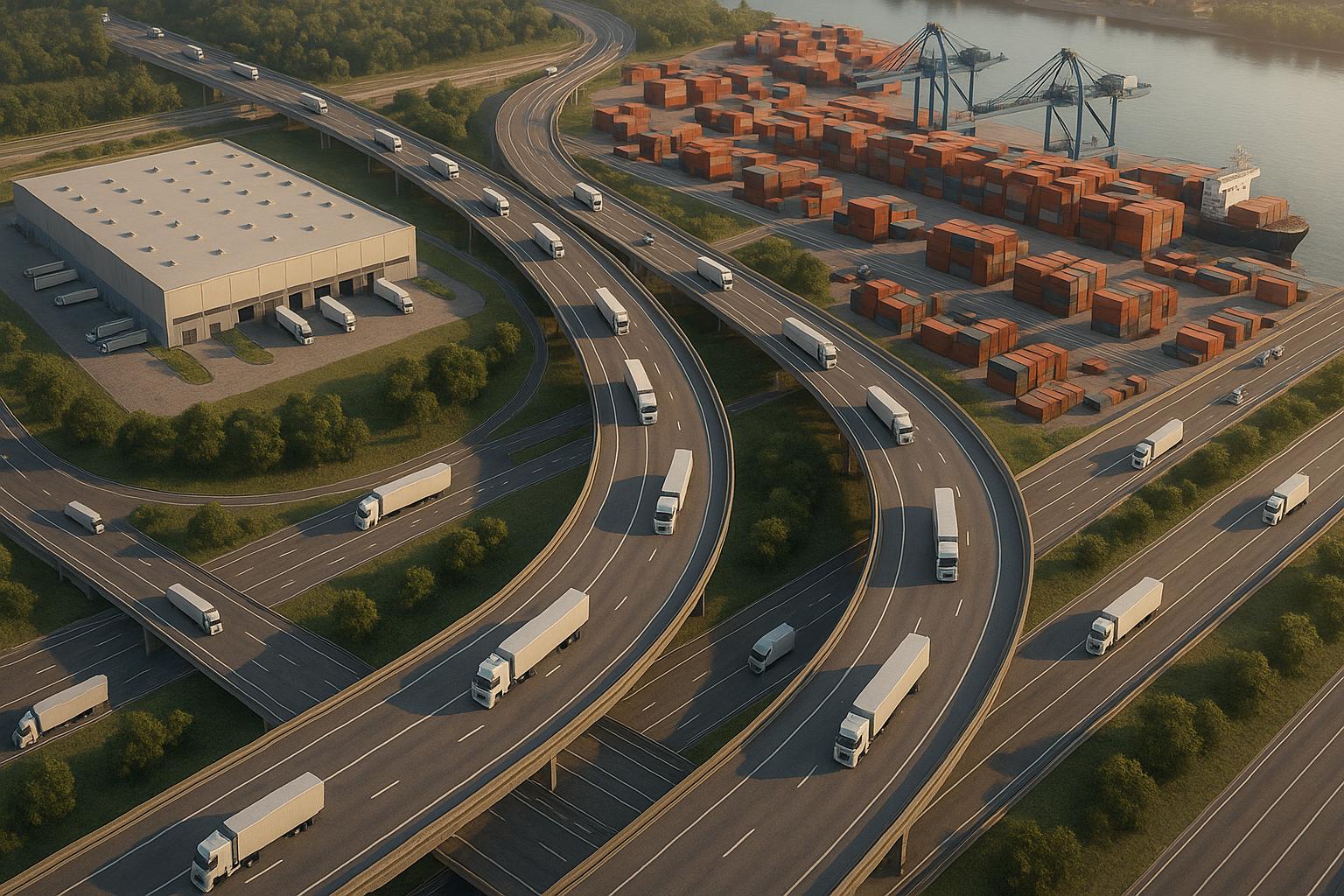
Supply chain risks are a major challenge for businesses, with issues like transportation delays, inventory mismanagement, and cybersecurity threats causing significant losses. In 2024, 80% of companies faced disruptions, while only 8% felt equipped to manage them. Third-party logistics providers (3PLs) offer solutions by using advanced technology, diverse carrier networks, and flexible warehousing to minimize risks and keep operations steady.
Key Supply Chain Risks and 3PL Solutions:
- Transportation Delays: Multi-carrier networks and real-time tracking reroute shipments around disruptions.
- Inventory Issues: Warehouse management systems optimize stock levels and reduce stockouts.
- Supplier Disruptions: Buffer stock programs and dual-sourcing logistics prevent production halts.
- Cybersecurity Threats: Encryption and anomaly detection safeguard data.
- Warehouse Errors: Technology like barcode scanning ensures accuracy in picking and packing.
- Peak Season Constraints: Flexible labor models and shared facilities handle demand surges.
- Returns Management: Centralized systems streamline reverse logistics.
3PL providers like JIT Transportation combine technology, nationwide networks, and tailored logistics to address these challenges, ensuring smoother operations and better outcomes for businesses.
Supply Chain Risk Management Process: 7 Key Factors & Major Risks | AIMS Education
How 3PLs Reduce Supply Chain Risks
Third-party logistics providers (3PLs) play a critical role in keeping supply chains running smoothly, even during disruptions. By leveraging extensive transportation networks, advanced technology, and adaptable warehousing, they help businesses navigate challenges and minimize risks. Let’s take a closer look at how these capabilities work.
Transportation Networks and Carrier Management
3PLs operate with diverse carrier networks and multiple transport modes across the United States, offering flexibility when issues arise. If a carrier fails or a route is blocked, they can pivot by rerouting shipments through alternative carriers or switching from truckload to intermodal options. For example, during congested port situations, they might opt to use inland terminals instead.
Real-time route optimization tools further enhance this flexibility. These tools analyze factors like traffic, weather, and geopolitical risks to adjust shipping paths dynamically. A great example occurred in 2025 when disputes in the South China Sea threatened ocean freight routes. By rerouting shipments, 3PLs managed to reduce logistics delays by up to 30% for affected deliveries.
Curtis Martin, Senior Operations Manager at Synnex, highlighted this adaptability: "JIT sets the bar high in logistics. Their on-time performance, ability to handle last-minute requests, and expertise in material handling are game-changers for us."
Technology and Real-Time Tracking
3PLs integrate advanced systems like Transportation Management Systems (TMS), Warehouse Management Systems (WMS), and Enterprise Resource Planning (ERP) platforms to create seamless, end-to-end visibility. This integration allows businesses to spot and address issues before they escalate. Tools such as GPS tracking, IoT sensors, and AI-driven analytics provide live updates on shipments, alerting teams to problems like temperature fluctuations in perishables or unexpected delays at border crossings. In fact, recent surveys show that such real-time monitoring has helped reduce operational risks by 25%.
Predictive analytics also play a big role. By analyzing historical data, 3PLs can identify vulnerabilities early. For instance, in 2025, predictive models flagged risks in sub-tier electronics suppliers, enabling 3PLs to adjust carriers in advance and prevent 80% of potential delays. As cyber threats continue to rise - supply chain attacks surged 431% between 2021 and 2023, and Gartner estimates that 45% of organizations will face such attacks by 2025 - 3PLs are stepping up with automated compliance checks and anomaly detection systems to safeguard data and maintain operations.
Flexible Warehousing and Multi-Location Distribution
Flexible warehousing is another key strength of 3PLs. By offering scalable storage and adaptable labor pools, they enable businesses to handle demand surges without the burden of fixed infrastructure costs. For example, during the 2024 holiday season, 3PLs helped 70% of their clients avoid stockouts by reallocating space across multiple facilities as needed. JIT Transportation exemplifies this strategy with strategically placed warehouses across the U.S., ensuring quick fulfillment wherever demand arises.
Geographic diversification also enhances resilience. Multi-location distribution ensures that regional disruptions don’t bring operations to a halt. When the 2024 Valencia floods disrupted operations, 3PLs quickly shifted fulfillment to unaffected locations, maintaining delivery schedules and cutting recovery time by 50%. This approach not only reduces last-mile distances but also insulates businesses from localized disasters.
Hal Shapiro of Seagate Technology summed it up well: "JIT has been a trusted logistics partner for Seagate for years, and their reliability is unmatched. Day in and day out, they prove their commitment to seamless operations, ensuring our supply chain stays on track."
10 Common Supply Chain Risks and 3PL Solutions
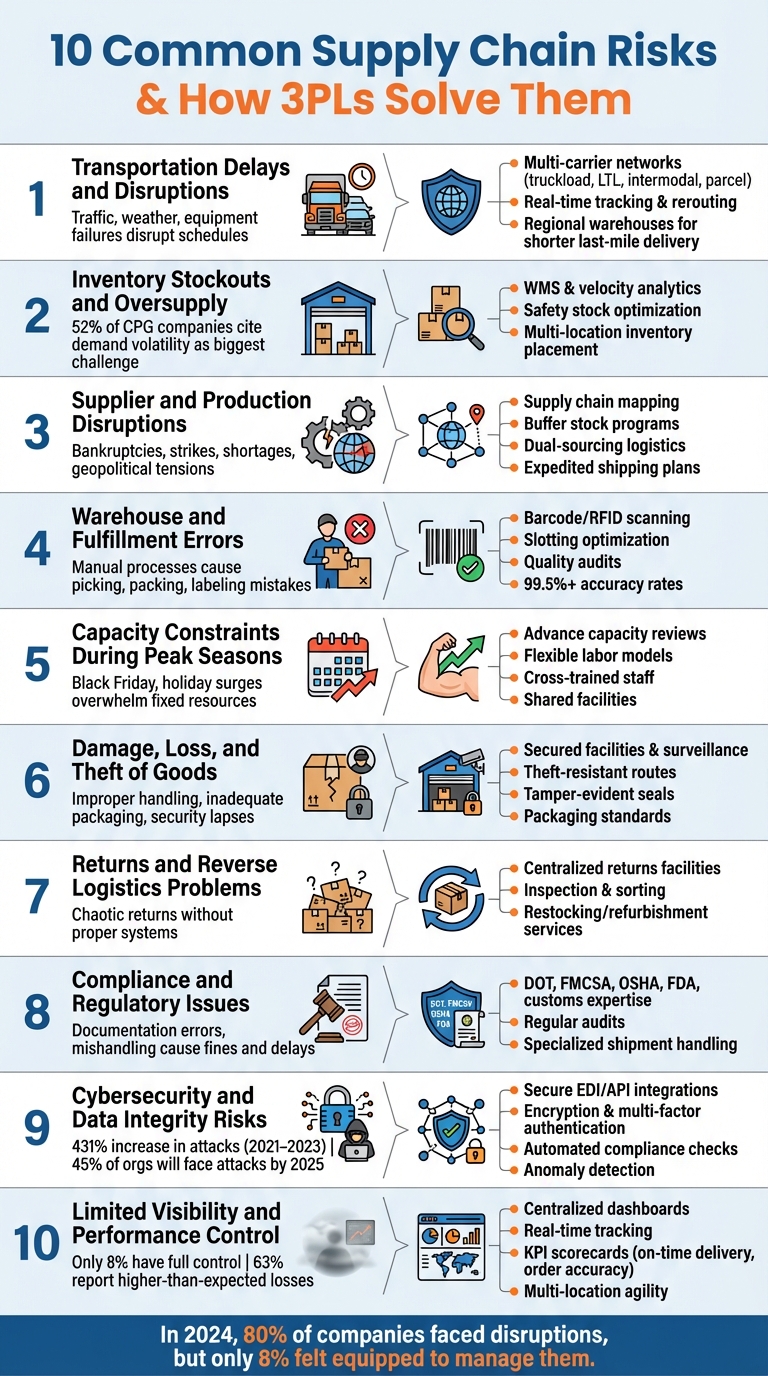
10 Supply Chain Risks and 3PL Solutions Infographic
Third-party logistics providers (3PLs) have developed effective strategies to address the most common supply chain risks. Here’s a breakdown of ten key risks and how 3PLs tackle them.
1. Transportation Delays and Disruptions
Delivery delays caused by traffic jams, severe weather, or equipment failures can wreak havoc on schedules. To address this, 3PLs rely on multi-carrier networks that can quickly switch between truckload, LTL, intermodal, and parcel options. Real-time tracking through transportation management systems allows them to reroute shipments around disruptions. Additionally, regional warehouses near high-demand areas shorten last-mile delivery distances, minimizing the impact of long-haul delays.
2. Inventory Stockouts and Oversupply
Fluctuating demand and long lead times often lead to either running out of stock or overstocking. For example, 52% of consumer packaged goods companies identify demand volatility as their biggest challenge. 3PLs combat this by using warehouse management systems and velocity analytics to monitor product movement and optimize safety stock levels. Strategically placing inventory in multiple fulfillment centers across the U.S. ensures products are closer to customers, reducing the need for excessive stock at any one location.
3. Supplier and Production Disruptions
Issues like supplier bankruptcies, labor strikes, material shortages, and geopolitical tensions can bring production to a standstill. To mitigate these risks, 3PLs map out inbound supply chains to identify weak points, establish buffer stock programs for critical items, and coordinate dual-sourcing logistics. They also create expedited shipping plans, such as pre-arranged airfreight or hot-shot trucking, to prioritize delivery once production resumes.
4. Warehouse and Fulfillment Errors
Mistakes in picking, packing, labeling, or shipping often stem from manual processes or poor warehouse organization. 3PLs address this with advanced warehouse management systems that use barcode scanning or RFID for accuracy at every stage - from receiving to shipping. Slotting optimization and quality checks, such as random audits or weight verification, further improve accuracy, often boosting fulfillment rates from around 97–98% to 99.5% or higher.
5. Capacity Constraints During Peak Seasons
Seasonal spikes in demand, like those during Black Friday or back-to-school shopping, can overwhelm fixed labor and space resources. To prepare, 3PLs conduct capacity reviews months in advance and use flexible labor models, cross-trained staff, and temporary workers to scale operations quickly. Shared facilities allow for dynamic storage allocation, helping to handle these seasonal surges more effectively.
6. Damage, Loss, and Theft of Goods
Goods can be damaged, lost, or stolen due to improper handling, inadequate packaging, or security lapses. 3PLs mitigate these risks with secured facilities, controlled dock access, and surveillance systems. They also design theft-resistant routes, implement packaging standards based on product fragility, and use tamper-evident seals for high-value items. Clear reporting processes ensure any incidents are documented, costs are recovered, and root causes are identified.
7. Returns and Reverse Logistics Problems
Returns can become chaotic without proper systems in place. 3PLs streamline the process by setting up centralized returns facilities where items are inspected and sorted. Products are categorized for restocking, refurbishment, resale, or recycling. Additional services like testing, refurbishment, and repackaging improve recovery rates and enhance the customer experience.
8. Compliance and Regulatory Issues
Failing to meet regulatory requirements - whether due to incorrect documentation, mishandling of goods, or labor violations - can result in fines and delays. 3PLs bring expertise in navigating U.S. regulations, including DOT, FMCSA, OSHA, FDA, and customs requirements. They maintain detailed operating procedures, conduct regular audits, and provide training to ensure compliance. Their ability to handle specialized shipments, like hazardous materials or temperature-sensitive goods, keeps operations running smoothly.
9. Cybersecurity and Data Integrity Risks
As supply chain cyberattacks rise - up 431% between 2021 and 2023 - weak security measures and outdated systems pose serious risks. By 2025, nearly half of organizations are expected to face software supply chain attacks. 3PLs protect against these threats with secure EDI/API integrations, encryption, multi-factor authentication, and regular system backups. Automated compliance checks and anomaly detection systems further safeguard data and ensure operational integrity.
10. Limited Visibility and Performance Control
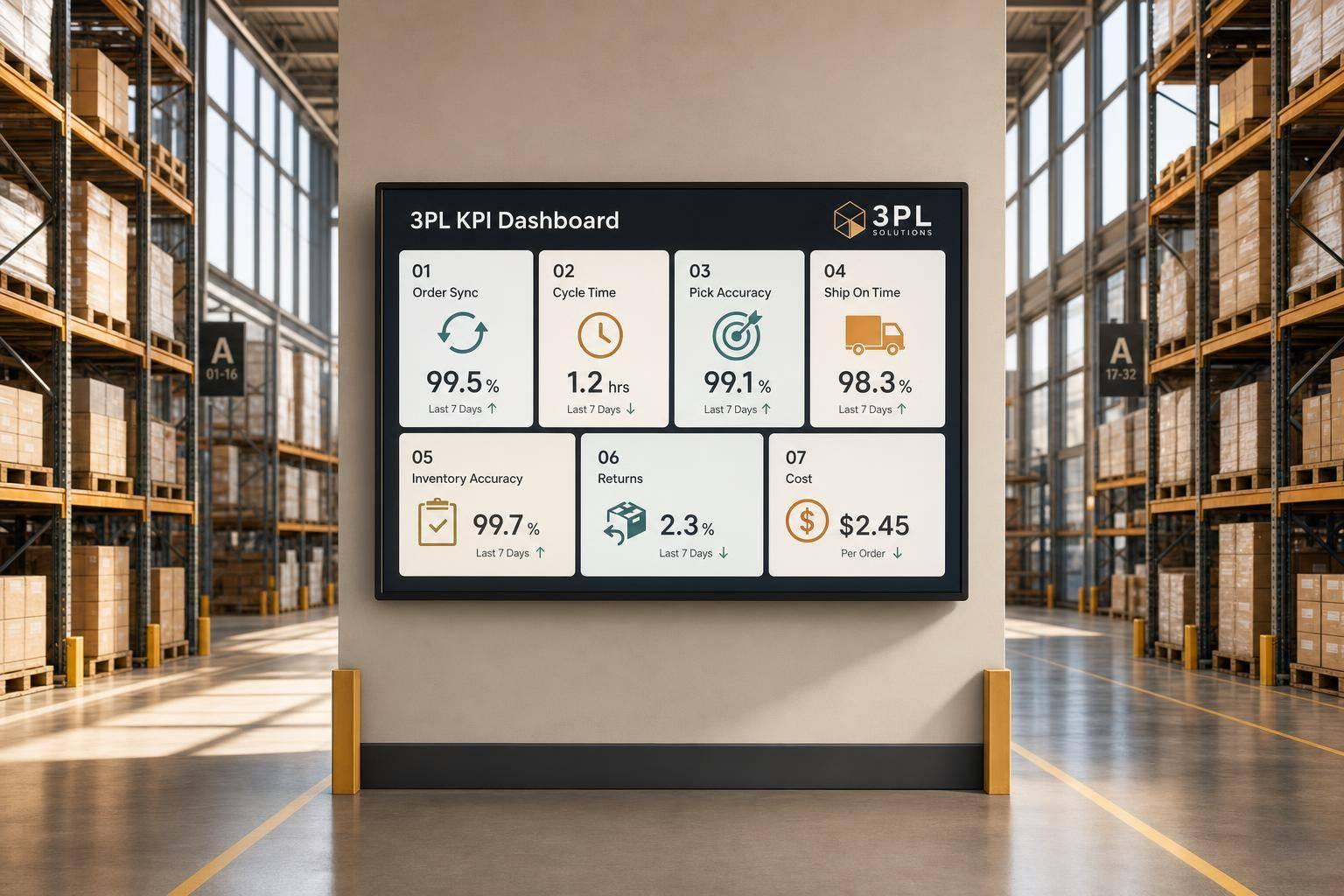
Fragmented systems and disconnected partners make it challenging to track orders, inventory, and shipments. Despite investments, only 8% of businesses feel they have full control over supply chain risks, and 63% report higher-than-expected losses. To address this, 3PLs provide centralized dashboards offering real-time visibility into shipments and inventory. They also deliver KPI scorecards tracking metrics like on-time delivery and order accuracy, enabling quick problem-solving through agile, multi-location strategies.
These methods illustrate how JIT Transportation strengthens supply chain resilience and efficiency.
sbb-itb-eafa320
How JIT Transportation Addresses Supply Chain Risks
JIT Transportation tackles supply chain challenges head-on by combining customized solutions, cutting-edge technology, and a flexible nationwide network. Their approach is all about adapting to the unique needs of businesses while staying agile enough to handle disruptions as they happen. Here’s a closer look at how their strategies help create a resilient and adaptable supply chain.
Custom and Scalable Logistics Services
JIT offers logistics solutions designed to grow alongside businesses, removing the need for expensive investments in permanent infrastructure. Their transportation services - ranging from local delivery to full truckload and white glove handling - are designed with flexibility in mind. For example, they provide alternative routing options to sidestep delays caused by port congestion, severe weather, or equipment issues. On top of that, their value-added services, such as pick & pack, kitting & assembly, and testing, bring essential production capabilities directly into the 3PL model. This approach not only saves time but also helps minimize risks by keeping critical operations under one roof.
Technology-Driven Visibility and Management
JIT leverages advanced technology to close visibility gaps and address cybersecurity risks in modern supply chains. By integrating ERP and warehouse management systems with real-time tracking, they provide businesses with a clear view of shipments and inventory. Their centralized dashboards make proactive decision-making easier, reducing the likelihood of costly errors or security breaches. Robust cybersecurity measures also ensure that operations remain secure in an increasingly digital world. This is especially crucial given that fewer than 8% of businesses feel they have full control over supply chain risks, and 63% report higher-than-expected losses.
Nationwide Network and Flexible Capacity
With strategic locations across the U.S., including cities like San Francisco, Los Angeles, and Memphis, JIT’s nationwide network is built to reduce last-mile delivery times and minimize transportation delays. Their wide-reaching carrier network allows for quick rerouting during disruptions, ensuring deliveries stay on schedule. During peak seasons, JIT’s ability to scale capacity dynamically - without requiring businesses to overexpand their own infrastructure - helps address the inventory and capacity challenges that often arise during surges in demand. This flexibility ensures businesses can meet customer expectations, even in the face of unexpected hurdles.
Conclusion
Supply chains are no strangers to challenges - disruptions can derail operations and drive up costs. Without a clear plan to manage risks, businesses face delayed shipments, unhappy customers, and mounting expenses.
This is where strong third-party logistics (3PL) providers step in. They mitigate risks by leveraging diverse networks, real-time tracking tools, and adaptable warehousing solutions that keep disruptions at bay. By standardizing processes, ensuring compliance, and safeguarding goods and data, 3PLs deliver tangible results: better on-time deliveries, lower inventory costs, fewer handling errors, and smoother operations during peak seasons.
Take JIT Transportation, for example. Their tailored 3PL solutions cover transportation, distribution, and fulfillment, backed by a nationwide network that enables quick rerouting and efficient regional distribution. With cutting-edge technology, they provide the visibility and control that fewer than 8% of businesses currently feel they have over supply chain risks. Services like pick-and-pack, kitting and assembly, and white-glove handling further reduce errors and damage, keeping critical operations under one roof. This approach not only improves efficiency but also strengthens overall business performance.
Choosing the right 3PL partner can mean the difference between chaos and consistency. A reliable provider ensures timely deliveries, accurate tracking, and faster recovery from disruptions - all of which boost customer satisfaction and loyalty.
As Armando Otiz, Manager 3PL/Inventory at Exclusive Networks, puts it:
"In logistics, consistency is everything - and that's exactly what JIT delivers. Their transportation services are dependable, seamless, and backed by a team that truly understands our business needs. Working with JIT has made a tangible difference in our efficiency and customer satisfaction."
Take a moment to assess your supply chain risks - whether in transportation, inventory, compliance, or data security. Evaluate the costs of lost sales, premium freight, and chargebacks. Partnering with a 3PL could help you achieve quick wins in areas like on-time performance and order accuracy, laying the groundwork for broader improvements across your operations.
FAQs
How do 3PL providers leverage technology to minimize supply chain risks?
Third-party logistics (3PL) providers leverage advanced tools to reduce supply chain risks and keep operations running smoothly. With technologies like real-time shipment tracking, predictive analytics, and automation, they can spot potential problems - such as delays or disruptions - before they turn into major headaches.
Take real-time tracking, for instance. It gives 3PLs the ability to monitor shipments at every step, offering visibility and enabling swift route adjustments when needed. Predictive analytics, on the other hand, helps uncover patterns and anticipate risks, allowing businesses to plan ahead. These tools work together to boost efficiency, improve reliability, and provide businesses with the confidence that their supply chains are in good hands.
How does flexible warehousing help businesses handle peak season demand?
Flexible warehousing gives businesses the agility to handle demand surges during busy seasons. With scalable storage options, you can secure the extra space you need for inventory without locking yourself into long-term agreements. This approach helps avoid delays, navigate disruptions, and keep order fulfillment running smoothly when demand peaks.
How do 3PL providers enhance cybersecurity in supply chain management?
Third-party logistics (3PL) providers play a key role in strengthening cybersecurity for supply chain operations. They implement strong data protection measures, like encryption and secure systems, to keep sensitive information safe. On top of that, they rely on state-of-the-art technology to maintain secure communication throughout the supply chain and enforce strict access controls to minimize exposure to cyber threats.
By keeping a close eye on their systems and staying proactive against new risks, 3PL providers help safeguard supply chains from potential breaches and maintain the security of critical data.
Related Blog Posts
Related Articles
7 WooCommerce 3PL KPIs Teams Track

Centralized vs Decentralized Replenishment
