
Freight Rate Negotiation for E-commerce Brands
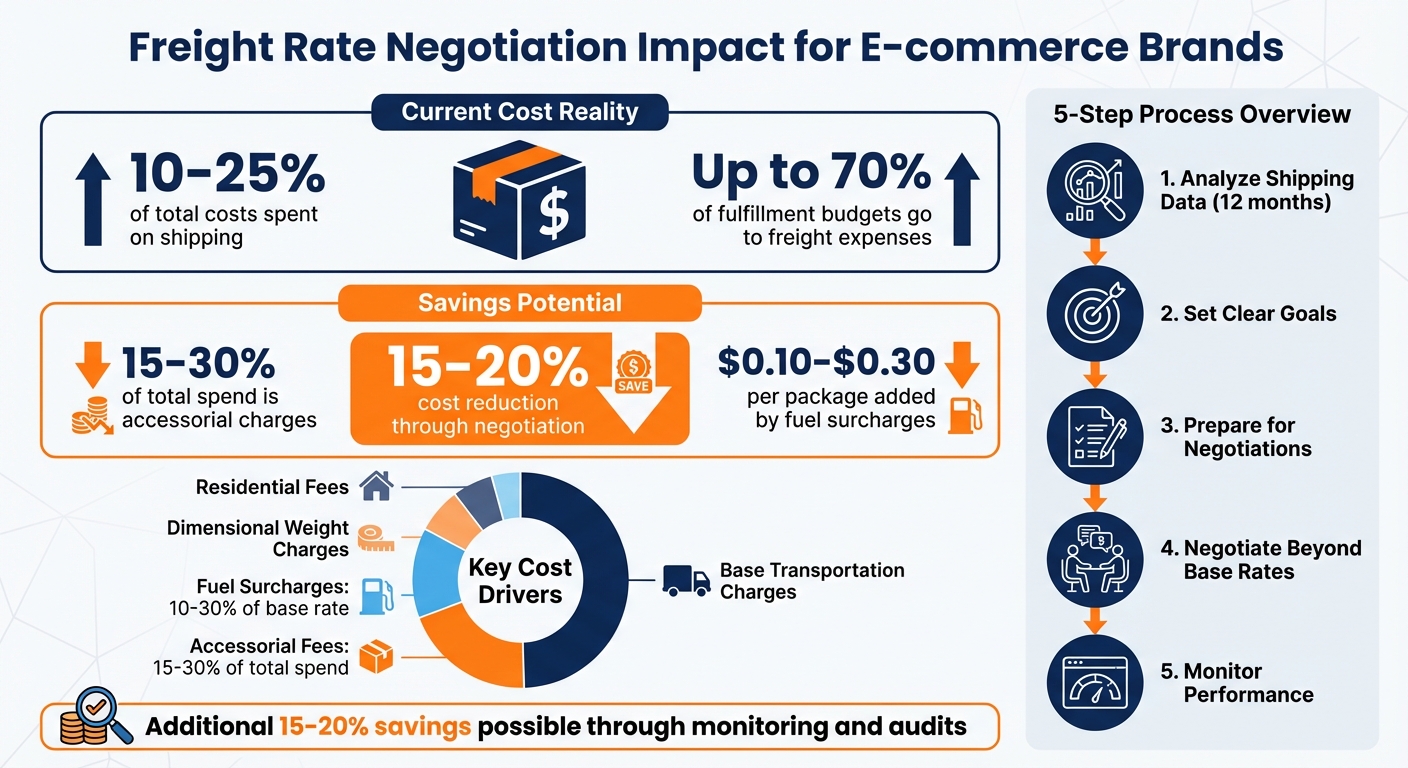
E-commerce brands in the U.S. often spend 10–25% of their total costs on shipping, with freight expenses reaching up to 70% of fulfillment budgets. Negotiating freight rates can cut these costs by 15–20%, improving profitability and ensuring better service during peak seasons. Here's how to do it:
- Analyze Shipping Data: Gather 12 months of shipment records to identify cost drivers like base rates, surcharges, and dimensional weight fees.
- Set Clear Goals: Define measurable objectives, such as reducing costs per order or securing volume-based discounts.
- Prepare for Negotiations: Build a detailed shipper profile, highlight operational strengths, and benchmark rates against industry standards.
- Negotiate Beyond Base Rates: Focus on fuel surcharges, accessorial fees, and service level agreements (SLAs).
- Monitor Performance: Audit invoices, track carrier performance, and review contracts regularly to ensure savings are realized.
For growing brands, partnering with a third-party logistics provider (3PL) like JIT Transportation can simplify the process by leveraging their expertise and pre-negotiated rates. This approach helps businesses control shipping costs while scaling operations effectively.
E-commerce Shipping Costs Breakdown and Negotiation Impact
Cut Shipping Costs by 23% in Just Two Negotiations!
Analyze Your Shipping Profile and Cost Factors
Before diving into negotiations, it’s crucial to understand where your money is going and why. Start by gathering 12 months’ worth of carrier invoices and shipment data. Organize this information in a spreadsheet or business intelligence tool. For each shipment, include key details like the ship date, service level (ground, 2-day, next-day), origin and destination ZIP codes, weight, dimensions, billed weight, delivery type, and any accessorial fees. Arrange the data so each shipment has its own row, with separate columns for every cost component. This setup allows you to break down and analyze costs by lane, service level, and package profile. This detailed data will serve as the foundation for your negotiation strategy.
Review Your Shipment Data
Once your data is organized, it’s time to dig into the numbers. Calculate metrics such as total packages shipped, total spend, average cost per shipment, cost per pound, and both actual and billed average weights. Break down shipment shares by service level and zone. Use pivot tables to pinpoint your top 10 lanes by total spend. Scatter plots can help you visualize weight versus cost, making it easier to spot outliers. This analysis will shine a light on where your budget is being stretched and highlight specific areas to target during negotiations - whether it’s certain zones, service levels, or accessorial charges driving up your costs.
Identify Your Main Cost Factors
Next, rank your total spend by cost category. This includes base transportation charges, fuel surcharges, residential fees, delivery area surcharges, oversize charges, additional handling, address corrections, Saturday delivery, peak surcharges, and returns. Typically, the base rate is the largest expense and serves as the starting point for all other charges. Fuel surcharges, which can range from 10–30% of the base transportation charge, often add $0.10–$0.30 per package for ground shipments, depending on fuel price fluctuations.
One major cost driver for lightweight but bulky items, like pillows or apparel in oversized boxes, is dimensional (DIM) weight. Carriers calculate DIM weight using the package’s dimensions (length × width × height divided by a DIM divisor) and bill you based on whichever is higher - actual weight or DIM weight. This can sometimes double or even triple the billed weight. Accessorial charges, which often make up 15–30% of the total spend for direct-to-consumer shippers, are another area to watch. Securing discounts or caps on these fees can lead to noticeable savings.
Group Your Shipments by Type
To refine your analysis, group shipments based on weight, dimensions, and handling needs. For example, you might create categories for lightweight parcels (5 pounds or less, within standard size limits), standard parcels (5–50 pounds, in typical boxes), oversized packages (those exceeding length or girth thresholds or requiring extra handling), and palletized freight or LTL (less-than-truckload) shipments, which are typically over 150 pounds or involve multiple boxes on a pallet. For each group, calculate annual shipment counts, total spend, and averages.
Because pricing structures vary significantly between parcels and LTL shipments, analyzing these groups separately gives you an edge in negotiations. This approach helps you focus on areas with the most potential for cost reduction. Partnering with a data-driven third-party logistics provider (3PL), like JIT Transportation, can further streamline this process. They can consolidate your shipment data across carriers, standardize cost components, and model scenarios - such as shifting certain SKUs from parcel service to palletized freight or optimizing packaging to reduce costs. These insights will sharpen your negotiation strategy and align with your broader goal of managing shipping expenses effectively.
Set Clear Goals and Priorities for Negotiation
Once you've analyzed your shipment data, the next step is turning those insights into actionable negotiation goals. Your targets should be clear and measurable. For example, you might aim to reduce your blended rate by 15% within six months or lower your cost per order from $5.25 to $4.50. Negotiating tiered discounts tied to future volume growth can also be a smart move. This approach not only secures better rates as your business expands but also reduces the need for frequent renegotiations.
Compare Your Current Rates to Industry Standards
Before diving into negotiations, compare your existing rates to industry averages. This benchmarking process helps uncover savings opportunities and strengthens your position at the table. Use resources like carrier rate cards, tools such as Freightos or DAT RateView, and reports from organizations like the American Trucking Associations or Shipware's quarterly indexes. For instance, if you're shipping less-than-truckload (LTL) from Chicago to Los Angeles, check how your rate per hundredweight (CWT) stacks up against the national average, which ranged from $2.50 to $3.50 per CWT in Q4 2023.
For parcel shipping, let’s say your Zone 4 ground shipping rate is $12 per parcel, while the industry average is $10. That 20% difference highlights an opportunity to negotiate for a 15% discount by committing to higher volumes. Don't overlook surcharges, either - knowing that parcel surcharges typically make up 10–15% of base rates can help you identify where to cut costs.
Rank Your Negotiation Focus Areas
Focus on the cost drivers that have the biggest impact on your expenses, such as base rates and significant accessorial fees. To do this, analyze 6–12 months of invoice data, break down costs into categories (base, surcharges, fuel, residential fees, etc.), and calculate their share of your total spend. Applying the Pareto principle - concentrating on the top 20% of costs that account for 80% of your expenses - can guide your strategy.
For example, if fuel surcharges make up 28% of your costs and diesel prices are averaging $3.50 per gallon, this should be a top priority. One apparel company saved $45,000 annually by negotiating a 1:139 DIM divisor instead of the standard 1:166 for 50,000 monthly parcels. Similarly, an e-commerce business capped fuel surcharges at 15% instead of the market rate of 20–25%, saving $22,000 on a $1 million annual spend.
With these priorities in mind, tailor your negotiation goals to align with your company’s growth trajectory.
Factor in Your Growth Plans
Your negotiation strategy should account for future growth, including increased volumes, new markets, and seasonal demand spikes. If you anticipate a 50% year-over-year increase in shipping volume, aim to secure escalating discounts that adjust as your business grows - such as 20% off at 100,000 parcels per month. Include flexible terms for seasonal fluctuations to protect against rate hikes and maintain predictable costs.
Use 12–24 months of sales forecasts to back your projections. For instance, if a new West Coast warehouse is expected to drive 30% volume growth, negotiate commitments that scale from 18% to 25% discounts as volumes rise. Adding provisions for new shipping lanes, like international routes, and capping related surcharges can further safeguard your margins.
Experts from TransVirtual and 3G Logistics suggest creating "win-win" agreements with carriers by combining longer-term contracts (2–3 years) with growth-based discounts.
However, avoid overcommitting to volume targets without factoring in a buffer. Missing these targets can result in penalties of 5–10%. Using historical data with a 20% cushion ensures your projections remain realistic.
How to Negotiate Freight Rates
Once you've analyzed your cost drivers and set clear objectives, you're ready to negotiate freight rates with confidence. Approach these discussions as a well-prepared, data-driven partner that demonstrates both reliability and growth potential.
Build a Complete Shipper Profile
A detailed shipper profile is your foundation for successful negotiations. Include key information such as your daily, weekly, and monthly shipping volumes, along with any seasonal spikes (e.g., November–December volumes being 2.3× higher than average). Map out your primary shipping lanes (like California to New York) and detail the breakdown between residential and commercial deliveries, as well as domestic versus international shipments.
Your profile should also cover your service mix - ground, two-day, next-day, and economy shipments - and any specialized services you require, such as signature confirmation or white glove handling. Be transparent about your current rate structure, including base rates, discounts, fuel surcharges, and common accessorial fees. Highlight your operational strengths, such as pickup cut-off times, dock hours, packaging quality, label accuracy, and on-time tendering. To strengthen your case, include year-over-year shipping data and a 12–24 month forecast to justify requests for volume-based discounts.
Organize all this information into a concise data deck or presentation. A polished profile signals to carriers that you mean business and helps position you for better terms.
Use Volume and Efficiency as Bargaining Tools
Your shipping volume and operational reliability are powerful assets in negotiations. Committing to specific volume levels by lane and service can help you secure better base rates or tiered discounts. Consolidating your volume with a primary carrier not only strengthens your negotiating position but also demonstrates predictable density, which reduces costs on their end. Carriers value consistency, so emphasize stable daily pickups, reliable cut-off times, and high stop density.
Operational excellence is another key bargaining chip. Highlight metrics like low re-bill rates, accurate labeling, compliant packaging, minimal claims, and quick dock turnarounds. Collaborating with carriers by sharing promotional calendars and volume forecasts can also help them optimize their resources, which may lead to rate protections during peak periods.
Curtis Martin, Senior Operations Manager, Synnex: "JIT sets the bar high in logistics. Their on-time performance, ability to handle last-minute requests, and expertise in material handling are a significant competitive advantage. Add to that their competitive pricing and professional service, and it's clear why they're one of our most valued partners."
If managing these negotiations feels overwhelming, consider working with a 3PL partner like JIT Transportation. A 3PL can leverage aggregated volume from multiple clients, access pre-negotiated tariffs, and provide tailored services to meet your specific needs.
Once you've established your operational strengths, shift your focus to negotiating beyond just base rates.
Negotiate More Than Just Base Rates
While base rate discounts are important, they’re only part of the equation. To maximize savings, expand your negotiations to include other cost factors. For instance, fuel surcharges can significantly impact costs, so discuss the calculation method, the index used, and whether you can cap or floor the surcharge percentage. Similarly, accessorial fees - like those for residential delivery, address corrections, liftgate service, and Saturday delivery - can add 20–40% to your total costs. Identify the fees that affect you most often and push for discounts or waivers.
Dimensional weight (DIM) rules are another area worth negotiating. Adjustments to the divisor value, minimum billed weight, or agreements tailored to your box sizes can help reduce DIM charges. Additionally, negotiate caps on annual general rate increases (GRIs) and ensure there are no structural changes during the contract term that could hurt your margins. Service level agreements (SLAs) are also critical - define on-time delivery percentages, acceptable damage thresholds, and remedies like refunds or discounts if those targets aren’t met.
Lastly, address payment terms and billing accuracy. Establish clear timelines for resolving disputes to avoid unnecessary delays. Tackling these contract elements can significantly lower your effective shipping costs - often by 15–20% - beyond what base rate discounts alone can achieve.
sbb-itb-eafa320
Manage Costs After Negotiation
Securing lower freight rates is just the first step. To truly benefit from your hard work, you need to ensure accurate billing and verify that the savings you negotiated are being delivered. Without consistent monitoring, billing mistakes and service failures can quietly eat away at your discounts.
Check Invoice Accuracy and Service Performance
Within the first 30–90 days after activating your contract, audit 10–20% of shipments across various service levels and zones. Use your signed contract and rate matrix to validate charges line by line. Pay special attention to high-cost shipments (anything over $50) and lanes prone to surcharges, such as remote areas or oversized packages. These are the areas where errors can have the biggest financial impact. If you’re using shipping or TMS software, set it up to flag discrepancies automatically. Keep a log of all billing errors and make sure to request corrections within the carrier’s dispute window, which is typically 15–30 days. If errors occur often, escalate the issue to your carrier representative. Provide documented examples and ask for a long-term fix, like updating your profile or correcting service codes, rather than addressing each error individually.
It’s also crucial to monitor carrier performance against your SLAs (Service Level Agreements). Use data from your TMS or order management system to track promised versus actual delivery dates. This will allow you to calculate on-time delivery percentages by carrier, service level, and lane. Keep records of lost or damaged packages, customer complaints related to shipping, and instances where pickups were missed or delayed. Compare these metrics to your SLA targets - like a 97% on-time delivery rate - and use this information during quarterly business reviews to push for improvements or renegotiate terms. These audits provide the foundation for tracking the performance metrics outlined below.
Monitor Key Performance Metrics
To catch cost increases and service issues early, track a set of key metrics every month. Focus on cost per shipment, cost as a percentage of sales, on-time delivery rates, transit-time variance, surcharge percentages, claim rates, and your carrier mix.
Break down cost per shipment by service level, carrier, and region. If you notice rising costs, it could signal underlying issues. Monitoring cost as a percentage of sales can help you determine whether your logistics expenses are scaling appropriately with your growth.
Pay close attention to surcharge percentages, which include fuel and accessorial fees divided by your total freight cost. Many shippers find that 15–30% of their spending goes toward surcharges. These costs can often be reduced through packaging adjustments or contract updates. Track your claim rate and calculate the cost of damage or loss per 1,000 shipments. Also, keep tabs on your carrier mix to maintain leverage in future negotiations. With effective monitoring, you could save an additional 15–20% on shipping expenses beyond the discounts already secured.
Schedule Regular Contract Reviews
Make it a habit to hold monthly internal reviews and quarterly business reviews with your carriers or 3PL partner. Use these meetings to discuss KPIs, billing trends, and any service concerns. These insights should guide your periodic contract evaluations.
Plan for an annual or semiannual contract review to assess whether changes in your shipment profile - like volume, average weight, service mix, or delivery zones - warrant updated pricing or terms. Benchmark your current rates against the market by gathering quotes from other carriers or using market intelligence. Use these reviews to adjust discount tiers if your volume has increased, update fuel and accessorial structures, or add new service levels and fulfillment lanes. Be sure to document all amendments and immediately update your internal rate tables and audit tools to avoid discrepancies.
If you’re partnered with a 3PL like JIT Transportation, require detailed performance reports that break down metrics by carrier and lane. This allows you to address any service issues early. A strong 3PL can also help you take advantage of aggregated volume and pre-negotiated tariffs, giving you more flexibility to refine your freight costs between contract cycles.
Negotiation Tips for Fast-Growing E-Commerce Brands
Scaling an e-commerce business comes with its own set of challenges, especially when it comes to managing shipping volumes and cash flow. These tailored negotiation strategies can help you navigate the complexities that come with rapid growth.
Fast-growing brands often face unpredictable order volumes and tight budgets, making it essential to approach negotiations with a clear plan.
Plan for Seasonal Demand and Volume Increases
Start with a 12-month shipping forecast that details your expected volumes by service level, region, and time period. Sharing this forecast with carriers during contract discussions allows them to plan capacity better, which could lead to more favorable pricing for committed volumes. Pay special attention to major U.S. peak seasons like Thanksgiving, the December holidays, back-to-school, and any promotional events unique to your brand.
Instead of fixed volume commitments, negotiate tiered volume structures. For example, set a conservative baseline based on last year’s numbers with modest growth, and include additional tiers that kick in when volumes exceed specific thresholds during peak seasons. This approach minimizes penalties if growth is slower than expected while still securing better rates as you expand. To further protect your business, add seasonal appendices to your contracts. These appendices can outline rates, capacity guarantees, and surcharges for high-demand periods like Q4, without requiring a complete contract overhaul. Also, consider asking for grace periods that allow you to qualify for volume discounts while ramping up, with a review after your first peak season instead of facing immediate penalties for shortfalls.
These tactics help you keep shipping costs predictable, even as your business grows.
Control Costs Without Sacrificing Delivery Quality
One effective way to manage costs is to segment your orders by their specific needs. Use premium shipping services for high-margin or time-sensitive products, while routing lower-margin items through economical options that still meet customer expectations. This strategy can reduce shipping costs by 15–20% without compromising the customer experience.
When negotiating with carriers, establish clear Service Level Agreements (SLAs) for key metrics like on-time delivery, damage rates, and claim resolution. Make sure these agreements include remedies, such as refunds or credits, when carriers fail to meet their targets. Regularly monitor carrier performance data - such as on-time percentages, damage rates, and billing accuracy - and use this information during quarterly business reviews to push for better rates or operational improvements. Don’t overlook surcharges like residential delivery, fuel costs, and dimensional weight fees, which can account for 15–30% of your total freight expenses. Addressing these charges can have a big impact on your bottom line.
Work with a 3PL Partner
Teaming up with a third-party logistics (3PL) provider can give you a major advantage in negotiations. 3PLs combine the shipping volumes of multiple clients, which often allows them to secure better rates and capacity than smaller brands can achieve on their own.
For example, a U.S.-based 3PL like JIT Transportation offers tailored logistics solutions, including transportation, distribution, fulfillment, and value-added services like pick & pack, kitting, testing, and white-glove handling. By consolidating shipments, optimizing routes, and providing detailed data on shipping costs, JIT can help you strengthen your negotiation position. This partnership not only supports rapid growth during peak seasons but also reduces the risk of service disruptions, keeping your operations running smoothly.
Conclusion
Mastering freight rate negotiations is an ongoing process that revolves around preparation, execution, and regular evaluation. To achieve success, start with a well-rounded shipper profile that includes detailed data on shipment volumes, routes, and cost trends. Compare your rates against industry benchmarks and focus on areas with the most potential for cost savings. Don’t forget to consider your company’s growth plans - negotiating terms that align with your future needs can help ensure long-term efficiency.
Once your contract is finalized, it’s critical to stay vigilant. Regularly auditing invoices can help confirm that cost savings and service levels are being met. If your carriers fall short of agreed-upon Service Level Agreements (SLAs), enforcing these terms can recover 5–10% of costs, keeping your logistics operations running smoothly as your business scales.
For e-commerce brands experiencing rapid growth, freight negotiations can feel overwhelming. Partnering with a skilled 3PL like JIT Transportation can make a world of difference. By leveraging their aggregated shipping volumes and advanced technology, you can keep your logistics both scalable and cost-efficient. With services ranging from transportation and fulfillment to specialized options like pick & pack, kitting, and white-glove handling, JIT Transportation offers the expertise and competitive pricing you need to grow sustainably while maintaining top-notch delivery standards.
FAQs
What’s the best way for e-commerce brands to analyze shipping data for better freight rate negotiations?
To get better freight rates, e-commerce brands should begin by diving deep into their shipping data. Pay close attention to details like shipment volumes, delivery timelines, shipping costs, and how well carriers are performing. This analysis can uncover patterns and inefficiencies, such as frequent delays or unusually high costs.
Leveraging tools like data visualization software or logistics management platforms can simplify the process of spotting trends and areas where savings are possible. Armed with clear, data-driven insights, brands can negotiate with logistics providers more confidently and persuasively.
What are some effective strategies for negotiating freight rates beyond the base cost?
To get the best freight rates, it’s important to think beyond just the base price. One option is leveraging volume discounts - shipping more can often lead to lower per-unit costs. Another strategy is working with flexible delivery schedules, which gives carriers the chance to optimize their routes and cut expenses. You might also want to negotiate fuel surcharges or tweak service levels to align with your exact needs, which can help trim costs.
On top of that, consider bundling extra services like warehousing, pick-and-pack operations, or white-glove handling. This approach can streamline your logistics process, creating efficiencies that not only save money but also improve your supply chain overall.
What are the benefits of working with a 3PL provider like JIT Transportation for freight rate negotiations?
Working with a 3PL provider such as JIT Transportation can make a big difference when it comes to negotiating freight rates for e-commerce businesses. Thanks to their extensive network, deep industry knowledge, and cutting-edge technology, they can help secure shipping rates that fit your business’s goals and bottom line.
On top of that, JIT Transportation provides customized logistics solutions aimed at streamlining your supply chain and tackling the specific challenges that fast-growing e-commerce brands often face. This means quicker, more dependable, and cost-efficient transportation services that keep your logistics running like clockwork.
Related Blog Posts
Related Articles
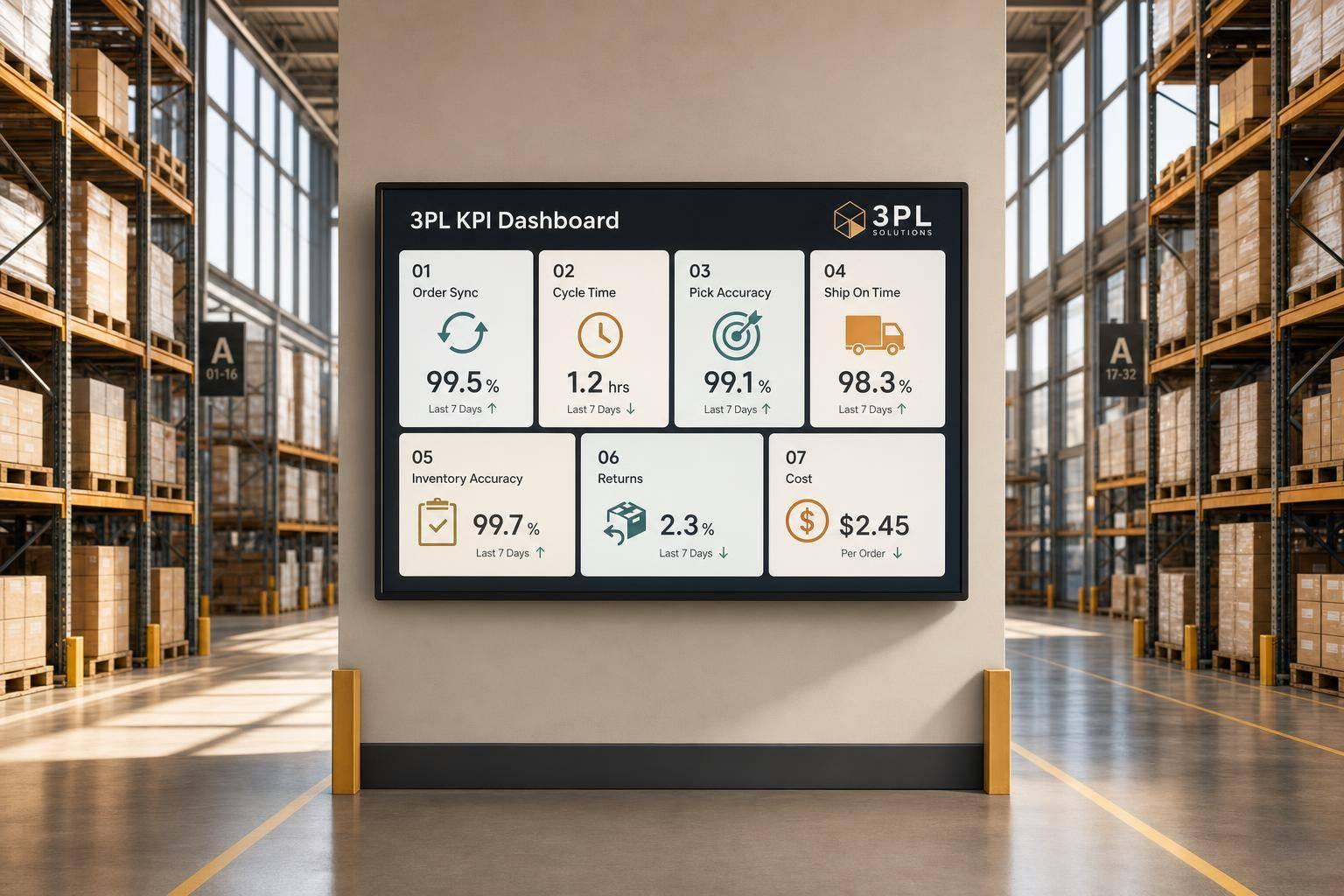
7 WooCommerce 3PL KPIs Teams Track

Centralized vs Decentralized Replenishment
