
How HMI Improves Labor Management in Warehouses
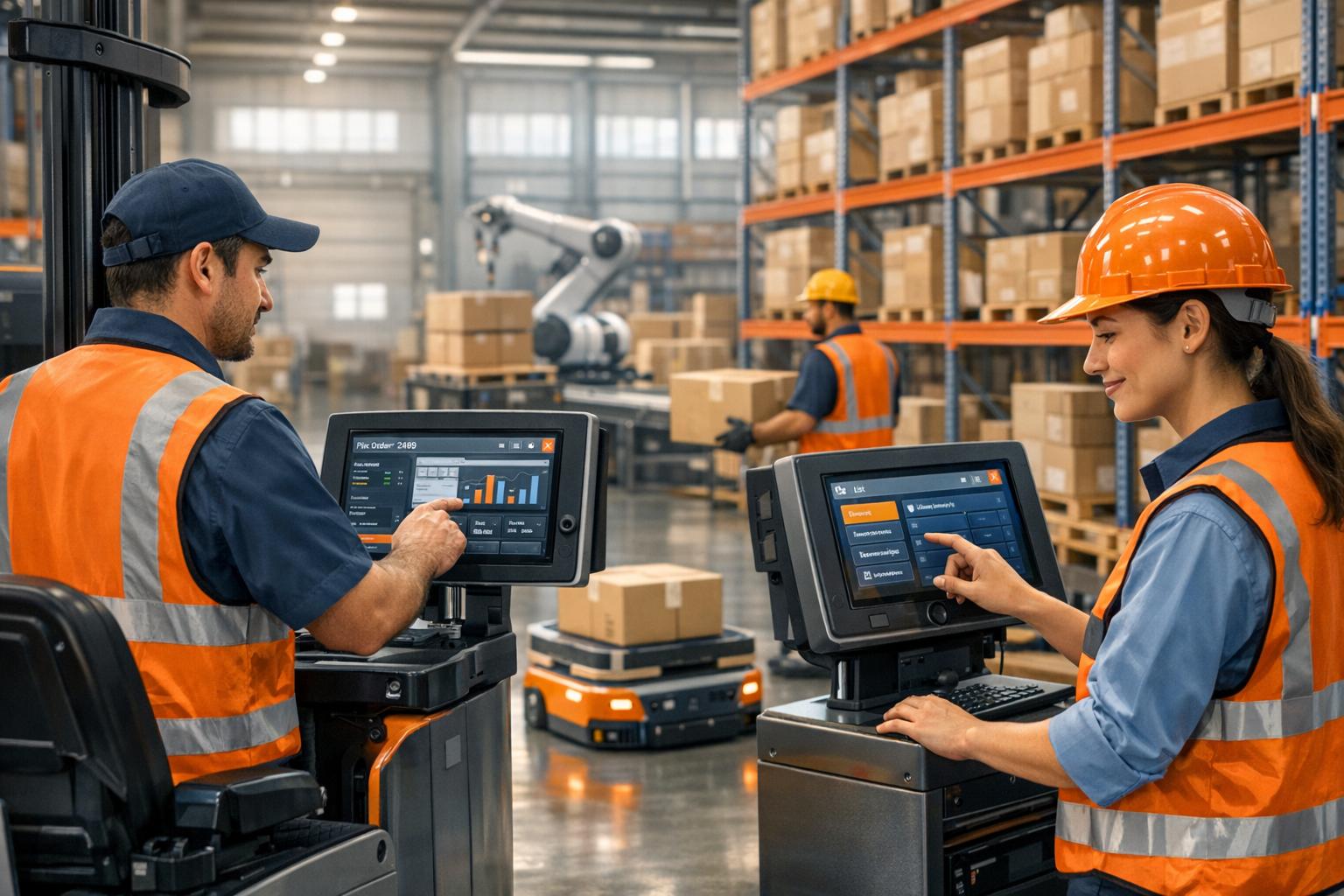
Human-Machine Interfaces (HMI) are transforming warehouse labor management by simplifying processes, improving productivity, and boosting safety. Here’s how:
- Efficiency Gains: HMI tools like touchscreens and mobile devices make data easy to understand, enabling faster task allocation and real-time adjustments. This increases productivity by up to 36% and cuts labor hours by 10%.
- Worker-Friendly Tech: 83% of employees want workplace tools as intuitive as smartphones, and HMI meets this demand with user-friendly interfaces.
- Real-Time Insights: Dashboards track worker performance metrics like pick rates and task completion times, helping managers make smarter decisions.
- Safety Improvements: Remote monitoring, wearable sensors, and predictive maintenance alerts reduce risks and prevent accidents.
- AI and IoT Integration: Voice commands, predictive analytics, and sensor data enhance usability and help prevent bottlenecks before they occur.
Companies like JIT Transportation are using HMI to optimize labor across multiple locations, improving task accuracy and meeting tight shipping deadlines. By integrating HMI with AI and IoT, warehouses can proactively manage labor, ensuring every shift runs smoothly.
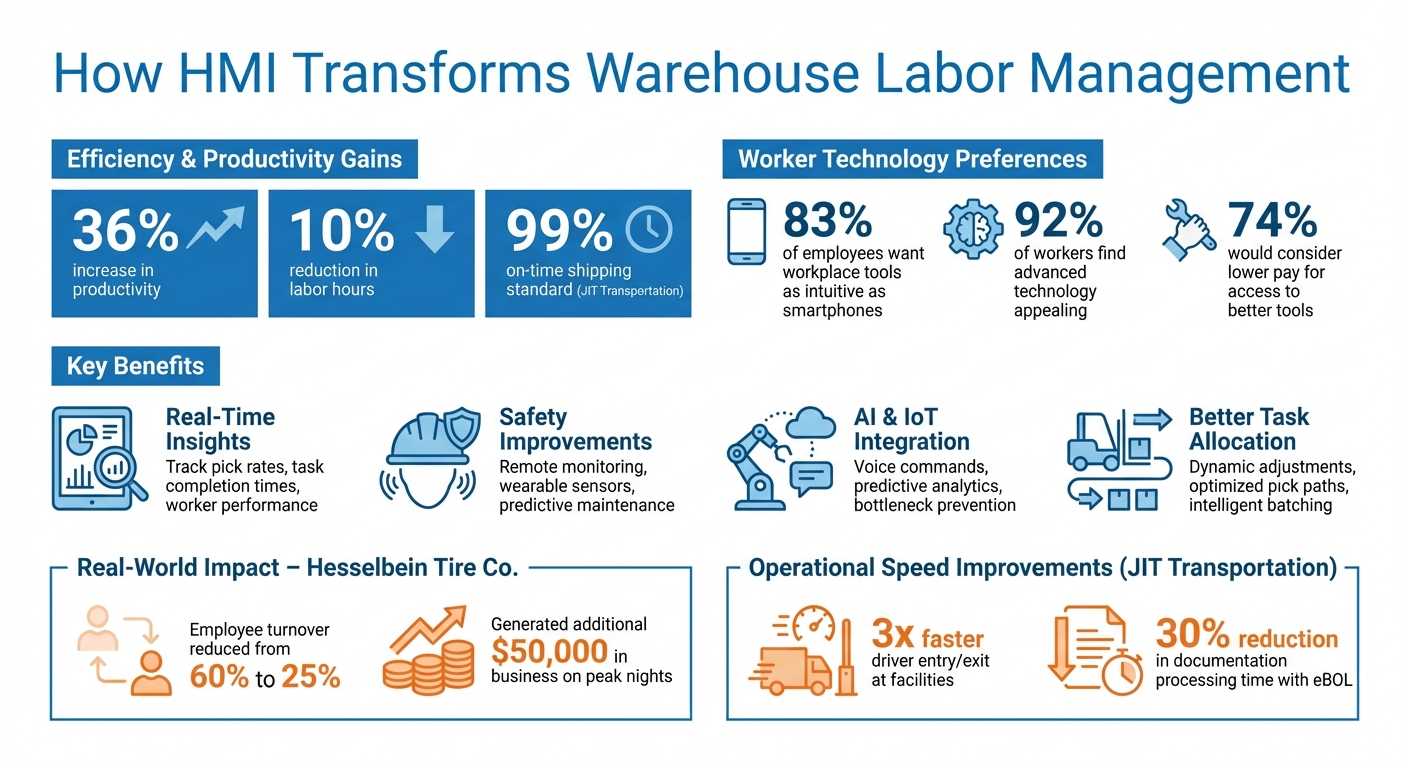
HMI Impact on Warehouse Labor Management: Key Statistics and Benefits
The importance of an intuitive HMI
What is HMI in Warehouse Operations?
A Human-Machine Interface (HMI) serves as the bridge between warehouse workers and automated systems like Programmable Logic Controllers (PLCs). Instead of dealing with complex code or piles of paperwork, workers can rely on user-friendly touchscreens, dashboards, and mobile devices that present real-time data in a clear, accessible way.
From industrial monitors and rugged tablets to wearables, HMI hardware teams up with software that displays real-time graphs, alerts, and metrics. This combination allows workers to respond immediately to issues. For instance, if a machine requires maintenance or a picking zone starts falling behind schedule, the HMI highlights the problem instantly, helping prevent minor hiccups from spiraling into major disruptions.
What sets HMI apart is its ability to integrate with Labor Management Systems (LMS) and Warehouse Management Systems (WMS). These systems go beyond inventory tracking by presenting data on worker performance - metrics like pick rates, travel distances, and task completion times. With this integration, raw data transforms into actionable insights, empowering managers to make smarter decisions about labor distribution throughout the shift. This functionality plays a key role in streamlining task allocation and workforce management, as explored in later sections.
How HMI Works in Warehouses
HMIs provide real-time updates by pulling data from sensors and PLCs, allowing operators to track equipment status, production metrics, and alerts. Sensors feed information to PLCs, which then send these updates to the HMI, giving workers a clear picture of ongoing operations.
But it’s not just about monitoring - HMIs enable two-way interaction. Operators can use them to adjust conveyor speeds, override automated systems during maintenance, or send other commands through Ethernet and OPC protocols.
With mobile devices like tablets, supervisors no longer need to stay tethered to a central control room. They can monitor operations while moving around the facility, saving time and allowing for quicker responses to any emerging issues.
HMI Integration with AI and IoT
Taking HMI functionality to the next level, integration with Artificial Intelligence (AI) and the Industrial Internet of Things (IIoT) is transforming warehouse operations. By linking with IIoT, HMIs collect data from countless sensors and devices across the warehouse, creating a comprehensive view of operations that includes environmental conditions and equipment performance in real time.
AI adds another layer of sophistication. Features like Natural Language Processing (NLP) allow workers to use voice commands instead of navigating touchscreens - an especially handy tool in noisy environments or when their hands are occupied. Gesture-based controls are also emerging, offering yet another hands-free option.
"We're seeing an infusion of consumer technology into the industrial field, where techniques like large language models (LLM) can transform massive printed manuals into interactive real-time training."
– Holger Kenn, Director of Business Strategy for AI and Emerging Technologies, Microsoft
AI doesn’t just enhance usability; it also powers predictive analytics within the HMI. Instead of merely reporting what’s already happened, the system anticipates future challenges. It can forecast bottlenecks, suggest break times for workers based on performance trends, or flag equipment that’s likely to fail. This shift from reacting to problems to proactively managing them helps warehouses tackle issues before they disrupt operations.
How HMI Improves Labor Management
When Human-Machine Interface (HMI) systems are integrated with AI and IoT, they completely transform how warehouses handle their workforce. Instead of simply monitoring activities, these systems enable proactive management, allowing warehouses to fine-tune every aspect of labor deployment. Here's how HMI reshapes three key areas of labor management.
Better Task Allocation
With HMI, managers can assign tasks in real time, adjusting on the fly as conditions change. By leveraging AI and IoT, these systems ensure labor is allocated where it's needed most. For instance, if a team finishes early in one zone, the system immediately redirects them to another area requiring support, making sure every labor hour is used efficiently. AI also predicts staffing needs by analyzing historical data and current conditions, helping avoid over- or under-staffing mistakes.
HMI systems also cut down on wasted time by combining tasks. Instead of sending a worker to put away inventory and then return empty-handed, the system pairs that task with a picking assignment along the same route. By creating intelligent task batches and optimizing pick paths, workers follow the most efficient routes through the warehouse.
"We've seen a monumental shift in the role of labor management over the past 20 years. It's moved from a glorified reporting system to becoming an operational execution system."
– Peter Schnorbach, Senior Director of Product Development, Manhattan Associates
When paired with pay-for-performance models, these systems can double productivity while motivating top performers. With dynamic task prioritization, orders get completed on time, eliminating the chaos of last-minute adjustments.
Productivity and Performance Tracking
HMI dashboards turn abstract productivity goals into tangible metrics that workers can see during their shifts. This real-time feedback loop encourages continuous improvement. Managers can monitor key metrics like task completion rates, pick rates, and overall productivity scores, allowing for immediate coaching and adjustments.
These tools have led to impressive results, including a 36% boost in productivity and a reduction in labor hours by more than 10%. Mobile accessibility enhances this even further - supervisors can track metrics, receive alerts, and address issues directly from smartphones or tablets, ensuring problems are resolved in minutes, not hours.
Take Hesselbein Tire Co., for example. Struggling with a 60% employee turnover rate, the company implemented the Raymond Lean Management (RLM) system in 2023. By using HMI data to re-evaluate shift lengths and engaging employees in continuous improvement, they slashed turnover to 25%. This change also boosted responsiveness, with some nights generating an additional $50,000 in business.
Beyond productivity, these metrics also play a role in improving safety, creating a work environment that’s not just more efficient but also more secure.
Improved Safety and Risk Reduction
HMI systems go beyond productivity - they make warehouses safer. Real-time monitoring gives operators instant visibility into system statuses, such as pressure levels or temperature readings, enabling quick responses to potential hazards. Alarms use color-coded signals - red for critical issues, yellow for warnings - ensuring urgent problems are noticed even in noisy environments.
Remote operation features allow workers to control equipment from a safe distance, keeping them out of high-risk areas with moving machinery or high-voltage panels. Controlled access through user logins prevents unauthorized changes, while audit trails track every system adjustment.
Wearable sensors integrated with HMI add another layer of safety. Using technologies like IMUs (inertial measurement units) and EMG (electromyography) sensors, these systems monitor worker posture and fatigue, providing haptic feedback for unsafe movements. Smart PPE connected to the HMI tracks vital signs, such as heart rate and temperature, while also detecting harmful gases. If thresholds are exceeded, automatic alerts are triggered.
Key safety features include:
- Remote operation: Keeps workers away from hazardous areas.
- Integrated E-Stop controls: Improves emergency response times.
- Predictive maintenance alerts: Identifies recurring issues before they escalate.
- Smart PPE: Monitors gas levels and vital signs, protecting workers from overexertion or exposure to toxins.
On-screen standard operating procedures (SOPs) further enhance safety by guiding workers step-by-step in real time. This ensures they have the right information exactly when they need it, reducing errors that could lead to injuries.
sbb-itb-eafa320
HMI Implementation at JIT Transportation
JIT Transportation has embraced HMI technology across key hubs in San Francisco, Los Angeles, Houston, and Memphis to streamline labor management for its value-added services. By integrating mobile interfaces, voice-directed systems, and real-time dashboards with its ERP and Warehouse Management Systems, the company has created a seamless connection between workers and operational data.
The HMI system plays a central role in guiding workers through tasks like picking and packing, kitting, assembly, and testing. It records results in real time, enabling JIT's ERP to monitor labor productivity and inventory levels simultaneously. This real-time tracking equips floor managers with actionable insights, allowing them to make mid-shift adjustments to improve performance. For a 3PL managing diverse client needs, this capability supports labor planning and forecasting at a granular level, helping refine service pricing and margin strategies.
Connecting HMI with JIT's ERP Systems
The integration begins with establishing labor standards, such as transaction times, travel durations, and acceptable idle thresholds. Workers interact with mobile screens that automatically log task start and completion times, as well as travel data.
A key aspect of this system is synchronizing user IDs across HMI, ERP, and Warehouse Execution Systems to ensure data consistency. Performance scores - ranging from excellent to unacceptable - are calculated by comparing actual performance against engineered benchmarks using a ratings algorithm. If workers exceed the pre-defined time for a task, the system logs the extra time as idle rather than productive.
"The key innovation we continue to see is mobility, mobility, and more mobility. Labor-management was always intended to be real-time, in terms of putting data into the hands of supervisors, but we continue to see the push to make that information more accessible." – Jeremy Hudson, Director of Client Services, Open Sky Group
For JIT's intricate kitting processes, the HMI provides visual guidance and automated error detection to improve accuracy. If incorrect parts are loaded, the system alerts operators, reducing errors and preventing costly delays. This precision is critical for maintaining JIT's impressive 99% on-time shipping standard across its network.
With these integrated systems in place, JIT leverages real-time dashboards to fine-tune labor allocation across its entire operation.
Real-Time Labor Optimization Across JIT's Network
Operating across nine major U.S. hubs with a fleet of 120+ trucks and 300+ trailers, JIT uses HMI dashboards to maintain real-time visibility into labor requirements across time zones. The system analyzes outstanding tasks against labor standards, predicting the workforce or hours needed to meet demand.
Supervisors can access these dashboards on smartphones or tablets, allowing them to monitor lost time and cost fluctuations by functional area. This real-time data helps identify bottlenecks and adjust labor resources on the fly. When non-standardized transactions arise, the system converts them into new labor standards, improving future planning accuracy.
The integration also extends to yard and dock operations. Automated Yard Management Systems, combined with digital check-in features, allow drivers to enter and exit JIT facilities three times faster. Additionally, Electronic Bills of Lading (eBOL) streamline documentation, cutting processing times by up to 30%, further boosting efficiency.
"The more data points a WES has, and the more frequent those data points come in, the better decisions WES can make." – Jason Franklin, Director of Product Management, Honeywell Intelligrated
This real-time optimization highlights how HMI transforms labor management. For pick-and-pack tasks, the system tracks part availability and offers instant visual feedback, making it especially useful for training new team members. Similarly, in testing and revision upgrades, it monitors critical parameters like temperature and pressure in real time, ensuring tighter tolerances and higher product quality.
Conclusion
Human-machine interfaces (HMI) are reshaping how warehouse labor is managed. By simplifying task assignments, offering real-time productivity tracking, and improving safety measures, HMI technology tackles some of the most persistent challenges in warehouse operations. The numbers speak volumes: 92% of workers find advanced technology appealing, and 74% would even consider lower pay for access to such tools.
At JIT Transportation, HMI integration goes a step further by seamlessly connecting ERP systems and enabling real-time labor optimization. This connection streamlines processes like kitting, assembly, and testing, allowing for smarter resource allocation and smoother workflows across operations.
What’s especially transformative is the shift from reactive reporting to proactive management. Today’s HMI systems provide predictive insights, empowering supervisors to make adjustments before issues arise. As Jeremy Hudson puts it:
"Labor management was always intended to be real-time, in terms of putting data into the hands of supervisors, but we continue to see the push to make that information more accessible".
In a fast-paced logistics landscape, having tools like mobile interfaces, voice-directed systems, and real-time dashboards gives teams the clarity and precision they need to stay on track.
Beyond efficiency, there’s also a growing expectation among workers for technology that feels as intuitive as their smartphones and apps. Investing in advanced HMI systems not only boosts productivity but also helps attract and retain skilled employees. The takeaway is clear: intuitive, real-time HMI technology is now a cornerstone of effective warehouse labor management.
FAQs
How does integrating HMI with AI and IoT improve warehouse labor management?
Human-machine interfaces (HMIs) act as a seamless bridge between warehouse workers and automated systems. Paired with AI and IoT, these interfaces present real-time data - like machine performance, inventory levels, and environmental conditions - through easy-to-navigate dashboards. With AI analyzing this data, users gain practical insights, such as alerts for predictive maintenance, optimized pick routes, and workload forecasts.
In labor management, this combination ensures tasks are assigned to the best-suited workers, shift schedules adjust dynamically to match demand, and potential bottlenecks are flagged before they cause disruptions. Supervisors benefit from faster, data-backed decisions, which helps streamline operations, cut down on idle time, and maintain high service standards in distribution centers. The result? Warehouses that operate smarter, quicker, and more efficiently.
How does HMI enhance warehouse safety?
Human-machine interfaces (HMIs) play a key role in making warehouses safer by limiting the need for workers to engage directly with potentially dangerous tasks. Using real-time visual controls and alerts displayed on touchscreens, operators can manage equipment - starting, stopping, or adjusting it - from a safe distance. This significantly reduces exposure to hazards like moving machinery, heavy loads, or high-temperature zones. Additionally, automated systems overseen by HMIs take on many repetitive and physically demanding tasks, cutting down on the risk of repetitive-motion injuries.
Another safety advantage of HMIs is their ability to provide instant feedback about unsafe conditions. They can alert operators to issues like equipment overloads or sudden temperature increases, enabling quick action to prevent accidents. For logistics companies such as JIT Transportation, these features not only create a safer work environment but also result in fewer workplace injuries, reduced workers’ compensation costs, and smoother day-to-day operations.
How does HMI technology enhance task allocation and workforce productivity in warehouses?
Human-machine interfaces (HMIs) give warehouse managers a clear, real-time view of how their equipment and workforce are performing. By pulling together data like production times, key performance indicators, and machine inputs into one easy-to-read dashboard, HMIs make it simple to spot underused or overloaded resources. This helps supervisors assign tasks to the right team members quickly and effectively. Plus, by cutting down on manual data entry and reducing errors, these systems free up employees to focus on tasks that add more value.
What makes dynamic HMI systems even more powerful is their ability to update in real time throughout a shift. They can automatically balance workloads, suggest task assignments, and send alerts when workers are falling behind. These platforms even provide real-time feedback directly to handheld devices, so issues can be resolved on the spot. Companies like JIT Transportation rely on these tools to optimize operations, speed up processes like pick-and-pack, and get the most out of their workforce, leading to noticeable productivity improvements.
Related Blog Posts
Related Articles
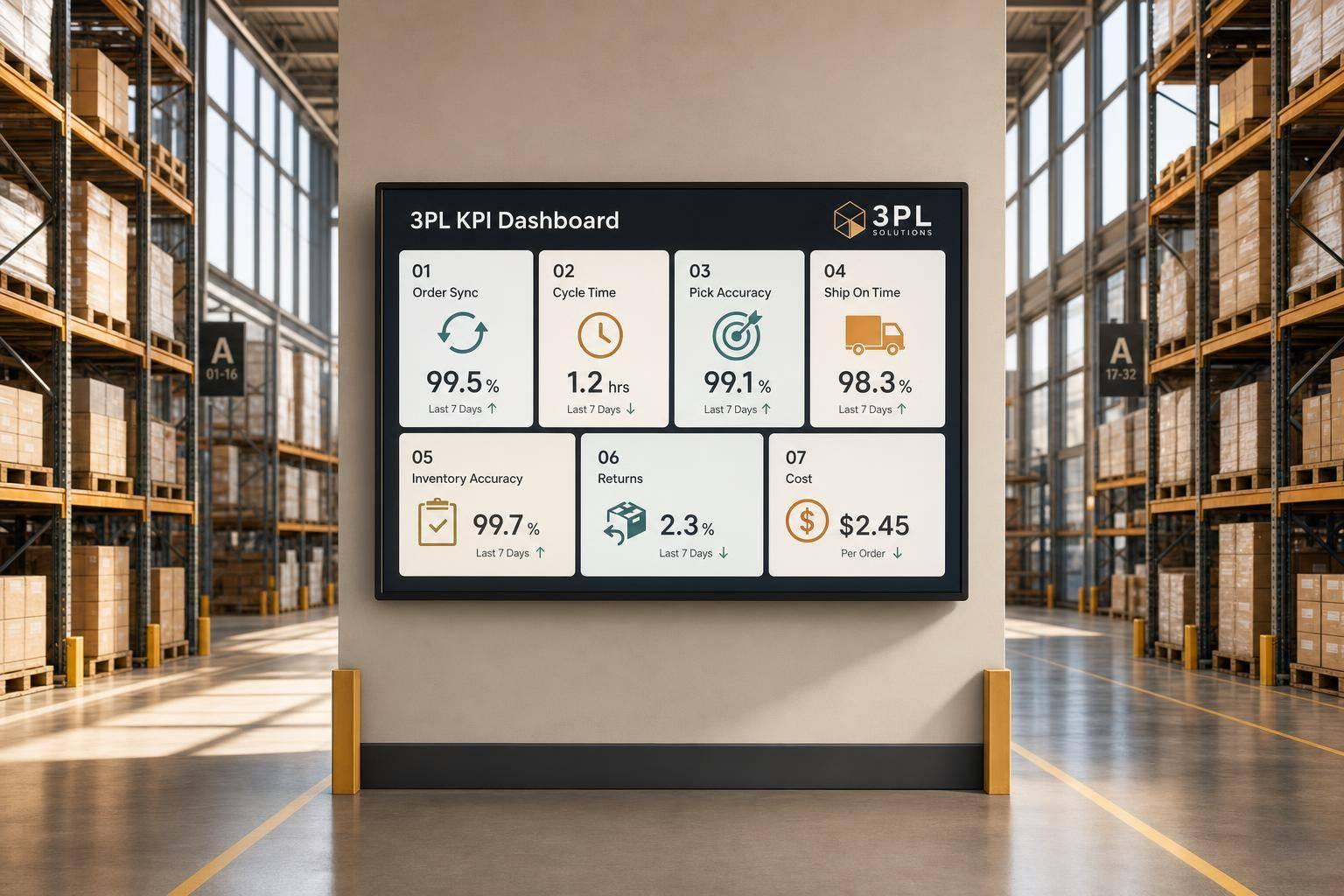
7 WooCommerce 3PL KPIs Teams Track

Centralized vs Decentralized Replenishment
