
How 3PLs Use Analytics to Lower Shipping Costs
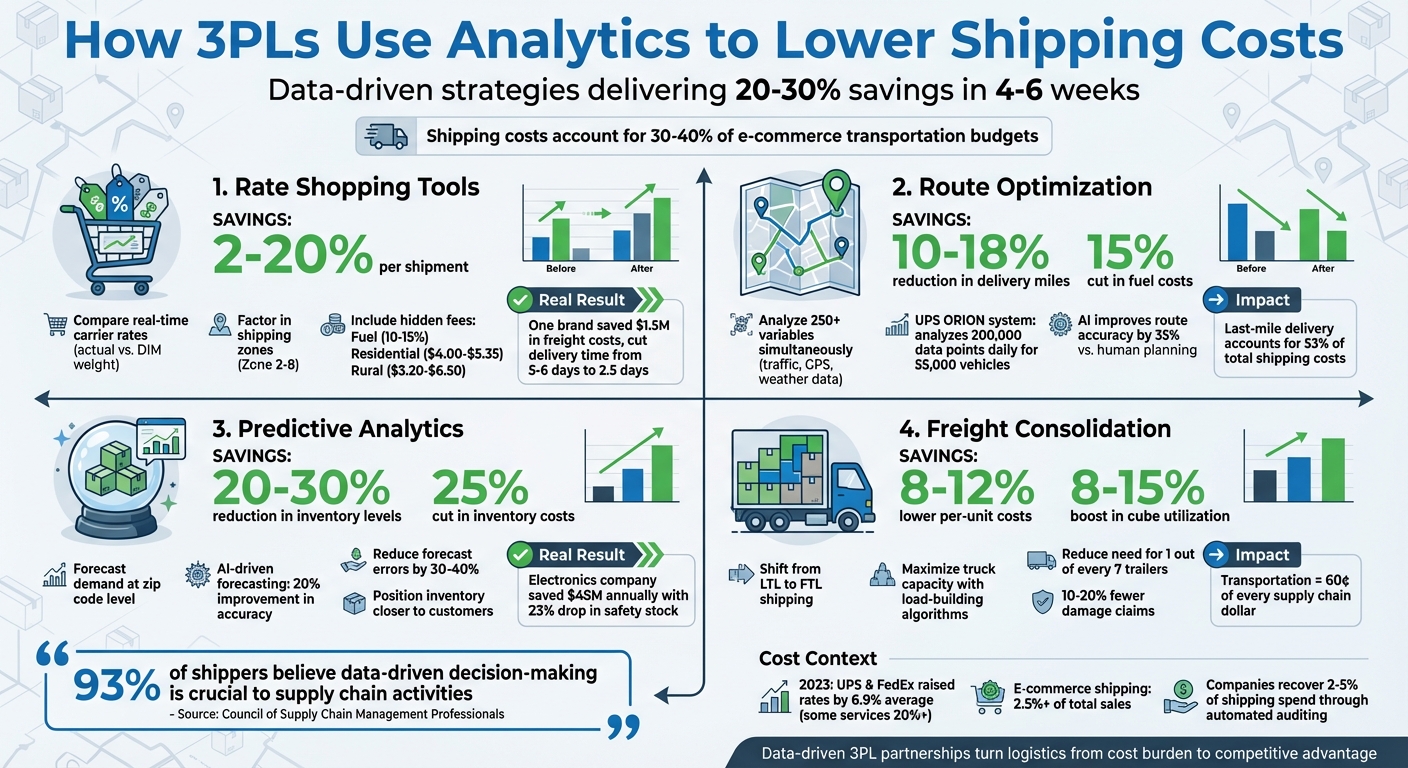
Shipping costs are a major expense, especially for e-commerce businesses, where they can account for 30-40% of transportation budgets. Here's how third-party logistics (3PL) providers are cutting these costs using analytics:
- Rate Shopping Tools: Compare real-time carrier rates to find the most cost-effective options, saving 2-20% per shipment.
- Route Optimization: Use traffic, GPS, and weather data to reduce delivery miles by 10-18% and cut fuel costs by 15%.
- Predictive Analytics: Forecast demand to position inventory closer to customers, reducing shipping zones and transit times.
- Freight Consolidation: Group shipments and maximize truck capacity, lowering per-unit shipping costs by 8-12%.
How 3PLs Use Analytics to Reduce Shipping Costs: Key Strategies and Savings
Jordan Johnsen: How Barrett Uses Data Analytics to Save 3PL Clients Money
Rate Shopping Analytics: Comparing Carrier Costs
Shipping costs can vary widely depending on the size, weight, and destination of a package. For instance, sending a 2 lb cosmetics package to Brooklyn is a far cry from shipping a 15 lb home goods box to a rural area. This is where rate shopping analytics comes in - it helps 3PLs pinpoint the most cost-effective carrier for each shipment by comparing real-time rates based on package specifics.
Real-Time Rate Comparison
Real-time rate comparison takes carrier selection to another level. By integrating with a 3PL's Warehouse Management System (WMS), rate shopping tools pull package details and query carrier APIs for live pricing. They calculate the billable weight - choosing the higher of the actual weight or dimensional (DIM) weight - to ensure accurate cost assessments.
Shipping zones also play a major role. In the U.S., these zones typically range from 2 (local) to 8 (coast-to-coast), with long-distance shipments costing up to 2.3 times more than local deliveries. On top of that, hidden fees like fuel surcharges (10%-15%), residential delivery fees ($4.00–$5.35), and rural surcharges ($3.20–$6.50) are accounted for. By factoring in all these variables, rate shopping tools can save anywhere from 2% to 20% per shipment.
"If you're treating rate shopping like a 'set-it-and-forget-it' tool, you're hemorrhaging profits for every DTC client you serve."
– Joe Henderson, Deposco
Selecting the Right Carrier for Each Shipment
Rate shopping analytics isn’t just about finding the cheapest option - it’s about balancing cost with performance. For instance, a 3PL might choose a slightly more expensive carrier if it offers better on-time delivery rates. Similarly, ground shipping might be prioritized over air freight for nearby zones when a 2-day delivery window can still be met.
Take one brand as an example: By analyzing shipping data, they began fulfilling orders from the center closest to their customer base. This change saved them $1.5 million in outbound freight costs and cut average delivery times from 5–6 days to just 2.5 days. Additionally, 3PLs can negotiate carrier discounts - ranging from 10% to 30% off standard rates - by combining shipping volumes across multiple clients.
Analytics also helps track carrier performance for various shipment types, whether lightweight packages, heavy goods, or rural deliveries. This data allows 3PLs to tailor carrier selection to match each brand’s product mix and customer locations. At JIT Transportation, these insights are a cornerstone of our approach, ensuring shipments are both cost-efficient and dependable. Such practices set the stage for even greater savings through advanced route optimization strategies.
Route Optimization: Improving Delivery Paths
After selecting the right carrier, the next challenge for a 3PL is ensuring packages are delivered via the most efficient routes. Route optimization uses analytics to process massive amounts of data - like traffic patterns, GPS signals, weather forecasts, and delivery schedules - to create the best possible paths. For e-commerce businesses handling hundreds or even thousands of daily shipments, manual route planning simply can't keep up. The result? Longer delivery times, wasted fuel, and higher labor costs.
Using GPS and Traffic Data
Modern routing software relies on live traffic updates, road closure notices, and construction alerts to avoid delays. Predictive models built on historical data help identify potential bottlenecks before they happen. If an unexpected disruption occurs - like a highway accident - the system can instantly adjust, resequencing stops or rerouting vehicles to stay on schedule.
Advanced geocoding tools also play a key role. They can turn unclear addresses or landmarks into precise GPS coordinates, helping drivers locate destinations faster and boosting overall efficiency. These tools evaluate over 250 variables at once, such as vehicle capacity, driver expertise, fuel levels, and specific delivery time requirements. For instance, UPS uses a system called ORION, which analyzes up to 200,000 data points daily - ranging from addresses to traffic and weather conditions - to optimize routes for its 55,000-vehicle fleet. AI-based models have also enhanced route prediction accuracy by more than 35% compared to human-only planning. This integration of real-time and historical data feeds directly into strategies aimed at tackling the costly challenges of last-mile delivery.
Reducing Last-Mile Costs
The last mile of delivery is notoriously expensive, accounting for 53% of total shipping costs. Route optimization helps tackle this issue by clustering deliveries to reduce overlapping routes and minimize total mileage. By maximizing truck capacity and increasing the density of orders per route, some 3PLs have managed to double their delivery capacity without adding more vehicles to their fleets.
Predictive analytics also deliver measurable savings, cutting delivery times by 20% and reducing fuel costs by 15%. Since fuel expenses make up 60% of a fleet's operating costs, even small improvements can lead to significant financial benefits. At JIT Transportation, for example, these analytics are applied to ensure every mile counts - whether by strategically positioning inventory near high-demand areas or using automated dispatch systems to assign the right vehicle to the most efficient route. These methods not only improve operational efficiency but also lay the groundwork for demand forecasting and inventory positioning, which will be explored in the next section.
Predictive Analytics: Forecasting Demand and Inventory
Once routes are optimized, the next step is ensuring products are available exactly where and when they're needed. Predictive analytics is reshaping how 3PLs handle inventory, using historical sales data and seasonal trends to predict customer orders. This approach helps avoid two costly pitfalls: overstocking, which leads to higher warehouse costs, and stockouts, which can force expensive expedited shipping.
Forecasting Demand
Predictive models go beyond simple historical averages. They drill down into demand at a detailed level, forecasting not only overall volume but also specific product variations - like size, color, or style - right down to individual zip codes. These systems integrate daily sales data and production lead times to automatically set reorder points, eliminating guesswork and reducing the need for last-minute shipping.
The impact is undeniable. AI-driven forecasting can improve demand prediction accuracy by up to 20%. Advanced techniques reduce forecast errors by 30–40% compared to traditional methods. For example, a consumer electronics company that adopted machine learning-based forecasting across 12,000 SKUs saw a 23% drop in safety stock requirements and an 18% cut in obsolete inventory, saving $45 million annually.
"Retailers that focus on efficiency and data-driven inventory management with technologies like predictive analytics can deliver trend-driven products faster than those sticking to traditional supply chain models." – Jarret Arnold, Strategic Lead at UPS
These refined forecasts play a critical role in determining where inventory should be placed.
Positioning Inventory Across Warehouses
With precise demand forecasts in hand, 3PLs can strategically position inventory to cut transit times and costs. By placing stock closer to anticipated demand, they reduce the number of shipping zones a package must cross, which directly lowers shipping expenses. Amazon, for instance, uses predictive modeling to forecast demand at the zip code level, ensuring inventory is positioned in the nearest fulfillment center to minimize last-mile delivery times.
The financial advantages are clear. Advanced analytics can reduce inventory levels by 20–30% while improving service levels by 5–10%, leading to an average 25% cut in inventory costs. In one case, a retail fashion network used probabilistic forecasting to optimize the placement of seasonal merchandise. This led to a 40% drop in inter-store transfers and a 15% boost in gross margins due to better initial inventory allocation. Similarly, JIT Transportation relies on predictive insights to distribute inventory across its nationwide network. This ensures products are strategically positioned to meet customer delivery expectations - whether for same-day or standard ground shipping - without resorting to costly air freight or expedited services.
sbb-itb-eafa320
Freight Consolidation: Lowering Per-Unit Shipping Costs
Once inventory is strategically placed, analytics step in to optimize how shipments are consolidated, delivering significant cost savings.
Transportation costs make up about 60¢ of every dollar spent in a supply chain, making it a major expense. By leveraging analytics, companies can shift from less-than-truckload (LTL) to full-truckload (FTL) shipping, cutting line-haul costs per pound by 8–12%.
The results are tangible. Sophisticated load-building algorithms can boost average cube utilization by 8–15%, while optimized load planning can reduce the need for one out of every seven trailers for the same freight volume. On top of cost reductions, better loading practices lead to 10–20% fewer over, short, and damaged (OS&D) claims, thanks to improved securement methods that minimize shifting during transit.
Grouping Shipments by Region
Modern analytics platforms can analyze incoming orders in real time, identifying opportunities to group shipments by region. Instead of sending separate packages to multiple addresses within the same metro area, these systems consolidate orders into multi-stop loops, often referred to as "milk-runs." These loops typically cover a 30–50 mile radius, increasing stop density while cutting down on stem miles - the distance between the warehouse and the first delivery stop.
Take J.B. Hunt, for example. By implementing machine learning algorithms to analyze GPS and trailer sensor data, they created predictive models that reduced issues like bottlenecks and detention delays by as much as 20%. These systems evaluate factors such as geographic proximity, delivery windows, weight and volume limits, and even real-time traffic patterns. When the conditions align, the system consolidates separate LTL shipments into one FTL route.
Another effective strategy is pool point distribution, which utilizes cross-dock facilities to reorganize freight for local delivery. Dense line-haul trailers arrive at these hubs, where freight is sorted by final destination and reloaded onto smaller vehicles for last-mile delivery. This hybrid model strikes a balance between the high costs of LTL shipping and the rigidity of FTL schedules. By grouping shipments in this way, companies can ensure trailers are loaded efficiently, maximizing every inch of available space.
Maximizing Truck Capacity
Once shipments are grouped, the next step is making the most of the trailer’s capacity. Load-building algorithms, powered by bin-packing heuristics and mixed-integer programming, evaluate millions of combinations of SKU dimensions, weights, and stacking rules. The objective? To maximize the trailer’s usable volume while adhering to safety regulations and protecting fragile goods.
"Every dollar saved through network redesign or carrier negotiation still passes through a single choke point: the moment freight planners decide which orders share a trailer, which routes a driver follows, and how cube and weight are balanced inside that moving box." – Umbrex
These systems rely on SKU data - like dimensions, weight, and stackability - and run simulations in real time to determine the best loading sequence. For instance, pallets destined for the last delivery stop are loaded first, streamlining the unloading process. Analytics also help third-party logistics providers (3PLs) select the right equipment size, such as switching to a smaller 48-foot trailer on days with lower freight density, avoiding unnecessary costs for unused space.
The benefits are clear. Optimized loading can lower fuel consumption per ton-mile by 2–4% and reduce miles per delivery by 10–18%. JIT Transportation applies these principles across its network, using advanced load-planning tools to ensure trailers leave fully loaded. This not only slashes per-unit shipping costs but also reduces the environmental impact of each delivery. Together, shipment consolidation and optimized loading demonstrate how data-driven strategies can transform supply chain efficiency and cut costs.
Performance Metrics and Continuous Improvement
Once consolidation and load optimization are in place, the next step is all about keeping the momentum going. Continuous monitoring becomes the backbone of maintaining cost savings and uncovering new ways to improve. For third-party logistics providers (3PLs), tracking key performance indicators (KPIs) in real time allows them to catch inefficiencies early and make data-driven decisions to keep shipping costs under control. These metrics are the foundation for real-time adjustments that help sustain cost efficiencies.
Tracking Shipping Costs and Delivery Times
Performance monitoring goes beyond just tracking - it shines a light on what’s driving costs. Effective cost management starts with detailed expense tracking. 3PLs focus on metrics like cost per shipment, cost per mile, and cost per unit shipped, which help pinpoint where financial inefficiencies might be creeping in - whether it’s a specific shipping lane or a particular carrier.
Carrier performance is another critical area. Metrics such as on-time delivery rate and on-time pickup rate are essential for evaluating whether carriers are meeting their agreements. For instance, if a carrier’s on-time rate dips below 90%, automated alerts can trigger immediate action, such as rerouting shipments to more reliable partners. Another key metric is the tender acceptance rate, which measures how often carriers accept assigned freight. This becomes especially important when capacity is tight and options are limited.
"You cannot fix what you cannot see. Time stamps show where misses start." – Becker Logistics
Billing accuracy is just as important for managing costs. Automated tools can catch duplicate charges, incorrect dimensional weight (DIM) calculations, or misapplied surcharges. On average, companies recover 2% to 5% of their total shipping spend through automated invoice auditing and refunds for service failures. In fact, brands using these tools often see 20–30% in measurable cost savings within 4–6 weeks. By keeping a close eye on these metrics, 3PLs can make immediate adjustments to their operations based on real-time data.
Making Adjustments Based on Data
The real value of tracking performance metrics lies in the actions they inspire. Armed with insights, 3PLs can tweak operations - whether it’s changing carriers, shifting shipment modes, or fine-tuning routes - to lock in savings. For example, if data reveals that more than 60% of packages are being shipped via air when ground service could deliver just as quickly, switching to ground shipping can save thousands of dollars without compromising delivery times. This type of zone-based service selection is a common adjustment that comes from analyzing shipping patterns.
Quarterly business reviews with carriers also provide a chance to put data to good use. With historical metrics in hand - such as damage rates (targeting below 0.5%) and on-time delivery rates (aiming for above 95%) - 3PLs can negotiate better rates or request the removal of certain surcharges. Even when carrier performance is satisfactory, running an annual request for proposal (RFP) ensures market rates remain competitive and contract terms stay favorable.
"Data helps shippers quickly identify opportunities, and allows them to react to them faster than ever before." – Todd Holt, President of Transportation at NFI
Companies like JIT Transportation use these analytics to fine-tune every shipment, balancing cost and speed to deliver tangible value for e-commerce brands. By leveraging data, they ensure every decision contributes to measurable improvements.
Conclusion
Data analytics has reshaped how third-party logistics (3PL) providers operate, bringing a new level of efficiency to shipping and fulfillment. By leveraging analytics, companies can make smarter decisions, such as comparing real-time carrier rates for cost-effective shipping. For example, data often reveals that over 60% of packages could be switched to ground delivery. Route optimization can trim delivery miles by 10–18%, predictive analytics helps position inventory closer to customers, and freight consolidation improves trailer cube utilization by 8–15%.
The results? Analytics-focused 3PLs can deliver measurable savings of 20–30% within just 4–6 weeks. Take the cookware brand Our Place as an example: they saved $1.5 million in outbound freight costs and generated an additional $500,000 in daily revenue during peak season - all thanks to continuous monitoring, automated invoice auditing, and data-backed decisions.
This approach is especially valuable as shipping costs continue to rise. In 2023, UPS and FedEx raised average rates by 6.9%, with some services spiking by over 20%. For e-commerce brands, where shipping often accounts for over 2.5% of total sales, optimizing these expenses through data-driven 3PL partnerships is crucial. Every percentage saved on shipping directly impacts the bottom line, making analytics a powerful tool in staying competitive.
"93% of shippers (and 98% of third-party logistics firms) feel like data-driven decision-making is crucial to supply chain activities." – Council of Supply Chain Management Professionals
JIT Transportation uses advanced technology and an extensive network to turn logistics from a cost burden into a competitive edge. By embracing analytics-driven strategies, e-commerce brands can cut costs and strengthen their market position.
FAQs
How do rate shopping tools help e-commerce businesses save on shipping costs?
Rate shopping tools are a game-changer for e-commerce businesses looking to cut shipping costs. These tools compare shipping rates from various carriers in real time, automatically picking the most budget-friendly and appropriate option for each shipment. This means businesses can secure the best deals without compromising on service quality.
Using these tools simplifies the shipping process, trims down operational expenses, and gives businesses more control over their logistics spending. The result? Greater efficiency and happier customers, thanks to timely and affordable deliveries.
How do 3PL providers use predictive analytics to improve shipping efficiency?
Predictive analytics gives 3PL providers the tools to dig into historical shipment data, traffic trends, weather forecasts, and carrier performance to fine-tune delivery operations. By spotting potential hurdles - like seasonal order spikes, traffic jams, or carrier capacity limits - before they happen, 3PLs can suggest smarter routes, better carrier choices, and load consolidation plans well before shipments even leave the warehouse.
For e-commerce businesses, this translates to fewer delays, reduced shipping costs, and quicker delivery times. Predictive models allow 3PLs to pinpoint bottlenecks early, enabling them to adjust routes, tweak schedules, or relocate inventory closer to end customers. A prime example is JIT Transportation, which leverages predictive analytics to optimize routing and carrier selection. This approach ensures dependable, cost-efficient deliveries for U.S. clients while keeping customer satisfaction levels high.
What is freight consolidation, and how does it help reduce shipping costs?
Freight consolidation involves merging multiple smaller shipments into a single, larger load, making better use of available truck space in terms of both volume and weight. This method cuts down on the number of trips needed, which in turn reduces fuel usage and driver-related expenses. It also allows fixed transportation costs to be distributed across a greater number of units.
The outcome? A lower per-unit shipping cost, offering businesses a smart way to simplify their logistics while keeping expenses in check.
Related Blog Posts
Related Articles
7 WooCommerce 3PL KPIs Teams Track

Centralized vs Decentralized Replenishment
