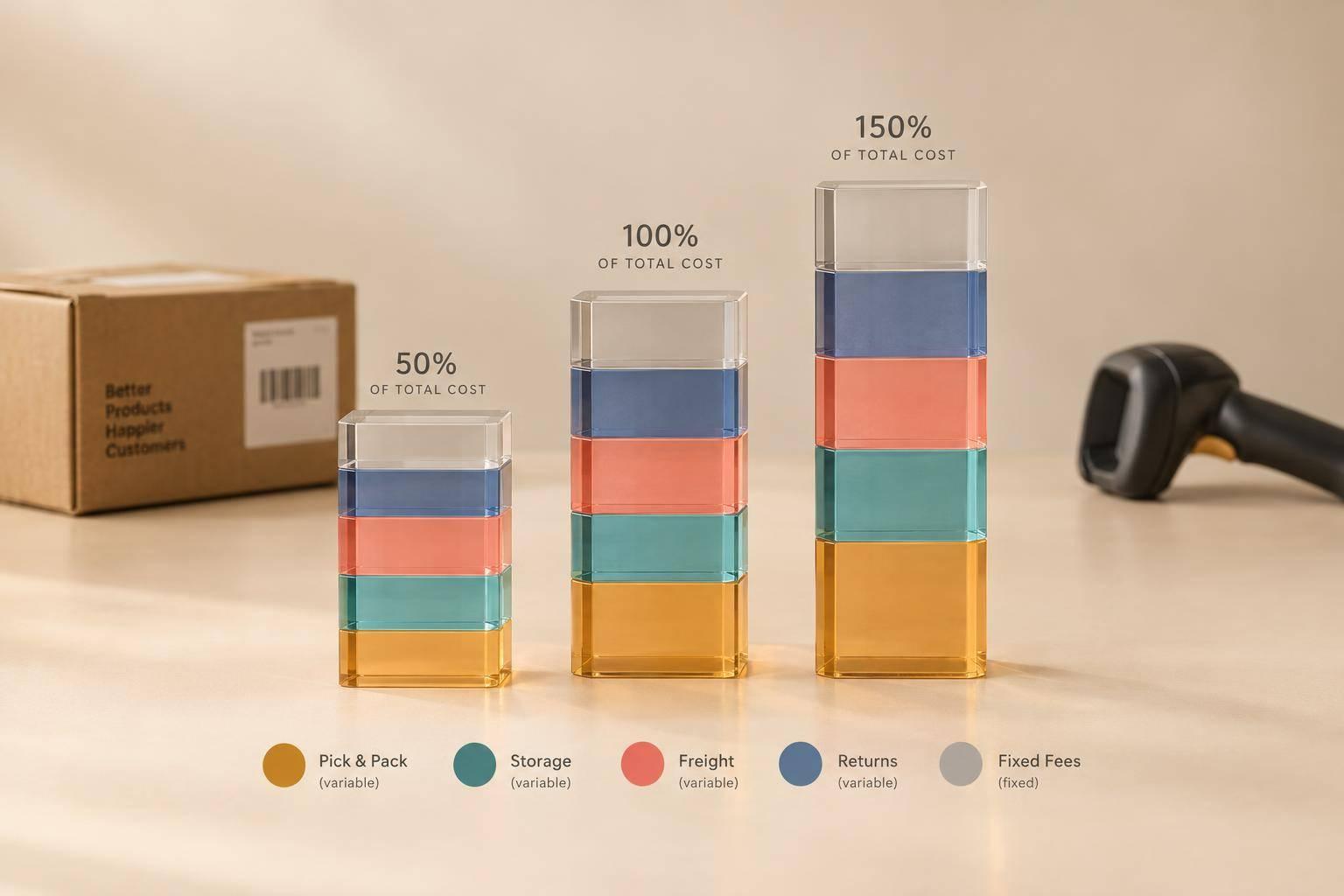
How Flexible Warehousing Supports Rapid Scaling

Flexible warehousing is reshaping how businesses manage storage and fulfillment. It offers on-demand solutions that let companies scale capacity in real time without long-term leases or heavy upfront costs. This approach is ideal for e-commerce brands handling seasonal spikes, expanding into new markets, or reducing delivery times. Here’s why it works:
- Quick Setup: Operations can start in 2–4 weeks, compared to 9–18 months for conventional warehouses.
- Pay-As-You-Go Pricing: Businesses only pay for the space and services they use, turning fixed costs into variable ones.
- Seasonal Flexibility: Scale up during peak demand (e.g., holidays) and down during slow periods, avoiding unused space costs.
- Improved Delivery: Position inventory closer to customers to cut transportation costs (often 3–8× higher than storage costs) and speed up shipping.
- Technology Integration: Advanced systems like Warehouse Management Systems (WMS) and automation tools enable real-time tracking, efficient operations, and faster scaling.
Case studies show brands like HalloweenCostumes.com and Lull slashed costs, boosted delivery speed, and handled demand surges effectively using flexible warehousing. Whether you're managing 3,000 orders a month or scaling to 10,000 daily, this model supports growth without overcommitting resources.
How Flexible Warehousing Supports Rapid Scaling
Managing Seasonal and Demand Fluctuations
E-commerce brands often face unpredictable demand cycles. Take toy retailers, for instance - they can see their stock needs skyrocket tenfold during November and December compared to quieter months. Flexible warehousing offers a solution by allowing brands to scale storage and staffing to handle these seasonal peaks and then scale back as demand eases.
Instead of being tied to a warehouse that sits half-empty for most of the year, brands can tap into on-demand storage options through digital marketplaces or third-party logistics (3PL) providers. This pay-as-you-go approach shifts fixed costs into variable ones, making cash flow easier to manage during slower periods. One national consumer packaged goods (CPG) manufacturer reported saving over 300% on storage costs by adjusting capacity seasonally.
"Instead of committing to a larger permanent footprint that sits underutilized for most of the year, logistics managers can deploy short-term storage in key regions when needed." – Kelly Zurawski, Part Owner, Equip Trucking & Warehousing, LLC
Speed is another game-changer. In major logistics hubs, small businesses can secure short-term storage and cross-docking services in as little as 24 to 72 hours. This quick turnaround is crucial for capitalizing on events like Black Friday or responding to unexpected demand spikes caused by viral trends. This kind of agility not only cuts costs but also helps reduce inventory risks.
Reducing Stockouts and Overhead Costs
Stockouts hurt sales, while maintaining too much capacity drives up costs. Flexible warehousing strikes a balance by letting brands adjust capacity in real time without being locked into long-term leases. Using advanced Warehouse Management Systems (WMS), businesses can track stock levels in real time, ensuring they make smarter replenishment decisions and avoid stockouts during high-demand periods.
The pricing model is designed to keep waste low. Instead of paying upfront for unused space, businesses are charged based on the actual flow of goods - often calculated per pallet per day or per square foot per month. This way, brands only pay for what they need. Additionally, spreading inventory across multiple flexible locations reduces risks tied to regional disruptions or delays at a single facility. If one warehouse encounters issues, others can step in to keep fulfillment running smoothly. This approach not only keeps costs under control but also enhances fulfillment efficiency.
Improving Fulfillment Speeds
Flexible warehousing doesn’t just optimize costs - it also speeds up last-mile delivery by strategically positioning inventory closer to customers. Since transportation costs often overshadow warehousing expenses, reducing the distance between inventory and end-users is critical for faster delivery and fewer last-mile bottlenecks during demand surges.
For example, a global apparel brand saved $6.7 million in transportation costs and cut annual operating expenses by 6.5% by adopting a scalable distribution model that placed inventory closer to its customers. This demonstrates how distributed networks can enable next-day or even same-day delivery during peak seasons - all without the need for permanent infrastructure.
What’s more, flexible warehousing allows brands to reposition inventory dynamically. Instead of guessing months in advance where demand might spike, they can adapt in real time, moving stock to the right locations to ensure faster delivery and happier customers.
sbb-itb-eafa320
The Future of On-Demand Warehousing - w/ Karl Siebrecht, Flexe CEO
Case Studies: Flexible Warehousing in Action
These examples highlight how flexible warehousing helps businesses adapt to seasonal demand, streamline delivery networks, and incorporate advanced third-party logistics (3PL) solutions. The results? Lower costs, faster delivery, and greater operational flexibility.
Scaling Fulfillment for Seasonal Surges
Take HalloweenCostumes.com, for instance. The company experiences a massive 15× increase in daily orders during its three-month peak season, which accounts for 80% of its yearly revenue. In September 2023, they teamed up with Amazon Multichannel Fulfillment (MCF) to handle this surge. Orders skyrocketed from 6,000 to 100,000 per day during Halloween, but by automating fulfillment with a custom API, they maintained an average click-to-delivery speed of 4.1 business days and achieved a 96% on-time delivery rate.
"When the peak period makes up 80% of our annual sales, we need to ensure we have the right provider in place to meet our needs and perform, and MCF is a perfect fit." – Matthew Burkett, Chief Financial Officer, HalloweenCostumes.com
By utilizing flexible warehousing, the company avoided the high costs of maintaining unused warehouse space during slower periods, while also improving delivery times during peak demand.
Reducing Transit Times with Distributed Networks
Lull, an online furniture retailer, restructured its logistics in January 2017 by moving from a single-location dropshipping model to a distributed network of four facilities. This shift cut their average delivery time by 51%, from 3.5 days to 1.8 days, reduced shipping costs with FedEx by 30%, and allowed them to reach 88% of their customers within two days.
Similarly, Aterian, a consumer goods company, introduced a network of 12 fulfillment nodes across the country by December 2021. This setup enabled them to deliver to 76% of customers within one day and 97% within two days, fueling a compound annual growth rate of 61%.
"The Flexe partnership gives us the opportunity to grow very quickly without having to invest in large capital infrastructure costs." – Kevin Nohl, Senior Vice President of Global Supply Chain, Aterian
These distributed networks not only cut delivery times but also significantly improved customer satisfaction and operational efficiency.
Integration with 3PL Services like JIT Transportation
For Domino & Juliette, an educational toy brand, scaling up meant stepping into the retail space. In April 2026, founder and CEO Cali Carleton implemented an Inventory Placement Program across five centers, slashing inbound inventory movement costs by 80%. By automating retail distribution through EDI integration with SPS Commerce, the company met strict retailer requirements while efficiently managing their screen-free product line.
"ShipBob is that partner for us. They see themselves as an extension of our brand, and act like it. They see our problems like their problems, which is absolutely invaluable." – Cali Carleton, Founder and CEO, Domino & Juliette
Technology Driving Flexible Warehousing
The backbone of flexible warehousing lies in digital tools that enable rapid scaling and seamless operations. These technologies transform warehouses from chaotic environments into well-coordinated, data-driven hubs that can respond instantly to fluctuating demands. At the heart of this transformation are advanced Warehouse Management Systems (WMS).
Warehouse Management Systems (WMS)
Modern WMS platforms are the operational nerve center of warehouses, managing everything from receiving to shipping. For brands experiencing rapid growth, these systems are essential for scaling from a few facilities to a nationwide network.
Take Flexport, for example. In 2023, they adopted Logiwa IO, an AI-powered WMS, as part of their move to a first-party fulfillment model. The results were astounding: they doubled their network size in just a few months. Within six months, they onboarded 1,500 new associates and launched new warehouses in an average of six weeks - a massive improvement compared to the typical 9–18 months required for traditional systems.
"Before Logiwa IO, it was really like herding cats… Now, fast forward, Logiwa IO has rolled out. It's really like a symphony. Everything is extremely orchestrated." – Cody Moreland, Sr Director of Fulfillment, Flexport
The system’s AI capabilities also optimized pick paths, moving from basic routes to advanced two-dimensional paths. This change saved $1,300 for every 10,000 order lines, or about $0.10 per item, while boosting pick productivity by 15% across the network. On top of that, the platform’s user-friendly design allowed Flexport to handle onboarding internally, reducing IT workload and speeding up their expansion.
Real-Time Inventory Management
Real-time inventory tracking has revolutionized how brands manage stock across multiple locations. Instead of relying on outdated end-of-day reports or weekly cycle counts, modern systems provide instant updates on inventory levels, order statuses, and warehouse capacity - all accessible through a single dashboard.
This real-time visibility is especially critical during periods of rapid growth. Traditional WMS setups can take 9–18 months to implement, but flexible warehousing platforms offer much faster deployment. For example, a national consumer packaged goods (CPG) manufacturer cut storage costs significantly by adjusting capacity dynamically based on real-time demand, paying only for the space they needed.
Accuracy is another major benefit. While traditional warehouses typically achieve 95–98% inventory accuracy through periodic counts, modern systems with real-time tracking can reach 99.9% accuracy. This level of precision is vital, especially since over 90% of consumers are likely to switch brands if their preferred product is out of stock. Real-time accuracy not only reduces disruptions but also enables brands to optimize storage on the fly, a crucial factor for scaling efficiently.
Automation and Integration
Automation takes real-time capabilities to the next level, streamlining operations and reducing errors. Technologies like Autonomous Mobile Robots (AMRs) handle material transport without requiring fixed infrastructure, making them perfect for flexible setups. For high-demand products, Automated Storage and Retrieval Systems (AS/RS), such as AutoStore, bring inventory directly to workers, eliminating travel time altogether.
One global sports and outdoor brand, grappling with labor shortages, implemented a phased automation strategy that included goods-to-person picking and AS/RS. The results? An 80% increase in throughput capacity, a 15% reduction in storage costs, and $6.7 million in transportation savings. Similarly, a 3PL provider saw a 505% increase in picking tasks and a 265× increase in packing tasks after deploying a modern fulfillment management system.
The secret to successful automation lies in integration. Modern platforms leverage API-first architectures, enabling real-time data exchange between systems like ERP tools, e-commerce platforms, and WMS. This connectivity eliminates outdated batch file uploads and simplifies the management of complex, multi-node networks. One 3PL operator, for instance, reduced training time by about 40 hours per hire, a huge advantage when onboarding hundreds of seasonal workers. These integrations are the foundation that allows flexible warehousing to scale efficiently and meet growing demands.
Flexible vs. Traditional Warehousing: A Comparison

Flexible vs Traditional Warehousing: Key Metrics Comparison
When deciding between flexible and traditional warehousing, factors like payment structure, scalability, and risk exposure play a big role. Traditional warehousing often involves long-term commitments and hefty upfront investments, while flexible warehousing charges based on actual usage. These differences are especially important for fast-growing e-commerce brands that need to scale quickly.
Key Metrics for Comparison
The contrast between these two models becomes clear when looking at the numbers. Traditional warehousing requires significant upfront spending on essentials like racking, Wi-Fi infrastructure, warehouse management system (WMS) setup, and deposits. For context, the national average warehouse rent was $9.12 per square foot annually in Q2 2025, with an additional $1–$5 per square foot for NNN charges (taxes, insurance, and maintenance). Rent typically makes up only 15% to 20% of a facility's total operating costs. Staffing a mid-sized warehouse can cost anywhere from $250,000 to $400,000 annually, with WMS expenses ranging from $300 to $10,000 per month.
Flexible warehousing flips this cost model. Instead of fixed expenses, you pay transactionally - usually 10% to 15% of gross sales - and only for the space and services you use. For example, one national consumer packaged goods (CPG) manufacturer cut its storage costs by over 300% by scaling capacity to match seasonal demand, avoiding the cost of unused space. Speed is another big advantage: traditional setups can take 9 to 18 months to establish, whereas flexible warehousing can be up and running in just days or weeks.
Here’s a side-by-side comparison of the two models:
| Feature | Traditional Warehousing (Lease) | Flexible Warehousing / 3PL |
|---|---|---|
| Capital Investment | High (CapEx for fit-out, racking, IT) | Minimal (OpEx-based) |
| Contract Terms | 3–10 years | As short as 30 days up to 2 years |
| Pricing Model | Fixed monthly rent + NNN | Transactional (pay-per-use/pallet) |
| Setup Time | 9–18 months | Days to weeks |
| Scalability | Limited by physical space | Easy to scale up or down |
| Carrier Rates | Standard negotiated rates | Aggregated discounts (10–30% off) |
| Operational Risk | High (fixed costs during downturns) | Low (costs adjust with volume) |
Another perk of flexible warehousing is the ability to leverage 3PL providers' aggregated shipping discounts, often reducing carrier rates by 10% to 30% compared to standard rates. These savings can make a big difference, especially since logistics costs typically account for 12% to 20% of revenue for many e-commerce businesses.
The choice often depends on order volume. Flexible models tend to be more cost-effective for businesses handling fewer than 100,000 to 150,000 orders annually. Beyond that, a private lease might become more appealing - if the business can handle the risks involved.
Challenges and Considerations
While flexible warehousing offers clear advantages, there are practical challenges to consider. Transitioning to a private warehouse can come with upfront costs ranging from $150,000 to $250,000 for deposits, racking, WMS, and labor. Even more concerning is the risk of being locked into a long-term lease, which can be a financial burden if growth slows. As Shabnam Mansukhani from Credilinq explains:
"The decision is sticky. Warehouse leases run 3–5 years. Signing one at the wrong volume level locks you into a fixed cost structure that punishes you if growth stalls or demand dips."
Before committing to a traditional lease, it’s smart to stress-test scenarios where revenue drops by 20% to 30%. For many high-growth brands, this analysis often steers them toward flexible models, which allow for greater adaptability during uncertain times.
For businesses experiencing rapid growth, the key is finding the right balance between agility and risk management. Many companies with revenues between $5 million and $20 million are adopting a hybrid approach: using a 3PL for high-volume direct-to-consumer orders while maintaining a smaller leased facility for specialized tasks like kitting or B2B orders. This strategy offers a middle ground, combining cost efficiency with operational control without overcommitting to a single solution.
How to Implement Flexible Warehousing
Transitioning to flexible warehousing starts with a thorough evaluation of your current operations and a phased approach to expanding your network. The most effective strategies follow a structured plan that addresses immediate needs while preparing for future growth. Below are key steps to help you implement a flexible warehousing strategy.
Partnering with Scalable 3PL Providers
Choosing the right third-party logistics (3PL) partner can significantly speed up your transition - often within 2 to 4 weeks. When assessing potential providers, prioritize those offering a single integration model, such as one API or EDI connection, which links you to an entire network of warehouses. This simplifies operations and ensures seamless scalability.
Look for 3PLs with nationwide distribution networks that use micro-nodes to position inventory closer to your customers. This setup reduces transit times and last-mile delivery costs. For example, JIT Transportation offers a network of micro-nodes along with services like pick and pack, kitting and assembly, testing, and white-glove handling. This means you’re not just renting space - you’re gaining operational capabilities without the need for heavy upfront investment.
Opt for transactional pricing models that align logistics costs with your sales cycles. This approach allows you to scale up during peak seasons and scale back during slower periods, avoiding the burden of fixed overhead costs.
Integrating Logistics Technology
Technology plays a critical role in supporting a flexible warehousing strategy. Ensure your 3PL provides a cloud-based warehouse management system (WMS) with a real-time dashboard. This centralized platform offers full visibility across all distribution nodes, helping you avoid overstock issues and make quicker decisions about inventory allocation.
Conduct a detailed audit of your item master data, focusing on dimensions and weight. Correcting inaccuracies in this data can improve storage utilization by up to 20%, directly lowering costs. For instance, a healthcare technology company conducted such an audit in March 2026 and saved $1–$2 million annually as a result.
For businesses managing high volumes, consider a phased automation strategy. One global sports and outdoor apparel brand partnered with Miebach to transition from a manual East Coast facility to a 3PL pilot, and eventually to a fully automated setup with goods-to-person picking and automated storage and retrieval systems (ASRS). This shift led to an 80% boost in throughput, a 6.5% cut in annual operating costs, and $6.7 million in transportation savings. Automation like this enables rapid scaling without proportional increases in costs.
Developing a Long-Term Scalability Plan
To ensure your flexible warehousing strategy supports long-term growth, start with a comprehensive network assessment. Evaluate your current distribution sites, labor availability, and transit times to identify gaps. Aim to keep storage utilization below 85% to reduce capacity strain. Use this data to create a phased implementation plan with clear "Go/No-Go" milestones.
Set up a Project Management Office (PMO) to oversee 3PL relationships and ensure accountability. This governance framework helps maintain consistent service levels as you scale and provides a clear process for addressing any issues that arise.
Finally, test your plan against scenarios where revenue drops by 20% to 30%. This stress test ensures your flexible model can handle demand fluctuations without jeopardizing your financial stability. Many businesses find success with a hybrid approach - using a 3PL for high-volume direct-to-consumer orders while maintaining a smaller facility for specialized tasks like kitting or B2B fulfillment. This strategy enhances your ability to scale quickly while keeping operations efficient and adaptable.
Conclusion
Flexible warehousing offers a game-changing solution for high-growth e-commerce brands dealing with fluctuating demand. By eliminating hefty upfront investments and long-term leases, this model enables businesses to scale operations quickly and efficiently. It also accelerates deployment timelines compared to traditional warehouse setups, providing much-needed agility across the entire fulfillment process.
Real-world examples show the impact: a national CPG manufacturer cut storage costs significantly by adjusting capacity for seasonal demand, while a U.S. retailer established a nine-node distribution network in just eight weeks to handle a 100% surge in e-commerce orders. These cases highlight how flexible warehousing supports rapid growth and operational efficiency.
The transactional pricing model is another advantage, aligning logistics costs with revenue cycles. Brands can ramp up capacity during peak seasons and scale back during slower periods. When paired with seamless technology integration, this approach ensures both agility and cost-effectiveness.
For brands hitting growth milestones - like processing 3,000+ monthly orders - partnering with experienced 3PL providers becomes essential. JIT Transportation offers a nationwide infrastructure and specialized services such as pick and pack, kitting, assembly, and white-glove handling. These services not only simplify logistics but also maintain a premium, brand-focused customer experience.
The ability to scale from handling 100 daily orders to 10,000 within just 48 hours demonstrates the operational resilience that fast-growing e-commerce brands demand. Providers like JIT Transportation combine flexible warehousing with advanced technology and dedicated support, ensuring seamless scaling without compromising fulfillment quality or customer satisfaction.
Flexible warehousing transforms logistics from a fixed cost into a scalable tool for growth. It empowers brands to enter new markets, handle demand spikes, and maintain profitability at every stage of their journey. This adaptability, combined with smart technology integration, helps businesses stay competitive in today’s ever-changing e-commerce landscape.
FAQs
When should I choose flexible warehousing instead of a long-term lease?
Flexible warehousing is the smart choice when your business needs to adjust quickly or manage unpredictable inventory levels. Traditional long-term leases, which can last for years, often lock you into a fixed agreement that may not suit changing market conditions. With flexible warehousing, you can scale your storage needs up or down as required, paying only for the space you actually use. This approach works perfectly for businesses dealing with rapid growth, seasonal spikes, or unexpected challenges like new tariffs or supply chain disruptions.
How do I connect my store and ERP to a 3PL network quickly?
To link your store and ERP to a 3PL network efficiently, consider using warehouse management systems (WMS) that offer smooth integrations. These systems allow for real-time data synchronization by pulling key details like inventory, shipping, and order information directly from your store and ERP. Opting for a WMS built to handle growth ensures a quicker setup process and makes it easier to expand your network without the need for heavy manual work.
What should I ask a 3PL to ensure it can handle peak-season spikes?
When evaluating a 3PL provider's ability to manage peak-season demand, it's important to dig into their operational flexibility and preparedness. Start by asking if they have extra warehouse space available across multiple locations. This can help ensure they’re equipped to handle sudden inventory increases.
Next, inquire about flexible storage options - can they adjust storage capacity as your needs change? Also, don’t forget to ask about their approach to scalable staffing. Do they have the ability to quickly bring in additional workers during high-demand periods?
Finally, confirm their use of proactive planning and streamlined workflows. These strategies are critical for managing surges without delays or errors, ensuring your operations run smoothly even during the busiest times.
Related Blog Posts
Related Articles

Demand-Driven Replenishment for Multi-Node 3PL

3PL Models Compared for Reverse Logistics Carbon