
Machine Learning in Logistics: Route Optimization Explained
Route optimization is reshaping logistics. It uses machine learning to solve complex delivery challenges like traffic, time windows, and capacity limits. By analyzing historical and live data, machine learning creates efficient routes, cutting costs by up to 15%, reducing delivery times by 20–30%, and improving service levels by 65%.
Key takeaways:
- Cost Savings: Machine learning lowers fuel use by 10–30% and reduces empty miles.
- Efficiency Boost: AI-based systems outperform human planners by 20% and handle thousands of stops with ease.
- Environmental Impact: Delivery trucks operate more efficiently, cutting emissions significantly.
- Real-Time Adjustments: Dynamic re-routing adapts to traffic, weather, and last-minute orders.
This technology is critical for U.S. logistics, where last-mile delivery makes up 50% of transportation costs. Companies using machine learning are staying ahead by improving delivery accuracy, reducing delays, and optimizing resources.
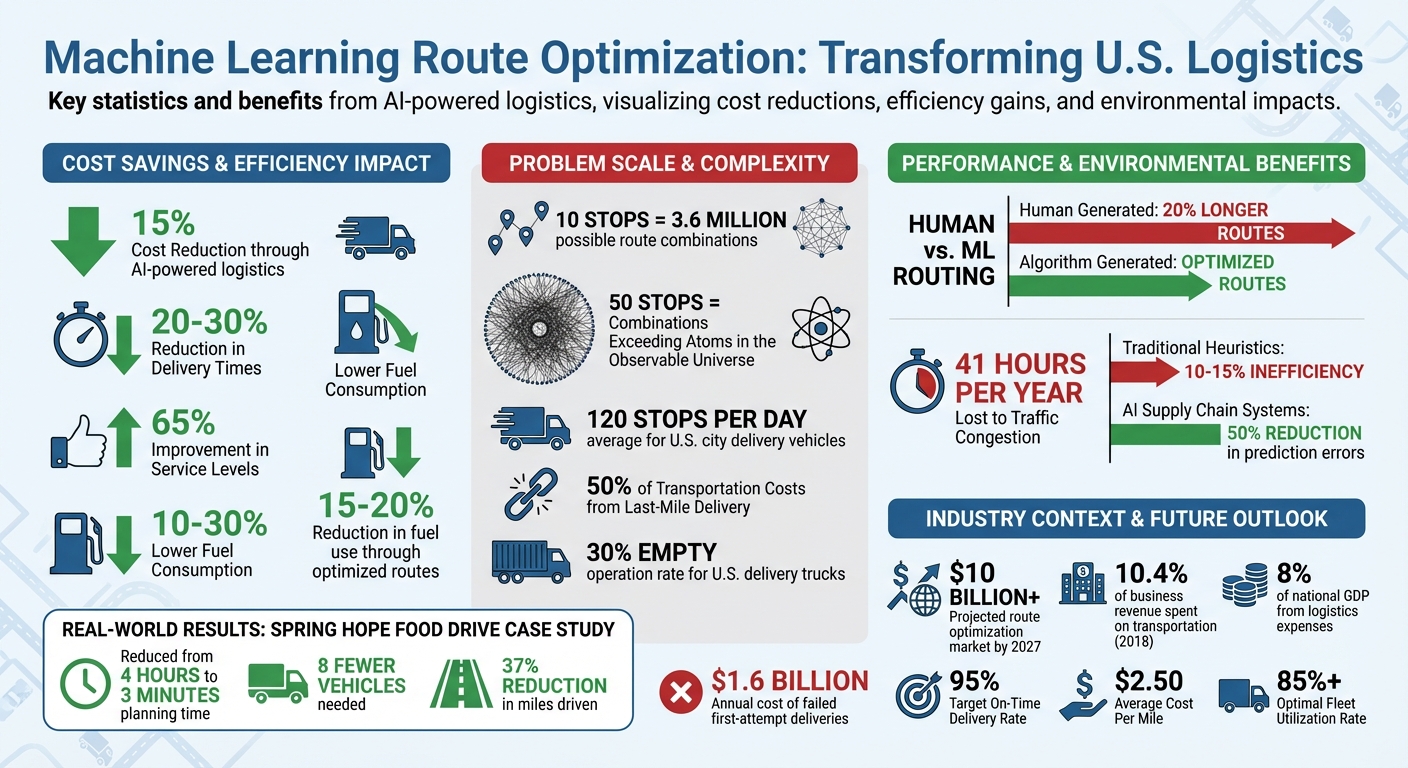
Machine Learning Route Optimization Impact: Cost Savings, Efficiency Gains & Environmental Benefits in Logistics
Route Optimization Challenges in Logistics
Common Problems in Logistics Routing
Route optimization is no walk in the park - it’s a mathematical maze. Picture this: with just 10 stops, you’re dealing with over 3.6 million possible route combinations. Bump that up to 50 stops, and the number of possibilities skyrockets to numbers that dwarf the atoms in the observable universe. This is what mathematicians call an NP-hard problem, where complexity grows exponentially with every additional stop.
But logistics isn’t just about crunching numbers. Real-world constraints make things even trickier. Delivery vehicles must stick to tight time windows, manage capacity limits for both weight and volume, and sometimes require drivers with specialized skills for specific tasks. Add urban environments into the mix, and the challenges multiply. In U.S. cities, for example, the average delivery vehicle makes about 120 stops per day. Drivers face obstacles like scarce parking and the added difficulty of navigating multi-story buildings compared to simpler ground-floor deliveries.
"The average delivery vehicle in a U.S. city makes about 120 stops. It can take a while to solve that explicitly... that's just too computationally expensive." - Matthias Winkenbach, Principal Research Scientist, MIT
And then there’s geocoding - mapping systems often pinpoint the center of a building instead of the actual entrance or loading dock, sending drivers to less-than-ideal spots. On top of that, real-time factors like traffic congestion, rush hours, school zones, road closures, and unpredictable weather create a constantly shifting puzzle. These challenges show why older routing methods often struggle to keep up.
Why Traditional Routing Methods Fall Short
With so many moving parts, traditional routing methods just can’t keep pace. They rely on static rules, which worked when stop-specific data wasn’t readily available. But in today’s fast-paced world, new orders can come in throughout the day, quickly rendering earlier plans obsolete.
Another issue is the manual effort involved in encoding constraints. Traditional operations research requires planners to translate every real-world challenge into mathematical equations. Adding new variables - like different street widths or extra time windows - means reworking the algorithm by hand. This manual approach often leads to inefficiencies. On average, human-generated routes are about 20% longer than those created by algorithms. Even when heuristics are used to speed things up, they still miss the mark by 10–15%.
Take the 2017 Spring Hope Food Drive in Vancouver as an example. Planners initially spent four hours manually organizing routes, requiring a large fleet of vehicles. After switching to an automated optimization system, they cut the fleet size by eight cars, reduced miles driven by 37%, and completed the planning process in just three minutes.
U.S.-Specific Logistics Constraints
The U.S. logistics landscape comes with its own set of hurdles. Traffic congestion is a major one - American drivers lose nearly 41 hours per year stuck in traffic during peak times. In 2018, transportation costs ate up 10.4% of business revenue, and logistics expenses accounted for about 8% of the national GDP.
Regulations add another layer of complexity. Routes must comply with hours-of-service rules to prevent driver overtime, all while meeting strict delivery windows set by customers. Regional differences in infrastructure also play a role. What works in a sprawling suburban area might be completely impractical in a dense urban center, where parking and building access can slow everything down.
Familiarity helps, though. Drivers perform 10% faster on routes they know well. But overlapping delivery paths - often called "spaghetti routes" - can lead to inefficiencies and frustration. These challenges contribute to the fact that last-mile delivery makes up 50% of total transportation costs. On top of that, U.S. delivery trucks operate, on average, 30% empty, highlighting just how much room there is for improvement.
sbb-itb-eafa320
How Machine Learning Works for Route Optimization
The Machine Learning Process in Logistics
Machine learning is reshaping route planning by relying on data-driven insights. It all begins with data collection, where information is gathered from various sources like GPS trackers, smartphones, real-time traffic feeds, weather updates, and IoT sensors installed on vehicles. This data includes details such as parking availability, building access, and service durations.
Once the data is collected, the next step is data preparation. Here, raw data is cleaned and processed. For example, addresses are geocoded into precise latitude and longitude coordinates, and important features are extracted to prepare the data for machine learning algorithms. Finally, the analysis phase kicks in. Advanced models, like neural networks or reinforcement learning algorithms, analyze the data to identify patterns. These patterns might reveal recurring delays during school pickup times or highlight differences in driver performance.
"A learning-based routing tool will continue to find improvements to your routes without you having to invest into explicitly designing these improvements into the algorithm."
– Matthias Winkenbach, Director of Research, MIT Center for Transportation and Logistics
This structured approach enables machine learning to lay the foundation for advanced routing capabilities that make logistics more efficient.
Machine Learning Features for Routing
Machine learning goes beyond just collecting and cleaning data - it introduces features that directly address logistical challenges. For instance, predictive ETAs use historical data and real-time traffic updates to provide accurate arrival times. Similarly, demand forecasting examines seasonal trends and promotional campaigns to predict spikes in order volumes, helping companies allocate vehicles and drivers more effectively.
Another standout feature is dynamic re-routing, which uses live data to instantly adjust routes. Whether it’s an accident blocking a road or a new order coming in mid-route, reinforcement learning algorithms can recalibrate paths without human input. Machine learning also accounts for operational constraints, like keeping perishables and electronics separate, while balancing multiple goals simultaneously.
A real-world example of ML in action comes from logistics provider Carryt. In June 2022, they partnered with Omdena to create an AI-powered route optimization system. By incorporating constraints like vehicle capacity and time-specific pickups and drop-offs, they achieved up to a 15% reduction in travel distance, fuel usage, and greenhouse gas emissions.
Combining ML with Optimization Algorithms
Machine learning becomes even more powerful when paired with traditional optimization methods. Together, they create robust routing solutions. ML excels at handling unpredictable variables, like estimating travel times based on traffic and weather, while traditional algorithms focus on calculating the most efficient paths using these predictions.
One effective strategy is the "Cluster First, Route Second" (CFRS) approach. Here, ML techniques such as K-means clustering group nearby delivery locations, and optimization algorithms then sequence the stops for optimal efficiency. Another innovative method uses Transformer models - originally designed for language processing - to treat delivery addresses like vocabulary, arranging them into logical and efficient routes. These hybrid systems, trained on historical data, can deliver near-instant solutions during operations.
The results speak for themselves: AI-powered supply chain systems have been shown to reduce prediction errors by up to 50%, lower logistical costs by 15%, and improve service levels by 65%.
Implementing ML-Based Routing in Daily Operations
Daily Planning and Real-Time Execution
Every day, machine learning combines historical data with live updates - like traffic conditions, weather changes, and driver performance metrics - to create the most efficient routes. As the day progresses, the system continuously refines these routes using live GPS data, weather alerts, and road closure updates from API integrations.
One standout feature is the ability to predict service times more accurately. Instead of relying on static estimates, machine learning analyzes factors like product details, delivery volumes, and customer-specific patterns to forecast stop durations. When unexpected events occur - an accident, a sudden roadblock, or a last-minute delivery request - the system recalculates routes automatically.
"Machine learning algorithms are able to optimize routes more effectively than ever before... It's like having a skilled co-pilot who can expertly steer you through congested traffic."
– Rakesh Patel, Founder, Upper Route Planner
This dynamic approach not only improves daily operations but also lays a strong foundation for managing the diverse demands of 3PL services.
ML Routing for 3PL Service Lines
Third-party logistics (3PL) providers face a variety of service demands, making intelligent routing essential. Clustering algorithms play a key role here, grouping nearby delivery stops to streamline local deliveries and pool distribution. This approach minimizes unnecessary detours and is especially valuable in last-mile delivery, which accounts for 50% of transportation costs.
For more specialized services, like white glove deliveries, machine learning ensures precision. It handles time-sensitive appointments by aligning routes with strict time windows while accounting for longer service durations. Additionally, it enforces compatibility rules, such as keeping perishables separate from electronics or ensuring pharmaceuticals are transported in climate-controlled vehicles. Companies like JIT Transportation, which offers niche services like kitting, assembly, and testing, benefit from ML routing by matching vehicles to specific service requirements and maintaining efficient schedules across their nationwide networks.
Technology Integration Requirements
For ML-based routing to work seamlessly, a well-synchronized data ecosystem is essential. This typically involves integrating multiple systems: a Transportation Management System (TMS) for carrier operations, a Warehouse Management System (WMS) for inventory tracking, and telematics hardware for real-time vehicle monitoring. For example, when the WMS detects low inventory levels, it can trigger the TMS to optimize routes for load consolidation, cutting down on unnecessary trips.
Modern setups rely on REST APIs and webhooks to sync data across systems like telematics, CRM platforms, and inventory databases. Geocoding engines further enhance routing by converting addresses into precise coordinates, ensuring accurate directions.
A real-world example of effective integration is the Colgate Distribution Center (Macro CEDIS). As of September 2025, this 100,000 m² facility processes 162 million boxes annually and generates $125 million in monthly turnover. Its success stems from synchronized WMS and TMS operations, supported by ground teams who validate route feasibility from the start.
Measuring Results and Future Trends
Performance Metrics for ML Route Optimization
When assessing the impact of machine learning (ML) in route optimization, it’s all about the numbers. Key performance metrics help quantify its effectiveness and provide a clear picture of operational improvements. At the forefront is On-Time Delivery Rate (OTD). Industry benchmarks push for 95% or higher, with anything below signaling inefficiencies in routing systems. Another critical measure is Cost Per Mile (CPM), which calculates total fleet expenses divided by miles driven. This metric typically averages around $2.50 but can vary by region. Companies tracking CPM often report annual cost reductions of 20–30%.
The Fleet Utilization Rate is another vital metric, comparing loaded miles to available miles. A rate above 85% is considered optimal. Similarly, the First-Attempt Delivery Success Rate directly impacts costs, as failed deliveries collectively cost U.S. businesses over $1.6 billion annually. ETA Accuracy plays a pivotal role in maintaining customer trust, while tracking Fuel Efficiency offers a tangible way to measure optimization success. For third-party logistics (3PL) providers, On-Time In-Full (OTIF) ensures that deliveries arrive on time and in the correct quantities. Together, these metrics provide a solid foundation for evaluating ML’s role and charting its future.
Future Trends in ML-Driven Logistics
The logistics industry is rapidly evolving, and machine learning is driving some of the most exciting advancements. Reinforcement learning is leading the charge, enabling systems to learn from every completed route to improve future decisions. For example, Amazon has leveraged this technology to shave over 30 minutes off same-day delivery windows in major metropolitan areas. Another innovation, digital twin technology, allows companies to test routing strategies in a virtual environment before implementing them in real-world operations.
Edge AI is also making waves by processing data directly on vehicles. This enables instant routing decisions, even in areas with unreliable connectivity. Meanwhile, predictive maintenance uses IoT sensors to monitor vehicle conditions - like vibration, temperature, and tire pressure - predicting issues before they lead to breakdowns. DHL’s SmarTrucking platform in India is a prime example, achieving a 95% on-time delivery rate with ML-driven predictive analytics. Additionally, an electric truck trial reduced CO₂ emissions by 90%. Then there’s Agentic AI, which allows planners to ask conversational questions like “Where are my delivery bottlenecks?” and receive immediate, visual insights. These advancements demonstrate how ML is reshaping e-commerce logistics, making it smarter and more efficient.
Advantages and Limitations of ML Routing
While machine learning has revolutionized route optimization, it’s not without its challenges. Here’s a closer look at the trade-offs:
| Advantage | Limitation |
|---|---|
| Efficiency: Optimized routes reduce fuel consumption by 15–20% and cut down idle time | Data Dependency: Models rely on clean, accurate data, and issues like incomplete addresses or outdated traffic information can disrupt operations |
| Scalability: Can manage thousands of vehicles and constraints across multiple shifts | Complexity: High upfront costs for IoT sensors, API integrations, and infrastructure can be a barrier |
| Customer Satisfaction: Real-time, precise ETAs enhance trust and reduce customer service inquiries | Edge Cases: Unusual scenarios often require human judgment, which ML systems may struggle to handle |
| Sustainability: Reduces empty miles and optimizes routes to lower emissions | Integration Challenges: Syncing ML systems with existing TMS, WMS, and legacy platforms can be resource-intensive |
"In 2025, if you are not treating route optimization as a core piece of infrastructure, you are already behind. The companies that win are the ones who route better, not just faster."
– NextBillion.ai
Looking ahead, the global route optimization market is projected to surpass $10 billion by 2027. For companies like JIT Transportation, which manage expansive networks and specialized services, the key to staying competitive lies in balancing the benefits of efficiency with the complexities of implementation. ML routing isn’t just a tool - it’s becoming a cornerstone of modern logistics strategy.
AI & Machine Learning Use Cases for Route Optimisation
Conclusion
Machine learning has transformed how U.S. third-party logistics providers (3PLs) optimize routes. By enabling real-time adjustments to traffic incidents, weather disruptions, and shifting delivery priorities, it offers a level of flexibility and precision that traditional static methods simply can't achieve.
The financial upside is undeniable. AI-powered logistics can slash costs by 15% while improving service levels by an impressive 65%. Some implementations have cut empty miles - previously averaging 30% across the industry - down to as low as 10% to 15%. For 3PLs managing intricate networks and specialized services like pick-and-pack, kitting, or white glove handling, these efficiencies lead to stronger profit margins and more satisfied customers.
But it’s not just about saving money. Machine learning tackles complexities that manual planning struggles to handle. It optimizes vehicle capacity, delivery windows, driver hours, and road restrictions across thousands of routes, all while cutting travel distances, fuel consumption, and greenhouse gas emissions by up to 15%.
"The 3PL that are likely to stand out are those that can not only provide better solutions, but also exhibit the expertise needed to manage them." – Radhika Mulastanam, Director of International Services at AFS Logistics
This shift to machine learning-based routing is more than just an upgrade - it's becoming essential for staying competitive. U.S.-specific challenges like multi-stop networks and complex service demands are now met with smarter, more adaptive solutions. 3PLs embracing these technologies can handle rising delivery volumes, meet tighter service agreements, and adapt to the ever-changing demands of modern supply chains. At JIT Transportation (https://jittransportation.com), we’re fully committed to leveraging these advancements to optimize routes and provide top-tier service. Success starts with clean data, active involvement from ground teams, and continuous refinement based on real-world results.
FAQs
How does machine learning make route optimization more efficient in logistics?
Machine learning (ML) is shaking up route optimization by creating systems that respond dynamically to real-world conditions like traffic jams, unpredictable weather, and fluctuating delivery demands. Unlike older, static methods, ML dives into both historical data and real-time updates to pinpoint the most efficient routes, ultimately saving time and cutting down on resources.
By using methods like clustering, neural networks, and reinforcement learning, ML-enabled systems can adapt on the fly. Imagine a road closure or a last-minute delivery request - these systems can quickly adjust routes without missing a beat. The results? Lower transportation costs, reduced fuel use, and faster deliveries.
At JIT Transportation, we put these advanced ML tools to work, offering logistics solutions across the U.S. that prioritize smarter routing. The outcome is not just streamlined supply chains but also happier customers who benefit from quicker, more reliable deliveries.
What challenges can arise when using machine learning to optimize logistics routes?
Implementing machine learning (ML) to optimize logistics routes isn't without its hurdles. One of the biggest challenges is the need for large, high-quality datasets. To build effective ML models, you need data like shipment records, traffic patterns, and driver performance metrics. But collecting, cleaning, and integrating this data from various sources can be a complicated and time-consuming process.
Another major issue is the complexity of routing problems. For instance, solving the Traveling Salesman Problem (TSP) - which involves finding the most efficient delivery routes - becomes exponentially harder as the number of stops increases. ML systems are tasked with balancing speed and accuracy, especially when real-time decisions are required to handle last-minute orders or unexpected traffic delays.
Then there’s the challenge of integrating ML-driven solutions into existing workflows and systems. Many businesses encounter resistance to change, whether it’s from employees or management, and implementing these solutions often requires specialized knowledge. On top of that, companies need to justify the upfront costs of adopting new technology, which can be daunting in an industry already dealing with rising operational expenses.
Even with these challenges, ML has the potential to transform logistics by streamlining operations and cutting costs, making it a promising investment for the future.
How does machine learning help reduce logistics costs and improve delivery performance?
Machine learning is transforming logistics by analyzing real-time data - like traffic patterns, weather conditions, vehicle capacity, and delivery history - to determine the most efficient routes. This means less fuel is used, travel distances are shortened, and fleets are managed more effectively. The result? Lower costs, time savings, and reduced vehicle wear and tear. Plus, it helps cut emissions, contributing to greener operations.
It doesn't stop there. Machine learning also improves delivery performance by offering precise, real-time delivery estimates and adjusting routes dynamically. If unexpected problems arise, like traffic jams or vehicle breakdowns, the system quickly reallocates resources to keep deliveries on schedule. These advancements not only trim expenses but also enhance customer satisfaction by ensuring a service that's both dependable and efficient.
Related Blog Posts
Related Articles
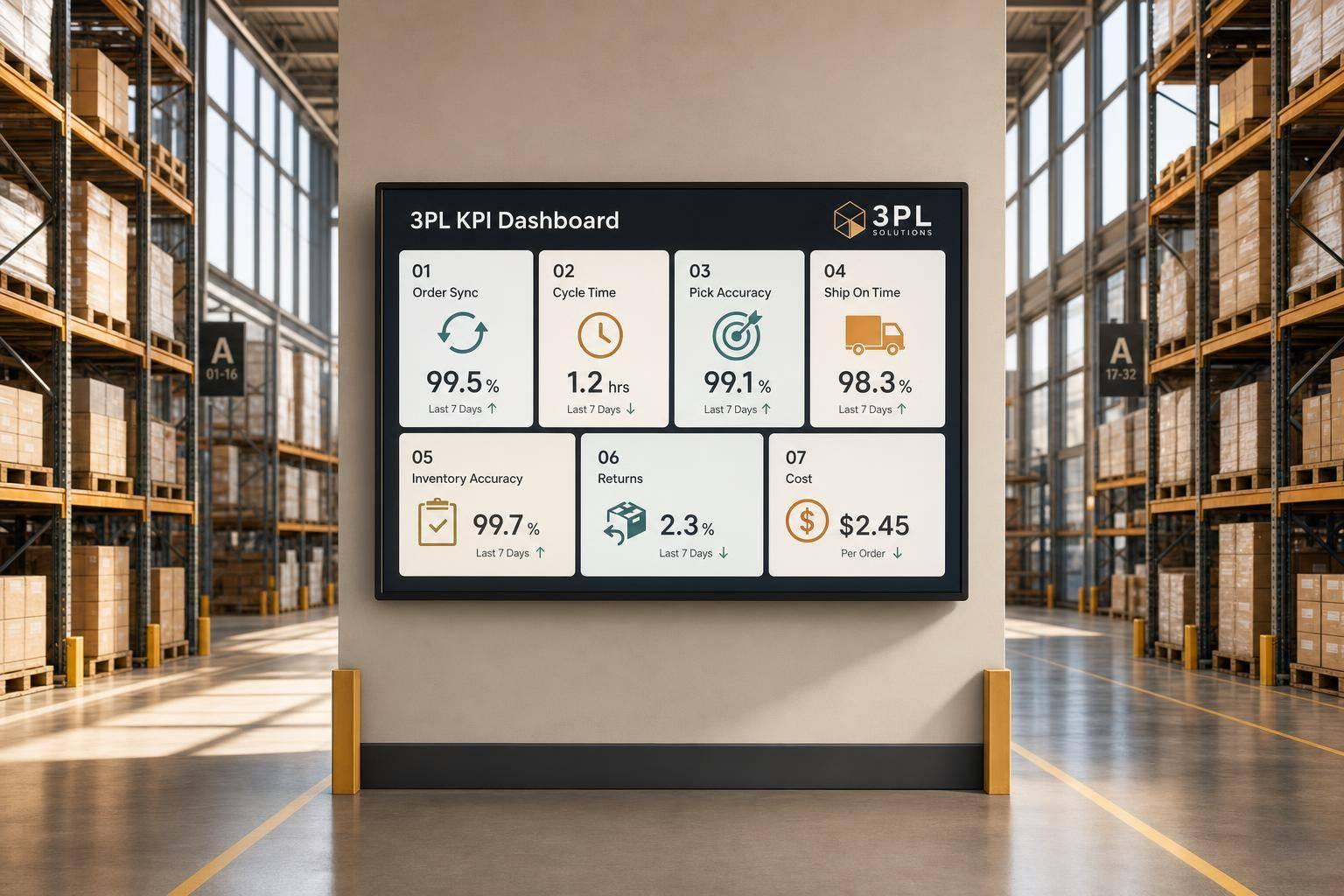
7 WooCommerce 3PL KPIs Teams Track

Centralized vs Decentralized Replenishment
