
Checklist for Managing Peak Season Scalability Risks

Peak season can make or break your business. With up to 50% of annual revenue on the line, retailers must prepare for surging demand, inventory challenges, and shipping bottlenecks. This article outlines a detailed checklist to help you handle staffing, inventory, technology, and transportation during high-demand periods.
Key Takeaways:
- Staffing: Use data-driven forecasts, start hiring early, and cross-train employees for flexibility.
- Inventory: Forecast demand 3-6 months ahead, optimize stock placement, and enable real-time tracking.
- Technology: Test system scalability, automate fulfillment, and monitor operations in real time.
- Transportation: Secure carrier capacity early, optimize routing, and set up end-to-end tracking.
Preparation is everything. Follow these steps to avoid costly disruptions and ensure smooth operations during peak seasons.

Peak Season Scalability Checklist: 4 Critical Areas for Retail Success
Staffing Readiness Checklist
Forecast Staffing Requirements
Getting staffing levels right is essential to handle peak periods without a hitch. Instead of just looking at last year's headcount, dig deeper. Use predictive analytics to examine factors like volume fluctuations, order patterns, throughput needs, and peak-to-base ratios. Tap into data from sales history, market trends, and customer behavior for a clearer picture. Keep in mind, events like promotions, product launches, or bundling trends can significantly shift order volumes and complexity. Collaborating early with your marketing and sales teams can help fine-tune these forecasts.
For example, warehouses often increase staffing by 15-20% during the holiday season. A typical staffing mix might include 60-70% full-time employees, 20-30% temporary workers, and 10-20% seasonal hires.
Once you've nailed down your staffing needs, focus on rapid onboarding and aligning skills to keep operations running smoothly during peak times.
Create Training and Onboarding Plans
The goal? Get new hires to 80% productivity within 3-5 days. To achieve this, start your recruitment process 8-12 weeks before the busy season. Streamline onboarding by digitizing processes - send tax forms and safety manuals electronically - and use short video tutorials to teach key tasks.
"Every day of training is a day without full productivity", says ThinkHire.
A buddy system can work wonders: pair temporary hires with experienced team members to speed up learning. Assign new workers to specific departments until they’re fully trained. Additionally, warehouse management systems with real-time prompts and scan-verification features can help new hires work more efficiently.
Once onboarding is complete, cross-training and smart shift scheduling will keep your team ready for the unpredictable demands of peak season.
Set Up Cross-Training and Shift Schedules
Cross-training is a game-changer during peak periods. Workers trained in multiple roles can step in where they’re needed most - like picking or packing - when demand surges. This flexibility is critical, especially when shipping volume can spike to 3 to 5 times the usual levels.
"Cross-training employees adds flexibility, ensuring shifts don't stall if one role is short-staffed", explains the Sellercloud Team.
To make the most of your workforce, analyze hourly volume patterns. For instance, if order spikes happen between 10 a.m. and 2 p.m., adjust shift schedules to ensure enough staff is available during those times. Start cross-training your core team about 4-6 weeks before peak demand to build a versatile workforce and reduce the risk of burnout during the busiest days.
sbb-itb-eafa320
Inventory Management Checklist
Conduct Demand Forecasting
Begin demand forecasting at least 3–6 months in advance to avoid stockouts or excess inventory. Combine historical sales data with market trends to create accurate predictions. Tools powered by AI can be especially helpful here, analyzing past sales patterns and identifying sudden spikes caused by viral trends. These tools can dynamically adjust stock levels, potentially cutting inventory by 20% to 30%. Incorporate real-time demand sensing to complement traditional methods. Collaboration with your marketing team is also key, as promotional campaigns heavily impact sales. For instance, during the 2024 holiday season, 85% of consumers planned to reduce non-essential spending.
"Knowing which products sell out right away versus sit on our shelves for months until Christmas is important, so we can not only have adequate and appropriate inventory, but are able to order ahead so artisans have time to produce inventory", shares Sylvia Fountaine, Owner and Founder of Feasting at Home.
Optimize Stock Placement
Strategically distribute inventory across fulfillment centers based on regional demand patterns. Implement dynamic slotting to position fast-moving items near packing stations, reducing fulfillment times. Many warehouse management systems (WMS) include AI-driven putaway features that can automatically determine the best storage locations during receiving. This approach not only improves space management but also reduces the distance warehouse workers travel - up to 15 miles daily - on inefficient routes. Before peak seasons, clear out slow-moving or outdated stock to free up space for high-demand items.
Enable Real-Time Inventory Visibility
Real-time tracking is crucial to avoid overselling or running out of stock. With holiday e-commerce sales reaching $254 billion in 2023 and Cyber Monday alone generating $12 billion, inventory blind spots can lead to costly mistakes. A cloud-based WMS can synchronize inventory across all sales channels, ensuring accuracy. Use tools like barcode scanners or RFID technology to automate restocking and reduce manual errors. Set up alerts for low-stock or high-demand items to trigger immediate action. Integrating your system with supplier platforms can facilitate vendor-managed inventory, allowing suppliers to monitor stock levels and prepare for surges in demand.
Collaborating with seasoned 3PL providers, such as JIT Transportation, adds another layer of support. They can help you maintain real-time visibility and respond quickly during busy periods.
"As volatile as the market has been, any insight we can share helps our customers make faster, more informed decisions, and often saves them significant time and money", says Tim Kolb, Group Director of Freight Brokerage at Ryder System, Inc..
Technology and Infrastructure Checklist
Test System Scalability
Make sure your systems can handle the pressure 2–3 weeks before peak season by running thorough load tests. Given that Q4 often contributes 30–40% of yearly revenue for many retail sectors, with order volumes surging 3–5 times higher - and events like Black Friday going as high as 8–10 times normal levels - your systems need to be prepared. This includes your warehouse management system (WMS), enterprise resource planning (ERP), and order management system (OMS). They must work seamlessly under these conditions without crashing or slowing down.
Use tools designed for load generation to stress-test both individual components (like APIs, payment processing, and carrier tracking) and the entire order process - from checkout to carrier handoff. In 2024, Fluent Order Management customers maintained 100% uptime during peak season, even with an 85% year-over-year increase in order volumes. Establish benchmarks for key performance indicators such as API latency, calls per second, and order creation speed. These metrics will help you identify any performance issues before they impact your customers.
"In peak season, keeping your site online is the bare minimum. True readiness comes from ensuring end-to-end performance across your entire order (and inventory) lifecycle." – Carlee Berrington, Fluent Commerce
Once your systems are stress-tested and ready, the next step is to incorporate automation to optimize fulfillment processes.
Enable Automation for Fulfillment
Labor costs can make up as much as 70% of warehouse expenses, which is why automation is a game-changer. Automate tasks like order grouping, directed putaway, and smart routing to cut costs and speed up operations. Use automated shipping rules to handle package dimensioning, label creation, and carrier rate comparisons. Smart order routing can automatically assign orders to the nearest warehouse, redirecting them if stock runs out at a specific location.
A modern WMS can help businesses cut labor costs by an average of 40%, even during peak periods. However, only 42% of companies feel confident their systems can handle the demands of peak season. That’s why 79% of businesses are turning to advanced warehouse management solutions to stay profitable during these critical times.
Monitor Systems in Real-Time
After testing your systems and implementing automation, real-time monitoring is the key to staying on top of operations during peak demand. Cloud-based dashboards can centralize data on order volumes, inventory levels, and shipment statuses across all channels. Configure webhook alerts in your WMS to receive immediate notifications about potential issues, so you can resolve them quickly. Predictive analytics can also help you anticipate demand surges and adjust resources before bottlenecks occur.
Automated scanning tools are essential for maintaining website speed, functionality, and security during high traffic periods. Slow load times often lead to cart abandonment, so monitoring is critical. Internal dashboards tracking daily order volumes and shipments will ensure you meet service level agreements (SLAs). Additionally, ensure barcode scanners and RFID systems provide accurate data to your monitoring tools, minimizing manual errors. With Deloitte projecting e-commerce holiday sales to hit approximately $294 billion in 2024, real-time monitoring is vital for capturing your share of this revenue.
Teaming up with experienced 3PL providers like JIT Transportation can further enhance your infrastructure. Their advanced systems and scalable solutions provide the automation and monitoring tools needed to keep your operations running smoothly during peak demand.
Peak Season Playbook Strategies for Smooth Warehouses | E11
Transportation and Fulfillment Checklist
During peak seasons, managing transportation and fulfillment efficiently is crucial. Securing carrier capacity, streamlining routes, and improving tracking systems can help ensure smooth operations when demand surges.
Audit Carrier Network Capacity
Start discussions with your carriers 2–3 months ahead of peak periods to share your sales forecasts and expected order volumes. This proactive approach helps secure priority delivery slots when capacity tightens. For example, on Cyber Monday 2023, U.S. consumers spent $12.4 billion online, with package volumes increasing by 20% year-over-year. Ensuring your carrier partnerships can handle this kind of surge is essential.
Avoid relying on just one provider. A multi-carrier strategy acts as a safety net if one network reaches its limit. Evaluate past performance, including on-time deliveries, damage claims, and capacity during previous peak seasons. Review your contracts for details on peak surcharges, volume caps, and backup options. Setting up accounts with secondary carriers before November ensures you're prepared for last-minute changes.
Distributing inventory across regional fulfillment centers can also help. This approach taps into ground shipping networks, reducing transit times. It’s especially important considering that 77% of shoppers are more likely to return to retailers who quickly replace lost or damaged items with fast shipping. Additionally, coordinate your dock schedules to avoid bottlenecks during carrier pickups.
Once carrier capacity is secured, focus on improving shipment routing and consolidation for greater efficiency.
Optimize Routing and Consolidation
Using cross-dock facilities to consolidate shipments can significantly cut costs during high-volume periods. Large trailers can group loads at pool points before transferring them to smaller vehicles for last-mile delivery. This strategy works well for geographic clusters within 30–50 miles, where individual orders don’t justify dedicated trucks.
Dynamic routing systems, which adjust in real time based on factors like traffic, weather, and dock delays, are another game-changer. These systems can reduce delivery miles by 10–18% and increase stops per driver shift by 8–12%. Additionally, advanced load-building programs that maximize trailer space can eliminate one in every seven trucks, boosting efficiency by 8–15%.
In 2024, a consumer-electronics company implemented several strategies, including shifting 40% of SKUs to economy service, offering a $3 premium for faster delivery, and setting up micro-hubs for top-selling items. The results? An 11% reduction in freight costs, a 160 basis point increase in gross margin, and an 18% cut in Scope-3 emissions per shipped unit.
Set clear "order by" deadlines for customers based on carrier cut-offs, and update these deadlines as networks become more constrained.
The next step is to ensure full visibility by leveraging comprehensive tracking systems.
Set Up End-to-End Tracking
Integrate your warehouse management system with multiple carriers through a unified interface. This allows you to automatically choose the best shipping option and provide customers with consistent tracking updates. With 69% of shoppers saying they wouldn’t buy from a brand again if their orders are delivered late, visibility is critical.
Tools like mobile barcode scanners and RFID technology can provide instant, stage-by-stage updates, ensuring up to 100% picking accuracy while reducing manual errors. Offering live tracking links also helps cut down on "Where is my order?" inquiries - important because more than half of customers won’t reorder after a poor delivery experience.
Companies like JIT Transportation offer advanced tracking solutions through their nationwide network. Their services integrate ERP systems with pool distribution, giving you visibility from the warehouse to the customer’s doorstep. For high-value items, their white glove handling ensures premium delivery options during peak demand periods.
Pre-Peak Testing and Monitoring Checklist
Getting your systems ready before the holiday rush can make all the difference between smooth sailing and costly disruptions. Take it from major retailers like Costco and Lego, who faced website crashes during Black Friday in 2024, losing millions in potential sales due to overwhelmed infrastructure. Don’t wait until November to test your systems - start early to avoid the same fate.
Run End-to-End Load Testing
Begin by checking how well your systems work together - your storefront, ERP, 3PL, and shipping software must handle high volumes seamlessly. Your website should be ready to manage traffic spikes of 5x to 10x its usual load while maintaining performance. With so much shopping happening on smartphones, ensuring a smooth mobile checkout process is a must.
To stress-test your warehouse systems, simulate peak conditions by processing 10,000 orders in a single hour during a quieter time. Skipping this step can be costly - just ask ASOS, whose untested warehouse management system caused inventory chaos and a $25 million loss.
"The holiday surge exposes every crack in disconnected systems: Shopify, 3PLs, carriers, ERPs." – Truce Hansen, Office Manager, Parabola
Don’t overlook the details. Validate API rate limits and implement retry logic with exponential backoff to catch silent failures and avoid lost orders. Measure manual processes, such as how long it takes to print manifests or move bins to docks, as these can become bottlenecks under pressure. Also, ensure address verification happens at checkout rather than during label creation to avoid unnecessary delays during peak times.
Once you’ve gathered your load testing results, shift gears to prepare for potential system failures.
Validate Contingency Plans
Run "Game Days" to simulate real-life failure scenarios, like a major carrier outage or API errors, to ensure your team and systems can adapt quickly. For example, in 2025, cookware brand Our Place used distributed inventory across six warehouses and implemented multi-carrier failover strategies. This allowed them to scale up and generate $2 million in extra holiday revenue, all while maintaining a 2.5-day average delivery time.
"A failure to plan is a plan for failure. In shipping, if you don't plan for failure, you are planning to fail." – Andy Hopper, Principal Solutions Architect, Shippo
Set up automated carrier failover rules so orders are rerouted to backup providers if your main carrier takes longer than 30 seconds to generate labels. Test your inbound operations by doubling the usual volume in a dry run to confirm your receiving team can handle the load without creating delays. Additionally, ship test orders and simulate "tracking not updating" scenarios to evaluate your support team’s response time and effectiveness.
Document Post-Peak Procedures
Once the rush is over, having a clear plan for returns, inventory restocking, and staffing transitions is crucial. Poor service during high-pressure times drives customers away - 96% of them won’t return if they have a bad experience. Track metrics like picks per hour, throughput time, dock-to-stock cycle time, and order accuracy to identify areas for improvement in the next season.
Hold a post-peak debrief with your team to review what worked and what didn’t. For businesses that self-fulfill without strong processes, error rates can soar to 50% during peak times - documenting these failures helps you address weak spots. Evaluate how well your temporary staff performed and update your training materials to streamline onboarding for the future. Lastly, benchmark your infrastructure’s capacity against industry standards - payment providers often keep system utilization below 30% to handle peak traffic spikes. Use this as a guide to decide if your systems need upgrades.
Conclusion
Achieving success during peak seasons requires careful planning across staffing, inventory, technology, and transportation. By preparing in advance, you can avoid the chaos of last-minute adjustments. Considering that Q4 can account for up to 50% of annual revenue, there’s little room for error when it comes to execution. A proactive approach to transportation strategy is especially critical.
Failing to plan ahead can cost you customers. Poor service drives them to competitors. On the other hand, companies that invest in scalable technology often see transformative results. Take State & Liberty, for example - they achieved a 75% faster picking process while reducing labor by 67% after implementing a mobile WMS in 2025. Similarly, systems with built-in buffer capacity can handle surges effectively, as demonstrated by payment processors operating at less than 30% utilization during normal periods to manage traffic spikes.
Another key factor is maintaining agility in your fulfillment network. Diversifying carrier options and strategically placing warehouses allows you to respond quickly to disruptions, whether it’s a bottleneck in a primary route or a carrier reaching capacity.
"With the flexibility that comes with working with a larger company, it's easier to pivot and serve your customers at or above their expectations".
JIT Transportation provides scalable 3PL solutions that include advanced tracking, multi-carrier capabilities, and strategically located warehouses to ensure speed and service quality during peak periods.
The earlier checklists offer a strong foundation, but long-term resilience depends on continuous improvement. Use quieter months to analyze historical data, identify successes and shortcomings, and refine your processes. This preparation ensures that when the next surge arrives - whether it’s Black Friday or an unexpected viral trend - you’ll be ready to meet the challenge head-on.
FAQs
What are the first peak-season risks I should address?
One of the biggest hurdles during peak season is handling the surge in shipping volume while dealing with limited carrier availability. If you're not ready, these factors can seriously disrupt your logistics and fulfillment operations.
To stay ahead, focus on planning for higher demand. This means forecasting sales accurately and ensuring you have enough carrier capacity lined up. Additionally, take a close look at your warehouse workflows - streamlining processes now can make a huge difference when orders start piling up. A little preparation goes a long way in keeping things running smoothly.
How can I forecast demand without overbuying inventory?
To predict demand effectively without ending up with excess inventory, it's crucial to rely on precise strategies that consider seasonality, trends, and shifting market dynamics. Leveraging tools like time-series analysis, causal models, or even machine learning algorithms can greatly enhance accuracy.
By combining demand forecasting with inventory planning - especially during peak seasons - you can align stock levels more closely with actual demand. This approach helps minimize the risk of overstocking, offering better control over your supply chain and making it easier to adapt as your business grows.
What should I load-test to avoid peak-season outages?
To avoid outages during peak seasons, it's crucial to load-test your systems. This process evaluates their speed, reliability, and scalability under conditions that mimic high-traffic scenarios. Make sure to test all critical components, including infrastructure, applications, and APIs.
You can use automated load testing tools or simulate heavy traffic through methods like stress testing or spike testing. For example, you might replicate traffic patterns from flash sales or other high-demand events. These tests help pinpoint bottlenecks, ensuring your systems are prepared to handle surges in demand without breaking down.
Related Blog Posts
Related Articles
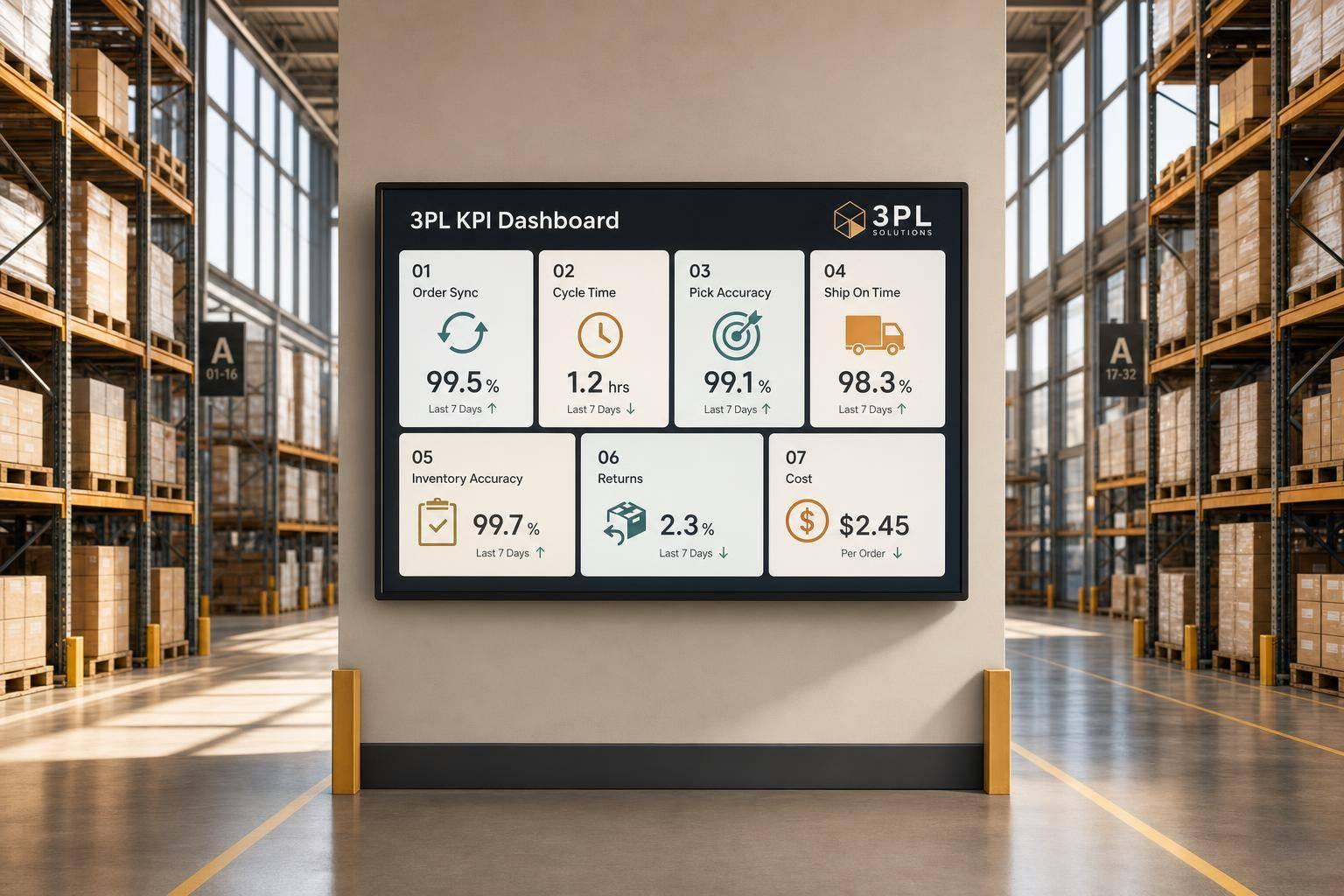
7 WooCommerce 3PL KPIs Teams Track

Centralized vs Decentralized Replenishment
