
Real-Time Demand Sensing: Key Benefits for E-commerce
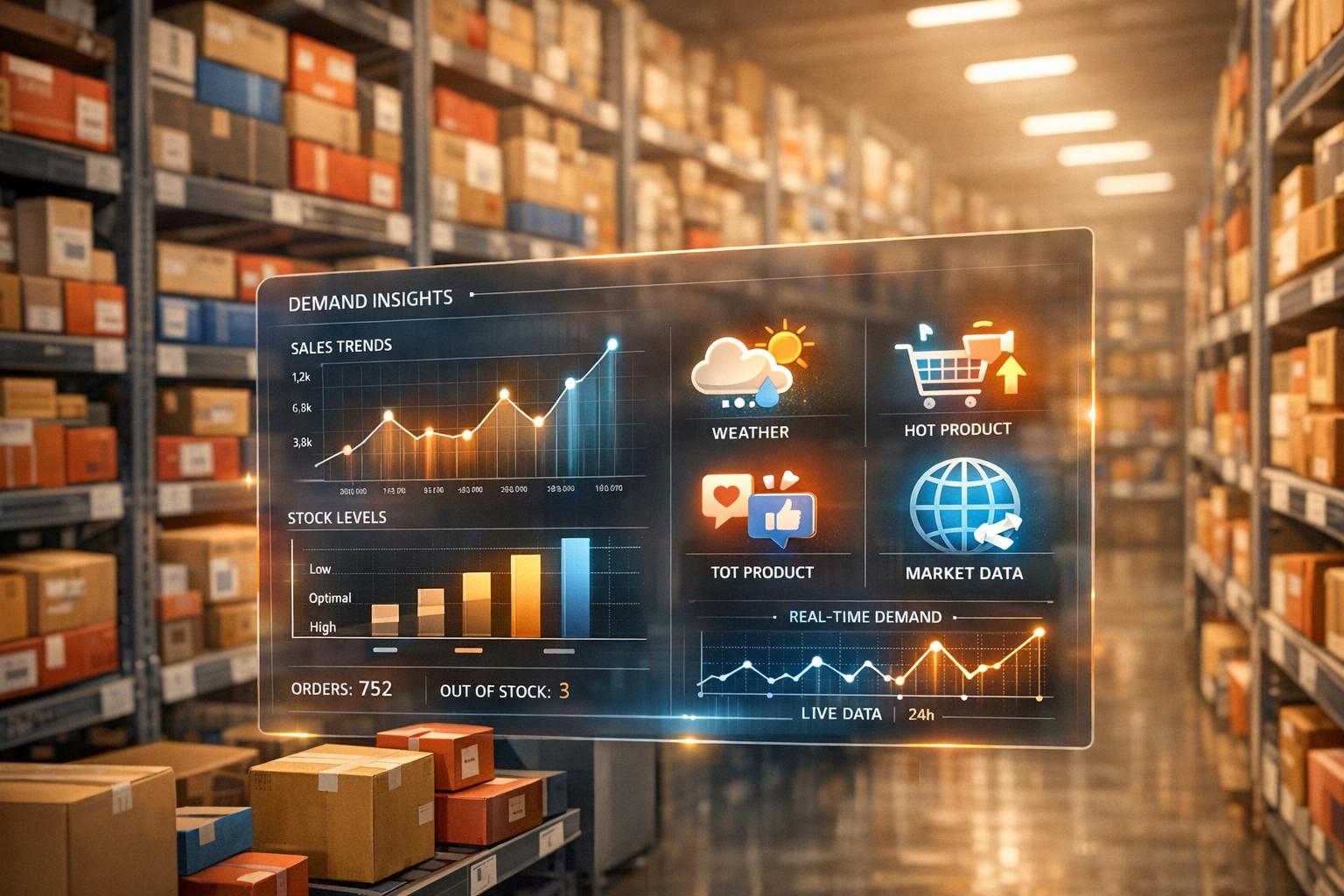
Real-time demand sensing allows e-commerce businesses to predict short-term market changes by analyzing live data from sources like sales systems, social media, and weather. This AI-driven approach improves forecast accuracy, reduces inventory costs, and enhances customer satisfaction by responding faster to market shifts.
Key benefits include:
- 30%-50% better forecast accuracy: Companies like P&G and Intel have seen error reductions and improved service levels.
- Lower inventory costs: Businesses report up to a 17% reduction in stock and fewer stockouts.
- Improved customer service: Faster responses lead to higher order fulfillment rates and better delivery reliability.
- Proven results across industries: Fashion, beauty, and general e-commerce sectors have seen measurable improvements in sales, inventory turnover, and customer satisfaction.
Real-time demand sensing outperforms older forecasting methods by using live data, enabling quicker decision-making and more efficient supply chains. Pairing it with logistics partners ensures these insights translate into action, helping brands meet rising consumer expectations.
Key Benefits of Real-Time Demand Sensing for E-commerce
Better Forecast Accuracy
Real-time demand sensing can boost short-term forecast accuracy by 30%–40%, and for certain product lines, improvements can reach up to 50%. This is made possible by using AI to analyze diverse data sources like POS transactions, social media sentiment, and even weather patterns. By processing this real-time data quickly, AI models help reduce errors in supply chain planning by as much as 40%.
Take Procter & Gamble (P&G), for example. By combining real-time data from POS systems, e-commerce platforms, and social media with machine learning, P&G saw a 50% improvement in forecast accuracy, cut inventory levels by 10%, and improved service levels by 17%. Similarly, Intel applied demand sensing to its supply chain, achieving a 40% increase in forecast accuracy, a 20% reduction in inventory, and a 15% boost in customer satisfaction.
When forecasts are more accurate, inventory management becomes more efficient.
Lower Inventory Costs and Better Stock Management
Accurate forecasting directly impacts inventory costs, helping businesses reduce excess stock and optimize inventory levels. Companies using demand sensing have reported up to a 17% reduction in total inventory and a 15% cut in surplus stock. These improvements free up working capital and lower operating expenses.
Walmart is a prime example of this in action. By adopting an AI-driven real-time data strategy, Walmart cut inventory costs by 15%, reduced stockouts by 30%, and increased sales by 20%.
"By avoiding restocking items that lack consumer demand, clients can now put their valuable capital towards achieving maximum revenue." – Malini Ganguly, Digital Technology Analyst, NTT DATA
Unilever also saw impressive results. The company reduced forecast errors by 25% and lowered its finished goods safety stock by three days, which in turn reduced freight costs tied to stock movement. By improving near-term forecast accuracy, businesses can minimize the need for excess safety stock, freeing up resources for other priorities.
These inventory improvements naturally contribute to better customer service.
Better Customer Service and Faster Response Times
With more accurate forecasts and leaner inventories, demand sensing allows e-commerce brands to respond quickly to market changes. This agility directly enhances customer service by improving delivery reliability and responsiveness. Businesses using demand sensing report a 14% increase in the perfect order rate, ensuring customers receive the right products on time.
"Demand sensing can improve the performance of key supply chain indicators, such as inventory turnover, service level, fill rate, and order fulfillment." – Intuendi
Research-Backed Case Studies in E-commerce
Fashion and Beauty Sector Results
The fashion and beauty industries have reaped impressive benefits from using real-time demand sensing. For example, one prominent beauty brand reported a 30% reduction in stockouts, a 25% increase in inventory turnover, a 20% rise in sales during seasonal promotions, and a 40% improvement in customer satisfaction ratings. These numbers highlight the tangible impact of adopting demand-driven strategies.
Similarly, a mid-sized fashion retailer tapped into real-time social media trends to make smarter inventory decisions. By analyzing social sentiment, they managed to cut markdowns by 30%, boost inventory turnover by 20%, reduce stockouts by 40%, and increase online sales by 35% within just one year. This approach helped them avoid the common pitfalls of overproduction and heavy discounting - a recurring challenge for many in the fashion world.
These success stories reflect a broader trend in the industry. In fact, 61% of leading consumer products and retail companies believe that demand-driven planning is a "game-changing" capability. The results from the fashion and beauty sectors underscore the potential for similar efficiencies across the wider e-commerce landscape.
General E-commerce Insights
The benefits of demand sensing aren’t confined to fashion and beauty. Across the e-commerce spectrum, brands are using this technology to adapt quickly to market fluctuations and improve their operations.
"Demand sensing technology consistently reduced forecast error by one-third compared to traditional methods, even during the extreme volatility of panic buying." – Pawan Joshi, EVP of Products and Strategy, E2open
One area where demand sensing has proven particularly effective is in managing slow-moving, less popular products. During recent market disruptions, planning errors for these items increased by 21 percentage points, compared to 11 percentage points for high-demand products. By combining demand sensing with multi-echelon inventory optimization, companies achieved a 40–50% reduction in safety stock.
These insights demonstrate how demand sensing not only supports smoother operations but also equips businesses to handle unpredictable market conditions with greater confidence.
AI Demand Sensing: Forecasting for Modern Supply Chains
sbb-itb-eafa320
Demand Sensing vs. Traditional Forecasting: A Comparison

Real-Time Demand Sensing vs Traditional Forecasting: Key Performance Metrics
Traditional forecasting methods lean heavily on historical data and static statistical models. While these methods are effective for long-term strategic planning, they often fall short in adapting to the fast-paced changes and unpredictability of today’s e-commerce landscape. These approaches assume that patterns remain stable over time - an assumption that quickly unravels when consumer preferences shift suddenly or unforeseen events disrupt the market.
Real-time demand sensing, on the other hand, takes a completely different route. Instead of relying on outdated snapshots, it taps into continuous streams of data from sources like POS systems, e-commerce platforms, social media sentiment, weather updates, and IoT devices. This enables businesses to identify emerging trends and adjust inventory plans on a daily - or even hourly - basis. By blending this short-term agility with the long-term planning strengths of traditional forecasting, companies can better navigate the complexities of modern retail.
The difference in performance between these two methods is striking. Businesses using demand sensing can detect market changes at least five times faster and respond three times quicker than those sticking to traditional forecasting. Accuracy in short-term forecasts improves by 30% to 40%, and some product lines experience a 50% reduction in weekly forecasting errors. Karen McNaughton, VP of Global Marketing at Algo, aptly summarizes the shift:
"Traditional methods assume the future will mirror the past, but in today's dynamic retail environment, that's no longer sustainable."
Comparison Table: Real-Time Demand Sensing vs. Traditional Forecasting
| Metric | Traditional Forecasting | Real-Time Demand Sensing |
|---|---|---|
| Primary Data Source | Historical sales and order history | Real-time signals (POS, social media, weather, IoT) |
| Update Frequency | Monthly or quarterly | Daily or near real-time |
| Time Horizon | Long-term strategic planning | Short-term operational execution (0–14 days) |
| Detection Speed | Baseline (1x) | 5x faster |
| Response Speed | Baseline (1x) | 3x quicker |
| Accuracy Improvement | Standard baseline | 30–50% higher accuracy |
| Inventory Impact | Higher safety stock to cover uncertainty | 10–20% reduction in inventory |
| Handling Volatility | Struggles with sudden shifts | Built for market volatility |
Adopting demand sensing doesn’t have to be complicated. One of the easiest ways to start is by shortening your forecast cycle - shifting from a monthly model to a two-week or even daily model. This simple change can lead to immediate improvements, enabling your business to respond to real customer behavior instead of outdated predictions. It’s a practical first step that lays the groundwork for stronger partnerships with logistics providers and more effective real-time strategies.
Working with Logistics Partners for Real-Time Demand Sensing
How 3PL Providers Support Demand Sensing
Real-time demand sensing only works when your logistics system can transform immediate demand signals into actionable steps. This is where third-party logistics (3PL) providers step in. Without their operational support, even the most precise demand forecasts remain just theoretical.
By connecting demand sensing tools with 3PL operations, businesses can act faster and ensure insights are implemented without delay. Modern 3PL providers use custom APIs to integrate seamlessly with leading e-commerce platforms, creating a constant data exchange between sales channels and warehouse operations.
Take JIT Transportation as an example. Their systems are designed to work effortlessly with platforms like Shopify, WooCommerce, Magento, BigCommerce, and Amazon FBA/SFP. This setup ensures that every transaction feeds directly into their fulfillment processes. Their extensive network and fleet allow them to reposition inventory quickly when demand signals point to a sudden surge in one region while stock sits idle elsewhere.
JIT’s physical network complements its operational flexibility. With partnerships spanning over 500 carriers and a fleet of more than 200 trucks, JIT ensures capacity is available even during peak seasons when demand sensing highlights critical opportunities. Malini Ganguly, a Digital Technology Analyst at NTT DATA, explains:
"A business can only move as fast as its supply chain. By incorporating demand sensing into your demand planning process, you can take advantage of information faster and position inventory to meet customer orders."
This combination of infrastructure and flexibility lays the groundwork for specialized services that further capitalize on real-time demand insights.
JIT Transportation's Specialized Services
Beyond integration, JIT offers tailored solutions that help businesses stay agile. For example, their kitting and assembly services allow brands to delay final product configurations until demand is confirmed. Let’s say demand sensing tools identify a growing interest in bundled skincare sets. Instead of pre-assembling these bundles, JIT can quickly combine individual items into the desired configuration, reducing the risk of holding unsold finished goods.
This approach minimizes the risk of excess inventory while maintaining the flexibility to respond to shifting market trends.
JIT also excels in returns management, which provides valuable real-time data on product returns. This feedback helps fine-tune demand models. For instance, if returns spike for a specific product in one region, the system can adjust future stock allocations and update availability instantly - no manual intervention required.
Their pick and pack services are designed to handle sudden demand surges efficiently. If there’s a spike in orders for a particular product, JIT’s round-the-clock operations ensure fulfillment continues without delays, even during weekends or off-hours.
Finally, JIT’s omni-channel fulfillment model ties everything together. By pooling inventory across all sales channels - whether orders come from social media, online stores, or marketplaces - they help eliminate stock discrepancies. This unified approach ensures that inventory is always aligned with demand, no matter where it originates.
Conclusion: Growing E-commerce with Real-Time Demand Sensing
Real-time demand sensing is reshaping the e-commerce landscape by turning uncertainty into clear, actionable insights. Studies show that businesses using these systems experience a 20% to 50% drop in forecast errors, a 5% to 10% reduction in inventory levels, and a revenue boost of up to 2%. This technology captures spikes in demand during pivotal moments - like Black Friday or viral social media trends - allowing businesses to adjust inventory proactively.
The financial benefits go far beyond just increased sales. Poor forecasting and overproduction result in a staggering $163 billion in annual inventory waste. By aligning inventory with real-time demand signals - such as point-of-sale data, weather conditions, and social media trends - companies can eliminate costly emergency shipments, reduce markdowns, and improve cash flow. These advantages highlight the importance of pairing accurate forecasting with nimble logistics.
However, technology alone isn't enough. To fully capitalize on demand sensing, logistics partners must act on these insights immediately. This is where providers like JIT Transportation play a critical role. JIT Transportation integrates directly with e-commerce platforms, redistributes inventory across the country, and offers specialized services like kitting and returns management. This ensures that real-time data translates into tangible results. Without this operational flexibility, even the most advanced demand sensing tools remain theoretical.
This blend of cutting-edge forecasting and responsive logistics ties back to earlier discussions about agility and customer satisfaction. With 87% of supply chain experts planning to invest in resilience and AI-powered technologies within the next two years, the question is no longer about whether to adopt these advancements - it’s about how quickly businesses can implement them to drive sustainable growth.
FAQs
How does real-time demand sensing enhance forecast accuracy for e-commerce businesses?
Real-time demand sensing leverages advanced AI to analyze live data streams, including sales trends, point-of-sale (POS) information, and external influences like weather patterns or social media activity. Unlike traditional forecasting methods that depend heavily on historical data, this approach continuously updates predictions, drastically cutting down on errors.
With an improvement in forecast accuracy of around 20–50%, e-commerce brands can align their inventory more closely with actual demand. This means fewer issues like overstocking or running out of stock, leading to happier customers, cost reductions, and a supply chain that can adapt quickly. The result? Stronger overall business performance.
How does real-time demand sensing help reduce inventory costs?
Real-time demand sensing is a game-changer for businesses looking to cut costs and improve efficiency. By enhancing forecast accuracy, companies can slash inventory expenses by around 22% and decrease safety stock needs by up to 20%. This means fewer resources tied up in excess stock, less overstocking, and a significant reduction in waste.
These savings don't just boost the bottom line - they streamline operations, enabling e-commerce brands to adapt more quickly to shifting market trends and meet customer demands with greater precision.
How can e-commerce businesses use demand sensing to improve logistics and fulfillment?
E-commerce businesses can fine-tune their logistics and fulfillment processes by incorporating real-time demand sensing into their supply chain strategies. This approach relies on data sources like online transactions, sales patterns, and external influences - such as weather conditions or promotional events - to produce highly accurate short-term forecasts. These forecasts make it easier to manage inventory, allocate stock to the most strategic warehouse locations, and plan shipments to handle demand surges effectively. The result? Fewer stockouts, less overstock, and a more streamlined operation.
A platform like JIT Transportation takes these forecasts and turns them into actionable logistics solutions. With its extensive network of warehouses and transportation services across the country, JIT uses real-time demand data to position products closer to customers, ensuring quicker delivery times. Tools like real-time shipment tracking and API-driven updates add another layer of efficiency, allowing businesses to meet the growing expectations for same-day or next-day delivery. By optimizing fulfillment in this way, companies can reduce costs while keeping customers happy.
Related Blog Posts
Related Articles
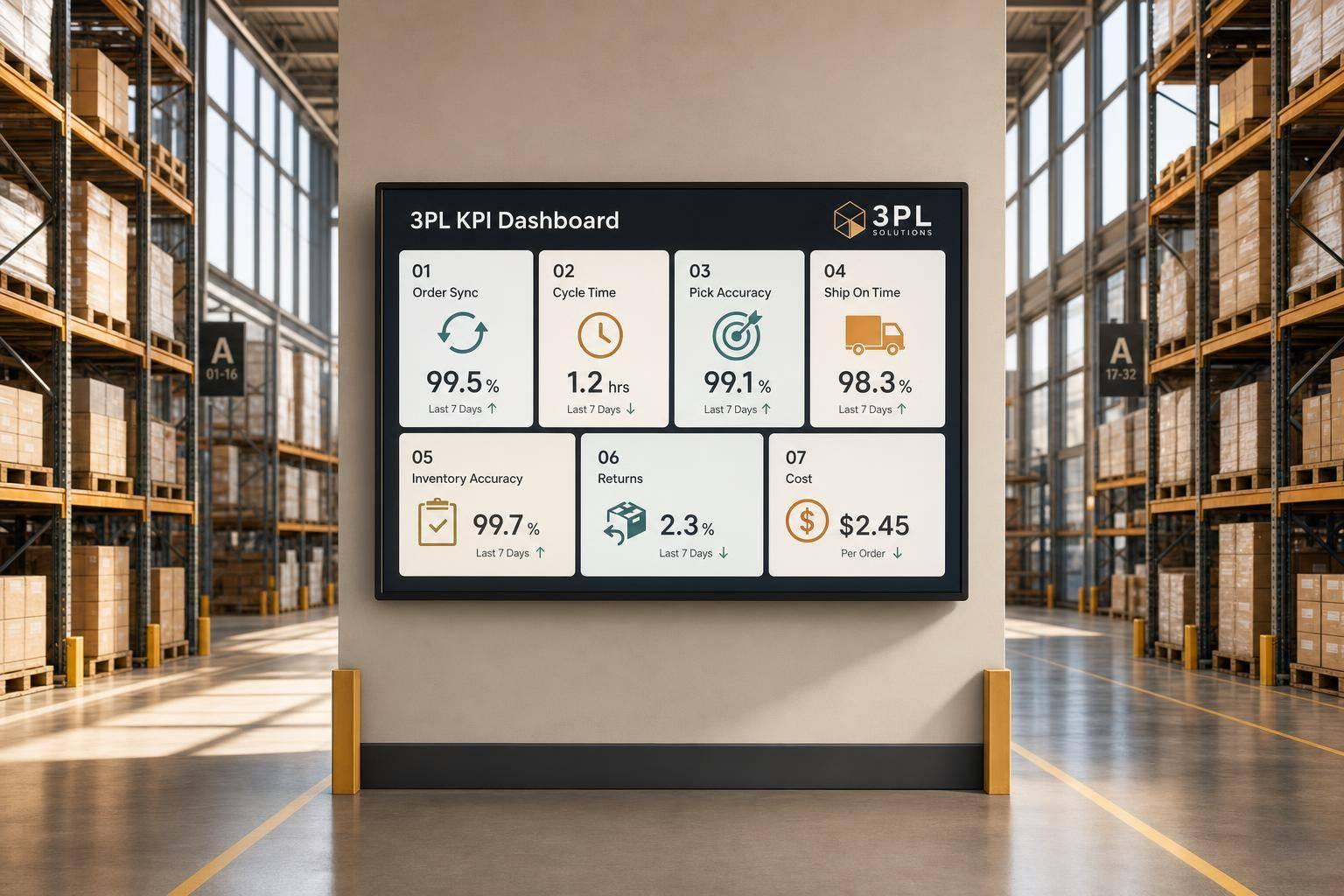
7 WooCommerce 3PL KPIs Teams Track

Centralized vs Decentralized Replenishment
