
How 3PL Analytics Boosts Fulfillment Performance
Want faster, more accurate deliveries? 3PL analytics can help you outperform competitors.
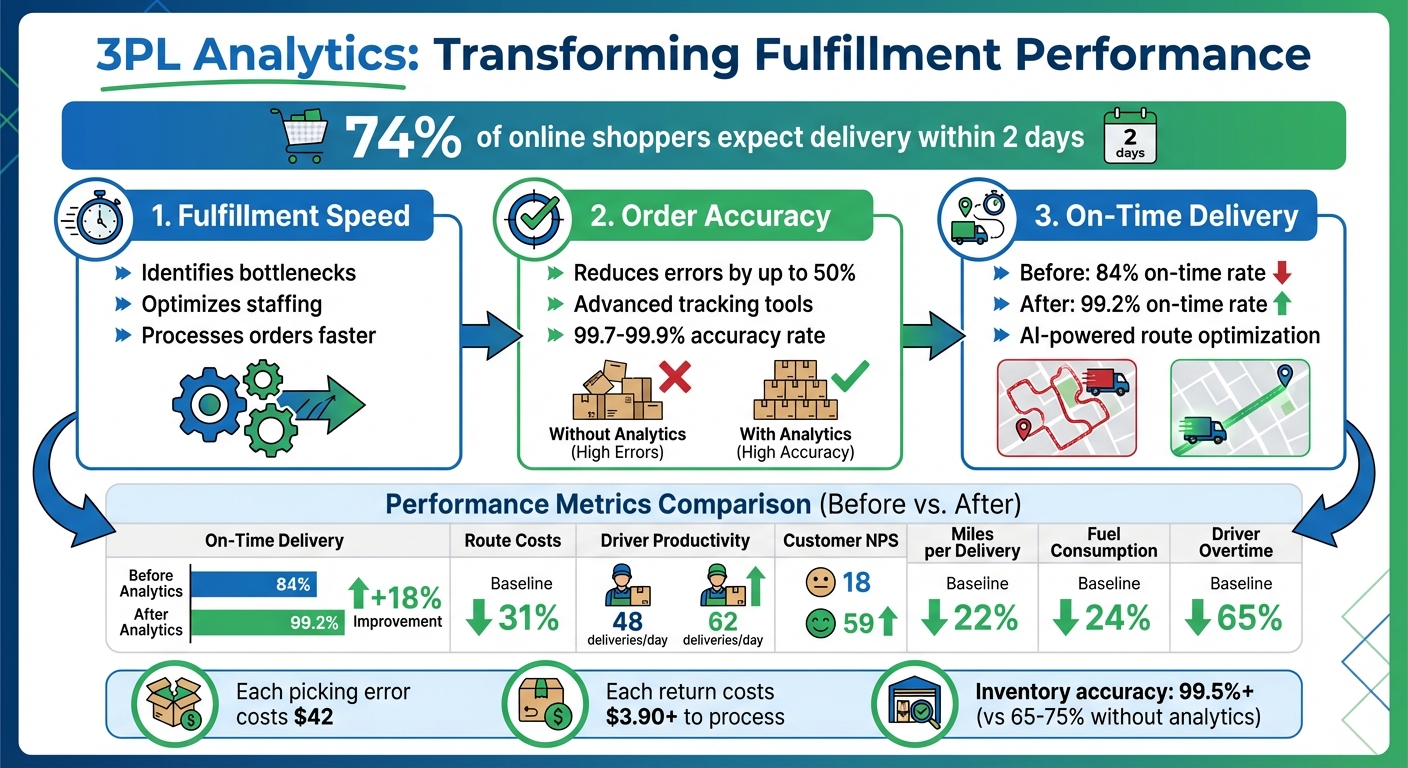
Brands today face rising pressure to deliver orders quickly and correctly, with 74% of online shoppers expecting delivery within two days. Using 3PL (third-party logistics) analytics, companies can improve fulfillment speed, order accuracy, and on-time delivery rates by leveraging real-time data and predictive tools.
Here’s how 3PL analytics transforms fulfillment:
- Fulfillment Speed: Identifies bottlenecks and optimizes staffing to process orders faster.
- Order Accuracy: Reduces errors by up to 50% with advanced tracking tools.
- On-Time Delivery: Boosts delivery rates from 84% to 99.2% with AI-powered route optimization.
These tools also enhance inventory management, predict demand surges, and cut costs through better planning. By integrating dashboards and real-time monitoring, 3PL analytics ensures smoother operations and happier customers.
3PL Analytics Impact on Key Fulfillment Metrics
How 3PL Software Powers Faster, Smarter Fulfillment
sbb-itb-eafa320
Key Metrics Improved by 3PL Analytics
When growing an e-commerce brand, focusing on three key metrics can make a big difference in fulfillment efficiency. These metrics set the stage for smarter, data-driven improvements in operations.
Fulfillment Speed
Analytics tools provide real-time insights into how quickly orders are processed, helping supervisors identify and resolve bottlenecks. Using historical data, predictive staffing ensures the right number of workers are scheduled at the right times. Dynamic labor allocation allows managers to shift resources on the fly to meet demand. By combining shipment data with external factors, such as weather or traffic, analytics can also predict delays and support effective contingency planning. This kind of precision is crucial for brands navigating the fast-paced e-commerce landscape.
Order Accuracy
Modern Warehouse Management Systems (WMS) track every step of the fulfillment process - scanning, picking, and packing - to reduce human error. Advanced analytics take it further by flagging potential issues before orders even leave the warehouse. For instance, a smart WMS can cut mis-shipments by up to 50% and overall errors by 30%. AI-driven quality checks and tools like RFID and IoT sensors also help avoid problems like phantom stock, which can lead to overselling or backorders. These improvements ensure smoother operations and fewer headaches for scaling brands.
Better order accuracy doesn’t just improve internal processes - it also enhances the customer experience by ensuring orders arrive as expected.
On-Time Delivery Rate
AI-powered route optimization continuously updates delivery plans based on real-time factors like traffic, driver availability, and order timing. This adaptive approach accounts for unexpected challenges, such as late-arriving shipments or road closures, and significantly boosts performance. For example, on-time delivery rates can jump from 84% to 99.2%, while route costs drop by 31%. These changes not only improve customer satisfaction but also increase driver productivity, with daily deliveries rising from 48 to 62.
Precise delivery windows - accurate to as little as 15 minutes - further enhance the experience by reducing uncertainty for customers. Research shows that better delivery performance can raise Net Promoter Scores by up to 41 points, directly strengthening customer loyalty and retention.
| Metric | Before Analytics | After Analytics |
|---|---|---|
| On-Time Delivery Rate | 84% | 99.2% |
| Route Costs | Baseline | 31% Reduction |
| Driver Productivity | 48 deliveries/day | 62 deliveries/day |
| Customer NPS | 18 | 59 |
Source:
Using Real-Time Data for Continuous Monitoring
The metrics we discussed earlier - like fulfillment speed, order accuracy, and on-time delivery - are only meaningful if tracked consistently. Real-time data changes the game by turning 3PL partnerships into proactive operations rather than reactive problem-solving. Instead of waiting for customer complaints to highlight issues, brands can catch problems as they arise and address them before they escalate. This kind of monitoring sets the stage for the advanced tools outlined below.
Integrated Dashboards for KPI Tracking
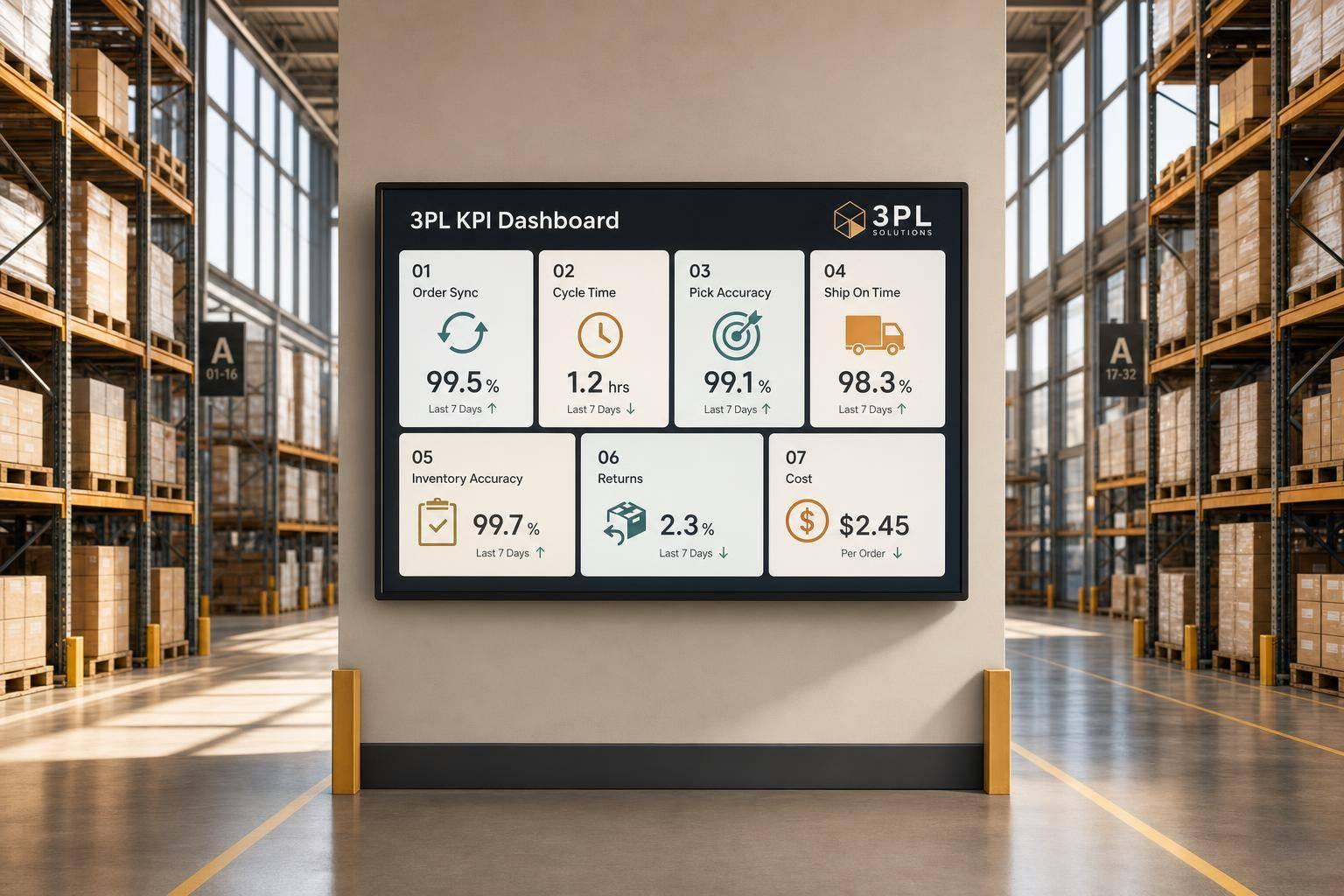
Today’s 3PL providers rely on integrated dashboards that pull data from systems like WMS (Warehouse Management System), TMS (Transportation Management System), and other logistics tools into one cohesive, real-time interface. These dashboards provide a clear view of key metrics such as:
- Warehouse utilization: How much storage space is being used.
- Picking efficiency: Orders picked per labor hour.
- Transportation costs: Actual spending versus budgeted amounts for each shipment.
These metrics are presented in visual formats that update around the clock.
"Technology platforms like TMS, WMS, and integrated fulfillment systems give modern supply chains the visibility, coordination, and precision required to execute true just-in-time logistics." - JIT Transportation
JIT Transportation’s technology platform offers custom dashboards nationwide, giving fast-growing brands instant insights without the delays of manual reporting. For instance, you can track whether your on-time shipping rate meets the 98%+ SLA (Service Level Agreement) target. Top-tier 3PL contracts often include weekly automated reports and API access, ensuring you’re always informed about performance metrics.
Immediate Issue Resolution
While dashboards offer a clear picture of operations, the real benefit comes from acting quickly on flagged issues. Real-time data allows for near-instant problem detection. For example, if a dashboard highlights a drop in picking efficiency - from 99% to 95% due to a mislabeled bin - you can immediately alert your 3PL partner. They can then perform a cycle count and correct the barcode, preventing over 50 potential order errors and saving about $2,100 in return costs.
The same approach applies to transportation delays. Rapid intervention ensures performance standards remain intact before customers feel the impact. This proactive management style is what distinguishes efficient fulfillment operations from those constantly struggling to stay ahead of issues.
How Advanced Analytics Improves Fulfillment Processes
Advanced analytics goes beyond real-time monitoring by predicting and preventing issues before they arise. By analyzing massive datasets, third-party logistics (3PL) providers are transforming warehouse management into a predictive and efficient system. This shift optimizes every step of the fulfillment process, making it faster and more reliable.
Identifying and Fixing Bottlenecks
One of the key benefits of analytics is its ability to pinpoint bottlenecks in the fulfillment process. A prime example is the Dock-to-Stock time - the period between when inventory arrives at the warehouse and when it’s ready for sale. While the industry average is 48 hours, operations leveraging analytics-driven processes can cut this time in half to under 24 hours. Reducing delays here prevents "phantom stockouts", where inventory exists but can’t be sold.
Analytics also track performance metrics like Orders per Hour, both for the entire operation and individual workers, to identify inefficiencies. For example, if pack stations are constantly at full capacity, analytics can flag this as a bottleneck before it leads to errors or safety risks. Predictive maintenance powered by AI further minimizes disruptions by using sensor data to predict equipment failures, ensuring smoother workflows.
Optimized picking strategies - such as batch, wave, and zone picking - are another area where analytics shine. These methods reduce picker travel time while increasing throughput. Thanks to these advancements, top-performing 3PLs now achieve order picking accuracy rates of 99.9% or higher, compared to the industry standard of 97–99%.
Once bottlenecks are resolved within the warehouse, analytics extend their impact to transportation, delivering cost savings and operational efficiency.
Route Optimization for Lower Costs
Transportation is one of the most expensive components of fulfillment, but analytics-driven route optimization can significantly reduce these costs. AI-powered systems create routes that account for factors like delivery time windows, vehicle capacity, driver hours, and real-time traffic. Companies using these systems have boosted on-time delivery rates from 84% to over 99.2% while cutting route costs by 31%.
| Metric | Before AI Optimization | After AI Optimization |
|---|---|---|
| On-Time Delivery Rate | 84% | 99.2% |
| Route Costs | Baseline | 31% Reduction |
| Miles per Delivery | Baseline | 22% Reduction |
| Fuel Consumption | Baseline | 24% Reduction |
| Driver Overtime | Baseline | 65% Reduction |
These systems continuously re-optimize routes in real time based on traffic, road conditions, and weather. Additionally, analytics can route orders to the most suitable fulfillment center based on location and inventory availability, minimizing transit distances. By distributing inventory across multiple centers, businesses can cut shipping times by up to 71% compared to using a single warehouse. This is critical since 69% of customers are unlikely to shop with a retailer again after experiencing a late delivery.
But the benefits don’t stop at transportation - analytics also revolutionize inventory management.
Inventory Management and Stock Forecasting
Predictive analytics plays a crucial role in forecasting demand by analyzing sales history, customer behavior, and market trends. This enables 3PLs to maintain optimal stock levels, avoiding the costly pitfalls of overstocking or running out of inventory. Real-time inventory tracking ensures that digital records match physical stock, keeping operations aligned.
Top-performing 3PLs achieve inventory accuracy rates of 99.5% or higher. In contrast, operations without integrated inventory management systems often struggle with accuracy rates as low as 65–75%. Errors in inventory management can be costly - each mistake can reduce a retailer’s profitability by up to 13% when factoring in returns and customer service costs.
Analytics tools also support automated reorder notifications, alerting managers when stock levels drop below a certain threshold to prevent backorders. Additionally, these tools help identify excess inventory by monitoring turnover rates, which vary by industry - ranging from 11.06 for restaurants to 2.80 for medical equipment. By addressing overstocking, businesses can lower carrying costs.
Dynamic slotting algorithms within Warehouse Management Systems further enhance efficiency by analyzing order patterns and suggesting inventory placement changes to improve labor productivity. This predictive approach, combined with real-time monitoring, ensures fulfillment operations remain agile and efficient.
Scaling Operations with Predictive Analytics
For brands experiencing rapid growth, scaling operations effectively is a must. Predictive analytics steps in by leveraging machine learning to analyze sales history, seasonal trends, and promotional schedules. This technology produces precise demand forecasts, allowing 3PL providers to prepare for growth ahead of time instead of scrambling to handle sudden spikes in order volumes.
Forecasting Demand Surges
One of the standout benefits of predictive analytics is its ability to anticipate demand surges by analyzing patterns in order history and seasonal behaviors. For instance, it can pinpoint how events like Black Friday, Mother’s Day, or the winter holidays historically lead to volume increases. With this insight, 3PL warehouses can proactively model their labor needs, ensuring they are fully staffed to handle these surges. This approach eliminates the chaos of last-minute staffing adjustments.
But it doesn’t stop at staffing. Predictive tools also enhance inventory distribution by forecasting which regions will see the highest demand. By strategically positioning stock in fulfillment centers closer to these areas, brands can cut down transit times and speed up deliveries. This matters because 74% of online shoppers expect their orders within two days, and 63% will switch retailers if deliveries take longer.
These proactive strategies not only improve customer satisfaction but also streamline resource management, keeping costs in check.
Reducing Costs Through Better Planning
Accurate demand forecasting doesn’t just improve efficiency - it also slashes costs. By analyzing historical trends, 3PL providers can create data-driven staffing schedules for peak periods, reducing labor expenses while ensuring adequate coverage. Real-time dashboards further enhance operations by helping managers monitor tasks and redeploy workers to address potential bottlenecks identified through pattern analysis.
Inventory management also sees major improvements. Predictive analytics helps brands maintain the right stock levels, avoiding costly overstocking while preventing stockouts that could lead to missed sales. Automated stock updates further simplify operations and reduce the risk of manual errors.
With the fulfillment services market expected to hit nearly $273 billion by 2030, predictive analytics is becoming a cornerstone for brands aiming to scale effectively. At JIT Transportation, we use advanced analytics to turn strategic planning into fulfillment excellence, helping high-growth brands expand without compromising on speed or accuracy.
Conclusion
For brands aiming to grow quickly, leveraging 3PL analytics isn't just helpful - it's essential. These tools can significantly boost key metrics like order accuracy (99.7–99.9%), on-time delivery (98%+), and inventory precision (99.9%). The result? Better profitability and stronger customer loyalty. When you consider that each picking error costs about $42 and processing a return exceeds $3.90 per item, the financial case for analytics becomes clear.
By moving from reactive fixes to proactive strategies, tools like real-time dashboards, predictive forecasting, and performance scorecards help prevent issues before they escalate. Analytics-driven 3PLs don’t just address problems - they stop them from happening in the first place. This proactive mindset lays the groundwork for choosing a fulfillment partner that aligns with your goals.
When selecting a partner, look for one that goes beyond basic warehousing. Set clear SLAs, such as 99% order accuracy and 98% on-time fulfillment, and ensure they offer integrated dashboards for ongoing KPI monitoring. At JIT Transportation, we combine advanced technology, a nationwide network, and scalable solutions to meet - and exceed - these benchmarks, ensuring your operations stay efficient and accurate.
In today’s fast-paced fulfillment world, precision and speed are non-negotiable. Brands that embrace analytics-driven 3PLs gain the tools to meet rising customer expectations while managing costs effectively. By embedding advanced analytics into your logistics operations, you turn fulfillment into a strategic advantage. A partner that predicts demand, refines delivery routes, and maintains top-tier accuracy gives your brand the edge it needs to thrive.
FAQs
What data do I need to share for 3PL analytics to work?
To get the most out of 3PL analytics, it's crucial to share key data points such as inventory levels, sales figures, order processing details, shipment tracking updates, demand forecasts, supplier information, and operational metrics like order accuracy rates and delivery timelines. These insights help drive smarter decisions and improve overall fulfillment efficiency.
How fast can analytics improve my fulfillment KPIs?
Analytics has the power to enhance fulfillment KPIs in just weeks or a few months, depending on how swiftly your 3PL adopts advanced tools. By keeping an eye on key metrics like order accuracy, transit times, and fulfillment speed, inefficiencies can be pinpointed and resolved. Tools such as real-time forecasting, route optimization, and inventory management play a crucial role in speeding up processing, reducing mistakes, and improving delivery rates. The result? Noticeable performance improvements and happier customers in a relatively short period.
Which SLA targets should I set with an analytics-driven 3PL?
For a 3PL that relies on analytics, some key SLA targets to aim for include:
- On-time delivery rate of 97–99%
- Order fulfillment accuracy exceeding 99%
- Inventory accuracy above 99%
- Quick resolution of any issues
These benchmarks are crucial for maintaining dependable operations and keeping customers happy.
Related Blog Posts
Related Articles
7 WooCommerce 3PL KPIs Teams Track

Centralized vs Decentralized Replenishment
