
Cross-Docking vs Flow-Through Distribution
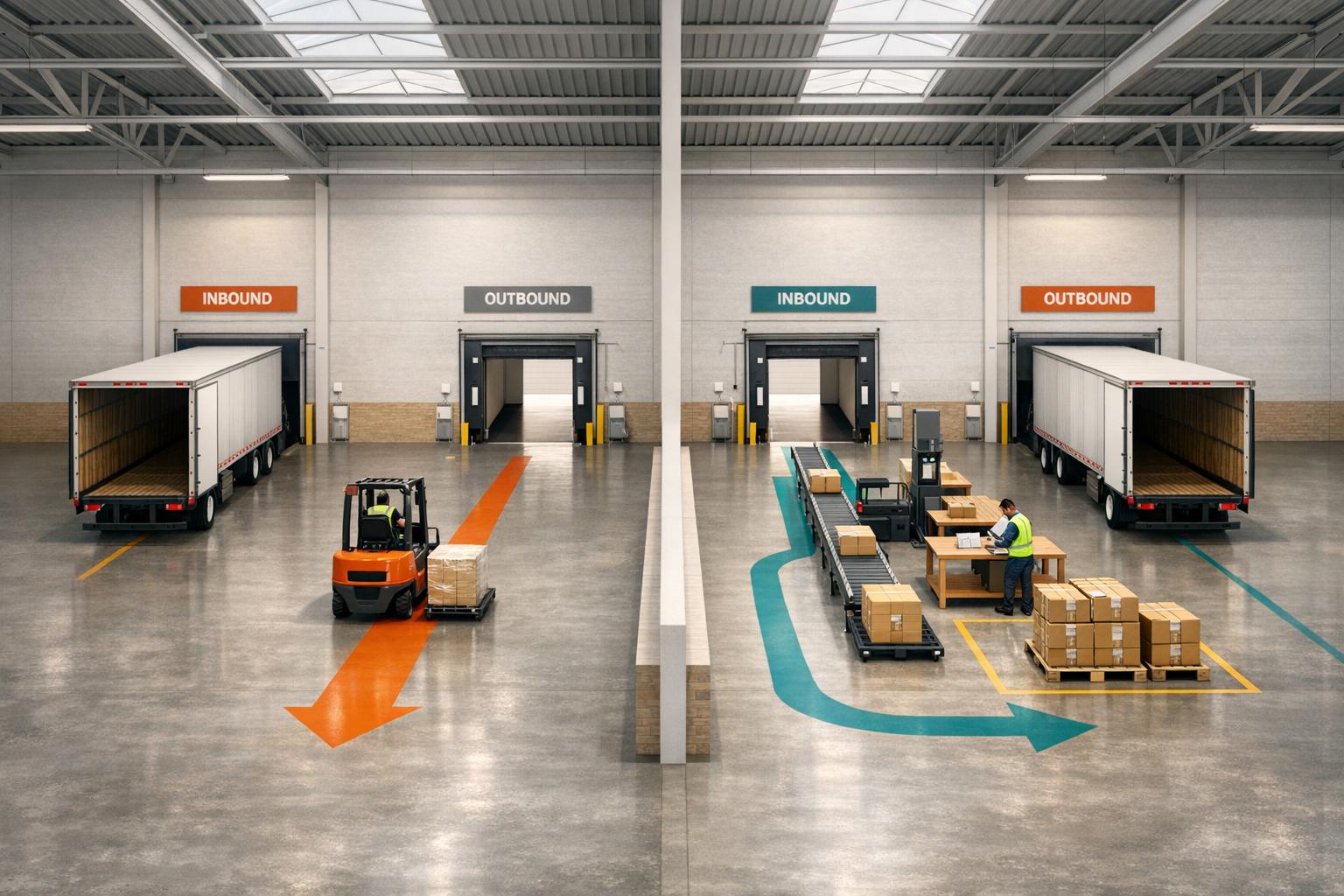
Cross-docking and flow-through distribution are two logistics methods helping e-commerce businesses move products faster and more efficiently. Here's a quick breakdown:
- Cross-docking: Products go directly from inbound to outbound trucks without storage, leaving the facility within 2–12 hours. It’s ideal for high-demand, fast-moving goods like perishables or electronics and reduces handling steps and warehousing costs by up to 30%.
- Flow-through distribution: Goods are staged briefly (up to 24 hours) for tasks like sorting, labeling, or kitting before shipping. This method is perfect for businesses needing customization or handling fluctuating demand.
Quick Comparison
| Feature | Cross-Docking | Flow-Through Distribution |
|---|---|---|
| Inventory Handling | Direct transfer, no storage | Temporary staging for processing |
| Dwell Time | 2–12 hours | Up to 24 hours |
| Value-Added Services | Limited (sorting, quality checks) | Supports kitting, labeling, etc. |
| Best For | High-volume, predictable demand | Custom orders, variable demand |
Both methods aim to reduce costs and speed up delivery times. The right choice depends on your business needs: cross-docking for speed and simplicity, flow-through for flexibility and customization.

Cross-Docking vs Flow-Through Distribution: Key Differences Comparison
“Cross-Docking: The Fastest Flow Strategy in Modern Logistics”
sbb-itb-eafa320
Main Differences Between Cross-Docking and Flow-Through Distribution
Both cross-docking and flow-through distribution prioritize speed, but they differ in how they manage inventory, the time required for processing, and the types of services they support. Knowing these differences is essential for e-commerce businesses to select the method that aligns with their operational needs.
How Each Method Handles Inventory
Cross-docking follows a "touch it once" approach. Goods are transferred directly from inbound to outbound docks without being stored or shelved. There’s no need for extended inventory management since products arrive pre-sorted and pre-labeled, ready to be shipped immediately.
Flow-through distribution, on the other hand, allows for temporary staging in designated areas. This added step lets businesses sort products based on current demand or perform additional processing before shipment. While it’s faster than traditional warehousing, this method accommodates slightly longer dwell times to allow for these tasks.
Processing Speed and Dwell Time
The speed of processing is another key distinction between the two methods. Cross-docking is all about quick turnarounds - goods are typically shipped out within 2 to 12 hours of arrival. Achieving this level of efficiency requires precise coordination among suppliers, carriers, and facility teams to ensure a seamless flow.
Flow-through distribution operates on a slightly slower schedule. Products are usually dispatched within 24 hours but may take longer if additional services like sorting or customization are needed. This approach trades some speed for flexibility, allowing businesses to verify and prepare orders without the urgency of immediate shipment.
Value-Added Services
The biggest difference between these methods lies in the range of services they support. Cross-docking is streamlined to handle essential tasks like sorting, consolidation, deconsolidation, and basic quality checks. The focus is on keeping products moving quickly, leaving no room for customization.
Flow-through distribution, however, is designed to support a variety of value-added services, such as kitting, specialized labeling, assembly, and repackaging. This flexibility allows businesses to customize orders during the distribution process while still maintaining faster-than-average shipping times. These added capabilities can significantly enhance order accuracy and customer satisfaction for e-commerce operations.
| Feature | Cross-Docking | Flow-Through Distribution |
|---|---|---|
| Inventory Handling | Direct transfer from inbound to outbound | Allows brief staging for sorting and processing |
| Dwell Time | Typically 2–12 hours | Can exceed 24 hours for additional tasks |
| Value-Added Services | Sorting, consolidation, basic quality checks | Kitting, labeling, assembly, repackaging |
| Primary Goal | Maximize speed and reduce transport costs | Enable customization while ensuring timely shipment |
| Coordination Required | Requires tight synchronization | Less dependent on precise timing |
Cross-Docking: How It Works and Its Benefits
The Cross-Docking Process
Cross-docking runs on a tight schedule. Suppliers send Advance Ship Notices (ASNs) ahead of shipments, giving facilities time to prepare outbound routes and staging areas. Once trucks arrive, goods are unloaded and scanned against ASN data, with quality checks happening immediately - no waiting, no long-term storage.
After unloading, products are sorted and directed to outbound staging areas based on their destination, customer, or order specifications. Shipments are then loaded in reverse-delivery order, ensuring smooth unloading at their final stops. Typically, this entire process is completed within 2 to 12 hours, though some operations may take up to 24 hours depending on complexity. This streamlined approach can cut the distribution cycle from over 28 days to just 24–48 hours.
A big part of cross-docking's efficiency comes from reducing how often goods are handled. Traditional warehousing can involve 10–15 touches per unit as items move through receiving, storage, picking, packing, and shipping. Cross-docking slashes this to just 3–5 touches - limited to receiving, sorting, and loading. Think of it like a relay race: products move seamlessly from inbound to outbound docks without unnecessary stops. This speed and simplicity allow for different configurations tailored to specific needs.
Types of Cross-Docking
Cross-docking isn’t one-size-fits-all - it adapts to different operational challenges with several models.
- Pre-distribution cross-docking: Here, products are assigned to their final destinations before leaving the supplier. This method is ideal for high-volume e-commerce operations with steady, predictable demand.
- Post-distribution cross-docking: Goods are sorted after arrival based on real-time customer orders. This flexibility is perfect for e-commerce brands dealing with fluctuating demand or managing returns.
- Continuous flow cross-docking: Items move directly from inbound to outbound with minimal handling. It’s a great option for fast-moving SKUs or perishable goods that can’t afford delays.
Other models include consolidation, where smaller inbound shipments are combined into full outbound truckloads to cut transportation costs, and merge-in-transit, where components from different origins meet at the dock to form a single customer order. For example, a convenience store chain with 340 locations used consolidation cross-docking in 2025, cutting transportation expenses by 34% and reducing store-level receiving labor by 40%. Each model offers specific advantages, depending on the operational goals.
Benefits of Cross-Docking
The efficiency and adaptability of cross-docking translate into major cost savings, faster delivery times, and better inventory management. Compared to traditional warehousing, cross-docking can reduce distribution costs by 30%–50% and handling costs by 50%–70%. Since inventory storage often accounts for up to 70% of an e-retailer’s logistics budget, minimizing or removing storage can lead to immediate financial benefits.
Speed is another standout benefit. For instance, an apparel retailer with 240 stores implemented cross-docking at the Los Angeles port for its seasonal collections in 2025. This reduced the import-to-shelf timeline by 16 days, extended the full-price selling window, cut markdowns from 32% to 24%, and boosted annual gross margins by $6.4 million.
A big-box retailer with 180 stores used cross-docking for its Black Friday merchandise in 2025. By syncing deliveries to all stores a week before the event, they eliminated stockouts on featured items (previously at 15%) and increased promotional sales by $8.2 million.
Cross-docking also supports Just-in-Time (JIT) fulfillment by reducing the need for large inventory buffers. For example, a regional grocery chain with 85 stores launched a near-port cross-dock for fresh produce in Los Angeles in 2025. By moving goods across the dock within 12 hours of their port arrival, the chain cut spoilage from 18% to 7%, saving $2.1 million annually and increasing sales by 8% due to fresher products.
Flow-Through Distribution: How It Works and Its Benefits
The Flow-Through Distribution Process
Flow-through distribution involves moving goods directly from inbound trailers to outbound shipping, skipping the traditional warehouse storage step. When items arrive at the distribution center, they are sorted based on their destination or specific order requirements. Unlike cross-docking, which minimizes handling, flow-through often includes light processing tasks like kitting, assembly, repackaging, or custom packaging. These steps prepare the goods for a short staging period that typically lasts between 2 and 24 hours. If items remain staged for more than 24 hours, they are moved into standard storage. Once ready, the processed goods are loaded onto outbound vehicles for final delivery.
"The goal is to reduce the time products spend in the warehouse while and maximize the speed of order fulfillment." - Joe Weaver, Fulfillment and Distribution
This approach is particularly well-suited for orders requiring some level of customization or additional handling, making it a versatile solution for various business needs.
When E-Commerce Businesses Use Flow-Through
Flow-through distribution is a flexible alternative to cross-docking, accommodating orders that need extra processing. It’s especially useful for complex requirements, such as monthly subscription boxes, gift baskets, or bundled discounts. For example, a subscription box company might receive individual items from multiple suppliers and assemble them into a single package before shipping.
E-commerce brands also rely on flow-through for product launches, especially when high-demand items like electronics need to reach customers quickly. Additionally, this method is ideal for perishable goods, as the rapid movement helps maintain freshness and extends shelf life.
Benefits of Flow-Through Distribution
Flow-through distribution offers businesses operational flexibility and cost-saving opportunities. One key advantage is its ability to support value-added services like kitting and custom packaging. This allows companies to manage complex SKUs without committing to long-term storage, which is significant given that warehouse operating costs averaged $7.91 per square foot in 2021. Reducing storage time can translate into substantial savings.
Another benefit is scalability. The flow-through model can adapt to seasonal demand spikes or high inventory volumes without requiring permanent warehouse expansion. This makes it an excellent option for growing businesses looking to enter new markets or manage a larger variety of products without heavy investments in infrastructure. Incorporating automation tools like barcode scanning and real-time inventory systems further reduces errors and speeds up order fulfillment.
"Flow through distribution is ideal for businesses with high-volume, fast-moving goods, and a need for some storage capabilities." - Joe Weaver, Fulfillment and Distribution
Additionally, the pay-per-use cost structure of flow-through operations eliminates the fixed expenses tied to leases and permanent staffing. This frees up capital that would otherwise be locked in inventory storage. The ability to quickly respond to market demands is crucial, especially when 40% of B2B buyers expect responses to inquiries within an hour. These advantages, combined with the speed benefits of cross-docking, make flow-through a powerful tool for efficient distribution.
How to Choose Between Cross-Docking and Flow-Through
Factors to Consider
Deciding between cross-docking and flow-through distribution requires a close look at how your inventory moves and the level of processing it needs. Cross-docking is a great fit for items that turn over within 24 hours, while flow-through works better for products requiring short-term staging before shipment. Another critical factor is demand predictability. Cross-docking thrives in scenarios where demand is steady, and shipments can be pre-assigned to destinations before arrival. On the other hand, flow-through is more adaptable for e-commerce operations with fluctuating orders, as it supports real-time sorting.
Supplier reliability is non-negotiable for both methods. Cross-docking, in particular, depends on accurate advance ship notices (ASNs) and strict dock scheduling, as it doesn’t rely on long-term storage buffers. Cost considerations also matter. If storage costs are high but labor is relatively affordable, cross-docking may be the way to go. Conversely, if labor costs dominate, flow-through can help smooth out peaks in workload. Lastly, think about processing needs: cross-docking minimizes handling by focusing on direct transfers, while flow-through allows for light processing tasks like quality checks, relabeling, or repacking. Using ABC/XYZ analysis can help you assign SKUs to the method that best matches their turnover and handling needs.
When Cross-Docking is the Better Choice
Cross-docking is ideal for high-volume operations with consistent demand. It’s particularly effective for fast-moving consumer goods, perishables, and electronics. In these cases, the facility acts as a transfer hub rather than a storage point. This method works well for replenishing retail stores at the pallet level or handling shipments that arrive pre-sorted and pre-labeled.
Take Deere & Company as an example. By adding merge centers and optimizing cross-docking terminals, they cut transport costs by 5% annually, reduced inventory by $1 billion, and slashed delivery times from 10 days to 5 days. Another case involves a major consumer goods brand that redesigned its warehouse layout, leading to a 30% reduction in logistics costs.
When Flow-Through Distribution is the Better Choice
Flow-through distribution shines when flexibility and order customization are top priorities. It’s especially useful in multi-channel fulfillment setups that manage retail, B2B, and online orders from the same facility while meeting different service level agreements. This method typically involves a short staging period - usually 24 hours - allowing for order verification, vendor consolidation, or handling variable delivery windows without resorting to long-term storage.
Flow-through is also the better choice when value-added services like kitting, assembly, or custom packaging are part of your operation. The brief staging time not only makes room for these light processing tasks but also provides a buffer to manage demand fluctuations effectively.
Conclusion
Summary of Differences and Benefits
Cross-docking and flow-through distribution both focus on accelerating inventory movement, but they differ in approach and purpose. Cross-docking transfers goods directly from incoming to outgoing docks within 24 hours, making it a go-to option for high-demand products like consumer goods, electronics, and perishables. This approach slashes storage costs and can improve order processing efficiency by up to 30%. On the other hand, flow-through distribution involves a short staging period for tasks like sorting, verification, and light services such as kitting or custom packaging. This method allows for greater adaptability to fluctuating demand.
The choice between the two depends on factors like inventory velocity, demand stability, and operational requirements. Cross-docking is ideal for predictable demand and dependable suppliers with accurate shipping notifications. Meanwhile, flow-through distribution is better suited for environments where customer needs frequently shift. The decision ultimately comes down to which method aligns best with your operational goals.
Recommendations for E-Commerce Brands
For e-commerce brands, selecting the right logistics strategy starts with evaluating your SKU velocity and supplier consistency. If you're managing high volumes of predictable products, cross-docking can significantly cut costs and improve delivery times.
However, if your business handles customized orders, works with numerous suppliers, or experiences variable demand patterns, flow-through distribution offers the flexibility to adapt without relying on extensive storage. To ensure success, test your chosen method on select SKUs or with specific vendors to identify potential bottlenecks. It's also critical to integrate your Warehouse Management System (WMS) and Order Management System (OMS) to maintain the real-time visibility these methods require.
Many e-commerce brands are now partnering with 3PL providers to tap into specialized infrastructure while avoiding hefty capital investments. As discussed throughout this article, both cross-docking and flow-through distribution can significantly enhance fulfillment operations when aligned with your overall growth strategy. The real question isn't just about speed - it's about creating a logistics plan that meets your business goals and keeps your customers satisfied.
FAQs
What are the biggest risks of cross-docking?
Cross-docking comes with its share of challenges, primarily product damage and logistical hurdles. Since items are moved rapidly from incoming to outgoing trucks without being stored, there’s minimal time to identify and correct handling mistakes. This process also demands tight coordination and real-time tracking, which can be difficult to manage. It’s particularly tricky for delicate goods or for operations that lack robust planning systems and advanced technology.
Do I need a WMS/OMS integration for cross-docking or flow-through?
Integrating a Warehouse Management System (WMS) or Order Management System (OMS) isn't a requirement, but it can make operations significantly smoother for both cross-docking and flow-through distribution. These systems boost real-time visibility, improve accuracy, and help coordinate inventory, orders, and transportation seamlessly.
For cross-docking, a WMS or OMS simplifies the sorting and transfer process, making it more efficient. When it comes to flow-through distribution, these tools ensure quicker fulfillment and tighter inventory control - critical advantages, especially in the fast-paced world of e-commerce logistics.
Can one facility use both cross-docking and flow-through?
Cross-docking and flow-through distribution can absolutely coexist within a single facility, offering a flexible approach to logistics. Cross-docking focuses on moving goods directly from inbound to outbound shipments with minimal or no storage. On the other hand, flow-through distribution allows for short-term storage to better align with demand fluctuations. By combining these methods, facilities can efficiently manage different shipment requirements - whether it's prioritizing urgent deliveries or fine-tuning inventory to improve overall operations.
Related Blog Posts
Related Articles
7 WooCommerce 3PL KPIs Teams Track

Centralized vs Decentralized Replenishment
