
3PL Compliance Study: Risk Points in Fulfillment

Most fulfillment compliance problems start at handoffs, not at one single task. If I had to sum this up in one line, it would be this: weak scans, weak timestamps, and weak exception records lead to chargebacks, claims, inventory disputes, and repeat returns.
Here’s the short version:
- Retailer chargebacks often run at 2%–5% of invoice value per violation
- Picking accuracy in many warehouses sits around 96%–98%
- Best-run sites reach 99.5%+, which can mean 5 or fewer errors per 1,000 orders
- Location errors drive about 40% of mispicks
- A label printed is not proof of carrier handoff
- Returned items need RMA, inspection, grading, photos, and disposition records before restock
If you want to find risk fast, I’d look at these points first:
- Receiving: count errors, damage notes, ASN mismatches
- Storage: bad bin moves, weak cycle counts, undocumented adjustments
- Picking and packing: wrong SKU, wrong variant, missed scans, bad labels
- Outbound: no carrier acceptance scan, manifest mismatch, weak chain of custody
- Returns: restocking before inspection, missing reason codes, poor condition records
The main idea is simple: every handoff needs proof. That means dock scans, bin scans, pick scans, pack checks, label logs, ASN records, carrier scans, proof of delivery, and return records all need to match the physical movement of goods.
Below, I break down where these failures show up most often and which records help stop the same problem from happening again.
Compliance risk map across the fulfillment workflow
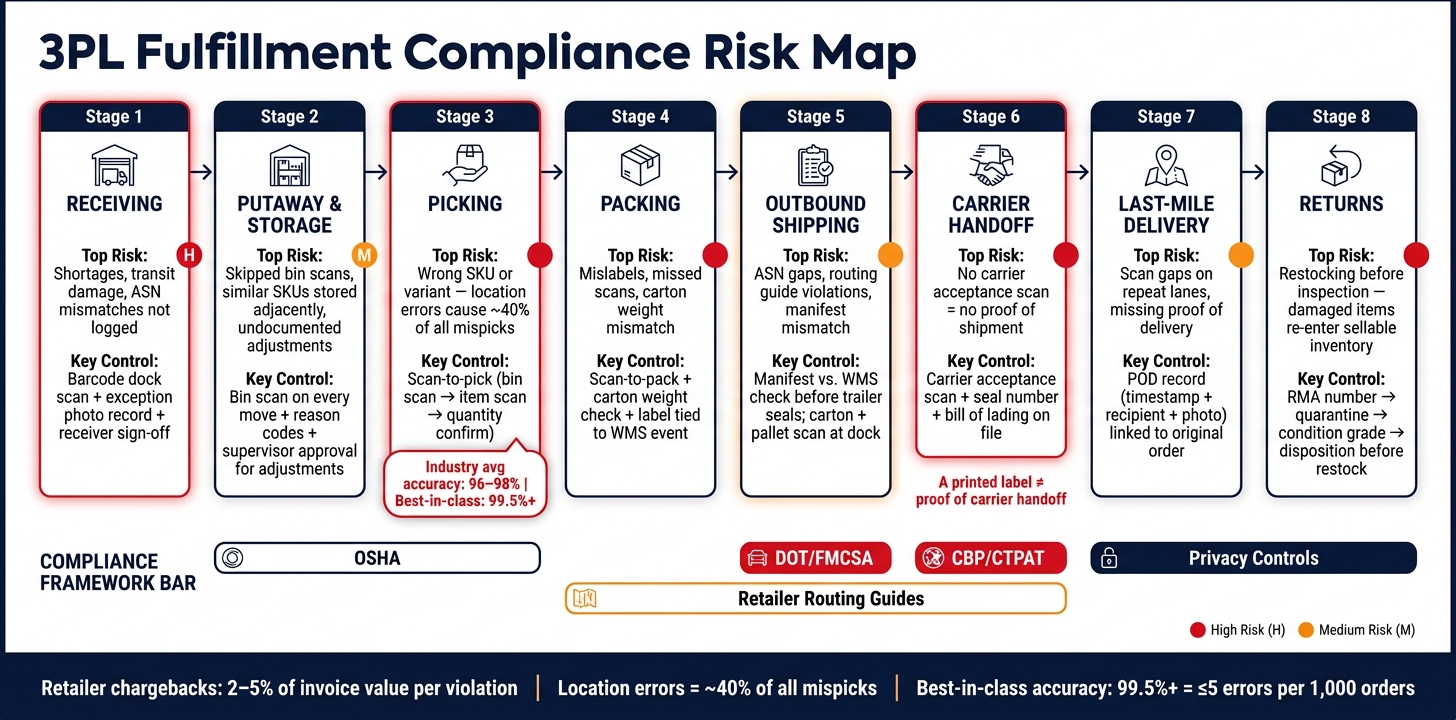
3PL Fulfillment Compliance Risk Map: Where Errors Happen & How to Stop Them
A standard 3PL workflow runs through eight stages: receiving, putaway and storage, picking, packing, outbound shipping, carrier handoff, last-mile delivery, and returns. Risk tends to spike at every handoff. Why? Because scans, timestamps, and exception records need to line up with the physical movement of goods.
Where errors tend to concentrate
Errors don't show up evenly across the workflow. They pile up in the same places again and again.
Inbound receiving is the first big trouble spot. If shortages, transit damage, or ASN mismatches aren't logged at the dock, inventory records can be off from day one. Then, after putaway, another problem shows up: inventory mismatches. These often happen when staff skip bin scans or place similar-looking SKUs too close together.
During fulfillment, the most common issue is simple but costly: picking the wrong SKU or the wrong variant. At packing and dispatch, label mistakes and ASN gaps can lead to retailer chargebacks and rejected deliveries. Farther down the line, some orders get marked as shipped without a confirmed carrier scan, which leaves the shipper without proof of shipment. At the end of the process, returns can create a new mess. If returned items are restocked without condition grading, damaged or opened products can slip back into sellable inventory.
When these things go wrong, the fallout tends to look like this:
- Inventory disputes
- Customer complaints
- Chargebacks
- Misroutes
- Claims exposure
- Restocking defects
Which compliance frameworks apply at each step
Different stages bring different rules.
OSHA covers worker safety across receiving, storage, and material handling. DOT and FMCSA rules apply to outbound shipping and carrier handoff, where freight movement and transport compliance come into play. CBP and CTPAT controls matter for cross-border shipments and bonded cargo, where import/export integrity and cargo security are required.
Retailer routing guides add another layer. They set rules for labeling, carton content accuracy, pallet setup, and delivery appointment windows. Miss a label or get it wrong, and that can lead straight to chargebacks or rejected deliveries. Privacy controls also matter anywhere shipment notifications, customer tracking updates, or delivery data are handled.
The practical point is simple: compliance is not one master checklist. It's a stack of overlapping rules, and each one connects to a certain stage in the workflow. A risk map only helps if it shows which rule applies where. With that map in place, the next pressure point is inbound receiving and inventory records.
sbb-itb-eafa320
Inbound, storage, and inventory records that prevent downstream disputes
Inbound receiving is the moment where the audit trail either stays solid or starts to crack. If receipt, condition, or quantity aren't recorded the right way, problems show up later as disputes over shortages, damage, or the wrong SKU. The best inbound controls make each handoff easy to verify.
Receiving controls: count, condition, and ASN matching
The main inbound records are the receiving log, ASN match report, exception report, photos, and receiver sign-off. Taken together, they show what arrived, when it arrived, what shape it was in, and whether it matched what the warehouse expected.
WMS matching should happen at the unit, carton, or pallet level so the team can catch SKU, quantity, lot, expiration date, or serial mismatches before the receipt is closed. Barcode scanning at the dock is a must. Manual entry makes it far easier to transpose numbers, miss cartons, or tag the wrong SKU.
If there's damage or a shortage, the exception record needs exact counts, condition notes, and photo proof. Record exceptions on the delivery receipt before signing. If the damage is concealed, note it within the carrier's time limit, often 5 to 15 days.
Once the receipt is clean, the next problem is simple: can the warehouse keep that same level of accuracy after storage starts?
Storage and inventory audit trails
Putaway, bin moves, cycle counts, and inventory adjustments should all be tracked with reason codes and approval. Every adjustment needs a reason code and approval, not just a changed number. If someone enters an undocumented adjustment to “fix” a count variance, the next cycle count may show the same issue again, with no clear way to tell whether the loss was real or just a bad data fix.
For lot- or serial-controlled goods, traceability records need to follow the item from receipt through storage. If a recall or quality dispute happens, the 3PL has to show exactly where each lot went, who moved it, and when. If that trail is missing, recalls can stall and shipments can get held.
Cycle counts work best when they're based on risk, not just a calendar. High-velocity SKUs, high-value products, regulated items, and any SKU with a history of receiving variance should be counted more often. Aim for inventory accuracy above 98% for priority SKUs and keep repeat discrepancy rates below 10%.
Those records set the baseline for pick, pack, and dispatch accuracy.
How repeat inbound issues get reduced
Repeat inbound exceptions drop when teams code exceptions the same way every time. That turns vague notes into categories such as shortage, damage, mismatch, or overage. From there, the warehouse can spot patterns by supplier, SKU family, shift, or receiver. That's what turns cycle counts from a cleanup task into a control that helps stop the same issue from coming back.
System rules should also block undocumented inventory changes. Requiring supervisor approval, an attached reason, and an audit log for material variances closes that hole. When warehousing, transportation, ERP links, and VMI workflows are tied together, POs, ASNs, receipts, and exceptions stay aligned, which lowers the risk of downstream disputes when inbound records are questioned.
With inbound records stabilized, the next failure point is picking and packing.
Picking, packing, labeling, and dispatch accuracy as the main error zone
The middle of the fulfillment workflow - picking, packing, labeling, and dispatch - is where most errors pile up. Wrong items, wrong quantities, wrong variants, and bad labels sit behind a large share of customer complaints and retailer chargebacks.
The numbers make the problem pretty clear. Average U.S. warehouse picking accuracy usually lands between 96% and 98%. That means about 20–40 errors per 1,000 orders. Best-in-class operations get to 99.5% or higher, which keeps mispicks at 5 or fewer per 1,000 orders. That difference hits the income statement fast. If a brand ships $10,000,000 in product each year, even a 1% swing in accuracy can mean about $100,000 in write-offs, rework, and penalties.
Common causes of pick and pack failures
Most mispicks come from the same few issues showing up again and again. Location accuracy issues alone account for roughly 40% of all warehouse mispicks. If inventory is not sitting where the WMS says it should be, pickers may grab the wrong item or swap in a similar SKU without meaning to.
That gets worse when look-alike products are stored side by side. In fast-moving pick zones, where people are under pressure to move fast, those mix-ups happen even more often. Paper-based picking adds more risk on top of that. Paper processes usually hit 90–96% accuracy, while barcode-scanning workflows tend to reach 97–99%+.
Mislabels are a different type of failure, but the root cause is often close to the same problem: label generation that is not tightly tied to WMS events. If a label prints against the wrong order, or a last-minute order change never reaches the label, the carton may hold the right goods and still trigger a retailer routing guide violation and a chargeback. Major retailers spell out strict routing guide rules for labeling, case packs, and pallet setups. One mistake can lead to penalties from $25 to thousands of dollars per occurrence.
Records that resolve disputes and support compliance
At this stage, the audit trail needs to be line-level and time-stamped from pick through dispatch. The core records include:
- Picker ID and task assignment
- SKU and bin location scans
- Quantity confirmations
- Pack verification logs
- QC exception notes
- Carton weights
- Label generation logs
- ASN/EDI records tied to each shipment
Carton weight data is especially helpful. If the actual weight does not match the expected contents, that is often an early sign that something was packed wrong before the carton leaves the dock. Without records like these, a dispute over a wrong shipment can drag on and become much harder to settle fast.
"A single mispick, missed scan, or incorrect label can trigger a chain reaction: returns, replacement shipments, customer complaints, and operational rework." - JIT Transportation
Controls that lower repeat shipment errors
Scan-to-pick and scan-to-pack are the clearest controls here. The picker scans the bin, then the item, then confirms the quantity. If something does not match, the task stops. At packing, each item gets scanned into the carton before the label prints.
Results from case studies show that putting these controls on high-volume SKUs can cut pick errors by 50% or more and move operations into the 98.5–99.8% order accuracy range. In one documented process change, pick accuracy moved from 96.2% to 99.6% within three months at the same order volume after similar-looking SKUs were slotted into separate micro-zones with clearer bin labels.
Exception-based QC adds another check without forcing a manual review on every order. The WMS can flag high-risk orders - new SKUs, products with a history of errors, high-value accounts, or orders picked by newer staff - for a targeted check before dispatch. The error codes logged during QC then point to the next fix. A "wrong location" trend usually points to weak bin discipline. A "missed scan" trend usually points to scanner habits.
Short 10–15 minute training sessions built around the prior week's actual error codes work better than broad refreshers. For value-added services such as kitting, assembly, and testing, JIT Transportation needs separate work orders, bill of materials scan checks, and QC sign-off tied to the outbound shipment record. Without that paper trail, even correctly assembled kits can look non-compliant if the ASN or EDI data does not show the final configuration.
Outbound, last-mile, returns, and ongoing compliance improvement
Carrier handoff and last-mile visibility gaps
Once packing is done, the main risk changes. It’s no longer just about whether the right item went into the box. Now it’s about proving the shipment actually made it into the carrier’s hands.
A printed label doesn’t mean the shipment is compliant. That risk window stays open until the carrier acceptance scan appears. Scan every carton or pallet at pack-out and again at dock loading so the order, tracking number, and handoff all stay linked.
Before the trailer is sealed, compare the carrier manifest with WMS data. Check total cartons, declared weight, and service level. If something doesn’t match, dig into it before the truck leaves, not weeks later when the billing cycle brings the problem back.
It also helps to keep one chain-of-custody record that includes seal numbers and the bill of lading. That record can protect you when short-shipment or damage claims show up. In plain terms, those outbound scans finish the same audit trail that started at receiving and inventory.
Last-mile blind spots usually don’t happen at random. They tend to show up on the same lanes or with the same carriers. Use scan gaps and repeat exceptions in carrier reviews to spot chargeback risk. Then connect proof-of-delivery records - timestamp, recipient, and photo - to the original order, while keeping privacy controls in place.
Returns and RMA records that stop defects from repeating
The same traceability used for outbound has to stay with the item on the way back in.
Here’s the problem: if a damaged or wrongly picked item is returned and sent straight back to sellable inventory without inspection, there’s a good chance the same bad item ships again. That’s where the RMA number matters. It links the return to the original order ID, the reason code, and the rules that decide whether the item can be restocked or has to be quarantined.
Every return should be quarantined before restocking. Condition grading, non-conformance notes, photos, and a disposition decision - restock, refurbish, or scrap - should all be recorded before the item goes anywhere near active inventory.
There’s another upside here. When you compare return reason codes with pick and pack error codes, you can separate packaging defects from fulfillment defects. That makes return data more than a record-keeping task. It becomes direct input for the same exception review process used in pick and pack.
Conclusion: The records and controls that matter most in outbound and returns
Compliance risk in fulfillment tends to gather in the same places: receiving, pick and pack, carrier handoff, and returns. The controls that matter most are carrier scan proof, RMA-linked return records, and routine exception review.
When teams review scan gaps, claim reasons, and return codes on a routine basis, isolated mistakes start to look less like one-off incidents and more like patterns that can be fixed.
FAQs
How do I audit handoffs in a 3PL workflow?
Map the full order path from checkout to delivery and note every system and physical handoff along the way. That means the online order, the order management flow, the warehouse pick and pack steps, the carrier handoff, and the final delivery. Then document the data needed at each stage - SKU, quantity, weight, dimensions, and tracking - and make sure those details match across your storefront, order management system, and warehouse system.
Use barcode scanning at every transition so you have a clear audit trail instead of guesswork. On top of that, compare 3PL reports against your own internal records and review issues on a regular basis. When something goes wrong, dig into the root cause and use documented SOPs to keep ownership clear and support accountability.
Which records matter most in a chargeback dispute?
The most important records are the ones that create a clear audit trail across the full order lifecycle. That usually means keeping RMA numbers, photo evidence for high-value or sensitive items, and detailed logs that show timestamps, user IDs, and inventory movements.
Lot numbers, serial data, and inspection results matter too. They help verify compliance, confirm fulfillment accuracy, and back up dispute resolution when questions come up.
What KPIs best show fulfillment compliance risk?
The clearest KPIs for fulfillment compliance risk are:
- Order accuracy
- OTIF
- Inventory accuracy
- Damage rate
- Event latency
These metrics show where mistakes usually happen: picking, packing, receiving, put-away, handling, routing, scheduling, and system updates.
When you track them in dashboards or scorecards, patterns start to show up early. That gives teams a chance to fix issues before they turn into chargebacks or put pressure on retailer relationships.
Related Blog Posts
Related Articles
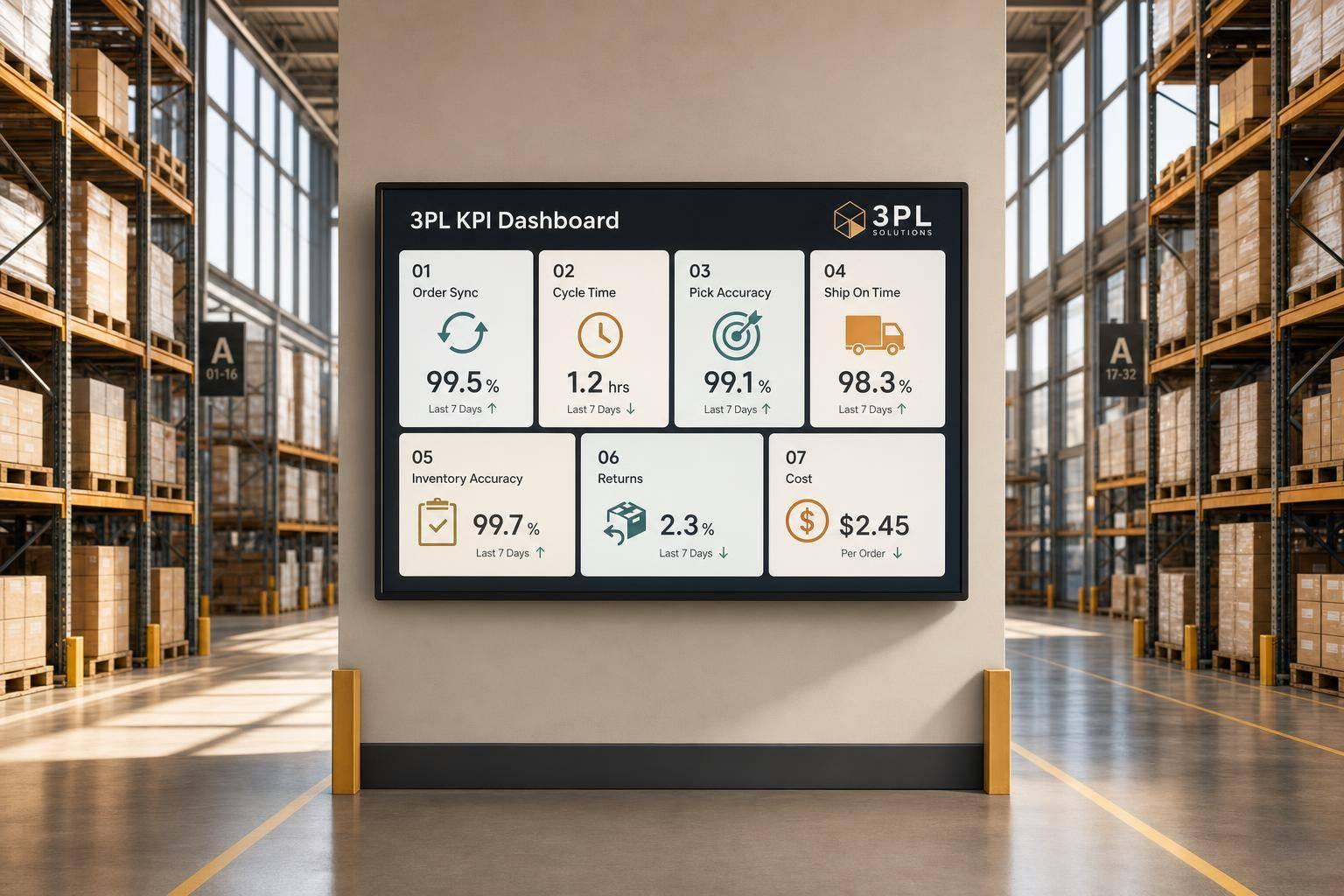
7 WooCommerce 3PL KPIs Teams Track

Centralized vs Decentralized Replenishment
