Centralized vs Decentralized Replenishment

Your replenishment model changes three big things at once: inventory cost, delivery speed, and stockout risk. If I need one simple rule, it’s this: centralized replenishment usually cuts total inventory, while decentralized replenishment usually puts stock closer to customers.
Here’s the short version:
- Centralized replenishment means one team or system decides what to buy, when to reorder, and where inventory goes.
- Decentralized replenishment means each warehouse or node makes those decisions based on local demand.
- If your goal is lower inventory and tighter control, centralized is often the better fit.
- If your goal is 1- to 2-day delivery and local availability, decentralized often makes more sense.
- Many brands use a hybrid setup: centralized for slow-moving or high-value SKUs, decentralized for fast movers.
A few numbers show why this choice matters:
- U.S. inventory carrying costs reached $302 billion in 2024
- Carrying costs often run 20% to 30% of average inventory value
- Pooling stock in fewer locations can cut safety stock through the square-root law
Centralized verses Decentralized Supply Chain
sbb-itb-eafa320
Quick Comparison
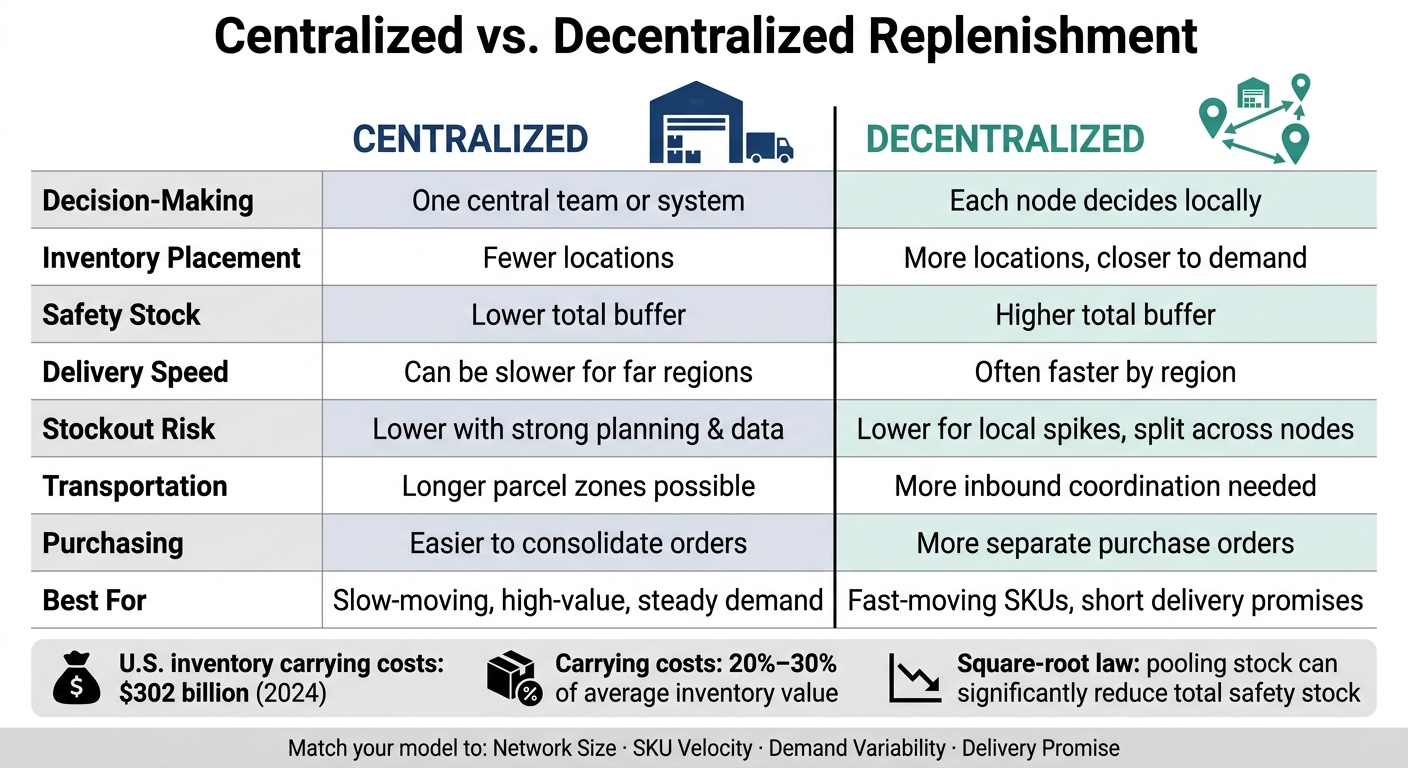
Centralized vs Decentralized Replenishment: Key Differences at a Glance
- Decision-Making: Centralized replenishment uses one central team or system, while decentralized replenishment allows each location to make inventory decisions independently.
- Inventory Placement: Centralized replenishment stores inventory in fewer locations, while decentralized replenishment distributes stock closer to demand.
- Safety Stock: Centralized replenishment typically requires less total safety stock, while decentralized replenishment needs larger combined inventory buffers.
- Delivery Speed: Centralized replenishment may result in longer delivery times for distant regions, while decentralized replenishment supports faster regional fulfillment.
- Stockout Risk: Centralized replenishment reduces stockout risk when planning and data are strong, while decentralized replenishment responds better to local demand spikes.
- Transportation: Centralized replenishment can increase shipping distances, while decentralized replenishment requires more inbound transportation coordination.
- Purchasing: Centralized replenishment simplifies purchasing through consolidated orders, while decentralized replenishment often requires more individual purchase orders.
- Best Fit: Centralized replenishment works best for slow-moving, high-value products with steady demand, while decentralized replenishment is better for fast-moving SKUs and shorter delivery promises.
If I’m choosing between the two, I’d look at network size, SKU velocity, demand variability, and delivery promise first. That gives a clear starting point before getting into systems, labor, and 3PL support.
Centralized replenishment: one control point across the network
In a centralized replenishment model, one planning team or system decides when to reorder, how much to buy, and where stock should go across the whole network. That includes Shopify, Amazon, wholesale, and other channels. Everyone works from one inventory record and one set of reorder rules. As a result, stock placement changes, and so does the way orders move from suppliers to downstream locations.
How centralized control affects inventory placement and order flow
With centralized control, inventory usually sits in fewer locations. That makes inventory risk pooling possible. Instead of each node holding its own safety stock buffer, the network keeps a shared reserve that can support demand from multiple channels at the same time.
The square-root law helps explain why this matters. If you pool safety stock from multiple locations into one central point, total safety stock drops to about 1/√n of the decentralized total. In plain English, the network needs less reserve inventory overall, which cuts the cash tied up in stock across nodes.
Order flow also changes. Demand signals from all channels feed into one central planning system, which then sends replenishment instructions to downstream nodes and suppliers. The planning team looks at combined demand, works out actual inventory needs, and decides when to reorder and where inventory should land. In a decentralized setup, each node would make those calls on its own. Centralized flow cuts duplicate decisions, but there’s a catch: the whole model leans hard on planning accuracy and clean data.
Lead time, stockout, and cost tradeoffs in a centralized model
Centralization often cuts inventory carrying costs and makes purchasing more efficient because orders can be consolidated. A case study of the Matahari Group, a large Indonesian retailer, found that centralizing distribution and inventory control led to a 54% drop in inventory holding requirements and a 40% drop in distribution costs. That means lower holding cost and less cash locked up in reserve stock.
It can also help purchase lead times, since buying and order consolidation are easier when one team runs the process. But there’s a tradeoff. If inventory is held in one central location, shipping distances to end customers may grow. That can increase transportation costs and stretch delivery times, especially for customers far from the central node.
Stockout risk can drop when pooled inventory is planned well. But when forecasting is off or allocation is weak, shortages can show up fast. Centralized replenishment works best when demand is fairly predictable, reorder points are tightly managed, and the system has accurate, real-time inventory data across all channels. Without real-time data, it’s easy to miss regional shifts in demand and send too little inventory where it’s needed.
The tradeoff is pretty straightforward: central control lowers inventory cost, but it can slow delivery speed and reduce local responsiveness.
Decentralized replenishment: local decisions closer to demand
In a decentralized replenishment model, each node restocks based on its own local demand. Local or regional fulfillment teams make the call, so control stays close to where buying happens. That can speed up response time, but it also splits inventory decisions across sites. In most cases, each location follows its own reorder rules, often EOQ, to balance ordering and holding costs.
How decentralized control affects inventory placement and order flow
Inventory sits closer to the demand each node serves, and replenishment stays linked to site-level needs. That sounds practical, and in many cases it is.
But there’s a catch. When each site orders on its own, suppliers get separate purchase orders instead of one combined signal across channels. As a result, coordination across the network gets weaker, and there are fewer chances to consolidate orders or shipments. That tradeoff stands out even more when you compare this setup with centralized replenishment.
Lead time, stockout, and cost tradeoffs in a decentralized model
The main tradeoff is network efficiency. Decentralized replenishment helps sites respond faster at the local level, but it also drives up total inventory and ordering costs compared with a coordinated network plan.
It can also mean more supplier setups and smaller production runs when orders aren’t synchronized. So the real issue is pretty simple: does faster local response make up for the loss in network-wide efficiency?
Direct comparison and best-fit use cases for each model
Once the tradeoffs are clear, the next step is simple: match each model to the network it fits best. The main tension comes down to inventory efficiency vs. delivery speed.
When centralized replenishment is the right fit
Centralized replenishment works best for slower-moving, higher-value SKUs and networks that can live with longer delivery windows. Think specialty electronics or premium home goods. In both cases, excess stock ties up too much cash, and demand is steady enough to plan at the national level.
It also makes life simpler. You can run one national purchasing plan and manage against simpler inventory targets.
That edge starts to fade when speed and local product availability matter more.
When decentralized replenishment is the right fit
Decentralized replenishment makes more sense when fast delivery is part of the offer and SKU velocity is high. If your brand promises 1- or 2-day delivery, inventory needs to be closer to where demand shows up.
This model fits consumables, fashion basics, and fast-moving home goods. These items move fast enough to support stock across several regional nodes. And during a promotion, the cost of a regional stockout can be higher than the carrying cost of extra inventory.
A simple decision framework based on network size and SKU mix
A practical way to choose is to look at four inputs:
- Network size
- SKU velocity
- Demand variability
- Delivery promise
Small, stable networks usually line up with centralized replenishment. Larger networks spread across regions usually line up with decentralized replenishment for core SKUs.
A good rule of thumb: use centralized replenishment when ground shipping can meet your service promise. Use decentralized replenishment when the target is nationwide next-day or 2-day delivery.
Many brands don’t pick just one. They segment SKUs and use both models.
Execution still comes down to systems, labor, and network visibility.
3PL support for replenishment execution and key takeaways
Once the replenishment model is set, execution is what makes it work. A plan can look good on paper and still fall apart if inventory, orders, and freight don’t stay in sync.
How 3PL capabilities support either replenishment model
A 3PL can support either model through transportation, warehousing, systems integration, and inventory visibility.
In practice, that means the 3PL has to move inventory, data, and orders together. On the transportation side, it includes inbound freight from suppliers, scheduled linehaul between nodes, and outbound parcel shipping to end customers. On the warehousing side, it means steady receiving, accurate cycle counts, and multi-channel fulfillment workflows all running from the same inventory pool.
That same pool may need to support:
- DTC pick and pack
- Case picking for wholesale
- Marketplace replenishment
JIT Transportation supports both models with nationwide distribution and fulfillment, transportation, and value-added services such as pick and pack, kitting and assembly, testing, and white glove handling. Its technology integrates with merchant systems to keep inventory visibility up to date across channels. That helps replenishment signals stay on time, whether they come from one central hub or from several regional nodes.
Fast returns inspection, restocking, and reallocation also help keep available inventory accurate. That matters even more in decentralized networks, where stock is spread across multiple locations.
Conclusion: choose the model that fits your service goals and inventory risk
Centralized models usually mean lower holding cost and tighter control. Decentralized models usually mean shorter lead times and better local availability.
The right choice should come from your network size and SKU profile. Smaller networks and long-tail catalogs often fit centralized models well. Larger networks with higher-velocity regional demand often get better results from decentralized or hybrid setups. And as your channel mix grows, the model should change with it instead of staying tied to the structure you started with.
Match the model to your network size, SKU velocity, and delivery promise.
FAQs
How do I choose a hybrid replenishment model?
Start with your business goals, tech stack, and day-to-day priorities. A strong hybrid model lines up replenishment methods with each product category and its demand pattern.
Use one inventory allocation system to get real-time visibility across channels. Advanced warehouse management systems and predictive analytics can automate reordering and stock transfers. JIT Transportation can help put that into action with scalable infrastructure and technical expertise.
What data is required for centralized replenishment?
Centralized replenishment runs on accurate, real-time data from every channel and location. If the data is off, the decisions will be too. That’s why teams pull from a few core inputs:
- Inventory levels: on-hand, in-transit, and allocated
- Demand data: sales history, open purchase orders, and website traffic
- Supplier metrics: lead times and fill rates
- External signals: weather and seasonal trends
These inputs come together through ERP, WMS, and sales platforms. Once connected, they support precise, automated replenishment decisions across the business.
When should I switch from centralized to decentralized?
Consider switching when one location starts creating delivery bottlenecks, higher shipping-zone costs, or missed delivery promises. This tends to happen at around 500–1,000 orders per month or when more than 35% of orders are going to distant, high-cost zones.
This setup works best for high-velocity SKUs that can handle split inventory. But there’s a trade-off: more locations mean more overhead, more complexity, and higher safety stock needs - about 42% more. So the math has to work. Your shipping savings should be greater than those added costs.
Related Blog Posts
Related Articles

Demand-Driven Replenishment for Multi-Node 3PL

3PL Models Compared for Reverse Logistics Carbon