
3PL Labor Planning: 7 Ways to Control Overtime

Overtime in a 3PL is usually a planning problem, not just a volume problem. If warehouse labor goes over 40 hours in a workweek, overtime pay jumps to 1.5x under the FLSA. That means a worker at $20.00/hour costs $30.00/hour in overtime, and even a small overrun can add thousands of dollars in a month.
If I wanted the short answer, it would be this: I can control overtime by matching labor to demand earlier and more accurately. The article points to 7 main ways to do that:
- Forecast labor hours from order volume
- Use core staff plus flex shifts
- Spread out promo and receiving volume
- Use temp labor and cross-training for spikes
- Set order cutoffs based on actual capacity
- Use labor standards and trigger points
- Build a peak-season surge plan before Q4 starts
A few numbers make the point fast:
- 50 associates x 5 overtime hours = $7,500 in overtime wages at $30.00/hour
- The same hours at straight time would cost $5,000
- That’s a $2,500 extra cost for the same 250 hours
- A common target is to keep overtime near 5% to 10% of warehouse labor hours
- If overtime stays above 10% to 15% for 3 straight months, the issue is often in planning, cutoffs, release timing, or staffing mix
The main takeaway is simple: forecast earlier, schedule in layers, smooth volume, and stop late-day compression before it starts. That is how I would keep labor cost per order from drifting up while still protecting same-day shipping.
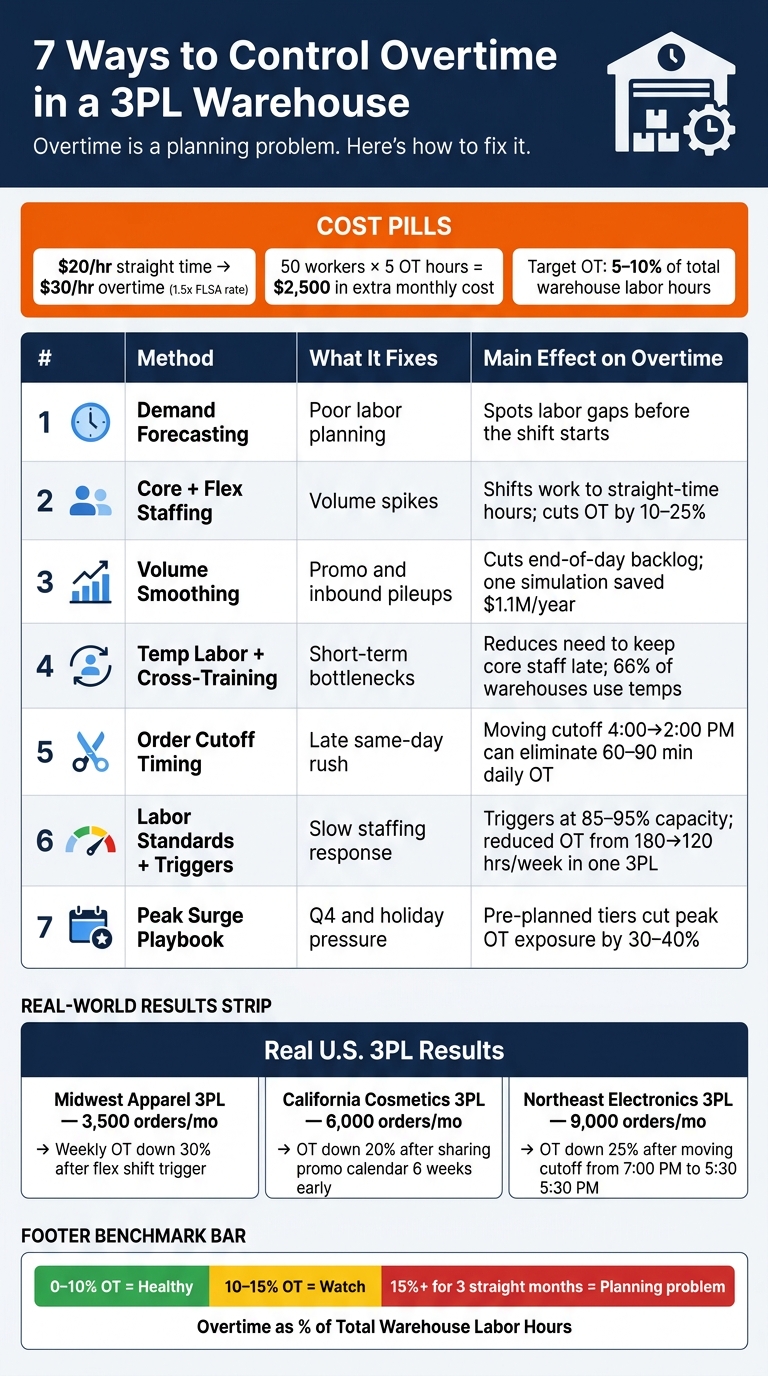
7 Ways to Control Overtime in a 3PL Warehouse
Quick Comparison
| Method | What it fixes | Main effect on overtime |
|---|---|---|
| Demand forecasting | Poor labor planning | Spots labor gaps before the shift starts |
| Core + flex staffing | Volume spikes | Shifts work to straight-time hours |
| Volume smoothing | Promo and inbound pileups | Cuts end-of-day backlog |
| Temp labor + cross-training | Short-term bottlenecks | Reduces the need to keep core staff late |
| Order cutoffs | Late same-day rush | Shrinks daily overtime windows |
| Labor standards + triggers | Slow staffing response | Tells supervisors when to act earlier |
| Peak surge playbook | Q4 and holiday pressure | Replaces repeated overtime with planned surge coverage |
If you run a 3PL shipping 3,000+ orders per month, this article shows that overtime is often less about working harder and more about timing work better.
sbb-itb-eafa320
Why Overtime Keeps Recurring in Fast-Moving 3PL Operations
Overtime in 3PL operations usually isn’t about random chaos. More often, it comes from the same planning misses showing up again and again. In fast-moving fulfillment, a few patterns tend to drive most overtime, and each one points to a labor-planning fix.
Uneven Daily and Weekly Order Volume
E-commerce order volume rarely stays steady. Mondays and post-promo days can come in 20–30% higher than a mid-week average, and a big sitewide sale can send daily order counts to 2–4x above baseline. That kind of swing breaks average-based staffing fast.
The problem gets worse when the ERP or marketplace sends fixed batch releases at set times during the day. Instead of a smooth flow of work, teams get hit with sharp intraday spikes. Base staffing can’t soak that up, so managers are left with two immediate choices: approve overtime or push orders into the next day. And next-day carry-over puts SLA performance at risk.
Late Order Release and End-of-Day Compression
Same-day shipping cutoffs are a major reason teams stay late. If a brand promises same-day shipping for orders placed until 3:00–4:00 p.m. local time, and carrier pickups land between 5:00–7:00 p.m., the warehouse may only have 1–3 hours to pick, pack, and stage those orders.
Late cart close tightens that window even more. For example, a promo that ends at 11:59 p.m. PST can send a large batch of orders into a warehouse running on Central Time. That shifts a heavy chunk of work into an already narrow same-day shipping window.
Here’s where it turns painful: if a site normally runs at 500–700 picks per hour and 60–70% of daily orders don’t arrive until after noon, outbound teams either extend the shift or miss the carrier trailer.
Receiving, Dock, and Value-Added Bottlenecks
Inbound work and value-added services don’t sit in their own neat lane. They compete for the same people, the same dock doors, and the same floor time as outbound fulfillment.
Container arrivals and large purchase order receipts often bunch up from Monday through Wednesday. That overloads the dock and drags receiving teams away from put-away. Then supervisors, trying to protect outbound SLAs, pull pickers off their main work to unload trailers. Picking waves slow down, backlog builds, and those same workers often have to stay late to finish shipping.
VAS adds another layer of pressure. If it’s scheduled poorly, it can add $0.25–$1.00+ per unit in labor cost and push overtime higher during launches and promotions.
Forecasting Gaps Between Brands and 3PL Teams
A lot of overtime starts upstream, before labor is even scheduled. Brands may share promo calendars, but that doesn’t always tell the 3PL what it needs to know: expected order lift, when orders will land, and which SKUs will move.
Monthly or quarterly forecasts also fall short when ad spend shifts fast or marketplace rules change mid-cycle. In that situation, 3PL teams are left filling in the blanks. Without clear inputs like order count, units per order, and touch time by function, labor planning turns into educated guessing - and overtime becomes the buffer.
The first control is simple: translate demand into labor hours before the schedule is built.
1. Demand Forecasting That Converts Orders Into Labor Hours
Turn forecasted orders into labor hours before you build the schedule. That way, planners staff against the work that’s coming, not against a rough guess. It also helps teams spot gaps early instead of finding out late in the day and paying overtime to catch up.
Start by breaking forecasted volume into labor by function: receiving, put-away, pick, pack, VAS, and loading. Then apply labor standards or productivity rates. After that, add indirect time and absenteeism buffers before you convert hours into headcount.
Impact on Overtime Hours
A labor-hour model makes staffing gaps visible early. With that view, planners can move people around or add flex hours before overtime begins.
Effect on Same-Day SLA Performance
When labor-hour forecasting is accurate, teams can staff earlier around peak release windows. That helps keep same-day SLA performance high on stable programs.
Staffing Responsiveness to Volume Swings
Hourly WMS backlog reports give supervisors a live read on where work is building up. That lets them shift cross-trained labor before a backlog snowballs into overtime.
Labor Cost Per Order
When staffing lines up with the hours the work actually needs, idle time drops, overtime comes down, and labor cost per order improves.
Once hours are forecasted, the next step is deciding how to split them between core and flex staffing. That sets the baseline for the next lever: designing shifts around the work, not the clock.
2. Flexible Shift Design With Core and Flex Staffing Layers
Once labor hours are set, the next step is simple: decide who works those hours. That’s where a forecast turns into an actual staffing plan.
A core-and-flex shift design splits the workforce into two layers. You have a core group of full-time staff sized for baseline volume. Then you have a flex layer made up of part-time, split-shift, on-call, or temp workers who step in when volume jumps.
In day-to-day operations, the core team handles the steady work: picking, packing, and replenishment. The flex layer takes the hit when order waves come in or promotions drive a spike. Instead of stretching everyone into longer shifts, managers can stagger flex coverage around peak windows. That works best when volume is smoothed out, which ties into the next lever.
Impact on Overtime Hours
The core-and-flex model cuts overtime by making spikes trigger more people, not more hours from the same people.
If a forecast shows volume running 20% above baseline before 10:00 a.m., supervisors can bring in flex staff for the afternoon block instead of asking core employees to stay late. That’s a big difference in practice. It gives the operation more room without leaning on the same crew shift after shift.
3PLs that use clear flex-activation rules often see overtime hours fall by 10–25%.
Effect on Same-Day SLA Performance
Staggered flex start times - for example, 11:00 a.m., 1:00 p.m., and 3:00 p.m. - keep labor lined up with peak order arrival windows and carrier cutoffs.
That matters because same-day shipping is all about timing. Flex staff can focus on same-day and express-priority orders while the core team keeps baseline throughput moving. In many cases, that setup helps operations keep same-day ship rates in the 95–99% range even when order inflow comes in above plan.
Staffing Responsiveness to Volume Swings
Fast response to volume swings depends on one thing: tying flex scheduling to live demand signals.
Supervisors need input from day-of-week volume profiles, promotion calendars shared by brands, inbound data, and real-time WMS order counts. With that signal in place, they can activate flex capacity before a backlog starts to snowball.
One example comes from Made In Cookware's distribution operation. The site kept a lean full-time management core alongside a labor pool of more than 60 trained operators, with 20 used on a weekly basis. That setup let the operation scale up or down based on forecast spikes and project demand.
Labor Cost Per Order
There’s also a direct cost angle here.
Under FLSA rules, U.S. overtime is paid at a 1.5x premium. So if even 10–15% of hours move from overtime to straight-time flex pay, labor cost per order can drop. A 3PL that shifts away from heavy overtime use and into a planned flex model might bring labor cost per order down from $1.40 to $1.25.
3. Order Volume Smoothing Across Promotions and Receiving
Volume smoothing separates promotion-driven outbound waves from inbound receiving so work stays balanced instead of piling up at the end of a shift. The point isn't to add more labor. It's to use the labor you already have at the right time.
Impact on Overtime Hours
Start by splitting outbound waves from inbound appointments. Release orders in timed WMS waves, and set inbound appointments by shift window. One simulation cut receiving to finished by 10:40 a.m. and saved $1,113,390 per year. That's what can happen when inbound scheduling is treated as a labor-planning call, not just a dock calendar issue.
Effect on Same-Day SLA Performance
Planned waves help prevent the late-afternoon pileups that push work past cutoff. For promotional SKUs, it helps to schedule priority inbound containers earlier in the day, such as from 7:00 a.m. to 12:00 p.m. That gives inventory time to reach pick faces before the afternoon wave lands. In plain terms, dock-to-stock timing can decide whether an order ships the same day or misses the SLA.
Staffing Responsiveness to Volume Swings
Smoothing makes volume swings easier to see coming, so supervisors can staff before the surge instead of scrambling after a backlog forms. Appointment-based receiving is a big part of that. Veryable reported that after adding flexible labor tied to scheduled inbound appointments, on-time receiving improved from 44.3% to about 80%, and driver dwell-time incidents dropped by roughly 38%. When inbound volume is visible ahead of time, staffing can move away from last-minute overtime and toward planned labor.
Labor Cost Per Order
Every overtime hour avoided during a promotion stays at straight time, which lowers labor cost per order.
After peaks are smoothed, temporary labor and cross-training can handle the remaining spikes.
4. Using Temporary Labor and Cross-Training to Cover Volume Swings
Once volume smoothing cuts the surges you can see coming, you still have gaps to deal with. Those gaps need a faster, lower-risk backup than overtime. A planned temp-labor pool, paired with cross-trained staff, helps absorb day-to-day spikes without stretching shifts.
The point isn't just adding more people. It's putting the right labor in the right role. Temp labor works best for surge relief. Cross-training helps stop one weak spot from slowing down the whole floor.
Impact on Overtime Hours
Temp labor and cross-training help keep short spikes from turning into premium-pay hours. Temps can take on repeatable, lower-complexity work like packing, label application, and basic case-picking. Cross-trained employees can then move to whichever bottleneck needs help most.
If outbound packing starts to fall behind or a dock surge hits, a supervisor can shift labor right away instead of adding overtime at the end of the day.
This setup is already common across the industry. 66% of warehouses and distribution centers expect to fill positions with temp workers in the next year, and 54% report greater use of temp labor than before COVID.
Effect on Same-Day SLA Performance
Cross-training helps protect same-day shipment performance because it keeps work flowing through the building. One overloaded area doesn't have to jam everything behind it.
If outbound packing is short-staffed but receiving is light, cross-trained staff can move over fast. That gives late orders a better shot at shipping the same day instead of getting stuck in queue.
Staci Americas' Balsam Hill case study shows the model in practice. Balsam Hill provides forecast data so Staci could ramp space and labor accordingly, with temporary labor and cross-trained staff from other accounts used when order volume spikes.
Staffing Responsiveness to Volume Swings
A temp program only works when the groundwork is already done. If you're scrambling to find people after the spike starts, you're already behind.
The response gets faster and more steady when these pieces are set ahead of time:
- Approved vendors
- Pre-screened workers
- Role checklists
- Call-in triggers
Cross-training adds another layer of flexibility, especially when it covers adjacent tasks like pick/pack, receiving, replenishment, cycle counts, and returns.
Labor Cost Per Order
The lowest-cost setup is often a blended one. Core staff handle the baseline. Temps cover the spike. Cross-trained employees step in to handle short-term imbalances.
That mix can cut overtime, but that's only part of the story. The bigger target is labor cost per order. If temp labor leads to a slow ramp-up, rework, or mistakes, the savings from avoiding overtime can disappear fast.
That leaves one control point: when orders enter the system.
5. Setting Order Cutoff Times That Match Warehouse Capacity
After you've smoothed order volume and added flex labor, cutoff timing becomes the next lever to watch. A cutoff time isn't just a promise to the customer. It's a labor trigger.
Start with the last carrier pickup and work backward. Subtract the time needed for:
- picking
- packing
- labeling
- staging
- handling exceptions
What’s left is your usable processing window. Set the cutoff inside that window, not right on the edge. That extra space matters. It gives the team room to deal with the stuff that always pops up late in the day.
Once the cutoff is set, staffing has to follow real labor signals.
Impact on Overtime Hours
When the cutoff lines up with actual throughput capacity, late-day order spikes get smaller. Supervisors don’t have to scramble to force one last batch out the door before the truck leaves. Cutoff-based policies improved service levels versus the benchmark.
Here’s a simple example. Moving a same-day cutoff from 4:00 p.m. to 2:00 p.m. in a facility with a 6:30 p.m. carrier pickup can turn 60 to 90 minutes of daily overtime into regular-time work, especially when it's paired with proactive wave planning.
Effect on Same-Day SLA Performance
A tighter cutoff doesn’t automatically hurt SLA performance. In many cases, it helps.
When orders come in early enough, supervisors can build waves around known intake windows instead of reacting to a late rush. That’s a much steadier way to run a floor. It also helps teams avoid the domino effect that starts when one late batch throws off packing, staging, and carrier handoff.
Leave a buffer between the customer-facing cutoff and the warehouse cutoff. That gap helps absorb errors, rework, and congestion without pushing the shift into overtime.
Staffing Responsiveness to Volume Swings
Aligned cutoffs give supervisors a clearer read on the workload before the shift ends. By mid-day, the team can see how many orders are in queue, how much capacity is left, and whether current headcount can handle more same-day volume or needs to stop there.
That changes staffing from reactive to planned. Instead of calling in extra help at 4:30 p.m., planners can move cross-trained workers earlier in the day from lower-priority tasks, like cycle counting or non-urgent value-added services, into picking and packing.
Some operations take it a step further and use dynamic cutoffs. In plain English, they stop same-day intake when regular-time capacity is close to full.
Labor Cost Per Order
Earlier cutoffs move more work into regular-time hours and cut rework tied to end-of-day rushes. A standard same-day cutoff of around 1:00–2:00 p.m. local time is a common setup. Later expedited cutoffs can then be priced to cover the added labor.
With cutoff timing locked in, labor triggers can close the gap before overtime starts.
6. Using Labor Standards and Data Triggers to Staff Ahead of Volume
Once the cutoff is set, the next step is simple: figure out whether the team can clear the queue before orders hit that line.
A labor standard is the time it takes to complete one unit of work under normal operating conditions. That standard turns a deadline into required labor hours. From there, staffing triggers give supervisors a clear point to act. For example, you might use thresholds like 85% of capacity for flex labor and 95% for temp labor. Those triggers can connect to cutoff times, wave releases, or cumulative order intake using WMS and LMS data. In practice, that makes labor standards the daily control point, not just something used for planning.
Impact on Overtime Hours
When standards and triggers work together, the workload gets translated into hours before the shift gets away from you, not after a backlog piles up.
Measured standards and staffing rules can cut overtime by 10% to 25%. One U.S. 3PL fulfilling roughly 5,000 DTC orders per month reduced weekly overtime from 180 hours to 120 hours after putting pick/pack standards and morning-volume triggers in place, while still maintaining service levels.
Effect on Same-Day SLA Performance
Standards help planners answer one direct question: Can the current headcount finish same-day orders before the cutoff?
If the answer is no at 11:00 a.m., there is still time to step in. One U.S. apparel 3PL used a trigger that moved two cross-trained associates from returns to picking whenever open same-day orders at 11:00 a.m. went above 75% of pick capacity. Over three months, same-day SLA adherence rose from 94% to 98% without adding overtime hours.
Staffing Responsiveness to Volume Swings
Data triggers shift intraday staffing from reactive to demand-driven.
If receiving volume is light but picking hours are running hot, a trigger can tell supervisors when to move receivers into picking based on cross-training and the standard pick rate. For brands running promotions or dealing with inbound PO surges, triggers can also tie straight to the promotion calendar so labor plans account for spikes before they reach the floor.
That same logic matters even more when peak demand stretches across several weeks instead of a few heavy days.
Labor Cost Per Order
Labor standards set the expected labor minutes per order or per line. That becomes the cost baseline.
Triggers help the operation stay close to that baseline by reducing inefficient overtime and last-minute staffing moves. When hours per order come down, labor cost per order drops too, even if hourly wages stay flat. Tracking this weekly, by brand, gives teams a plain check on whether labor planning is doing its job.
In peak season, these triggers need earlier thresholds and broader flex coverage.
7. Building a Peak Season Surge Playbook for 3PL Fulfillment
Peak season changes the whole staffing equation. Normal triggers aren't enough on their own. They need to kick off a preset surge plan.
That matters even more in Q4, when peak volume in many fulfillment operations runs 3–5x normal daily order flow for weeks at a time. At that point, you're not dealing with a short spike. You're dealing with sustained pressure. And that's when overtime can get out of hand fast, because the volume stays high for weeks, not just a few hours.
The fix is to tie forecasting, order cutoffs, staffing triggers, and flex labor into one response. If those pieces sit in separate plans, teams end up reacting too late and patching holes shift by shift.
A good playbook lays out staffing tiers by volume band, temp labor agreements with notice terms already locked in, zone-based shift templates, and clear escalation authority. Planning should start 60–90 days before peak. Use prior-year Q4 trends, promo calendars, and inbound purchase order schedules to map out base, moderate surge, and peak surge scenarios.
The big win here is speed. When Black Friday volume lands, supervisors should be able to run a preset labor plan instead of making calls hour by hour.
Impact on Overtime Hours
Overtime works best as a pressure valve for narrow bottlenecks, like receiving or pack-out. It shouldn't be the main plan.
One of the plainest ways to keep overtime from climbing is to pre-book temp workers for the stretch from Black Friday through year-end. If you wait until backlog is already piling up, you're paying more and getting less control.
Effect on Same-Day SLA Performance
Same-day SLA misses during peak usually happen late in the day. Orders flood in, the clock keeps moving, and the team has to make a tough tradeoff: ship on time or hold the line on overtime.
A surge playbook reduces that pressure by pre-assigning extra labor to picking, packing, and shipping closeout work on known heavy-volume days. It also helps to plan throughput by the hour for days like Cyber Monday evening waves, not just by daily totals. That gives supervisors a much clearer read on where the shift is going.
When order cutoff times match what the operation can actually handle during surge periods, service levels are easier to protect without depending on a last-minute push.
Staffing Responsiveness to Volume Swings
Once staffing tiers are in place, speed of movement matters next. It's not enough to add labor. Teams also need a clear rule for when to shift labor between zones.
The playbook should set exact trigger thresholds. For example, Tier 2 flex labor might activate if volume runs 15% above forecast for two straight days. That builds directly on the day-to-day staffing controls from section 6. With cross-training in place, Tier 2 labor can move right away between receiving, picking, and pack-out when those thresholds hit.
Labor Cost Per Order
After the labor plan is live, the next step is simple: check whether it cut premium hours without dragging down service.
A solid surge plan should reduce overtime even if total labor spend rises a bit during peak weeks. That's usually a fair trade. More of the extra workload gets covered by planned flex and temp labor instead of premium-rate hours.
Track these numbers against prior-year peak weeks:
- Overtime dollars
- Labor cost per order
- Temp spend
- On-time ship rate
- Backlog hours
- Productivity by labor type
Comparison Snapshots and U.S.-Based Operational Examples
Use these snapshots to match the right control lever to the problem: forecast error, shift compression, temp coverage, or peak surges.
Forecasting Method Comparison
Historical average forecasting gives you a simple daily headcount. The catch? It’s weak for task-level labor planning, tends to react late to promotions, and can leave you with a higher overtime risk.
Time-series forecasting with promo inputs is more precise. It maps labor hours by role and zone, gets ahead of expected spikes, supports smoother weekly schedules, and helps cut overtime risk.
Shift Design Comparison
Fixed shifts bring schedule stability, but they also tend to carry recurring weekly overtime risk. Core-plus-flex shifts give up some stability, but they make better use of labor and keep overtime tied to actual peak demand instead of showing up week after week.
- Fixed shifts: high stability, low flexibility, recurring weekly overtime
- Core-plus-flex shifts: medium stability, high flexibility, better utilization, overtime limited to genuine peaks
Staffing Model Comparison
At an $18/hour wage, all-in overtime costs about $31/hour. Temp labor comes in at roughly $27.50/hour. That’s a gap of about $3.50 per hour in favor of temp coverage.
An overtime-heavy staffing model may need less training upfront, but it often brings more fatigue, more error risk, and more late shipments when peaks push core teams too far. A temp-augmented model gives operators more room to scale during promotions and keep service steadier.
Peak Planning Comparison
One documented 3PL example moved same-day shipping performance from 64% to 99% and removed 38 hours of weekly warehouse overtime after switching to a structured fulfillment process.
The difference is pretty plain:
- Reactive: spiky overtime, more backlog risk, more day-to-day chaos
- Planned: documented triggers, smoother costs, better SLA protection, less labor strain
Short U.S.-Based Operational Examples
The examples below show how those levers cut overtime in U.S. operations shipping 3,000 to 10,000 orders per month.
A Midwest apparel brand shipping 3,500 orders per month was averaging 2 hours of overtime per associate on Mondays and Tuesdays. After its 3PL set a staffing trigger at 20% above baseline volume and added a 4-hour Monday flex shift, weekly overtime fell by about 30% while same-day SLAs stayed steady.
A California cosmetics brand at 6,000 orders per month was stacking promotions at month-end. That pattern forced 3–4 days of heavy overtime each cycle. Once the brand shared its promo calendar 6 weeks in advance, the warehouse swapped unplanned overtime for scheduled temp labor. The result: overtime hours dropped by about 20%, and order accuracy improved during promotions.
A Northeast electronics brand shipping 9,000 orders per month had a 7:00 p.m. same-day cutoff and an 8:00 p.m. carrier pickup. That gap created 1.5–3 hours of late-shift overtime on most days. By moving the cutoff to 5:30 p.m. and adding a flex band only on forecasted peak days, the operation cut weekly overtime by about 25% with no change to carrier pickup timing.
How a Scalable 3PL Partner Helps Control Overtime
When Brands Need More Than Ad Hoc Overtime Fixes
These controls do the most good when one partner runs them across the network.
Past a certain point, overtime stops being a fix and starts looking like a warning sign. That usually happens when promotions, multiple sales channels, and inbound spikes all hit at once. One clear signal: weekly overtime sits above 10%–15% for three straight months. Then the pattern gets harder to ignore. Late releases pile up, inbound freight bunches together, and peak-week overtime keeps coming back. The warehouse team ends up carrying that load through longer shifts.
At that stage, brands need one operating plan across transportation, warehousing, and VAS.
That shifts the labor issue from day-to-day scrambling to coordinated capacity planning.
How Flexible Capacity Reduces Overtime Pressure
Here, integration matters more than one-off fixes.
A scalable 3PL lowers overtime by controlling the conditions that cause it in the first place. When inbound, dock, fulfillment, and outbound all run on one schedule, work spreads across the day instead of piling up at the end. That means less end-of-day compression.
A tiered staffing model helps too:
- Core staff handle the base workload
- Part-time and on-demand labor come in when forecasts trigger them
- This setup can cut peak-week overtime exposure by 30%–40%
On-demand labor and workforce management can also improve efficiency and lower unit cost by reducing reliance on overtime.
Integrated VAS plays a big part here as well. When pick & pack, kitting & assembly, testing, and white glove handling sit inside the same 3PL operation as standard fulfillment, that work can be scheduled into daytime capacity windows using labor standards. In plain terms, VAS stays inside regular shift hours instead of spilling into late nights.
The same idea applies across a broader fulfillment network.
JIT Transportation fits this model with integrated transportation, fulfillment, and VAS under one nationwide network. For multi-region brands, that setup spreads volume across sites so one location doesn't have to absorb every surge.
Conclusion
These seven controls work because they go after the root cause of overtime: demand, staffing, and timing falling out of sync. Overtime has a place when volume spikes for a short stretch. But when it becomes routine, it pushes up labor cost per order, covers up planning problems, and wears people down. That often leads to fatigue and higher turnover.
Benchmarks put target overtime at about 5–10% of warehouse labor hours. Once you’re above that range, the problem is usually planning, not demand.
Taken together, these seven levers should work as one labor plan, not seven isolated fixes. That means forecasting demand, building teams with core and flex labor, smoothing volume where you can, using temp labor and cross-training, setting cutoffs your operation can actually handle, triggering labor early, and prebuilding peak plans. For 3PLs shipping 3,000+ orders per month, disciplined forecasting, shift design, cutoff timing, and surge planning are what keep growth from turning into chronic overtime.
FAQs
How do I know if overtime is a planning problem?
Overtime becomes a planning problem when demand keeps running past planned capacity and extra hours stop fixing the shortfall.
You can usually spot it when volume stays 25%–40% above baseline, teams keep leaning on overtime or added shifts just to keep up, the receiving backlog grows while labor stays flat, and fulfillment metrics start to slip.
What data do I need to forecast labor hours accurately?
Start with 12 to 24 months of order history by SKU, channel, and destination region.
Use last year’s weekly unit sales as your baseline. Then adjust that number for year-over-year growth and live demand signals, like marketing calendars, promotions, and carrier pickup windows.
You’ll also want to pull in the operational side of the picture. That includes:
- Actual UPH for receiving, picking, packing, and shipping
- SKU velocity trends
- Inbound replenishment dates
- Historical overtime, absenteeism, and 15% to 20% turnover buffers
This gives you a forecast that reflects not just what customers may order, but what your team can actually handle on the floor.
When should I use flex shifts instead of temp labor?
Use flex shifts for short-term needs like late carrier cutoffs, same-day order processing, or delayed inbound shipments. They give you extra coverage right where you need it, without locking you into a full-day shift.
Use temp labor when volume jumps during peak periods or seasonal surges. That way, your core team can stay focused on steady, day-to-day operations.
Related Blog Posts
Related Articles
7 WooCommerce 3PL KPIs Teams Track

Centralized vs Decentralized Replenishment
