3PL Pricing Models Explained for DTC Brands
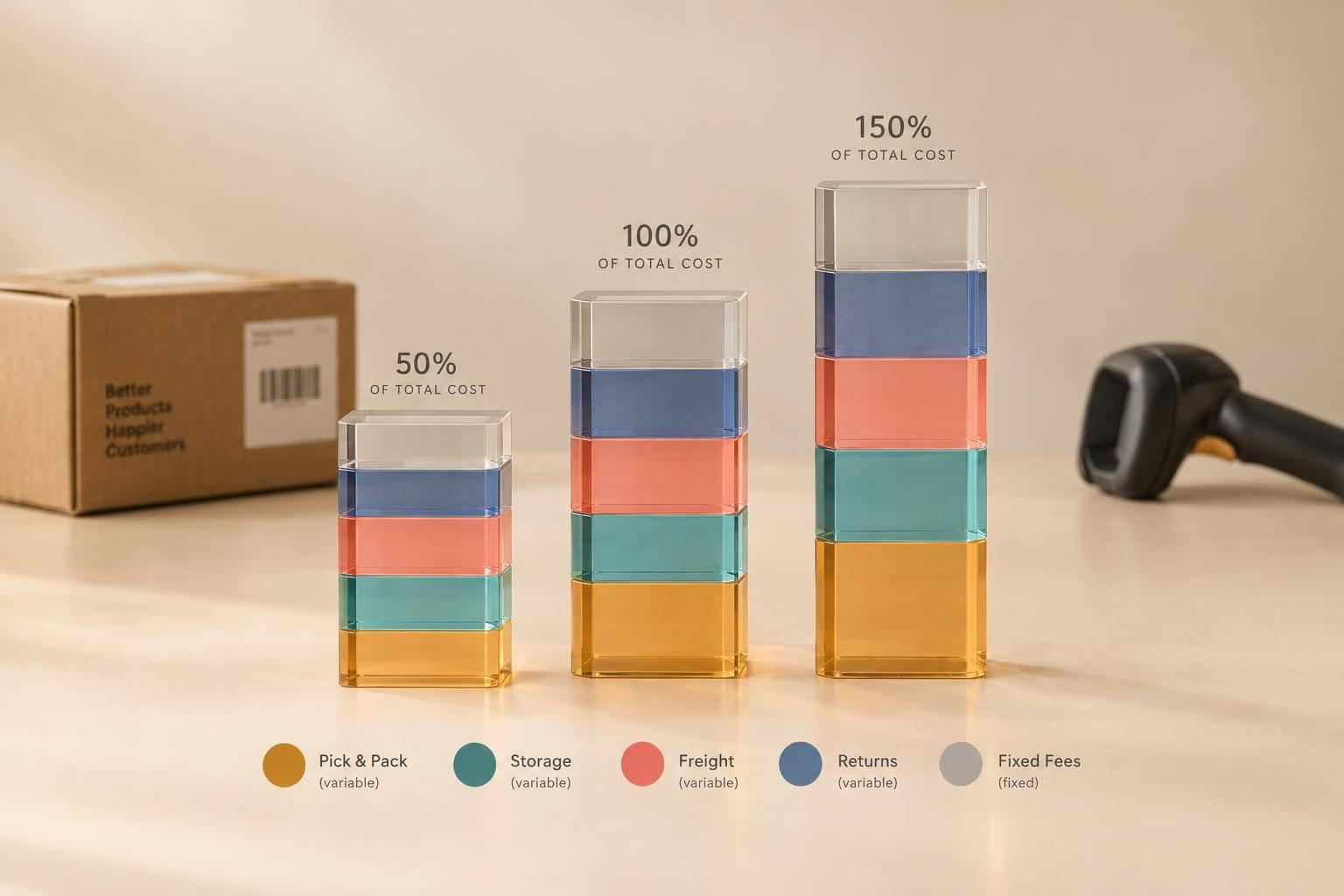
I compare 3PL quotes by total cost - not just the pick-and-pack rate. Add receiving, storage, packaging, fixed fees, shipping, and returns, then test the bill at 50%, 100%, and 150% of expected orders.
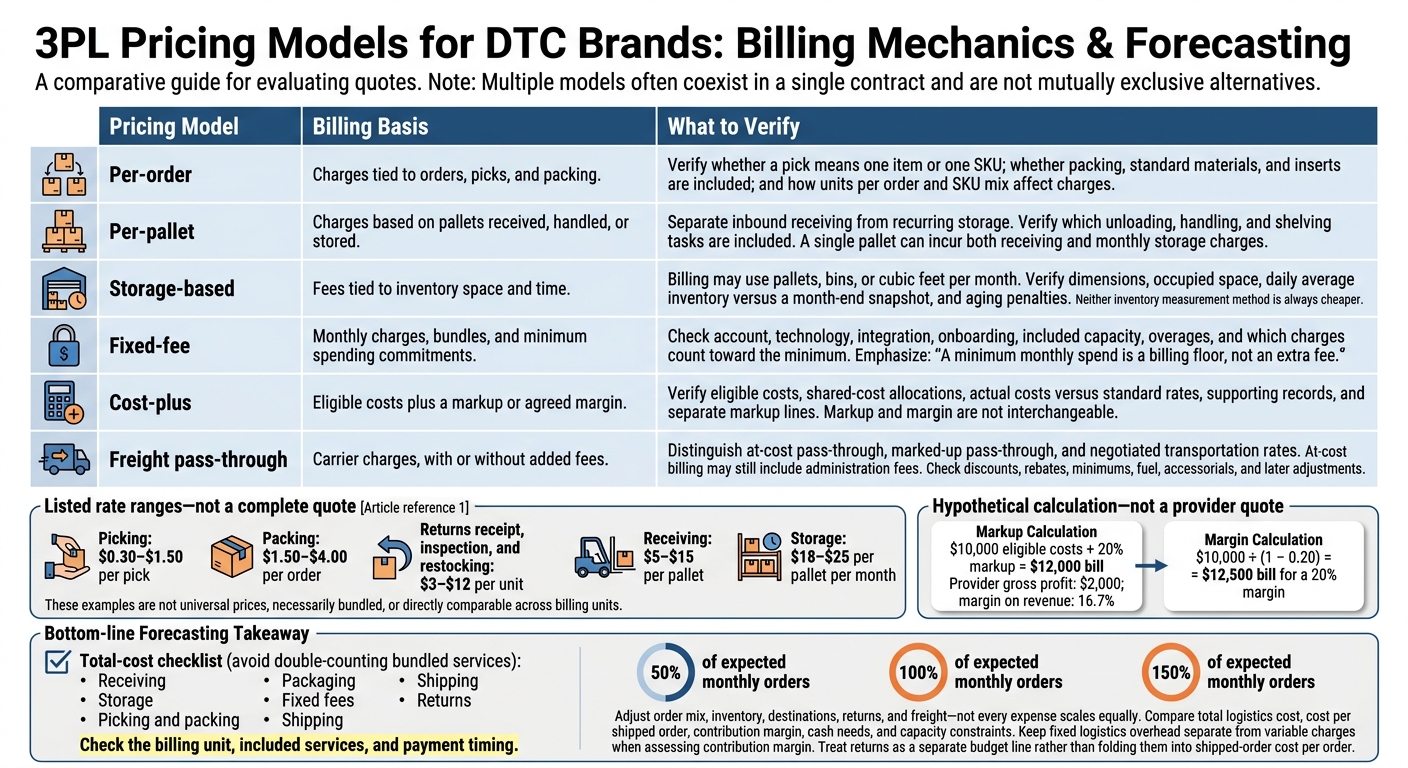
Here’s how I sort the six pricing models:
- Per-order: Charges tied to orders, picks, and packing.
- Per-pallet: Charges based on pallets received, handled, or stored.
- Storage-based: Fees tied to inventory space and time.
- Fixed-fee: Monthly charges, bundles, and minimum spending commitments.
- Cost-plus: Eligible costs plus a markup or agreed margin.
- Freight pass-through: Carrier charges, with or without added fees.
My rule: <u>check the billing unit, included services, and payment timing</u>. A low rate can still mean a high monthly bill. I also review minimums, surcharges, service terms, and exit fees so the forecast shows both profit per order and cash needed before inventory sells.
3PL Pricing Models: Compare the Total Cost
Per-Order, Storage, and Fixed Fees
Billing units tell you how charges are measured; services tell you what those charges cover. A single pallet can incur both a receiving fee and monthly storage charges. Check the rate, unit, and billing frequency for every line item. For DTC brands, these costs shape margins before revenue scales. Reviewing them shows how a quote translates into monthly cash outlay.
Per-Order Fees: Picking, Packing, and Materials
A base order fee may cover picking, packing, and standard materials - or each may be billed separately. Listed rates range from $0.30–$1.50 per pick and $1.50–$4.00 per order for packing.
Confirm whether a “pick” means one item or one SKU. That distinction changes the bill for multi-item orders. Check whether inserts and packaging materials cost extra, too.
Forecast with order count, units per order, and SKU mix, not order count alone. More picks increase fulfillment costs and can shrink contribution margin. Budget for returns separately: receipt, inspection, and restocking can cost $3–$12 per unit.
Inventory Fees: Receiving, Handling, and Storage
Receiving is an inbound charge; storage repeats over time. Providers may bill receiving per pallet or carton and storage per pallet, bin, or cubic foot per month. Listed rates range from $5–$15 per pallet for receiving and $18–$25 per pallet per month for storage.
Ask which unloading, handling, and shelving tasks the receiving fee covers. For storage, confirm how the provider measures dimensions and occupied space. Also check whether it bills based on daily average inventory or a month-end snapshot. Neither method is always cheaper - inventory timing determines which costs more.
Build your forecast around package dimensions, replenishment dates, and projected inventory balances. Bulky products take up more space. Slow-moving and seasonal stock can rack up repeated charges. Check aging thresholds and penalties for long-term storage.
Fixed Fees: Accounts, Bundles, and Minimums
Monthly account, technology, and integration fees add overhead whether you ship orders or not. Onboarding may also carry a separate upfront charge. If you're considering a bundle, check how many orders, how much storage, which materials, and what support it includes. Then review the overage rates.
A minimum monthly spend is a billing floor, not an extra fee. Ask which activity charges count toward that minimum and which fees fall outside it.
At lower volumes, fewer orders share the fixed costs. These commitments set your cost floor. More volume improves margins only until overages or capacity limits kick in. Use included capacity, monthly commitments, and contribution per order to calculate break-even volume.
Before committing, request a sample invoice that shows how the minimum works alongside separate fees. Then model freight pass-through separately from these fulfillment charges.
sbb-itb-eafa320
Cost-Plus Pricing and Freight Charges
Some 3PLs bill actual costs rather than fixed fulfillment rates. That makes freight and overhead less predictable - and contribution margin and cash flow harder to forecast.
Cost-Plus Billing: Costs, Markups, and Margins
Cost-plus billing charges actual labor, space, materials, or transportation costs plus an agreed markup or target margin. Unlike a fixed per-order fee, the bill increases when eligible costs go up, even if order volume stays flat. You get more visibility into costs, but your brand takes on price swings and invoice review.
Hypothetical calculation - not a provider quote: On $10,000 in eligible costs, a 20% markup produces a $12,000 bill. The provider’s $2,000 gross profit represents a 16.7% margin on revenue - not 20%. If the agreement instead requires a 20% margin, the price is $10,000 ÷ (1 − 0.20), or $12,500.
Define which costs qualify, how shared labor and space are allocated, and whether billing uses actual costs or standard rates. Require supporting invoices, hours, quantities, and separate markup lines.
Set written approval thresholds for special projects and expedited shipments. Also specify rate-change notice periods and dispute windows. Warehouse invoices and freight adjustments may arrive separately, so set aside cash for later charges.
Freight Billing: Parcel, LTL, and Truckload
Transportation is often billed separately from fulfillment labor and storage, adding another variable to your forecast.
At-cost pass-through bills the carrier’s charge without a transportation markup, though administration fees may still apply. Marked-up pass-through adds a percentage or fixed fee. Negotiated transportation rates use an agreed rate card. Clarify who keeps discounts and rebates, which minimums apply, and how fuel charges are calculated.
Require shipment-level details for base rates, discounts, surcharges, and adjustments. Specify whether markup applies to fuel and accessorials - not just base freight - so your forecast doesn't understate costs.
Parcel costs depend on destination, service level, dimensions, and billed weight, often the greater of actual or dimensional weight. LTL also factors in freight class, pallet characteristics, and possible reclassification charges. Truckload costs depend more on lane, equipment, capacity, timing, and detention.
Budget separately for fuel, residential and delivery-area surcharges, liftgate service, and appointments. Before serving new destinations, request ZIP-code or lane-level rates based on actual package data. Compare standard and expedited costs, and check how often surcharges are likely to apply. Use final billed freight in contribution-margin forecasts, and track carrier adjustments separately.
Forecast Total Costs and Review Contract Terms
Turn the rate card into a monthly cost forecast. Build a worksheet using SKU dimensions, weights, inventory levels, order mix, and shipment records. Convert each SKU’s dimensions from inches to cubic feet using length × width × height ÷ 1,728, then multiply by the number of stored units. Apply the storage method in your contract, and match every rate-card charge to its billing unit and forecast quantity.
Calculate Cost per Order and Contribution Margin
Use these formulas to track logistics spending:
- Cost per shipped order = total logistics cost ÷ shipped orders
- Logistics share of revenue = total logistics cost ÷ net revenue × 100
Keep returns out of the shipped-order cost-per-order calculation.
Contribution margin = net revenue − product cost − variable logistics charges − other specified variable costs, such as payment processing and sales commissions. Divide that result by net revenue to get the contribution-margin percentage.
Keep fixed logistics overhead, such as monthly tech or account fees, separate from variable charges. That way, low-volume months won’t distort your view of order-level profitability.
Model Slow, Expected, High-Growth, and Peak Demand
Once you have a baseline, test how the contract performs at 50%, 100%, and 150% of expected monthly orders. Adjust order mix, inventory, destinations, returns, and freight for each scenario instead of scaling every expense equally. If applicable, add a seasonal inventory buildup before Q4 sales.
Model tiered rates, minimums, overages, and capacity limits exactly as the contract specifies. Map deposits, inventory purchases, and logistics payments against expected customer cash receipts to find any funding gap. Then compare total logistics costs, cost per order, and contribution margin to spot shrinking margins and capacity limits.
Check Rate Cards and Custom Service Needs
Check sample invoices against your forecast and resolve any charges missing from the rate card. Confirm service levels, custom-service requirements, reserved capacity, payment terms, and how deposits will be handled. Get these terms in writing before forecasting peak-season commitments.
Conclusion: Budget for Total Costs and Commitments
After pricing each fee category, add up the total contract cost. Budget for the full logistics contract - not just pick and pack. Variable fees depend on orders and inventory, fixed fees set a cost floor, and freight costs change with each shipment.
Before signing, test the total cost against your expected volume mix and seasonal spikes. Check how those shifts affect margins, cash flow, and capacity needs.
Ask for a fully itemized written proposal covering minimum charges, markup rules, rate increases, service standards, peak-season surcharges, SLA credits, and exit terms. The right 3PL model keeps total logistics costs predictable as volume grows, turning the quote into a budget you can use to plan that growth.
FAQs
Which 3PL pricing model best fits my growth stage?
The best fit depends on your order volume and how complex your fulfillment needs are. For early-stage and high-growth DTC brands, variable, transaction-based pricing often works well because fulfillment costs scale with sales. Look for volume-based discounts as your business grows.
For businesses with predictable, high order volumes, hybrid or fixed-fee models may make budgeting easier. Test costs at 50%, 100%, and 150% of projected volume to see whether the pricing model stays within your budget.
Can I negotiate 3PL minimums for seasonal demand?
Yes. Discuss 3PL minimums before signing a contract. Review penalties for order volumes that fall below projections, and check that the terms fit your seasonal demand.
Look for exit clauses or options to change terms without steep penalties. Favor variable pricing tied to actual usage over fixed commitments so fulfillment costs can adjust as demand changes throughout the year.
How should I budget for kitting and custom packaging?
Treat kitting and custom packaging as separate, variable budget items, not part of your standard pick and pack rate. Typical costs run $1–$3 per kit, $35–$60 per hour for labor-intensive projects, and $3–$8 per assembled subscription box.
Set aside funds for inserts ($0.15–$0.30 each), gift wrapping ($1.50–$5 per order), and extra boxes ($3–$8 per shipment). Ask for an itemized fee schedule to prevent rate drift, and test profitability at 50%, 100%, and 150% of projected volume.
Related Blog Posts
Related Articles

Demand-Driven Replenishment for Multi-Node 3PL

3PL Models Compared for Reverse Logistics Carbon