
3PL Strategies for Reducing Empty Miles

Empty miles - when trucks travel without cargo - are a costly problem in logistics, wasting resources and increasing expenses. These unproductive trips cost the industry around $30 billion annually and contribute to higher freight rates. For example, a truck driving 100,000 miles yearly with 20% empty miles incurs about $37,000 in losses. Reducing empty miles improves efficiency, lowers costs, and cuts emissions.
Key strategies include:
- Backhauling: Plan return loads during outbound trips.
- LTL Consolidation: Combine smaller shipments into one trailer.
- Triangulation: Add extra stops to avoid empty trips.
- Digital Matching: Use tech to pair loads with trucks in real time.
- AI Route Optimization: Adjust routes dynamically to minimize waste.
Tracking metrics like empty mile percentage, load utilization, and cost per mile helps measure progress. Companies using tools like Transportation Management Systems (TMS) and predictive analytics can reduce empty miles and boost profitability. Cutting empty miles isn’t just about saving money - it’s about running smarter operations.
Key Strategies for Reducing Empty Miles

5 Key Strategies to Reduce Empty Miles in 3PL Logistics
Collaborative Shipping and Network Sharing
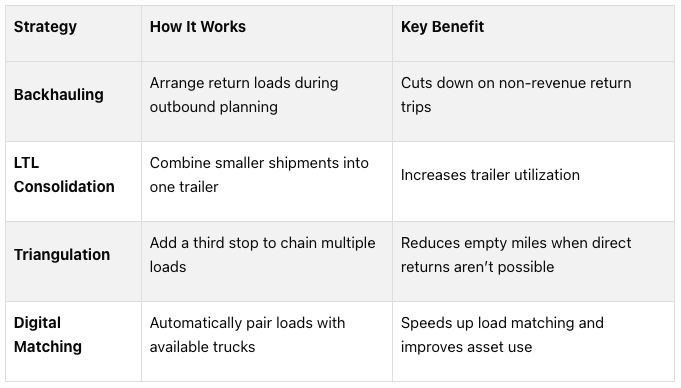
Logistics doesn't work well in isolation. To cut down on empty miles, shippers, carriers, and 3PLs need to share data and coordinate better. Take backhaul coordination as an example: instead of waiting for a truck to finish its delivery before finding the next load, dispatchers can arrange a return load during the planning stage. This simple adjustment transforms an otherwise empty return trip into a revenue-generating one.
Another effective approach is load consolidation, where 3PLs combine smaller LTL (less-than-truckload) shipments from various customers into one trailer. If a direct return load isn’t available, triangulation can help by routing the truck through an additional location, stringing together multiple loads to avoid running empty. Considering that 58% of truckloads in 2024 moved with unused trailer space, there’s a lot of potential for improvement. Tools like Volvo Trucks North America's Load Finder make this process easier by pulling data from over 40 load boards, helping carriers match trucks to nearby freight quickly and efficiently.
 These strategies lay the groundwork for new digital tools that can take logistics efficiency even further.
Using Technology to Cut Logistics Waste
One essential tool for reducing waste is a Transportation Management System (TMS). These platforms connect available freight with carriers, giving 3PLs a clear view of capacity and demand. Many modern TMS solutions also integrate with real-time telematics, sending out "deadhead alerts" to help dispatchers secure last-minute loads before trucks leave empty.
Cloud-based collaboration platforms go a step further by connecting suppliers, carriers, and warehouses on a shared system. This allows for automated load matching and faster confirmations across the network. Programs like the Freight Logistics Optimization Works (FLOW) initiative provide a broader, national view of supply and demand trends while safeguarding sensitive pricing data. With U.S. trucks operating at just 64% capacity on average, better data sharing is crucial to closing that gap.
Route Optimization and AI Tools
Building on tools like TMS and cloud platforms, AI-powered route optimization offers even more ways to reduce waste. These systems adjust routes in real time to handle unexpected issues like traffic, weather, or cancellations, ensuring deliveries stay on track without unnecessary detours. AI can also link multiple loads across different shippers, a method known as continuous move optimization. This keeps trucks moving efficiently between pickups instead of traveling empty.
"High utilization is the driver of [cost-effective operations]. If you run a truck only half of the time... then you're likely to run empty backward." - Robert Ziegler, GM EMEA, Einride
Predictive analytics adds another layer of efficiency by analyzing historical freight patterns and seasonal trends to forecast demand. This allows 3PLs to position trucks in the right areas ahead of time, avoiding last-minute scrambling to fill capacity. In fact, AI-driven load optimization and intelligent routing can boost fleet efficiency by up to 35%. Over time, these improvements significantly reduce the number of empty miles traveled.
sbb-itb-eafa320
How JIT Transportation's 3PL Solutions Help Reduce Empty Miles
Custom Logistics Solutions Built for Efficiency
JIT Transportation takes a personalized approach to logistics, crafting solutions that directly address the issue of empty miles.
The foundation of efficient logistics lies in well-designed operations. JIT Transportation creates custom 3PL strategies tailored to each business's specific freight needs. By designing routes with minimal wasted capacity from the start, they ensure efficiency. Services like local delivery, full truckload, and white glove handling are planned with coordinated backhauls and multi-stop routes. Instead of waiting until a truck is already empty to find a return load, JIT identifies backhaul opportunities during outbound planning.
Additionally, JIT offers services such as pick & pack, kitting & assembly, and vendor-managed inventory (VMI). These services consolidate multiple fulfillment tasks in one location, reducing the need for additional trips to move the same volume of goods. This streamlined approach helps cut down on unnecessary mileage and maximizes efficiency.
Nationwide Network and Scalable Infrastructure
A strong carrier network plays a critical role in reducing empty miles, and JIT Transportation's nationwide presence is a key advantage. By leveraging major freight corridors like I-35, I-75, I-95, I-80, and I-10, JIT ensures consistent outbound load availability and dependable backhaul coverage.
With strategic locations near major freight hubs such as Chicago, Atlanta, Dallas-Fort Worth, and Los Angeles, JIT minimizes the risk of trucks traveling without loads. They secure return loads across various equipment types throughout the year, avoiding "deadhead traps." This approach is not just about efficiency - it’s also about cost savings. Data reveals that each deadhead mile costs approximately $0.95 in fuel and wear, along with lost revenue opportunities. Even a 5% reduction in deadhead miles can save an owner-operator between $8,000 and $12,000 annually.
JIT’s scalable warehouse infrastructure adds another layer of efficiency. By consolidating less-than-truckload shipments from multiple customers into single trailers, they ensure maximum trailer utilization before departure. This strategy optimizes resources while reducing unnecessary trips.
Technology Integration for Better Visibility
Technology is at the heart of JIT Transportation's efforts to minimize inefficiencies. With GPS tracking and telematics, JIT provides real-time freight visibility. This allows dispatchers to quickly assign nearby loads to available trucks, avoiding empty trips back to a home base.
JIT also integrates its operations with shippers' ERP systems, ensuring seamless communication and reducing delays in order updates and dispatch. When combined with delivery management software that accounts for real-time factors like traffic and weather, this system enables dynamic routing. The result? Trucks stay productive, cutting down on wasted mileage and keeping operations running smoothly.
Measuring Results and Improving Over Time
KPIs to Track Empty Mile Reduction
Tracking the right metrics is essential for gauging the success of your empty-mile reduction strategies. Without proper data, it’s impossible to know if your efforts are paying off or falling short.
Here are the key metrics you should monitor:
- Empty Mile Percentage: Measures the share of total miles driven without carrying freight or a payload, helping identify inefficiencies and wasted capacity
- Load Utilization Rate: Tracks how much of a vehicle’s cargo capacity is filled on each trip, providing insight into space optimization and operational efficiency
- Cost per Mile: Calculates the total operational expense per mile driven, including fuel, labor, maintenance, and other transportation costs
- Backhaul Search Time: Measures the amount of time required to secure a return load after a delivery is completed, impacting asset utilization and profitability
- CO2 Emissions: Evaluates the environmental impact generated per mile driven, supporting sustainability reporting and emissions reduction initiatives
Let’s put the cost into perspective: at an estimated $1.85 per empty mile, which includes fuel, maintenance, and driver wages, a truck driving 100,000 miles annually with 30% empty miles incurs $55,500 in unnecessary expenses. That’s a direct hit to profitability that no business can afford to ignore.
An example of success comes from Giant Eagle, which optimized its fleet of 340 trucks using the Manhattan TMS in 2021. By streamlining routes and improving backhaul planning, the company achieved an 8% reduction in empty miles and a 7.7% decrease in total miles traveled. This is a clear example of how combining the right tools with diligent tracking can yield measurable results.
Once these KPIs are in place, the focus shifts to maintaining these gains and finding new opportunities for improvement.
Tips for Keeping Improvements on Track
Sustaining progress isn’t a one-and-done effort - it requires ongoing evaluation and flexibility. Start by establishing a baseline, such as your current empty mile percentage and cost per mile. From there, run periodic audits - quarterly reviews of carrier performance, route efficiency, and technology usage often work better than waiting for an annual deep dive.
"Reducing empty miles is one of the fastest and most reliable ways to increase profit margins - no added trucks, no higher rates, just smarter route optimization." - PCS Software
To keep efficiency gains on track, consider embedding automated backhaul planning into your dispatch process. Real-time communication between dispatchers and drivers is also critical, ensuring that the next load is secured before the current delivery is completed. These steps align with broader 3PL strategies, ensuring that every mile driven contributes to operational efficiency.
Conclusion: Building a More Efficient 3PL Operation
Reducing empty miles requires a mix of well-thought-out strategies. Planning, leveraging technology, and fostering collaborative networks all contribute, but the real impact comes when these elements work together seamlessly.
In the U.S., empty miles make up 20–35% of truck miles, leading to approximately $30 billion in annual costs that are ultimately reflected in freight rates. By using AI-powered tools for load optimization and route planning, fleets can increase efficiency by as much as 35%. These numbers highlight the need for immediate action.
"Companies that leverage AI to cut empty miles today will become tomorrow's cost and sustainability leaders in logistics." - Bernhard Huber, VP, Primotly
This perspective emphasizes the importance of taking meaningful steps. Simple but effective actions - like pre-booking backhauls, adopting a TMS, sharing capacity data, and closely monitoring KPIs - can significantly improve operational efficiency.
FAQs
What’s a good empty-mile percentage target for my lanes?
An ideal empty-mile percentage for your routes usually falls between 20% and 35%. Research indicates that in the U.S., 20–35% of truck miles are commonly driven without cargo. Keeping your operations within this range can help maintain efficiency and cut down on avoidable expenses.
How do I start backhaul planning without disrupting service?
To begin backhaul planning without interrupting service, start by pinpointing freight opportunities for return trips. This helps cut down on empty miles and improves efficiency. Leverage data analytics and real-time visibility tools to identify backhaul options and create the most efficient routes.
Partnering with a 3PL provider, such as JIT Transportation, can make a big difference. They offer advanced technology and scalable solutions that simplify backhaul planning while ensuring service standards remain high.
Which TMS or AI features reduce deadhead the fastest?
Reducing deadhead miles - those unproductive, empty trips - is a top priority in logistics. The quickest ways to tackle this challenge involve smart freight matching and route optimization powered by advanced tools like TMS (Transportation Management Systems) or AI.
Here's how it works: AI-driven systems analyze multiple factors, including truck locations, driver preferences, lane history, and real-time market rates. By doing so, they can slash empty miles by as much as 30%.
Additional features like triangulation and backhaul planning take things further. These tools strategically match loads and optimize routes, reducing unproductive travel by another 20–35%. The result? Fewer empty trips and a more efficient, cost-effective operation.
Related Blog Posts
Related Articles
7 WooCommerce 3PL KPIs Teams Track

Centralized vs Decentralized Replenishment
