
How 3PLs Handle Kitting for High-Volume E-commerce
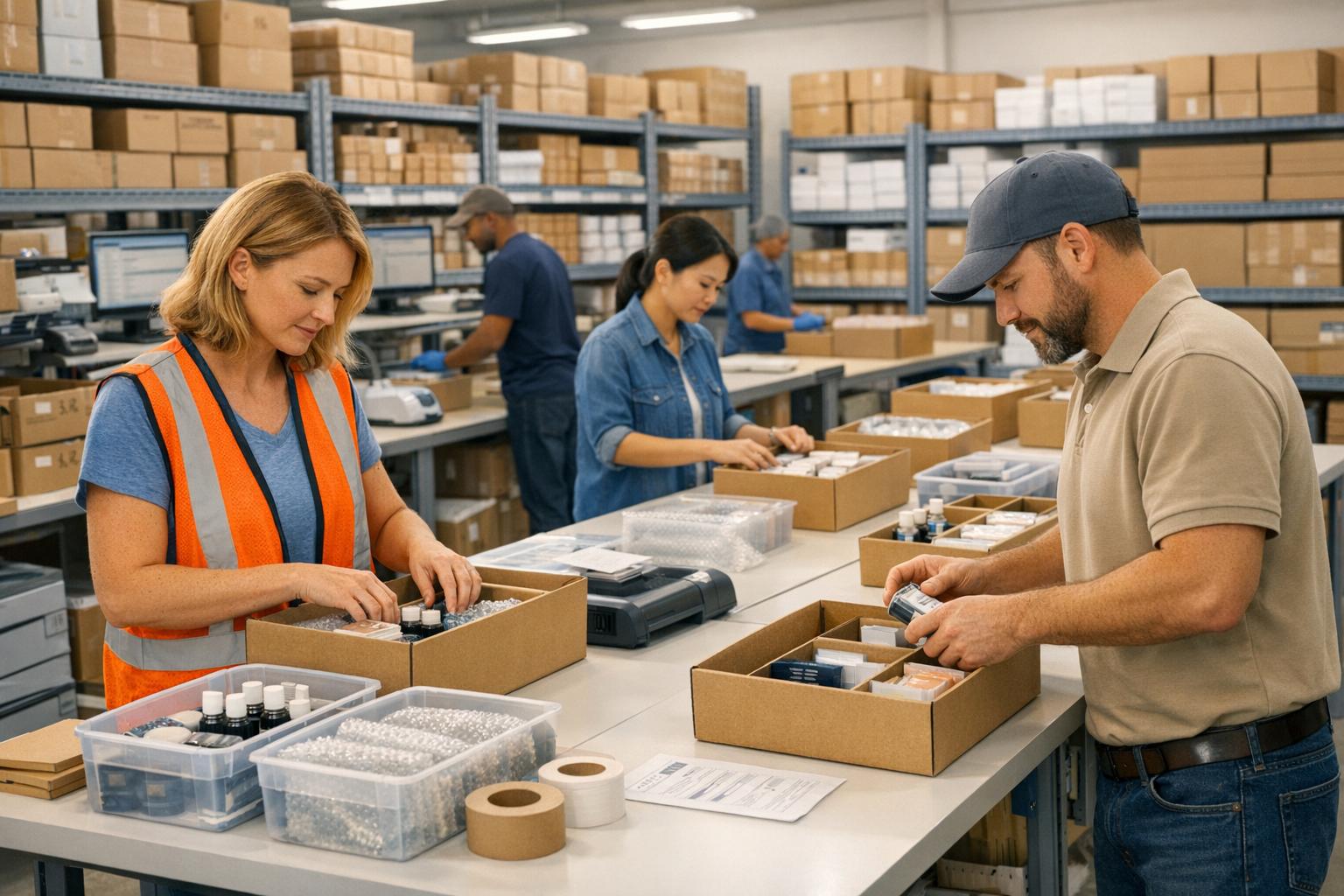
Kitting is a process where multiple items are bundled into a single package with a unique SKU, commonly used for gift sets or subscription boxes. For e-commerce businesses managing high order volumes, kitting reduces labor costs (by 20%-40%), speeds up fulfillment, and helps move slow-selling inventory. It also enhances customer experience, with 78% of consumers more likely to repurchase from brands offering curated kits.
However, scaling kitting operations comes with challenges like labor demands, inventory management, and accuracy. This is where third-party logistics (3PL) providers step in. They streamline kitting using dedicated workstations, advanced inventory systems, and quality checks like barcode scanning and weight verification. Whether pre-assembling kits or building them on demand, 3PLs offer flexibility to meet fluctuating demand.
To ensure success, businesses should analyze order patterns, create clear documentation (like Bills of Materials), and align kitting workflows with demand. Partnering with a 3PL can cut costs by 15%-30% while maintaining high accuracy and quality. For peak seasons, scalable 3PL operations prevent bottlenecks and ensure timely deliveries. JIT kitting (Just-In-Time) offers additional flexibility by assembling kits only when orders are placed, minimizing inventory risks.
Key Takeaways:
- Kitting simplifies fulfillment, reduces costs, and improves customer retention.
- 3PLs manage kitting efficiently with advanced systems and quality control.
- Pre-assembled kits suit predictable demand, while JIT kitting handles fluctuating orders.
- Clear planning, documentation, and communication with 3PLs are critical for scaling operations.

Key Benefits and Cost Savings of 3PL Kitting for E-commerce
Planning a Scalable Kitting Program
Analyzing SKU and Order Patterns
The backbone of a successful kitting program lies in understanding your customers' buying habits. Dive into your order history to identify items that are frequently purchased together - whether they share a theme, purpose, or complement each other. This analysis helps pinpoint which products are ideal for bundling into high-demand kits.
Once you've identified these product combinations, decide between pre-assembled kits or on-the-fly kitting. Pre-assembled kits work well when demand is steady and predictable, offering quicker fulfillment and reduced labor costs. On-the-fly kitting, on the other hand, provides greater inventory flexibility, especially when demand fluctuates. If you're running a subscription-based business, align your kitting schedule with your shipment cycles - whether weekly, monthly, or quarterly - to streamline operations. Bundling multiple high-demand products into a single SKU simplifies inventory management and minimizes picking errors.
It's also critical to share your sales volume projections and growth plans with your 3PL partner early on. This ensures they can allocate the necessary labor and assembly space, particularly during peak seasons. Outsourcing kitting to a 3PL can cut operational costs by 15% to 30%, turning fixed costs into variable ones. For example, a beauty subscription service saw a 65% jump in its subscriber base within six months by outsourcing kitting and focusing on customer acquisition.
These insights are the foundation for developing your documentation and processes, which we'll explore next.
Creating Bill of Materials (BOM) and Work Instructions
Clear documentation is essential when assembling thousands of kits. Start by syncing all components and the final kitted product within your inventory management system before launching operations. Assign a unique SKU to each finished kit to differentiate it from individual components, avoiding inventory mix-ups.
Your BOM should specify the exact quantities of each component needed for a kit. Work instructions should go a step further, detailing tasks like assembling boxes, placing dividers, and sealing packages. Include precise instructions for label placement, barcode positioning, and branding elements to maintain consistency. Add reference images so staff can visually compare completed kits to a "gold standard".
"Kitting and assembly is one piece of an ecommerce fulfillment strategy. When done correctly, it can save you time and money, and get orders shipped to customers quicker." - ShipBob
Plan ahead by scheduling kitting projects 2-3 weeks in advance. This gives your 3PL enough time to prepare labor and capacity. Keep in mind that pre-kitting typically adds 1-3 business days to fulfillment timelines, while "Kit at Pack" operations may add about one additional day.
Designing Kitting Workflows and Packaging
With your planning and documentation in place, it's time to focus on efficient workflows and packaging. Collaborate with your 3PL to determine whether pre-assembled kits or on-the-fly kitting is the better fit for your business. Pre-assembled kits are ideal for predictable, high-volume demand, while on-the-fly kitting provides flexibility for handling variable orders.
Seamless integration between your e-commerce platform (like Shopify or BigCommerce) and your 3PL's inventory management system is key. This setup enables real-time SKU tracking and automated inventory updates, ensuring that individual components are deducted from stock as soon as a kit is sold. Such integration helps prevent discrepancies and boosts efficiency.
Packaging and labeling should meet both branding and carrier requirements. For example, JIT Transportation operates over 2.5 million square feet of warehouse space across 14 U.S. facilities, allowing businesses to position kits closer to customers for faster, cost-effective delivery. Partner with a 3PL that offers services like labeling, light assembly, and quality checks in-house. This reduces reliance on multiple vendors and simplifies your supply chain.
"ShipBob also allowed us to make changes to bundles on the fly with complete control and visibility, which is important in monthly subscription boxes, holiday bundles, and many more scenarios." - Gerard Ecker, Founder & CEO, Ocean & Co.
Maintaining Accuracy and Quality in Kitting
Common Kitting Errors and Their Costs
Even small mistakes in kitting can have a big impact, harming your brand’s reputation and cutting into profits. Issues like missing components, mislabeled items, or incorrect placements are particularly common in high-volume operations. When a customer receives an incomplete kit, the fallout can include the cost of reshipping, negative reviews, and losing long-term customers. This is especially critical for subscription boxes and promotional bundles, where customers expect a complete and thoughtfully assembled package every time.
Weight discrepancies - whether too high or too low - can signal missing or extra items before shipment. Barcode mismatches, on the other hand, can create inventory inaccuracies, misrepresenting stock levels and leading to further complications, including compliance problems. Tackling these challenges requires stringent quality control measures, which are outlined below.
Quality Control and System Validation Methods
Strong quality control practices are essential to catching errors before kits leave the facility. Many modern 3PLs use multiple layers of verification to ensure accuracy. The table below highlights the key methods used in high-volume kitting operations:
| Quality Control Method | Primary Error Prevented | Technology/Tool Used |
|---|---|---|
| Barcode Scanning | Wrong item inclusion / Mislabeling | Handheld Scanners / WMS |
| Weight Verification | Missing components | Digital Scales |
| Visual Reference | Incorrect positioning / Aesthetic errors | Reference Images / Video Calls |
| Lot Tracking | Expired or recalled product shipment | WMS / Lot Coding |
| Digital Checklists | Skipped assembly steps | Tablet-based SOPs |
For more complex or high-value kits, visual verification provides an additional safeguard. Workers compare assembled kits to high-resolution reference images or "golden samples" to confirm that every component is in the correct position and nothing is missing. Some 3PLs even offer photo verification services, where images of completed kits are sent to brands for approval before sealing.
Random audit sampling by quality control specialists during production runs helps catch issues early. Digital checklists and Standard Operating Procedures (SOPs) ensure consistency across shifts and warehouse locations. For products that are perishable or time-sensitive, lot tracking using FEFO (First-Expired, First-Out) ensures that items closest to their expiration date are used first. These combined methods protect both operational efficiency and brand reputation in high-volume environments. Additionally, adhering to external regulatory standards further strengthens kit integrity.
Meeting Regulatory and Labeling Requirements
Regulatory and labeling requirements vary depending on the product type and target market. To ensure kits are ready for retail and compliant with shipping regulations, 3PLs handle tasks like applying UPC and FNSKU barcodes, country-of-origin labels, and hazmat stickers. For healthcare and supplement brands, strict lot tracking is crucial to meet FDA and other regulatory standards.
In industries with higher stakes, such as aerospace, even stricter measures are necessary. For example, AS9100D certification is often required to ensure traceability and accuracy in kitting operations. For sensitive products like cosmetics or pharmaceuticals, climate-controlled assembly areas maintain specific temperature and humidity levels. If labeling errors occur, 3PLs can fix them through label remediation, replacing or covering incorrect labels before products move forward.
For additional assurance, some 3PLs provide remote support managers who offer real-time visual validation. This allows brands to confirm assemblies meet their specifications - especially helpful for new product launches or intricate gift sets. Most kitting projects are completed within 24–48 hours, offering predictable timelines even for quality-intensive builds.
How it Works: 3PL Kitting Services
sbb-itb-eafa320
Scaling Kitting for Seasonal Peaks and Growth
Planning and maintaining high-quality operations are essential, but the ability to scale effectively during peak periods is what sets successful businesses apart.
Managing Labor and Capacity During Peak Seasons
Seasonal surges like Black Friday or back-to-school shopping can create huge spikes in order volumes for e-commerce brands. The best 3PLs handle these challenges by operating continuously, ensuring kitting operations don’t miss a beat during critical times. Instead of locking brands into fixed costs, they combine stable and flexible resources. This allows them to ramp up labor and warehouse capacity during busy seasons without saddling brands with extra costs during slower months. A strategically distributed, nationwide network also helps by spreading the workload across multiple facilities, preventing bottlenecks and shortening shipping times during high-demand periods.
To keep accuracy high even during these busy times, system integration plays a key role. By connecting warehouse management systems directly to platforms like Shopify, Amazon FBA, and Magento, real-time inventory updates happen automatically. This eliminates manual errors and ensures that as kits are assembled, inventory levels adjust instantly. Even with high throughput, this approach helps maintain an impressive 99% inventory accuracy rate.
Once labor and capacity are addressed, optimizing facility layouts becomes the next step in scaling for growth.
Adjusting Layouts and Processes for Growth
As brands expand, their kitting requirements change. Leading 3PLs adapt by refining workflows instead of just adding more workers. For instance, they might set up dedicated work cells for high-demand kits, ensuring all components are within easy reach during assembly. During peak times, some facilities create hot pick zones, grouping fast-moving SKUs together to cut down on travel time.
Consolidating workflows under one roof is another game-changer. When kitting, custom packaging, labeling, and quality control all happen in the same facility, the process becomes smoother and faster. This eliminates delays and errors caused by coordinating with multiple vendors. By reducing handling touches, brands can accelerate the transition from assembly to last-mile delivery. For businesses launching new products or expanding into retail, this streamlined approach supports consistent performance across both direct-to-consumer and wholesale channels. These measures help maintain 99% on-time shipping rates, even during volume spikes.
For even greater flexibility, some brands turn to just-in-time (JIT) kitting models.
Using Just-In-Time (JIT) Kitting
JIT kitting flips the traditional process on its head. Instead of pre-assembling kits and storing them, 3PLs assemble kits only after an order is placed. This reduces the need for warehouse space and allows more room for high-demand SKUs or production areas.
"By assembling kits in the warehouse and delivering them as needed, businesses can be more responsive to demand while keeping inventory levels low." – ShipHero
The financial advantages are clear too. With JIT, brands are invoiced only for components used during assembly, which helps preserve working capital. It also prevents overproduction and reduces the risk of dead stock when demand fluctuates. In times of supply chain disruptions, JIT kitting adds another layer of resilience. Bulk-stored components can be assembled on demand, helping brands manage shipment delays and sudden order spikes.
However, JIT success depends heavily on technology. Warehouse management systems must track components in real time, automatically deducting inventory as items are assembled into kits. When supported by efficient pick walls and dispatching stations, JIT operations can handle up to 500 items per hour, even during peak periods.
The trade-off with JIT kitting is labor flexibility. Pre-assembled kits can speed up fulfillment during predictable high-demand periods, while on-demand assembly may require additional labor during unexpected surges. The right approach depends on a brand’s specific demand patterns - consistent seasonal peaks might favor pre-assembly, while unpredictable or limited-stock scenarios are better suited for JIT kitting.
Conclusion
Key Takeaways
High-volume kitting is a game-changer for creating systems that can grow with your business. Flexible workflows allow brands to scale up during peak seasons and dial back when demand slows. However, accuracy is non-negotiable - just one mistake can lead to costly returns and damage customer trust. That’s why many businesses rely on technology-driven solutions like barcode scanning and real-time SKU tracking to maintain precision.
When it comes to choosing between pre-assembled kits or assembling kits on demand, the decision hinges on your specific business needs. For situations where inventory levels shift or you’re experimenting with new product bundles, assembling kits as orders come in gives you the flexibility to avoid overproduction. Aligning your kitting method with your business model is essential for efficiency and success.
These strategies pave the way for utilizing advanced 3PL services effectively.
How JIT Transportation Supports Kitting Success
JIT Transportation provides the infrastructure and tools that make efficient kitting operations possible. With 2.5 million square feet of warehouse space spread across 14 key U.S. locations, they ensure streamlined processes from start to finish. Their impressive 99% accuracy rate in inventory, receiving, and shipping significantly reduces errors and the costs associated with returns.
"Whether you're scaling eCommerce or coordinating national retail rollouts, JIT brings the infrastructure and responsiveness to move your business forward." – JIT Transportation
Operating around the clock, JIT Transportation ensures smooth kitting workflows even during peak seasons. Their advanced Warehouse Management System integrates seamlessly with platforms like Shopify, Amazon FBA, and Magento, enabling real-time inventory updates as kits are assembled. With a fleet of over 120 trucks, 300+ trailers, and access to a nationwide network of more than 500 carriers, JIT Transportation is equipped to handle demand surges with ease. For brands aiming to simplify their supply chain, JIT Transportation offers a one-stop solution - handling everything from kitting and assembly to final-mile delivery - so there’s no need to juggle multiple vendors.
FAQs
What are the benefits of outsourcing kitting to a 3PL for high-volume e-commerce?
Outsourcing kitting to a third-party logistics (3PL) provider can be a game-changer for e-commerce brands, especially those managing high order volumes.
One major advantage is the ability to scale and adapt. 3PLs offer flexible solutions that let businesses adjust warehouse space and workforce needs based on demand. Whether it's a holiday rush or a promotional event, you won’t have to worry about investing in extra facilities or hiring more staff.
Another benefit is the boost in speed and accuracy when it comes to order fulfillment. With specialized teams, advanced tools, and efficient processes, 3PLs help reduce errors and get orders out the door faster. This translates to happy customers who receive their packages on time and in perfect condition.
Finally, outsourcing kitting can help cut costs. By reducing labor expenses, avoiding the need for expensive equipment, and simplifying inventory management, businesses can save money while still delivering a seamless customer experience. These efficiencies not only improve customer satisfaction but also support sustainable growth over time.
What makes JIT kitting different from using pre-assembled kits in e-commerce inventory management?
JIT kitting operates by maintaining inventory in its raw component form and assembling kits only when an order comes through. This method relies on real-time inventory tracking to pull together the necessary parts as orders are fulfilled. The result? Less need to stock pre-assembled kits, improved inventory accuracy, reduced surplus stock, and less capital tied up in ready-made inventory.
On the other hand, pre-assembled kits are put together in advance and stored as single SKUs. While this can make order fulfillment faster, it hinges on accurate demand forecasts. A mismatch in forecasting can lead to either overstocked kits, wasting warehouse space, or understocked kits, causing delays and inefficiencies.
JIT Transportation’s kitting service takes an on-demand approach, assembling kits at the time of shipment. This model is particularly beneficial for high-volume e-commerce brands, combining the efficiency of just-in-time inventory with the speed and precision needed for seamless order fulfillment.
How do 3PLs ensure accuracy and quality in kitting for e-commerce brands?
3PL providers ensure kitting accuracy by embedding quality control measures into every stage of the process. From the moment items are received to when they’re packed, barcodes or RFID scanning creates a continuous verification loop, instantly flagging any errors. Along the way, dedicated checkpoints during receiving, picking, assembly, and packaging catch problems like damaged or incorrect components before they escalate.
To keep things running smoothly, 3PLs conduct regular inventory audits and rely on real-time updates to align system records with actual stock levels. They also adhere to standardized packaging guidelines to reduce handling mistakes and provide employees with clear standard operating procedures (SOPs) alongside ongoing training. By tracking key metrics, such as order accuracy and error rates, 3PLs can quickly identify and resolve issues, ensuring precision even in the fast-paced world of high-volume e-commerce.
Related Blog Posts
Related Articles
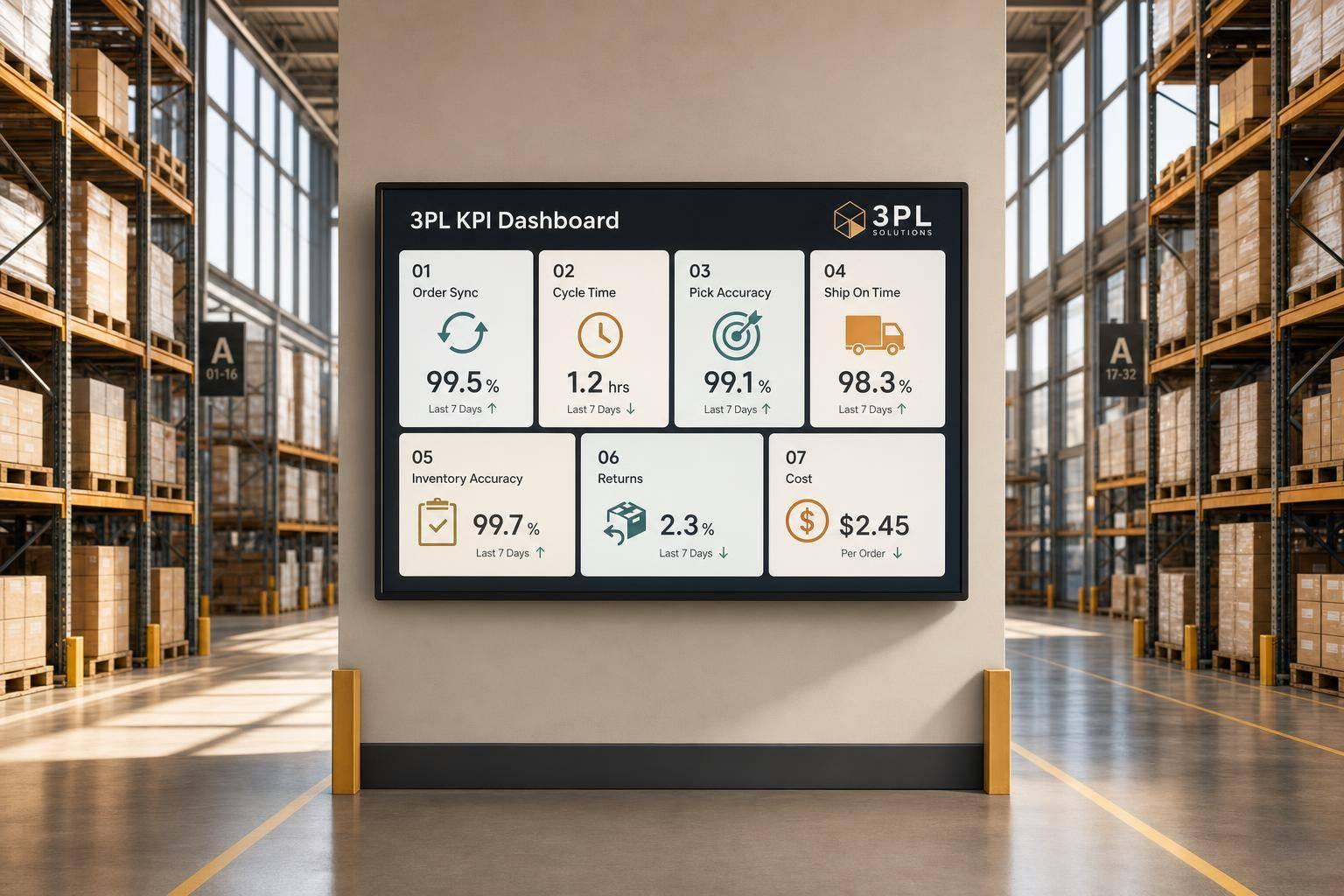
7 WooCommerce 3PL KPIs Teams Track

Centralized vs Decentralized Replenishment
