AI Fraud Detection in 3PL Logistics
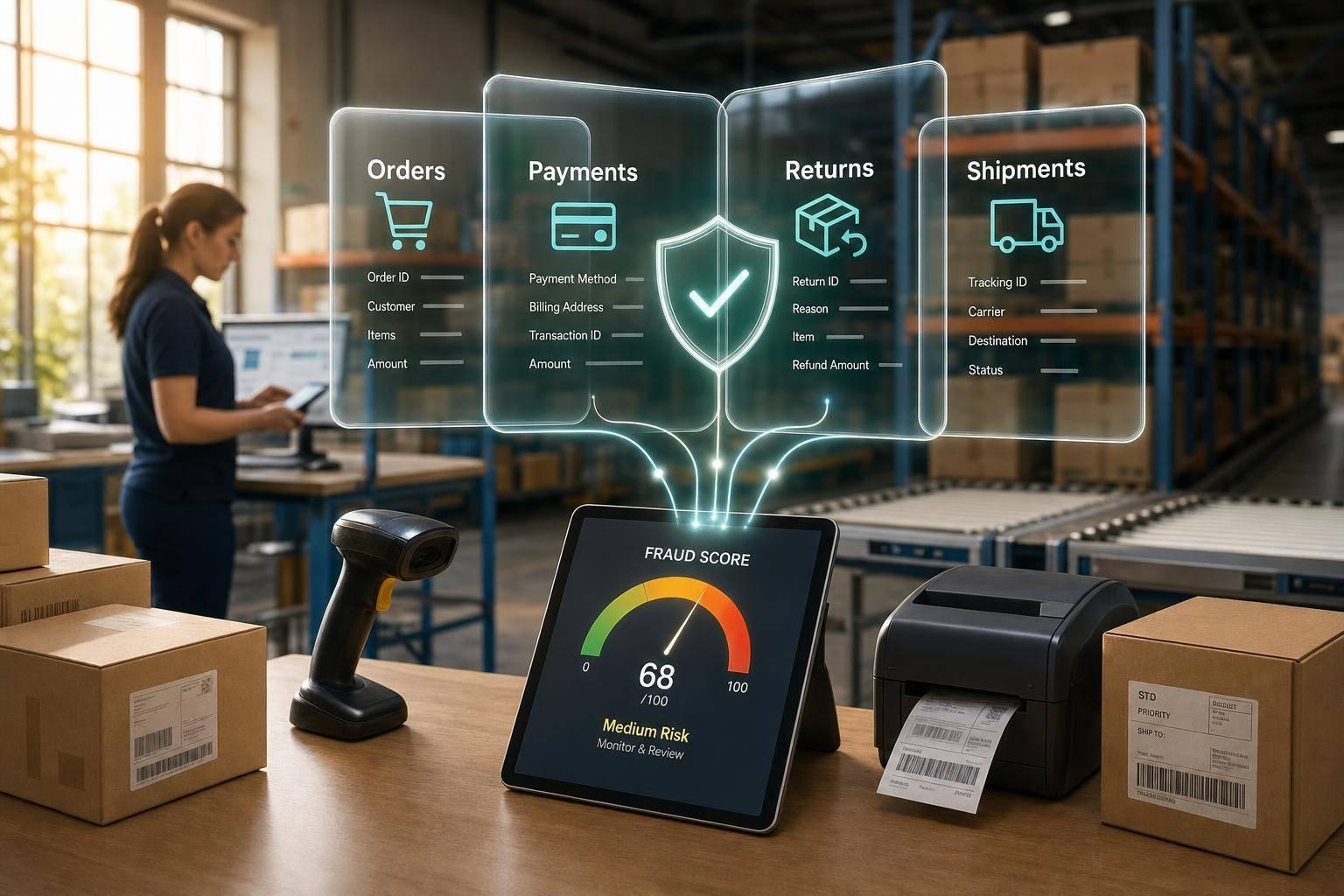
If you ship 3,000+ orders a month, even a 1% fraud rate can put about $4,500 per month at risk on a $150 average order value - before fees, shipping loss, or labor.
I’d sum it up like this: AI helps 3PL teams spot fraud by connecting orders, payments, returns, and shipments into one risk view. Instead of checking one signal at a time, it looks at patterns across systems and helps teams decide when to release, hold, review, or block a case.
Here’s the full picture in plain English:
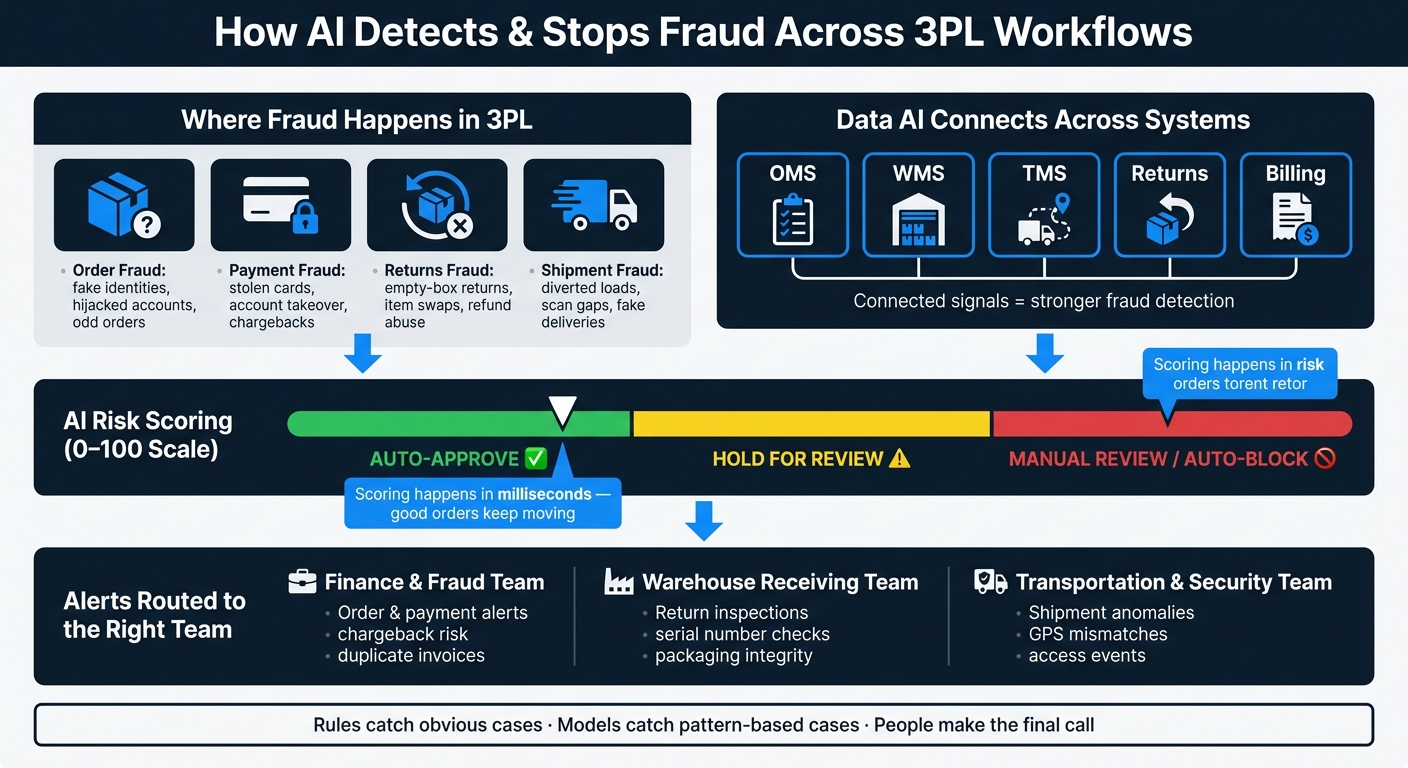
- Order fraud: fake or hijacked identities, large or odd orders
- Payment fraud: stolen cards, account takeover, and chargebacks after delivery
- Returns fraud: empty-box returns, item swaps, false claims, and refund abuse
- Shipment fraud: diverted loads, scan gaps, fake delivery events, and theft
What I’d focus on first:
- Connect data from OMS, WMS, TMS, returns, and billing
- Score risk using both rules and ML models
- Set clear cutoffs for auto-approve, hold, and manual review
- Route alerts to the right teams: finance, warehouse, or transportation
- Start with 1–2 high-risk workflows
- Feed review outcomes back into the model with clean labels like confirmed fraud or false positive
A simple way to think about it: rules catch the obvious cases, models catch the pattern-based cases, and people make the final call when needed. That mix helps stop loss earlier - before an order ships, a refund goes out, or a shipment closes as delivered.
This article explains how that works across a U.S. 3PL network, what data matters most, and how I’d put it into place without making the process harder for your team.
How AI Detects & Stops Fraud Across 3PL Workflows
Fraud Detection with AI in Supply Chains
sbb-itb-eafa320
The data AI uses to detect fraud in 3PL workflows
3PL systems throw off fraud signals across order management, warehouse activity, transportation, returns, and billing. AI does its best work when those signals are tied together across systems. Once that data is connected, it becomes the input for the scoring and alert rules covered next.
Order, customer, and payment signals
At the order and payment level, AI looks at combinations of fields, not just one odd detail. Order value, SKU mix, discount depth, and shipping speed are common starting points. But they mean a lot more when AI can pair them with customer data like account age, order history, whether the billing and shipping addresses match, and the payment method. Behavioral signals such as IP address, device fingerprint, failed payment attempts, and checkout behavior add even more context.
A large order from a new account, by itself, isn't a problem. If the device history lines up, the shipping address looks familiar, and the payment profile fits past behavior, that order may be fine. The risk goes up when the same order also shows a new device fingerprint, a billing and shipping mismatch, multiple failed card attempts, and a much deeper discount than normal. Put those signals together, and you may be looking at account takeover, card testing, or another form of payment abuse. One unusual detail is often just noise. Several signals pulling in the wrong direction at once are what call for review.
Returns, warehouse, and shipment signals
For returns, AI pulls from return reason codes, time from delivery to return request, prior refund behavior, receiving inspection results, and the order of return steps. A return filed right after delivery, paired with repeated item not as described claims from the same customer, presents a different level of risk than a routine return submitted two weeks later. Warehouse inspection data adds a physical check. It can show whether the returned item matches what was shipped, whether the packaging shows tampering, or whether the box even contains the right product. That's how empty-box returns and item swaps can be flagged before refunds go out. These are the signals AI uses to pause refunds before the loss is locked in.
For shipments, AI tracks scan events, route changes, handoff times, GPS data, carrier account activity, and delivery exceptions. If a shipment loses scan continuity between facilities, or a delivery scan doesn't line up with GPS data, that can point to diversion or tampering. Those kinds of anomalies can trigger holds before stolen goods or false deliveries are marked complete. Inside the warehouse, access logs and inventory movement records can also point to employee theft. One example is repeated inventory adjustments in the same zone by the same user, or missing scans between dock receipt and put-away.
Why connected data matters for custom 3PL operations
When transportation, fulfillment, and returns data sit in separate systems, those links disappear. Connected data lets AI tie order, shipment, and return events into one risk profile. That means it can follow the full chain of events, even when a suspicious order looks clean in one system but shows odd activity in the carrier handoff log and later leads to a return under a different SKU.
A unified 3PL network can connect transportation, fulfillment, returns, and billing data so AI can score each workflow against the others. A provider like JIT Transportation supports that kind of shared operational data across its nationwide network. That connected view feeds the scoring models and review queues described in the next section.
How AI flags order, payment, return, and shipment fraud
Order and payment fraud scoring
Once the data is connected, AI turns fraud signals into a simple choice: hold the order or let it go.
It usually starts with rules. These handle hard limits, like blocking orders above $5,000 from high-risk IP ranges or holding a first-time customer who places a large overnight electronics order. Rules work well because they’re fast, clear, and easy to audit. After that, a machine learning model looks at all the signals together.
The model gives each order a numeric risk score, often on a 0–100 scale. In many setups, scores below about 30 to 40 are auto-approved. Scores between 40 and 70 get held for a second check. Scores above 70 to 80 go to manual review or get auto-blocked, based on the thresholds set by the 3PL and merchant.
This is where the ML layer helps. A new device fingerprint, a billing-to-shipping mismatch, and repeated card declines might not trip a rule by themselves. Put them together, though, and they can push the order into hold territory. That scoring can happen in milliseconds, which means good orders keep moving without extra friction. Those scores then feed the alert thresholds and review queues covered next.
Returns fraud detection before refunds are approved
Returns fraud scoring follows much the same path, but it looks at different signals. Here, the system leans on claim history and inspection results.
A return request submitted before delivery confirmation is an instant rules-level flag. If that same customer also has a history of item not as described claims, and past inspections found missing accessories or signs of wear, the model can assign a high return-risk score and send the refund into a hold queue.
Inspection results matter a lot in this step. When warehouse receiving logs show a serial number mismatch, an empty box, or a counterfeit item, that information goes back into the model as a confirmed fraud label. Over time, the model learns which signal combos most often lead to loss. It can also suggest options other than a refund, such as store credit or a stricter verification step, before any money goes out.
Shipment and warehouse anomaly detection
For shipments, AI learns what normal looks like for each lane. That includes transit times, scan patterns, and usual carrier behavior. Then it flags anything that falls outside that pattern.
Anomaly detection models can spot outliers even when there aren’t labeled fraud cases. Say a high-value pallet moving from Dallas to Chicago shows GPS activity near an unapproved facility. Or a shipment loses scan continuity between a cross-dock and the next hub. In cases like that, the system can assign a high anomaly score and trigger a transportation hold.
Inside the warehouse, AI links access control logs and inventory movement records to spot patterns like unusual badge swipes between 1:00 a.m. and 4:00 a.m. in a restricted area, especially if those time windows line up with inventory shrinkage or missing put-away scans. When anomaly scores cross the alert threshold, the system escalates the issue to warehouse managers. They can then pull CCTV, check driver logs, or start an inventory audit before the loss is confirmed. Those anomaly scores decide what gets escalated for operational review.
How alerts, thresholds, and review queues work day to day
Rules, thresholds, and risk tiers
A risk score only helps if it leads to a clear next step. After a model marks a case as low, medium, or high risk, that case needs to go to the right queue. Low-risk cases are auto-released. Medium-risk cases go to secondary review. High-risk cases are held or sent to manual review.
Those thresholds vary by operation. A 3PL moving high-value electronics will usually use tighter cutoffs than one handling standard consumer goods. In practice, teams tune thresholds by channel, customer segment, order value, and how much delay the operation can accept.
Rules take care of the obvious stuff. They act fast and don't need the model to weigh in first. For example:
- A duplicate invoice with the same vendor, amount, and bank account can go straight to review
- A shipment with an impossible transit time can be flagged at once
- Repeated after-hours access attempts at a restricted dock area can trigger an alert
- A customer account with unusually high return frequency can also be flagged
Who reviews flagged orders, returns, and shipments
Not every alert belongs with the same team. Different fraud patterns call for different people.
Fraud and finance teams usually handle order and payment alerts. They're in the best spot to check chargeback risk, duplicate invoices, and account or customer oddities. Warehouse receiving teams review suspicious returns because they can inspect item condition, weight, packaging, and scan integrity. Transportation or security teams handle shipment issues and access events, since they know how to tell the difference between a real route problem and a normal operating exception.
Speed matters. An alert only helps if it arrives before the loss is locked in. That means routing alerts before release, capture, refund, or exception closure. Each case should also show the score, the trigger, and the next action, so reviewers don't have to piece the story together from scratch.
Putting AI fraud detection to work in a US 3PL network
Start with the highest-risk workflows and clean data
Once scoring and review queues are set up, it's time to roll this out. But don't try to automate everything in one shot. That's usually where teams get into trouble.
A better move is to start with a small pilot focused on 1–2 workflows with the clearest fraud risk. That could mean high-value orders, product categories with lots of returns, or transportation lanes that already show a pattern of shipment exceptions and claims.
Data cleanup matters just as much as the pilot itself. Standardize dates as MM/DD/YYYY, along with SKU IDs, customer IDs, and one transaction key that stays with the record from capture through final disposition. When the data is consistent, the model can learn from outcomes that actually line up.
Each reviewed case also needs a standardized outcome label:
- confirmed fraud
- chargeback
- false positive
- approved exception
These labels teach the model what happened. If a carrier-damage payout gets tagged as "confirmed fraud" when it should be "approved exception", the model starts learning the wrong pattern. At that point, you're feeding it noise instead of signal.
Build feedback loops between operations, finance, and warehouse teams
Model accuracy gets better only when review outcomes make their way back into the system. And that happens only if reviewers log those outcomes the same way every time.
Use structured review forms inside case-management tools, keep a shared queue for operations, finance, and warehouse teams, and hold a monthly cross-functional review to spot repeat misclassifications and adjust thresholds. Here's a simple example: if finance sees a pattern of chargebacks tied to orders that were previously marked "approved exception", that's a sign the model needs tighter features for that order type.
A connected 3PL network can make this much easier. A provider like JIT Transportation can centralize transportation, fulfillment, and review data across a nationwide network. Instead of each brand building separate data pipelines and review queues from scratch, one integrated platform can apply the same fraud rules across all distribution centers and lanes. Local teams can still handle investigations, then send outcomes back into the shared system.
Conclusion: What AI changes in fraud prevention
Fraud in 3PL logistics doesn't sit in just one spot. It can show up in orders, payments, returns, and shipments, and often in combinations that a single rule or a manual reviewer won't catch at scale.
What AI changes is the ability to connect those signals across the full workflow in real time. Rules handle the obvious cases fast. Scoring models surface the subtle ones. Human reviewers make the final call when judgment matters. That mix - not any single piece by itself - is what makes fraud detection accurate, auditable, and able to work across a US 3PL network. The strongest programs begin with clean data, consistent labels, and fast feedback loops.
FAQs
How accurate is AI fraud scoring?
AI fraud scoring accuracy comes down to the model behind it.
Supervised learning is usually the top pick for speed and accuracy when the system is dealing with known fraud patterns. That includes things like repeat offenders or address manipulation. If the pattern has shown up before, this approach tends to spot it fast.
Unsupervised learning is a bit different. Its accuracy is more middle-of-the-road, but it does a better job finding new or emerging anomalies. That matters when fraud shifts shape and old rules stop working.
Deep learning can be highly accurate for more complex schemes. The tradeoff is that it needs a lot of data and computing power. It’s not the lightest option, but it can handle messier patterns that simpler models may miss.
Accuracy also gets better over time as teams retrain models with fresh data. That helps cut false positives and improves threat detection.
What data should a 3PL connect first?
Start by connecting your e-commerce platform, order management system (OMS), and enterprise resource planning (ERP) system to the 3PL’s warehouse management system (WMS) through API or EDI.
That setup creates a real-time, two-way flow of data for SKUs, order quantities, shipping addresses, and payment status. The payoff is simple: more accurate inventory tracking and automated order checks.
Once that foundation is in place, you can bring in external data sources and IoT sensors to make fraud detection stronger.
Who should review fraud alerts?
Fraud analysts and data scientists should review fraud alerts to track activity and fine-tune detection models. At the same time, operational teams should keep an eye on dashboards and exception queues so they can handle irregularities in real time.
For returns, quality and product teams should dig into escalated issues. Warehouse staff also play a big part here: they help spot flagged breaches, quarantine affected items, investigate what happened, correct the issue, and update standard operating procedures.
Related Blog Posts
Related Articles

Demand-Driven Replenishment for Multi-Node 3PL

3PL Models Compared for Reverse Logistics Carbon