
AI-Powered WMS: Benefits for E-commerce Brands
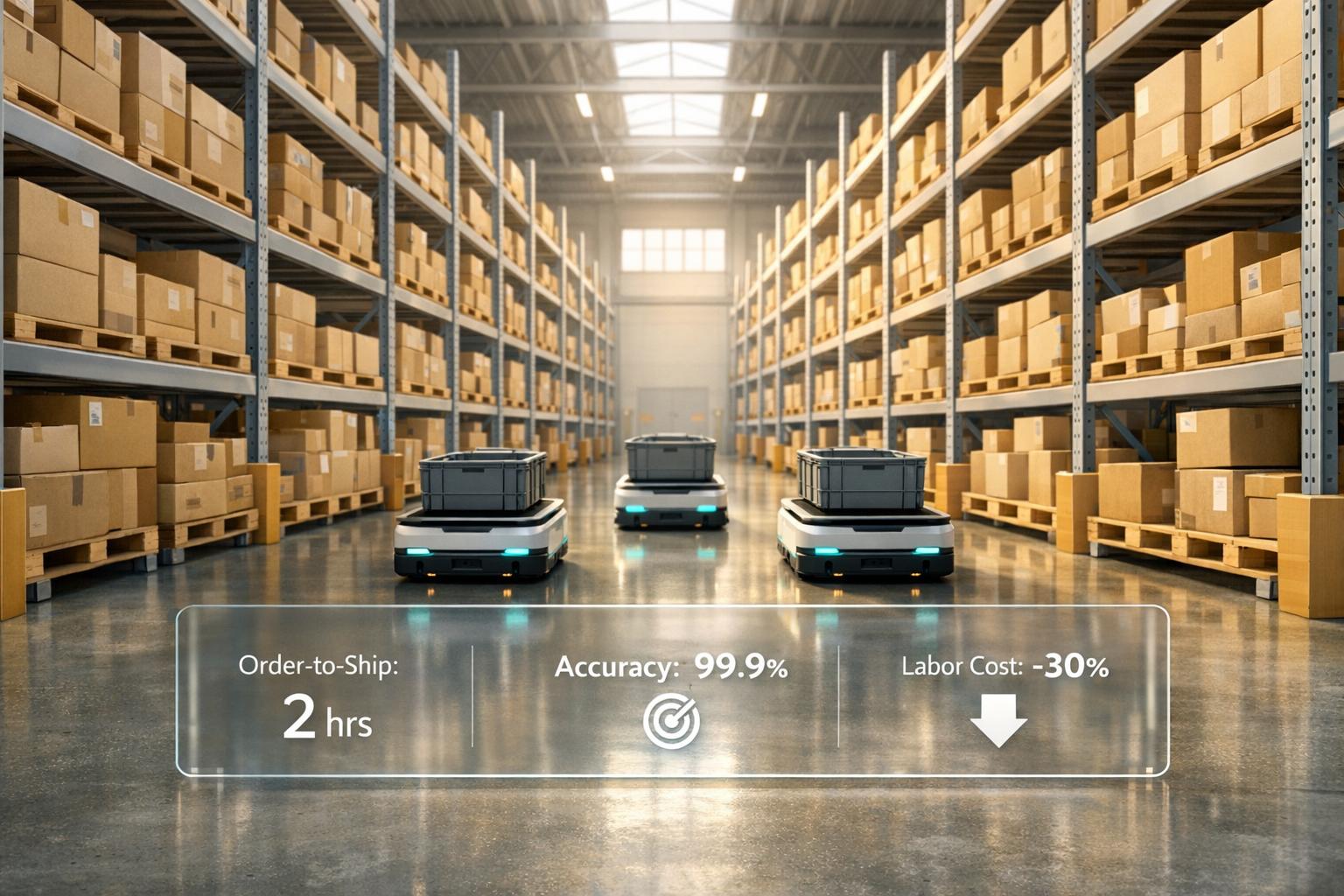
AI-powered warehouse management systems (WMS) are transforming e-commerce logistics by improving speed, accuracy, and scalability. Unlike older systems, which rely on rigid rules and manual processes, AI-WMS uses machine learning to optimize inventory placement, predict demand, and streamline operations. This means faster order processing, fewer errors, and reduced costs, helping brands meet growing customer expectations for same-day or next-day delivery.
Key Takeaways:
- Speed: AI systems cut order-to-ship times by up to 71% and reduce travel distances by 25–40%.
- Accuracy: Boosts order accuracy to 99.9% (up from 94.2%) with real-time checks and smart cartonization.
- Scalability: Handles peak volumes with cloud-based designs, increasing capacity by 156% without extra staffing.
- Cost Savings: Labor costs drop by 30–50%, and inventory carrying expenses are reduced by 38%.
For e-commerce brands, AI-WMS offers a faster, more precise, and scalable solution to keep up with the $8.1 trillion online retail market projected for 2026. Walmart, Target, and other industry leaders are already seeing massive efficiency gains, proving that AI is becoming a must-have for competitive fulfillment operations.
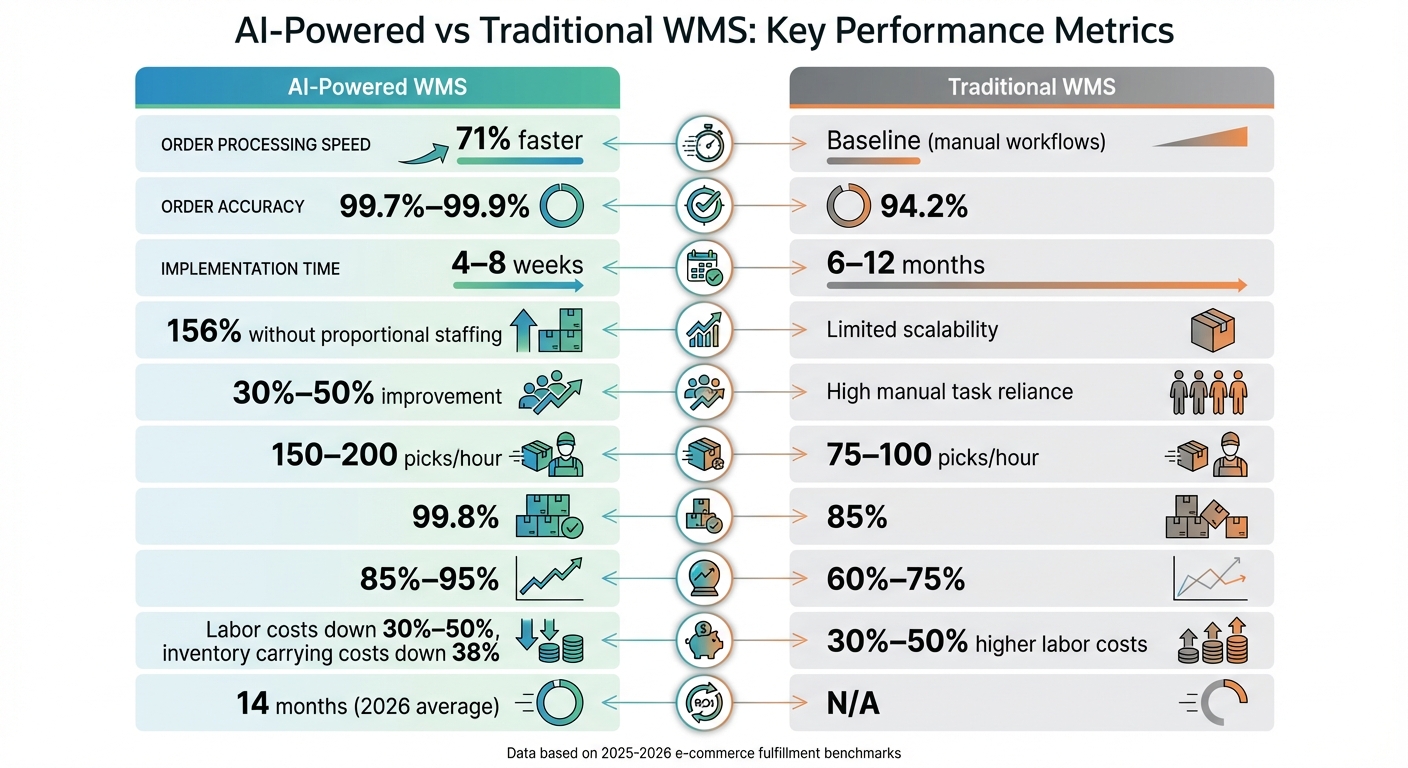
AI-Powered vs Traditional WMS: Performance Comparison for E-commerce
Leveraging AI in Warehouse Management with Chat WMS
sbb-itb-eafa320
1. AI-Powered Warehouse Management Systems
AI-powered warehouse management systems shift warehouse operations from reactive processes to predictive strategies. Instead of relying on rigid "if-then" rules (like "Place SKU-A in Zone 1"), these systems analyze massive datasets to recommend optimal product placement. For example, they might suggest grouping related SKUs together to minimize travel time during order picking. This machine learning-driven approach reshapes how warehouses handle everything from storage to order fulfillment.
Speed
AI-powered systems eliminate traditional batch processing bottlenecks with waveless processing, which releases orders immediately once they meet fulfillment criteria. This dynamic approach is paired with real-time slotting, where inventory is constantly repositioned based on demand. High-demand items are moved to easily accessible locations, and products frequently ordered together are stored nearby. These changes trim order-to-ship times by about 2 hours and reduce travel distances by 25–40%. On average, e-commerce order processing times drop by 71% when AI is involved. Decision-making also speeds up, with AI reducing the time needed for operational choices by 30–50%.
The speed benefits don’t stop there. AI-powered systems simplify onboarding and training, enabling new warehouse associates to become productive in just 1–2 hours - compared to the weeks required with older systems. Deployment times for these systems are also slashed, dropping from several months to just 4–8 weeks.
Accuracy
AI systems introduce multiple verification layers to ensure accuracy at every step. For instance, scan-based verification combines computer vision and barcode scanning to catch errors during receiving, picking, and shipping. AI-guided cycle counting further improves accuracy by flagging potential issues like mismatched quantities or misplaced SKUs, prioritizing bins for review based on calculated risks. These innovations improve order accuracy rates from 94.2% in traditional setups to 99.9% in AI-powered warehouses.
Another standout feature is smart cartonization, which calculates the best box size and configuration in real time, cutting down on packaging mistakes and dimensional weight charges. Inventory accuracy also jumps from 85% in manual systems to 99.8% with AI. Even demand forecasting sees a boost - AI analyzes sales trends, market conditions, and even weather patterns to achieve 85–95% forecasting accuracy, a big improvement over the 60–75% range of conventional methods.
Scalability
AI systems are built with cloud-native architecture, enabling them to handle peak volumes without requiring infrastructure upgrades. During high-demand periods like Black Friday, these systems automatically allocate resources to manage sudden spikes in orders. Labor scalability is another advantage: AI-powered systems can increase peak season capacity by 156% without needing a proportional increase in staffing.
In 2025, Flexport implemented an AI-driven fulfillment system to support a new 1P fulfillment model. Under the leadership of Cody Moreland, Sr. Director of Fulfillment, this transition enabled the company to double its network capacity in just a few months. The system also improved pick productivity by 15%, saving $1,300 for every 10,000 order lines (or $0.10 per item) by optimizing pick paths.
"Logiwa IO really made the process of onboarding warehouses simple for us. Logiwa gave us the tools and data sets to self-serve and get ourselves onboarded quickly."
– Cody Moreland, Sr. Director of Fulfillment, Flexport
AI-powered systems also allow businesses to manage multiple warehouses or clients from a single platform. Tools like "Tenancy Wizards" enable rapid onboarding, reducing deployment timelines from months to just 30–90 days. This flexibility makes it easier to scale fulfillment operations as demand grows.
Integration and Efficiency
AI-powered systems seamlessly integrate with existing platforms, thanks to API-first designs. They connect directly to enterprise resource planning (ERP) systems like NetSuite or SAP, as well as e-commerce platforms like Shopify. This integration ensures a unified inventory pool across B2B and B2C channels, eliminating data silos and minimizing synchronization errors. Real-time data updates - often every 10 seconds - keep all systems aligned with current information.
These systems also incorporate Native Robotics Execution (REX), which directly coordinates automated mobile robots (AMRs) and automated storage and retrieval systems (AS/RS). This eliminates the need for separate middleware, reducing data latency and simplifying operations. As a result, AI-driven picking environments achieve 150–200 picks per hour - double the 75–100 picks per hour typical of manual workflows.
Labor costs drop by 30–50% after AI implementation, not due to workforce reductions but because of increased productivity and fewer errors. Gamification features, such as leaderboards and achievement badges, further enhance productivity by 15–25% while also reducing turnover. These advancements streamline warehouse operations, allowing workers to focus on exceptions rather than routine tasks.
2. Traditional Warehouse Management Systems
Traditional Warehouse Management Systems (WMS) often fall short when faced with the fast-paced demands of modern e-commerce. These systems rely on rigid, pre-set rules instead of learning from operational data. As a result, they struggle to adapt to fluctuating demand patterns or seasonal changes. Decisions about inventory placement, order routing, and resource allocation are frequently managed using spreadsheets, handwritten notes, or knowledge passed down among warehouse staff.
"The cost of manual orchestration shows up as missed cutoffs, wasted travel, labor overtime, incorrect shipments, chargebacks, and slow response to demand changes." – JASCI LLC
Speed
Traditional WMS platforms use batch processing, grouping orders into hourly waves. This outdated approach causes bottlenecks and idle labor time between order releases, making same-day or next-day shipping a challenge. Warehouse layouts remain static, failing to adjust for SKU velocity or seasonal demand shifts. On top of that, manual workflows limit productivity to just 75–100 picks per hour - roughly half the output of AI-driven systems.
Implementation is another pain point. It can take 6 to 12 months to deploy a traditional system and often costs millions of dollars. Training new staff is equally time-consuming, requiring weeks to master legacy interfaces, compared to just a couple of hours with newer platforms. Even small workflow changes demand costly custom development or consulting, adding months of delays. These inefficiencies not only slow operations but also compromise order accuracy.
Accuracy
Traditional systems average an order accuracy rate of 94.2%, significantly lower than the 99.9% seen in AI-powered warehouses. The gap is largely due to fragmented data - inventory, order, and shipping information are often stored in separate systems, requiring manual reconciliation. This leads to inconsistent stock counts and errors. Many businesses manage B2C and B2B channels separately, creating different inventory views and increasing the likelihood of overselling. Forecasting accuracy with these systems is also limited to 60–75%, forcing companies to either overstock or risk running out of inventory.
Scalability
As order volumes grow and SKU counts expand, traditional systems struggle to keep up. Manual processes turn high-growth periods into a "daily obstacle course", with repetitive tasks and on-the-spot decisions slowing operations. Labor costs in such environments are 30–50% higher than in AI-optimized warehouses due to inefficient workflows and wasted travel time.
"Most of the customers who come to us from another 3PL, their challenges have always been access to their data, order accuracy and efficiency, and meeting the committed requirements." – Maureen Milligan, Director of Operations and Projects, G10 Fulfillment
On-premise systems add to the financial burden. Initial setup costs range from $100,000 to $500,000, with annual support fees between $5,000 and $30,000. Companies also spend 15–20% of their yearly WMS budget on upgrades and maintenance. IT costs for these systems can be up to 40% higher than their cloud-based counterparts. Limited integration capabilities only compound these challenges.
Integration and Efficiency
Legacy WMS platforms lack the architecture needed to integrate smoothly with modern robotics, such as automated mobile robots (AMRs) or automated storage and retrieval systems (AS/RS). Many require additional systems, like Warehouse Control Systems (WCS) or Warehouse Execution Systems (WES), which introduce data delays and complexity. Instead of real-time updates, these platforms rely on batch processing, leaving inventory balances and order statuses outdated. Adapting to new fulfillment needs - like handling multi-channel orders or integrating robotics - requires extensive custom development and lengthy testing cycles. This rigidity slows decision-making and limits operational efficiency.
Advantages and Disadvantages
This section breaks down the strengths and limitations of AI-powered warehouse management systems (WMS) compared to traditional systems, giving you a clear picture of both approaches.
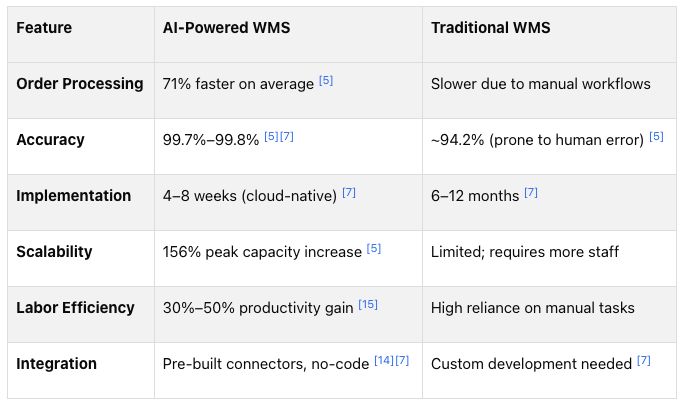
AI-powered WMS stands out for its speed, accuracy, and flexibility. These systems process orders 71% faster than traditional methods, achieve near-perfect accuracy (99.7%–99.8%), and adapt dynamically to demand spikes. For example, during peak seasons, AI systems can boost capacity by 156% without requiring a proportional increase in staffing. Labor productivity also improves significantly, with gains ranging from 30% to 50%, while inventory lead times shrink by as much as 30%. Walmart, for instance, reported in March 2026 that its AI-driven inventory systems reduced stockouts by an impressive 82% across its e-commerce operations.
Here’s a side-by-side comparison of key metrics:
 However, these advantages come with a higher upfront cost. Deploying an AI-powered WMS can range between $150,000 and $2.5 million, depending on the size of the facility. Integration with existing legacy systems can also be complex. That said, the investment is becoming more appealing: by 2026, the average payback period has dropped to 14 months, compared to 28 months in 2024.
"The payback period for warehouse AI investment has dropped to just 14 months on average... the technology has reached a tipping point where it's becoming essential for competitive e-commerce operations." – Sarah Rodriguez, Senior Analyst, Retail Technology Research
These performance benefits are particularly valuable for fast-growing e-commerce brands. AI-powered WMS enables them to meet higher customer expectations while keeping operational costs under control, giving them a crucial edge in today’s competitive landscape.
How AI-WMS Works with JIT Transportation
JIT Transportation's network of distribution centers across the country enables AI-WMS to strategically position inventory and reduce transit times. With facilities located in key cities like San Francisco, Los Angeles, Memphis, Houston, and Austin, JIT places products closer to consumers, cutting down delivery times significantly. This physical network is seamlessly linked with JIT's digital systems, creating a highly agile and efficient supply chain.
JIT takes full advantage of AI-WMS by integrating it into a comprehensive technology stack. This stack connects Transportation Management Systems (TMS), Warehouse Management Systems (WMS), and various fulfillment platforms into a single, cohesive digital framework. This integration allows for real-time data sharing across the supply chain, enabling predictive analytics to anticipate demand spikes, balance supply chain capacity, and consolidate orders from direct-to-consumer (DTC) sites, retail platforms, and distributors.
AI optimization within JIT's operations is a game changer. It reduces picker walking time by 30% through advanced path optimization and smart batching, which increases pick density. Additionally, JIT's AI capabilities enhance specialized services like kitting, assembly, and white-glove handling. Using AI-powered task interleaving, tasks are assigned based on employee proximity and skill level, ensuring maximum efficiency. Real-time inventory visibility is another standout feature, achieved through automated scanning and cycle counting, perfectly aligned with JIT's strategically located hub network.
"Our integrated systems ensure precision across the supply chain - from warehouse floor to final delivery." – JIT Transportation
JIT's technology infrastructure is built to scale rapidly, meeting the needs of fast-growing e-commerce brands. Fulfillment platforms provide end-to-end visibility through integrated dashboards, giving brands the ability to monitor performance, order accuracy, and delivery data in real time. This system adapts to seasonal surges while maintaining high customer satisfaction. By combining AI-WMS with a strong logistics framework, JIT sets a new standard in e-commerce fulfillment.
Conclusion
AI-powered warehouse management systems are transforming how e-commerce brands handle fulfillment. With order processing speeds increasing by up to 71%, accuracy hitting an impressive 99.7%–99.9%, and peak capacity jumping by 156%, these systems are reshaping customer satisfaction and profitability.
Unlike older systems that react to orders as they come in, AI-driven solutions predict demand surges, strategically position inventory, and optimize warehouse operations in real time. This shift has led to a 43% drop in labor costs and a 38% reduction in inventory carrying expenses. Even better, the average payback period for these implementations is now just 14 months as of 2026. For fast-growing e-commerce brands, JIT Transportation's 3PL solutions eliminate the need for hefty upfront investments - implementation costs range from $150,000 to over $2.5 million - while offering access to advanced AI tools, integrated systems, and a nationwide network. These figures highlight the competitive edge that AI-driven fulfillment provides in the fast-paced e-commerce world.
As competition intensifies, brands that embrace AI-driven fulfillment as a key operational strategy will be well-equipped to thrive in today’s challenging market.
FAQs
What data do I need to get an AI-powered WMS working well?
To get the most out of an AI-powered Warehouse Management System (WMS), you'll need to feed it the right data. This includes real-time inventory levels, order processing details, warehouse workflows, and key performance metrics like pick accuracy and throughput. With these inputs, the system can fine-tune your operations, boosting speed, improving accuracy, and handling growth more effectively.
How hard is it to integrate an AI-WMS with Shopify and my ERP?
Integrating an AI-driven Warehouse Management System (WMS) with Shopify and your ERP might sound complicated, but it’s entirely doable - especially for e-commerce brands looking to scale. The key is linking your Shopify store, ERP system, and WMS in a way that ensures real-time data flows seamlessly between them. This setup enables automation and smoother operations.
While the technical steps depend on the specific systems you’re using, many modern tools are designed to simplify the process. For fast-growing brands, this kind of integration is essential to manage higher transaction volumes and optimize workflows efficiently.
When does an AI-WMS usually pay for itself?
An AI-driven Warehouse Management System (WMS) often recoups its cost within just 6 to 12 months. This quick payoff comes from boosting operational efficiency, cutting down labor expenses, and enhancing accuracy across processes.
Related Blog Posts
Related Articles
How 3PLs Cut Last-Mile Costs for DTC Brands

AI Inventory Integration for Multi-Warehouse 3PL
