
Checklist for Sustainable Returns Audits
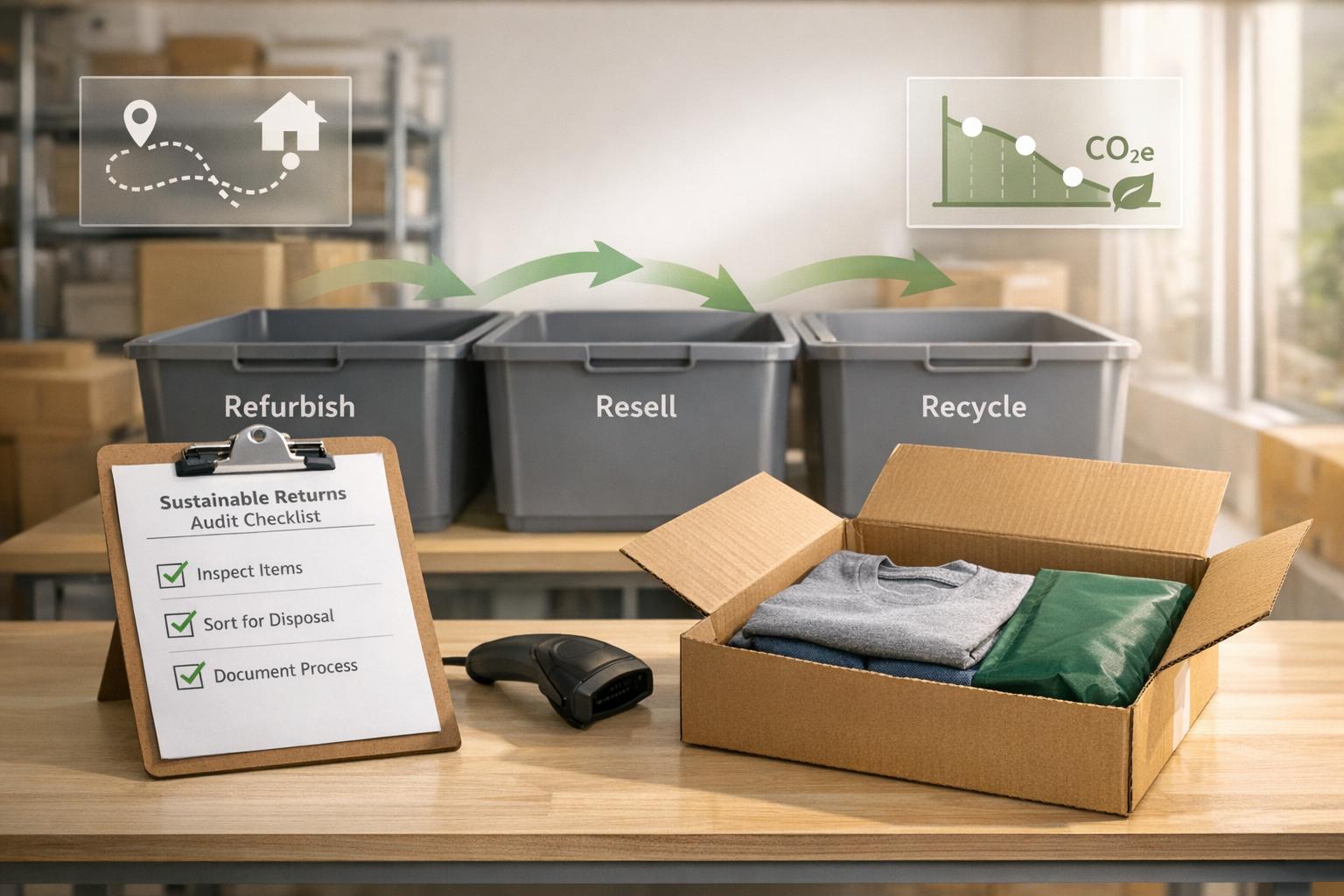
Managing product returns is no longer just a logistical challenge - it’s a high-stakes issue for businesses. With U.S. retail return rates at 16-18% and e-commerce returns projected to cost $890 billion by 2025, ignoring the reverse supply chain can be costly. Beyond financial losses, returns contribute to over 24 million metric tons of CO2 annually, and up to 60% of items are discarded instead of being reused.
A returns audit helps businesses identify inefficiencies, ensure compliance with regulations, and improve processes to recover value. This checklist focuses on actionable steps to streamline returns intake, refurbishment, recycling, emissions tracking, and governance.
Key Takeaways:
- Set clear goals: Define audit objectives - compliance, waste reduction, or revenue recovery.
- Prepare thoroughly: Collect data like RMA logs, recycling records, and transport invoices.
- Examine processes: Track return grades, refurbishment timelines, and recycling rates.
- Monitor emissions: Include reverse logistics in carbon accounting to reduce environmental impact.
- Ensure accountability: Assign ownership for each stage of the returns process.
By following a structured audit approach, businesses can reduce costs, comply with regulations, and minimize waste while improving the efficiency of their reverse logistics systems.
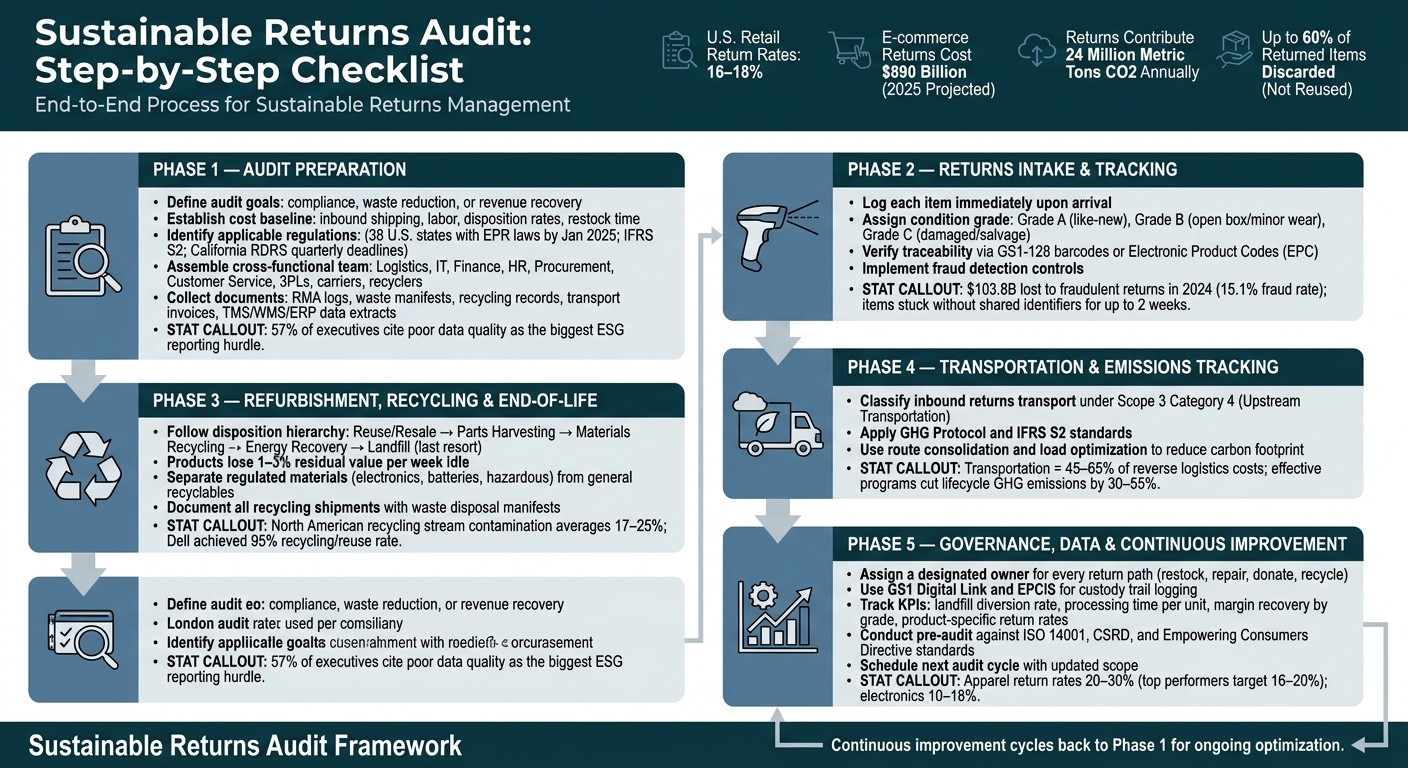
Sustainable Returns Audit: Step-by-Step Checklist
Audit Preparation Checklist
Getting ready for an audit is all about being thorough. Without proper preparation, audits can result in unclear findings that fail to address key issues. Start by clearly defining what you want to achieve and the boundaries of the audit.
Setting Goals and Scope
First, identify the purpose of the audit. Are you preparing for a certification review? Ensuring compliance with Extended Producer Responsibility (EPR) laws? Or perhaps aiming to cut down on landfill waste or increase revenue from returned items? Your objectives will determine what metrics to track and how detailed your evaluation needs to be.
Establish a baseline for the cost of returned items. This should include factors like inbound shipping, labor, disposition rates, and the time it takes to restock. Marcus Holloway of Loop Returns highlights a common challenge:
"Brands have invested millions optimizing their pick-pack-ship workflows and then they treat the reverse flow like a warehouse afterthought. The unit economics on a returned item are often three times worse than original fulfillment because nobody engineered the process."
Once goals are in place, outline the scope. This means specifying which facilities, product categories, 3PL partners, and time periods the audit will cover. A well-defined scope ensures reliable findings and prevents the process from going off track.
Identifying Applicable Regulations and Standards
Next, list all regulations and standards relevant to your operations. On the federal level, this might include Scope 3 emissions reporting frameworks like IFRS S2 (ISSB). State-level requirements are also critical - 38 U.S. states will have EPR laws in place by January 2025. Additionally, California’s RDRS regulations mandate quarterly recycling reports, with deadlines on May 31, August 31, November 30, and February 28.
If your supply chain involves electronics, pharmaceuticals, or automotive parts, you’ll need to consider sector-specific frameworks like IEEE, FDA DSCSA, and AIAG. For voluntary standards, ISO 14040/14044 (lifecycle assessment) and GS1 Digital Link (traceability) are gaining traction, particularly among institutional investors interested in circular economy practices. If your operations extend into Mexico, don’t overlook the General Law on the Circular Economy, which requires take-back programs for electronics and batteries starting December 2024.
With these regulations and standards in mind, assemble the necessary team and documentation to support your audit findings.
Stakeholders and Required Documents
An effective audit requires a cross-functional team. Internally, include members from Logistics, IT, Finance, HR, Procurement, and Customer Service - not just sustainability leads. Externally, involve 3PL providers, carriers, recyclers, and any secondary market platforms managing refurbished products. Partnering with experienced logistics providers like JIT Transportation can improve the accuracy of your data.
Collect essential documents, such as Return Merchandise Authorization (RMA) logs, inspection checklists, waste disposal manifests, recycling records, transport invoices, and data extracts from your TMS, WMS, and ERP systems. Every figure reported should be backed by a verifiable source. As Transport Works puts it:
"Audits don't grade on vibes. They grade on defensibility."
– Transport Works
To improve data quality, compile your audit materials quarterly instead of waiting until the end of the year. This proactive approach addresses a common issue - 57% of executives cite poor data quality as the biggest hurdle in ESG reporting.
Scheduling and Logistics
Create a detailed timeline with clear milestones. Start with a baseline assessment in the first 15 days, then move on to document collection and schedule facility walkthroughs. Make sure to allow enough time to secure access to both physical locations and IT systems.
Decide on a sampling method. Whether you opt for a random sample of returned SKUs, a category-based sample, or a full-volume review for high-risk product lines, ensure that reported utility data can be cross-checked against actual meter readings. This is a standard verification step. A well-organized schedule keeps the process on track and ensures the audit accurately reflects your sustainable returns operations.
Operational and Compliance Checklist
Once your audit scope is set and your team is ready, the next step involves diving into the operations themselves. This means examining every stage of a returned item's journey - from the moment it arrives at your facility to its final destination. This process builds on your earlier groundwork, ensuring that every operational step aligns with sustainable and efficient returns practices.
Returns Intake and Tracking
The intake process often determines the success or failure of sustainable returns programs. Each returned item must be logged immediately upon arrival, assigned a condition grade (e.g., Grade A for like-new, Grade B for open box or minor wear, and Grade C for damaged or salvage), and directed to the appropriate next step. Consistent grading criteria are essential, and photo documentation is a must for items slated for liquidation or disposal.
Traceability is just as important. Check whether your returns platforms, warehouse management systems, and ERP systems use common identifiers like GS1-128 barcodes or Electronic Product Codes (EPC). Without these shared identifiers, inventory can get stuck in "quarantine" for up to two weeks. Sarah Chen, Founder of Fern & Thread, highlighted the importance of speed in this process:
"We pushed for a 24-hour receive-and-grade SLA on returns with a restocking credit tied to any overage... Our inventory availability on high-velocity SKUs improved immediately."
Fraud detection is another critical area. Practices like "wardrobing" (buying items for temporary use and returning them) and "bracketing" (ordering multiple sizes with plans to return most) contributed to U.S. retailers losing $103.8 billion to fraudulent returns in 2024, with a fraud rate of 15.1%.
Once items are logged and graded, the focus shifts to refurbishment and testing.
Refurbishment and Testing Processes
A clear hierarchy for refurbishment is essential: prioritize reuse/resale, followed by parts harvesting, materials recycling, energy recovery, and, as a last resort, landfill disposal. Time is also a factor - products lose 1% to 3% of their residual value every week they remain idle. For example, Apple's "Daisy" robotic disassembly system has cut the time to disposition from 21 days to under 7 days while recovering 14 key materials, including cobalt and rare earth elements, from 1.2 million devices annually.
Refurbished items should meet quality standards and include warranties comparable to new products. This helps build consumer confidence in secondary market offerings. Any materials that can't be resold must be channeled into proper recycling or disposal processes.
Recycling and End-of-Life Handling
Proper classification of waste streams is critical. Separate regulated materials - like electronics, batteries, and hazardous components - from general recyclables, and ensure every recycling shipment is documented with waste disposal manifests. In North America, contamination in recycling streams averages 17–25%, which can lower material quality and disrupt recycling efforts.
Monitor landfill use against reduction targets. Dell Technologies provides a great example: their closed-loop recycling program, spanning 1,000 U.S. collection points, incorporated 147 million pounds of recycled materials into new products in 2024. This program achieved a 95% recycling and reuse rate, with less than 5% ending up in landfills.
The final piece of the puzzle is transportation and its impact on emissions.
Transportation and Emissions Tracking
Transportation often makes up 45% to 65% of reverse logistics costs. Make sure inbound returns transport is classified under Scope 3 Category 4 (Upstream Transportation) in your carbon accounting, following GHG Protocol and IFRS S2 standards .
It's also important to work with logistics partners that can provide detailed data on custody events and emissions for each shipment. Strategies like route consolidation, load optimization, and choosing efficient carriers can significantly reduce your carbon footprint. Collaborating with a partner like JIT Transportation - which specializes in returns management, pool distribution, and ERP integration - can minimize empty miles and enhance visibility across the reverse supply chain. Effective reverse logistics programs have been shown to cut lifecycle greenhouse gas emissions by 30% to 55% compared to producing new items.
Governance, Data, and Certification Readiness
Once operations and compliance are in place, the next step in a sustainable returns audit is ensuring the foundational structures - governance, data integrity, and certification readiness - are solid. These elements provide the oversight needed to avoid value loss and operational blind spots.
ESG Governance Structure
A strong governance framework starts with clear ownership. Every return path - whether an item is restocked, repaired, donated, or recycled - should have a designated owner. This person must have defined accountability and service-level targets. Without clear ownership, decisions can stall, leaving items in limbo. This not only reduces value but also creates the kind of inefficiencies that ESG auditors are quick to flag.
"Reverse logistics cannot be managed with carrier portals, spreadsheets, email approvals, and tribal knowledge. That stack creates exactly the blind spots ESG auditors, fraud teams, finance leaders, and customers will punish." - CXTMS
By establishing clear accountability, you can then rely on robust data systems to maintain transparency and avoid these pitfalls.
Data Accuracy and Traceability
Accurate, transaction-level data is critical for a credible audit. Every item's custody trail - from intake to final disposition - must be logged in detail. Using GS1 Digital Link and Electronic Product Code Information Services (EPCIS) standards ensures that custody events and condition assessments can be shared seamlessly among retailers, 3PLs, and recyclers.
For carbon reporting, a per-transaction measurement approach aligned with ISO 14067 is highly recommended. This approach ensures transparency by clearly distinguishing between measured, estimated, and excluded data. As Pepijn Stribos, Co-founder of It Goes Forward, puts it:
"The credible position is per-transaction measurement against ISO standards, with a clear distinction between measured, estimated, and excluded categories." - Pepijn Stribos
One standout example of effective data practices is Walmart Canada's returnable transport packaging program. By applying GS1 Digital Link standards across 1,200 suppliers and tracking 45 million container movements annually, the program achieved a 99.2% container return rate and reduced packaging waste by 73% in 2024.
Risk Assessment and Controls
A sustainable returns audit must address two major risks: handling hazardous materials and preventing fraud. North American recycling streams face contamination rates of 17%–25%, often due to improperly separated regulated materials. To tackle this, ensure waste disposal manifests are in place for all regulated shipments and that staff are trained to identify items requiring special handling.
Fraud also remains a growing concern, with refund abuse climbing to 57% in 2025. To manage this risk, consider a tiered approach: fast-track refunds for reliable customers while applying stricter checks to high-risk patterns before issuing credits. For decisions involving Grade C or Destroy items, photo documentation is essential. This supports sustainability compliance and ensures accurate profit-and-loss reporting.
Certification and Audit Readiness
ISO 14001 certification continues to set the standard for sustainable operations. To meet its requirements, companies need documented procedures, measurable goals, and a commitment to continuous improvement.
For businesses operating in Europe, compliance with the Corporate Sustainability Reporting Directive (CSRD) and the Empowering Consumers Directive (effective September 2026) is crucial. These regulations require returns claims to be backed by per-transaction data rather than estimates or offsets. Conducting an internal pre-audit against these standards can help identify and correct gaps before an external review.
sbb-itb-eafa320
Follow-Up and Continuous Improvement
Analyzing Audit Findings
Once the audit is complete, start by categorizing the findings based on factors like cost, ESG risk, and customer experience. Focus on the most critical gaps first - those with the highest impact - and address them immediately. Lower-impact issues can be scheduled for later, but make sure every finding has a designated owner and a clear deadline.
One of the most valuable tools at this stage is analyzing return reason codes. For example, a high frequency of "doesn't match description" returns often highlights content or listing issues, while a surge in "defective" returns could point to problems with a specific manufacturing batch. Instead of treating this data as just another logistics challenge, use it as a feedback loop to address root causes and prevent recurring issues.
"The companies that win in 2026 will stop asking only, 'How do we process returns cheaper?' The sharper question is, 'Can we prove every returned unit was routed to the right outcome quickly, ethically, and profitably?'" - CXTMS
Prioritized findings should then guide the creation of actionable metrics for ongoing improvement.
Tracking Key Metrics
Turn your categorized findings into measurable performance indicators. Transition from monthly to weekly returns analysis reports to identify and act on issues faster. For instance, spotting a manufacturing defect in the first week can prevent thousands of defective units from reaching customers.
Key metrics to track include:
- Landfill diversion rates
- Processing time per unit
- Margin recovery by disposition grade
- Product-specific return rates
To put things into perspective, typical return rates for apparel and footwear hover around 20%–30%, with top-performing brands aiming for 16%–20%. For consumer electronics, return rates generally range from 10%–18%. Monitoring these benchmarks helps provide context and ensures that progress is clear to both auditors and leadership.
Staff Training and Partner Alignment
Metrics alone won't drive change - your team and partners need to be fully aligned with the audit findings. Train staff to understand the importance of proper handling. For example, when frontline employees know why correctly tagging an item ensures it gets refurbished instead of scrapped, compliance improves. Standardize grading criteria across all locations, including clear thresholds for Grades A through D and photo documentation requirements for "Destroy" decisions. This consistency ensures reliable data no matter where the work is done.
Alignment with external partners is equally crucial. Take a page from Philips Consumer Electronics, which reduced returns costs by $100 million annually in the early 2000s by forming a cross-functional returns team, standardizing policies, and integrating consumer return data into product design. Achieving such results requires deliberate coordination. For example, tie your 3PL (third-party logistics) partners' compensation to sustainability goals, not just throughput volume.
Planning the Next Audit Cycle
As you wrap up, set the stage for the next audit cycle. Update your scope to include new risks, regulatory changes, or certification goals that have emerged since the last review. For instance, if your operations involve European markets, you'll need to factor in the EU's Packaging and Packaging Waste Regulation (PPWR), which mandates that 40% of transport packaging be reusable by 2030, increasing to 70% by 2040. Incorporating these evolving requirements into your future audits ensures your operations stay ahead of the curve.
Scheduling the next audit while insights are still fresh ensures that continuous improvement remains an active priority - not just a good intention.
Conclusion: Using Audits to Improve Returns Practices
Using the checklist outlined earlier, businesses can adopt a structured approach to audits that ensures continuous improvement in their returns processes. A well-executed returns audit isn’t a one-time task - it’s an ongoing process that drives operational improvements and enhances compliance. With this approach, reverse logistics can shift from being a hidden cost to a transparent, efficient system that recovers value, minimizes waste, and supports broader ESG goals.
The key lies in focusing on traceability and accountability. These elements transform returns management from a reactive process into a proactive strategy. Audits that aim to identify actionable insights - not just inefficiencies - can lead to meaningful changes. For instance, setting clear objectives, monitoring compliance, analyzing how products are handled after return, and creating feedback loops all help prevent repeated issues and uncover opportunities for cost savings.
To fully leverage audit findings, businesses need a strong reverse logistics framework. This is where partnerships with companies like JIT Transportation come into play. Offering services such as returns management, distribution, testing, and specialized handling, they provide the tools and expertise needed to turn audit insights into measurable improvements across the entire returns lifecycle.
FAQs
What should a sustainable returns audit include?
A sustainable returns audit involves examining every stage of the returns process, from the moment a return is initiated to its final resolution. This includes evaluating timeframes, costs, customer impact, and understanding the reasons behind returns. It's also crucial to verify traceable ESG (Environmental, Social, and Governance) data and ensure compliance with safety regulations, especially when dealing with hazardous materials.
Additionally, it's important to confirm that disposition rules - such as restocking, refurbishing, or recycling - are properly followed. This means having clear documentation for grading and testing returned items, maintaining accurate return records, and tracking metrics like carbon emissions and material recovery rates. These steps ensure a transparent and efficient process while aligning with sustainability goals.
What returns data should I gather before auditing?
Before diving into an audit of sustainable returns, it’s crucial to gather all the relevant data. Start with RMA numbers tied to the original orders, order IDs, SKUs, and reason codes to understand why items are being returned. Don’t forget to include customer-requested resolutions and any supporting documentation provided by the customer, such as photos of the product.
You’ll also need details about your return policy, along with timestamps, tracking numbers, and the condition of the returned item. Make sure your warehouse management system (WMS) records clearly indicate the next steps for each item - whether it’s restocked, refurbished, or disposed of. If disposal is the final action, ensure there’s documented proof to back it up.
How do I track emissions from reverse logistics for Scope 3?
To effectively track emissions from reverse logistics for Scope 3, it's crucial to categorize them accurately. Inbound returns are classified under Category 4: Upstream Transportation, while emissions related to the end-of-life treatment of sold products fall under Category 12. Following the guidelines of the GHG Protocol is essential for creating a comprehensive inventory of these emissions.
To get accurate measurements, gather detailed data such as:
- Distance traveled
- Mode of transportation
- Fuel type used
- Weight of packaging materials
Using a dashboard to monitor progress can help keep everything organized and transparent. Tools like JIT Transportation's advanced technology make this process even more precise by providing real-time tracking, ensuring emissions are monitored down to the smallest detail.
Related Blog Posts
Related Articles
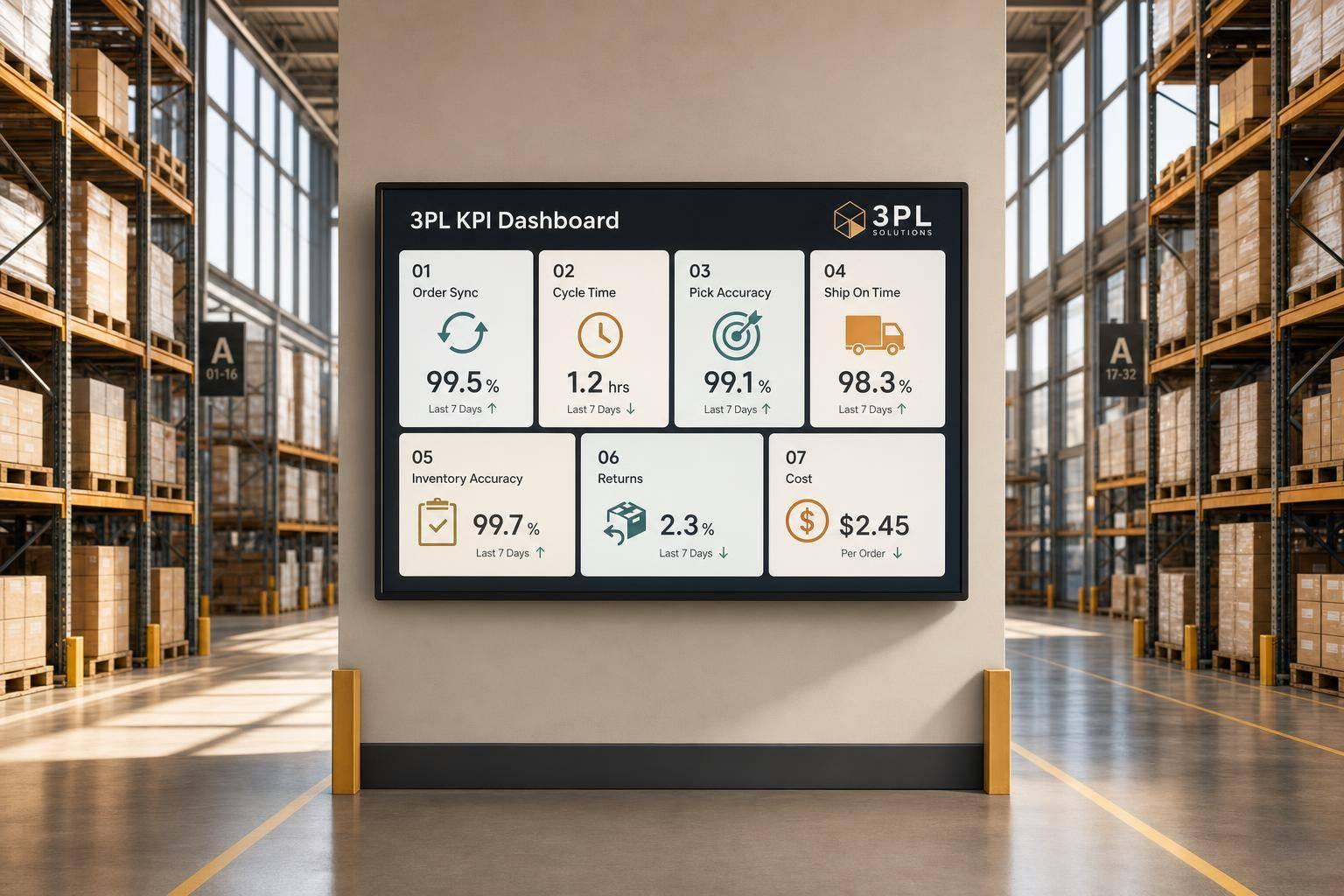
7 WooCommerce 3PL KPIs Teams Track

Centralized vs Decentralized Replenishment
