Top 10 Fulfillment Metrics for E-commerce 3PLs

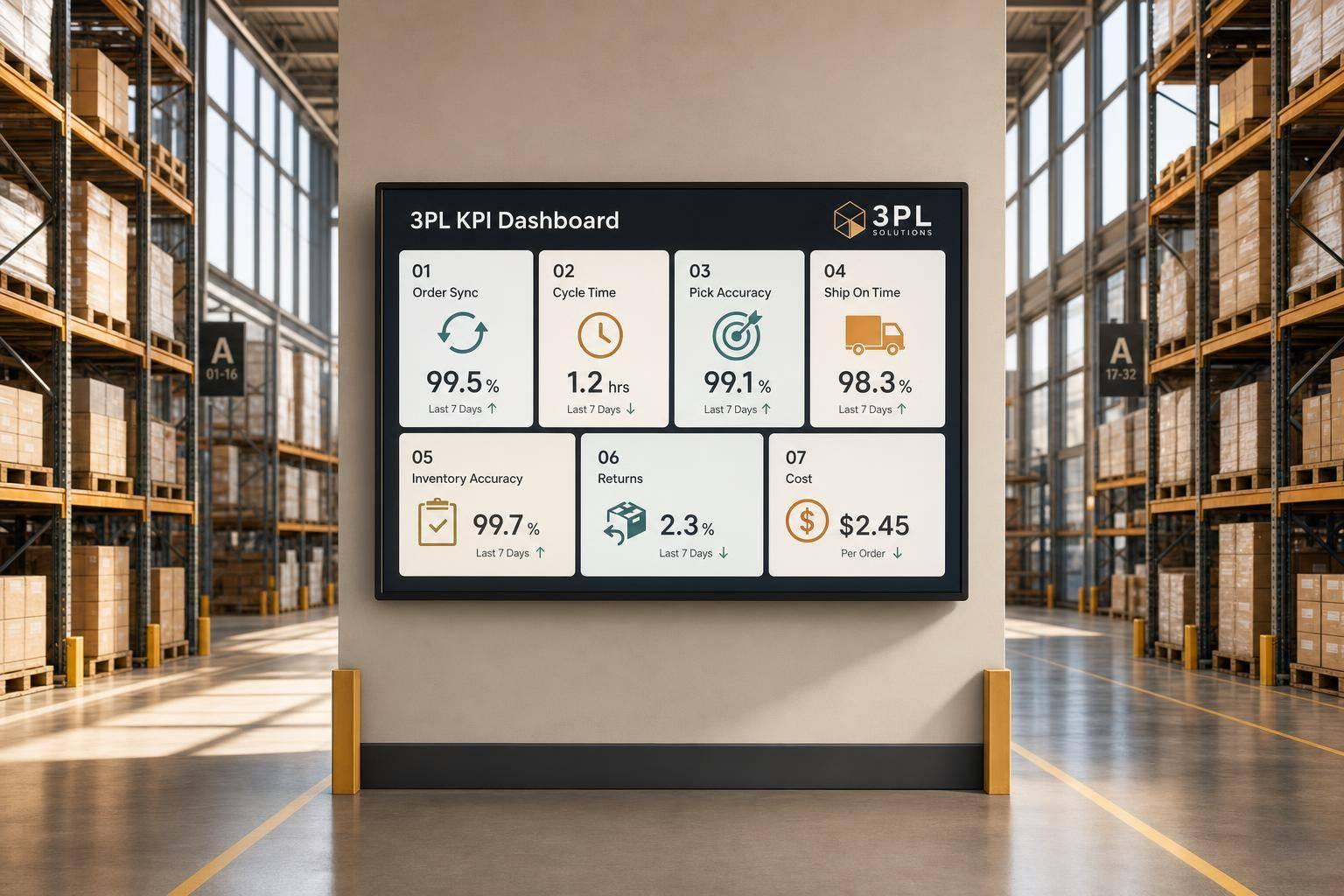
Your 3PL's performance can make or break your e-commerce business. Tracking the right metrics ensures your fulfillment partner meets expectations, prevents costly errors, and keeps customers happy. Here are the 10 key metrics every e-commerce brand should monitor:
- Order Accuracy Rate: Measures how many orders are shipped without errors. Target: 99.7% or higher.
- On-Time Shipping Rate: Tracks the percentage of orders shipped within the promised timeframe. Best-in-class: 99%+.
- Order Cycle Time: Monitors the time from order placement to shipment. Standard: Less than 24 hours.
- Dock-to-Stock Time: Measures how fast inventory is available after arriving at the warehouse. Ideal: Under 10 hours.
- Inventory Accuracy: Compares physical stock to system records. Target: 99.5%+.
- Inventory Turnover: Tracks how often stock is sold and replenished. Industry average: 8.3 turns/year.
- Cost Per Order (CPO): Calculates the total cost of fulfilling a single order. Keep it below 20% of Average Order Value (AOV).
- Perfect Order Rate (POR): Combines on-time, complete, damage-free, and accurate documentation. Aim for 95%+.
- Return Rate and Processing Time: Focuses on returns and how quickly they’re processed. Target: Under 72 hours.
- On-Time Delivery and Transit Time: Evaluates delivery success and time from shipment to doorstep. OTIF goal: 98%.
Why it matters: Studies show 1 in 5 customers won’t reorder after a fulfillment mistake, and many brands fail to monitor these metrics effectively. By tracking these benchmarks, you can improve trust, reduce costs, and scale efficiently.

Top 10 E-commerce Fulfillment Metrics: Benchmarks & Targets
1. Order Accuracy Rate
Order accuracy rate reflects the percentage of orders shipped without errors - whether it’s the correct item, quantity, packaging, or address. The formula is simple: (Total Orders Shipped − Orders with Errors) ÷ Total Orders Shipped × 100. For instance, if you ship 10,000 orders and 50 have issues, your accuracy rate comes out to 99.5%. Maintaining a high accuracy rate is essential to protect customer trust and keep operational costs in check. Even small mistakes can take a toll on profitability.
Mistakes in order fulfillment aren’t just inconvenient - they’re expensive. Each error can cost anywhere from $15 to $40 when you factor in return shipping, reshipping, and labor costs. Beyond the financial hit, these errors can cause long-term damage to customer loyalty.
As G10 Fulfillment explains:
"Every order that is shipped incorrectly can create problems, including returns, reships, customer service calls, negative reviews, and eroded trust in a brand."
Recent data from 2026 shows that the median pick-and-pack accuracy for 137 Shopify brands was 99.1%. While impressive, this figure still falls short of the 99.7% accuracy target commonly outlined in Master Service Agreements. Leading third-party logistics (3PL) providers aim even higher, achieving 99.9%+ accuracy by leveraging barcode scanning at every step - picking, packing, and shipping - to catch and prevent mistakes before orders leave the warehouse.
Technological solutions like advanced Warehouse Management Systems (WMS) paired with pick-to-light or voice-picking systems are game-changers. They identify discrepancies in real time, significantly reducing human error. JIT Transportation, for example, combines cutting-edge technology with strict quality control to ensure high shipping accuracy across its operations. Tracking accuracy at both the order level and the line-item level is equally important, as it helps identify recurring issues - whether tied to a specific SKU, picker station, or even a particular shift pattern.
Next, we’ll explore how timely shipping contributes to overall fulfillment success.
2. On-Time Shipping Rate
The on-time shipping rate tracks the percentage of orders that leave the fulfillment center and are handed off to a carrier within the promised timeframe or Service Level Agreement (SLA). The formula is simple: (Orders Shipped on Time ÷ Total Orders Shipped) × 100. It’s important to clarify what "shipped" actually means in this context - it could refer to a label being printed, an order being staged, or the moment a carrier accepts the package. These distinctions matter because they influence when customers can start tracking their orders. Missing these shipping windows can lead to more customer service inquiries, penalties from marketplaces, or even cancellations in B2B transactions.
Joel Malmquist, VP of Customer Experience at G10 Fulfillment, highlights this challenge:
"The reason I don't say ship is because sometimes it will be marked as completed, but the carrier doesn't actually pick it up right away... a good report separates warehouse completion from carrier acceptance."
Here’s how the industry benchmarks on-time shipping rates:
- 95%+: Acceptable
- 97%+: Strong
- 99%+: Best-in-class
Many brands fall short of these standards without realizing it, often because they don’t monitor SLA targets against actual performance data.
Technology is a game-changer when it comes to improving on-time shipping. Modern Warehouse Management Systems (WMS) use real-time, scan-based tracking to log physical events accurately, avoiding the errors caused by outdated timestamps. Companies like JIT Transportation rely on these advanced systems, integrating WMS with ERP platforms and leveraging a nationwide carrier network to ensure timely deliveries. As JIT Transportation puts it, "In a supply chain built on speed and precision, technology is the difference between 'on time' and 'too late.'"
Additionally, setting clear daily cutoff times - such as a noon deadline for same-day shipping - and keeping an eye on upstream metrics like dock-to-stock time are essential for maintaining high on-time shipping performance.
Next, we’ll take a closer look at order cycle time, another critical metric for fulfillment efficiency.
3. Order Cycle Time
Order cycle time measures how long it takes from when an order is placed to when it's shipped from the warehouse - excluding transit time. While delivery speed depends on your carrier, this metric is entirely up to your 3PL.
What sets this apart is how detailed it is. It doesn't just give you a single number; it breaks down the time spent on order validation, inventory allocation, picking, packing, and staging. This level of detail helps pinpoint where bottlenecks might be hiding.
For e-commerce businesses, speed is everything. 41% of shoppers are willing to pay extra for same-day delivery. A slow cycle time doesn't just hurt your efficiency - it can cost you sales. The industry standard for Order-to-Ship (OTS) on make-to-stock items is 24 hours or less for orders placed before the daily cutoff. Within that, warehouse processing (from pick release to packing completion) should take 4–8 hours.
One common issue that slows things down is upstream receiving. If inbound inventory isn’t stowed quickly, orders can get stuck in "hold" status - even if the items are physically in the building. That’s why cycle time is so valuable as an early warning system. If you notice delays, it often means something upstream - like receiving, slotting, or labor - is off track. JIT Transportation uses scan-based WMS for timestamped tracking and real-time visibility portals to keep tabs on order progress.
"If your cycle time is unstable, same-day promises become fragile." - Joel Malmquist, VP of Customer Experience, G10 Fulfillment
A helpful strategy? Break down cycle time by order type. Single-SKU orders and multi-line orders move through the warehouse differently. Combining them into one average can hide the real issues.
4. Dock-to-Stock Time
Dock-to-stock (DTS) time tracks how long it takes for inventory to go from arriving at the warehouse dock to being stored and marked as ready in your Warehouse Management System (WMS). This process includes several steps: unloading, inspection, labeling, data entry, and putting items away.
The formula for DTS is simple: DTS = Inventory Available Timestamp − Arrival Timestamp. It’s important to note that the clock starts ticking the moment the truck arrives - not when unloading begins. This means delays like truck wait times or shift changes can significantly impact DTS.
Until inventory completes this process, it’s unavailable for orders, which can lead to phantom stockouts - inventory that exists but isn’t accessible for fulfillment.
"Receiving is the silent inventory killer." - Forthmatch
Performance in this area varies widely. The best warehouses achieve DTS in under 3.5 hours, and top third-party logistics providers (3PLs) manage it within 8 to 10 hours. However, data from 137 Shopify brands in 2026 shows a median DTS of 62 hours, with the worst performers taking up to 112 hours. That’s nearly five days where inventory is just sitting idle. These delays can clog up the entire order cycle, making efficient inbound processing essential.
Leading 3PLs use advanced tools and strict workflows to cut down on DTS. For example, Advanced Shipping Notices (ASNs) allow warehouses to assign dock doors, labor, and storage spots before the truck even arrives, shaving 25–35% off receiving times. Similarly, directed putaway logic in a WMS helps workers quickly find open storage slots. Companies like JIT Transportation streamline this even further with WMS integrations and scan-based receiving workflows, speeding up the process of making inventory available.
Reducing dock-to-stock time is a key step in improving fulfillment efficiency. Up next, we’ll dive into inventory accuracy to explore more ways to optimize operations.
5. Inventory Accuracy
Inventory accuracy reflects how well your Warehouse Management System (WMS) records align with the actual physical stock in your warehouse. The formula to measure it is simple: Inventory Accuracy = (Physical Count ÷ Recorded Count) × 100. For a more detailed look, you can calculate it at the SKU level using (Number of SKUs with Correct Count ÷ Total SKUs Audited) × 100.
When there's a mismatch between recorded and actual stock, it creates phantom inventory - items that seem available in the system but aren't physically present. This misalignment can cause overselling, stockouts, and canceled orders. Negative variances lead to canceled orders, while positive variances result in false stockouts and increased costs.
The numbers highlight the scope of this issue. For Shopify brands in 2026, the median Inventory Record Accuracy (IRA) is 97.4%, which falls 1.6 points short of the 99.0% target. Top-tier 3PL operations achieve 99.5% or higher, while anything below 95% signals serious issues. Businesses with an IRA below 95% spend 3.2 times more on expedited shipping to cover inventory gaps compared to those operating above 98%.
"A 3PL doesn't go from great to terrible overnight. Performance degrades gradually: accuracy slips from 99.5% to 98.7% over three months... Without a scorecard, you don't notice until customers start complaining." - Nventory Team
Technology plays a critical role in maintaining high accuracy. 100% scan-based workflows eliminate manual, paper-based processes, ensuring every stock movement is recorded instantly. Blind receiving - where staff count incoming units without access to the expected quantity - removes a significant source of human error. This is vital, as receiving mistakes account for 35–40% of all IRA issues. JIT Transportation uses these scan-based, WMS-integrated workflows to maintain precise inventory records and reduce discrepancies. Additionally, conducting regular cycle counts, rather than relying on a single annual physical count, helps catch and fix variances early, preventing them from escalating into major fulfillment problems.
Next, we’ll dive into inventory turnover and its role in optimizing fulfillment performance.
6. Inventory Turnover
Inventory turnover is a key metric for understanding how efficiently stock is sold and replenished throughout the year. Here’s the formula to calculate it:
Inventory Turnover Rate = Cost of Goods Sold (COGS) ÷ Average Inventory
Average Inventory = (Beginning Inventory + Ending Inventory) ÷ 2
A higher turnover rate typically indicates strong demand and effective inventory management. On the flip side, a low turnover rate suggests sluggish stock movement, which can lead to higher carrying costs. These costs - covering warehousing, insurance, depreciation, and labor - can account for roughly 25% of your inventory's total value. For context, the logistics industry averages around 8.3 inventory turns per year. Top performers achieve about 14.1 turns annually, while the bottom quartile averages just 4.5 turns. Even a single additional turn can improve profitability by approximately 5%.
Different product categories have varying turnover rates. For example:
- Electronics: 6–10 turns annually
- Beauty products: 5–9 turns annually
- Fashion: 3–6 turns annually
- Home goods: 2–4 turns annually
Knowing your product category’s typical turnover range helps you set achievable goals and quickly spot underperforming items. Another helpful metric is the Dead Stock Ratio, which measures the percentage of inventory that hasn’t sold in over 12 months. High levels of dead stock tie up space and capital, emphasizing the importance of improving turnover.
Strategies to Improve Inventory Turnover
Third-party logistics (3PL) providers can implement several strategies to boost turnover efficiency:
- Cross-docking: This process skips storage by moving incoming shipments directly to outbound orders, cutting down on dwell time.
- Optimized slotting: Placing high-demand items closer to shipping areas reduces handling time.
- WMS-driven demand forecasting: Warehouse Management Systems (WMS) analyze historical trends to align stock levels with actual demand, reducing the risk of over-ordering.
For e-commerce brands, tools like vendor-managed inventory (VMI) and ERP integration provide real-time visibility into stock levels. These systems allow smarter replenishment decisions, helping to address slow-moving inventory before it becomes a costly burden.
"The more a 3PL provides detailed performance metrics…the more you start providing a real look at productivity at the operational level." - Tim Brindley, Supply Chain Consulting Expert
sbb-itb-eafa320
7. Cost Per Order
Cost per order (CPO) measures the total expense involved in processing and delivering a single customer order - from the moment the order is placed to its arrival at the customer's doorstep. The formula is simple:
Cost Per Order = Total Fulfillment Costs ÷ Total Orders Shipped
These expenses typically include pick-and-pack labor, packaging materials, outbound shipping, storage fees, returns processing, and carrier surcharges.
CPO plays a critical role in determining profit margins. Siddharth Gangal of Fairview explains it best:
"Tracking cost per order is not ops reporting - it is margin management."
A good rule of thumb is to keep your CPO below 20% of your Average Order Value (AOV). For instance, fulfillment and logistics costs often average $20 for every $100 in online revenue. Brands with an AOV under $35, however, frequently see fulfillment costs consume 25%–35% of revenue, making it challenging to achieve profitable growth. To provide some context, the average 3PL fulfillment cost per order in 2026 ranges from $3.50 to $8.00 for standard single-item orders, while total landed costs for domestic direct-to-consumer (DTC) orders typically fall between $8 and $15.
Hidden Costs and Their Impact
One of the biggest pitfalls in managing CPO is overlooking hidden fees. Standard invoices often fail to account for things like carrier accessorial charges, re-work labor, and software fees. These hidden costs can quietly add 18%–35% on top of your expected expenses. For example, a 90-day audit of a mid-sized 3PL uncovered $142,380 in unbilled services, including $61,000 in accessorial charges and $44,000 in re-work labor. This resulted in an operating margin of –2.8%.
Reducing CPO Through 3PL Partnerships
Partnering with a third-party logistics provider (3PL) is one of the most effective ways to lower CPO. Since 3PLs pool shipping volumes across multiple clients, they can negotiate better carrier rates than individual brands can achieve on their own. Additionally, distributed warehouse networks allow inventory to be stored closer to customers, which reduces shipping zones and can cut transportation costs by 20%–30% per order.
Technology also plays a key role. Tools like cartonization logic and real-time carrier rate shopping help avoid extra fees, such as dimensional weight penalties, and ensure shipments are routed through the most cost-effective carriers. Providers like JIT Transportation offer ERP integration and vendor-managed inventory, giving brands real-time visibility into costs. This allows businesses to actively manage their CPO rather than simply tracking it after the fact.
James Liu, VP of Platform Analytics at Catalist AI, emphasizes the importance of understanding all costs upfront:
"The rate card is the beginning of the conversation, not the end. I've seen 3PL quotes that look 30% cheaper than competitors until you add in the monthly minimums, peak surcharges, and packaging markups."
Focusing on cost efficiency isn't just about cutting expenses - it directly supports margin management, a concept we delve into further with the Perfect Order Rate metric.
8. Perfect Order Rate
Perfect Order Rate (POR) measures how well orders are delivered by combining four key factors: being on time, complete, damage-free, and accompanied by accurate documentation. The formula is straightforward:
Perfect Order Rate = (% On-Time) × (% Complete) × (% Damage-Free) × (% Accurate Documentation) × 100
This metric highlights how small errors can add up. Siddharth Gangal of Fairview explains:
"Perfect Order Rate, a composite of four key delivery conditions, exposes compounded errors that isolated metrics can mask."
Here’s an example: if each category achieves 97% performance, the overall POR drops to 88.5% (0.97⁴). This shows how minor issues can quietly undermine customer trust. Industry benchmarks place the median POR at 90%, while top-tier operations aim for 95% to 97% or higher. Companies consistently exceeding 97% often achieve a Customer Lifetime Value (LTV) that’s 3 to 4 times their Customer Acquisition Cost (CAC).
How 3PLs Can Improve Your POR
A strong POR reflects excellence across the entire fulfillment process, and modern third-party logistics providers (3PLs) play a key role in achieving this. They focus on eliminating errors at every step, from receiving to shipping. For instance:
- Barcode scanning at critical points - like picking, packing, and shipping - reduces human error before the order leaves the warehouse.
- Automated alerts in Warehouse Management Systems (WMS) identify risks, such as missed same-day shipping cutoffs or inventory mismatches, in real time.
- Proactive tracking notifications can cut "Where Is My Order" (WISMO) inquiries by 50% to 70%, improving on-time delivery rates and documentation accuracy.
Companies like JIT Transportation demonstrate the value of integrating ERP systems with fulfillment operations. This integration provides real-time visibility across the order lifecycle, ensuring consistency in pick-and-pack workflows and returns management, even as order volumes grow.
If your POR isn’t meeting expectations, start by auditing each component individually to identify weak areas. Address these issues directly and monitor key metrics weekly instead of quarterly. In e-commerce, problems can escalate too quickly for a 90-day review cycle to catch.
9. Return Rate and Return Processing Time
Beyond order accuracy and shipping, tracking returns is a key way to assess post-delivery performance.
Return Rate refers to the percentage of orders customers send back. You can calculate it using this formula: (Total Returns ÷ Total Orders) × 100. Leading 3PLs often analyze this metric by SKU or category to identify specific problem areas. Another related measure, the Return to Restock Rate, tracks the percentage of returned items that can be resold, which directly affects how much margin can be recovered.
Return Processing Time measures how long it takes from the moment a return is received to its final outcome - whether it's restocked, refurbished, or discarded. According to the Forthmatch 2026 State of 3PL Performance Report, while the target for this metric is 72 hours, the median processing time across 137 Shopify brands in 2026 was 94 hours, leaving a 22-hour gap. During the busy holiday season, processing times worsened significantly, jumping from 68 hours in September 2025 to 162 hours in December 2025.
Returns are a massive expense for U.S. e-commerce businesses, costing an estimated $890 billion in 2025. On average, processing a single return at a U.S. 3PL cost $11.42 in Q1 2026, up from $7.80 in 2024. Delays in processing returns result in lost revenue opportunities, and a poor return experience makes customers three times less likely to shop with you again.
"Every returned item sitting in a warehouse is capital you can't access. A product that takes 14 days to process and restock is a product that can't be sold to another customer." - a2b Fulfillment
How 3PLs Improve These Metrics
Technology-focused 3PLs can significantly shorten the return cycle, reducing the typical 10–15+ days seen in in-house operations to just 2–4 days. This is achieved through strategies like dedicated dock-to-stock lanes and rules-based grading that speed up return processing. Self-service return portals also shave 1–3 days off the timeline by automating tasks like RMA generation and label creation. Automated refund triggers further reduce delays.
JIT Transportation enhances these efficiencies with dedicated return management workflows integrated into ERP systems. This setup provides merchants with real-time updates on return statuses and improves inventory recovery across their fulfillment networks.
10. On-Time Delivery and Transit Time
On-Time In-Full (OTIF) is a key metric that evaluates whether deliveries arrive both on time and in full. It’s calculated using the formula: (OTIF deliveries ÷ total deliveries) × 100. However, what counts as "on-time" can vary - it might mean reaching the gate, the dock, or even the receiving floor.
"A truck arriving 15 minutes late with the complete load fails OTIF the same way a truck arriving on time with one missing pallet fails OTIF." - TrucksOnTheMap
The gap between actual performance and expectations can be striking. Data from the Forthmatch 2026 State of 3PL Performance Report shows that the median OTIF rate across 137 Shopify brands is 94.2%. That’s nearly 4 percentage points below the standard contracted target of 98.0%. Brand size also matters: larger merchants with over $50M in GMV average a 97.0% OTIF rate, while smaller merchants under $1M GMV manage only 91.4%. Falling short of OTIF targets can lead to more than just retailer chargebacks - it can also damage customer trust built over time.
While OTIF measures overall delivery success, transit time focuses on how efficiently orders move from the warehouse to the customer.
Transit time is the period between when an order leaves the fulfillment center and when it reaches the customer’s doorstep. This metric is heavily influenced by a 3PL's carrier network and the location of its warehouses . Using a multi-node distribution model - where inventory is strategically placed closer to customers - can significantly cut down transit times. For instance, JIT Transportation, with its nationwide network of over 500 carriers and more than 200 trucks, ensures reliable delivery even during peak demand.
Technology also plays a big role. Predictive ETA modules powered by machine learning can achieve over 95% accuracy, compared to the 60–70% accuracy of static estimates. These tools often improve OTIF scores within 6–10 weeks. Additionally, JIT’s warehouse management system (WMS) integrates seamlessly with platforms like Shopify, Magento, and WooCommerce, offering automated, real-time shipping updates that reduce the volume of customer inquiries.
Conclusion
The 10 metrics outlined - ranging from order accuracy to transit time - do more than just measure performance. Together, they provide a clear picture of how well your fulfillment process is running. These metrics act as early warning signs, pinpointing areas where inefficiencies might be eating into your profits, damaging customer trust, or weakening your market position. They highlight the real cost of operational missteps.
The numbers make the stakes clear. According to the Forthmatch 2026 State of 3PL Performance Report, 8 out of 9 SLA misses go unnoticed because no one is monitoring them, and only 11% of brands have successfully recovered a chargeback for a missed SLA. Even more concerning, 44% of Shopify brands have never compared their SLA targets to actual performance data. This gap reflects more than just operational challenges - it’s a matter of accountability.
The solution starts with better visibility. Schedule monthly reviews with your 3PL, integrate your storefront with a real-time warehouse management system (WMS), and negotiate SLAs that account for peak periods - especially for returns processing, which can spike from 68 hours in September to 162 hours in December. These measures help ensure your fulfillment performance stays aligned with your SLAs.
Working with a dependable fulfillment partner can make this process smoother. JIT Transportation offers automated reporting, seamless integrations with platforms like Shopify, Magento, and WooCommerce, and a nationwide network of 14 warehouses covering over 2.5 million square feet. This infrastructure provides the visibility and flexibility needed to consistently meet your targets, even during the busiest times.
FAQs
Which 3 fulfillment metrics should I track first?
To create a solid fulfillment process, prioritize these three key metrics:
- Order Accuracy Rate: This shows how many orders are processed correctly. Strive for a rate of 99% or higher to minimize returns and maintain customer confidence. Mistakes in orders can quickly erode trust.
- On-Time Shipping Rate: This metric tracks whether orders are shipped by the promised cutoff time. A rate of 95% or higher ensures that delivery expectations are met, keeping customers satisfied and loyal.
- Inventory Accuracy: This ensures that your system's stock records match the actual inventory on hand. Aim for 99% or better to avoid issues like stockouts or overselling, which can disrupt operations and disappoint customers.
By focusing on these metrics, you'll build a fulfillment process that meets customer expectations and supports long-term success.
How do I set realistic SLAs for peak season?
To create realistic SLAs for peak seasons, start by reviewing past performance during similar high-demand periods. This will help you establish a baseline for factors like SKU complexity and order volumes. Break your workflow into key stages - such as order entry, picking, packing, and carrier handoff - to pinpoint any bottlenecks that could slow things down. Additionally, implement rolling forecasts that you update every 2–3 weeks. These forecasts will allow you to fine-tune staffing and inventory levels as demand fluctuates. For added support, consider scalable 3PL solutions like those offered by JIT Transportation to maintain efficiency during peak times.
What’s the best way to audit a 3PL’s hidden fees?
To get a clear picture of hidden fees, start by calculating your true landed cost per order. Do this by dividing your total monthly invoices by the number of orders shipped. This gives you a baseline to work from.
Next, break down line items such as:
- Storage fees
- Pick-and-pack charges
- Accessorial fees
Compare these charges to your rate card to spot any discrepancies. Keep an eye out for common issues like:
- Storage rate drift: Gradual increases in storage costs over time.
- Incorrect dimensional weight calculations: Errors in how package dimensions are factored into shipping costs.
- Duplicate charges: Being billed twice for the same service.
Finally, make it a habit to reconcile your physical inventory with system reports. This helps you identify errors like phantom inventory charges, where you're billed for items that don't actually exist in your inventory. Regular checks can save you from unnecessary expenses.
Related Blog Posts
Related Articles

AI Inventory Integration for Multi-Warehouse 3PL

Cross-Border Customs Forms: Checklist