
How to Evaluate 3PL Quality Assurance Processes
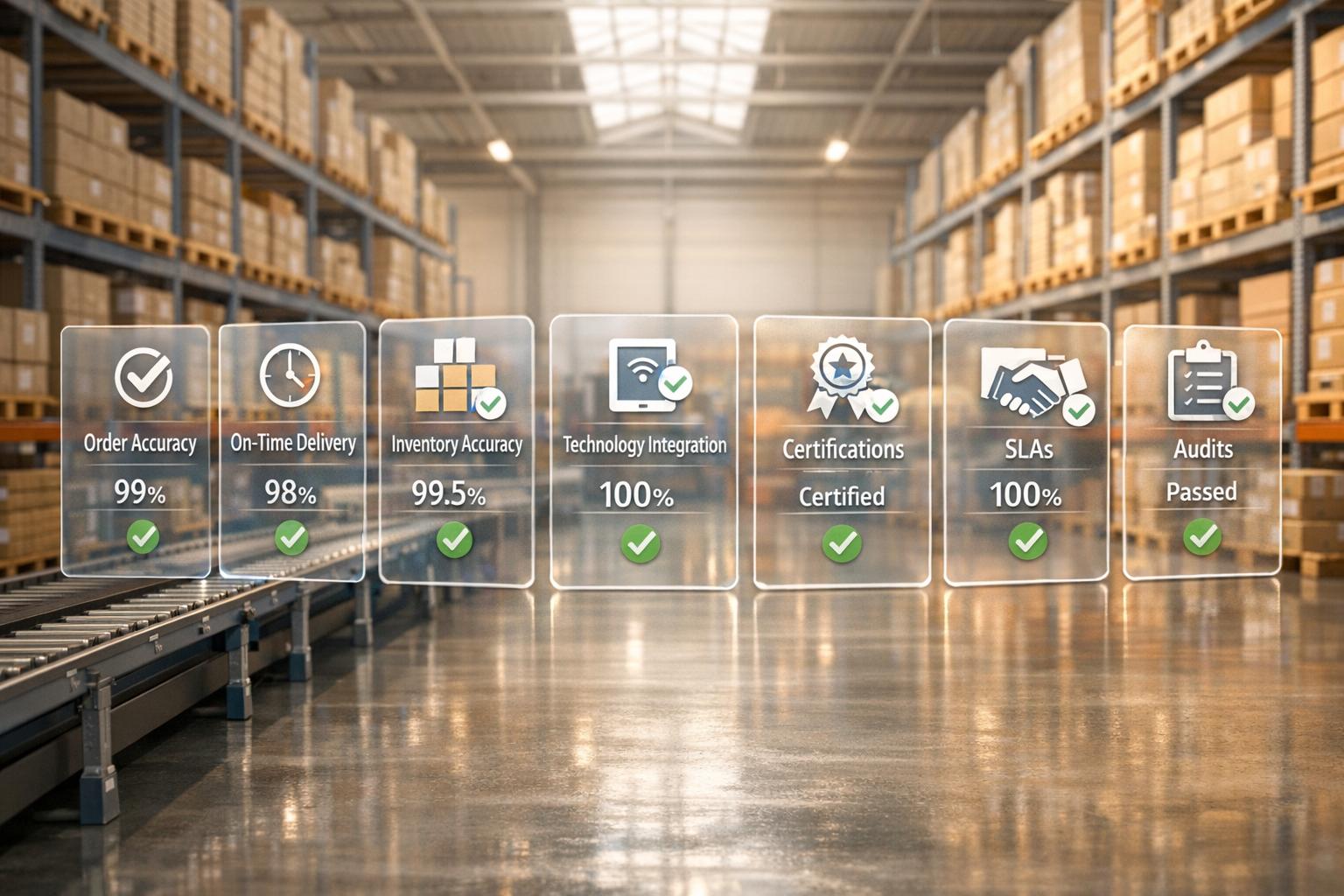
Your 3PL provider directly impacts your brand’s reputation. Every late delivery or error can cost customers, while effective quality assurance reduces costs and improves customer satisfaction. To evaluate a 3PL’s quality assurance, focus on these key areas:
- Order Accuracy Rate: Look for providers with at least 99.5% accuracy to minimize costly errors.
- On-Time Delivery: Ensure they meet 98%-99.9% benchmarks, with clear definitions in SLAs.
- Inventory Accuracy: Seek rates above 99% and fast dock-to-stock times (24-48 hours).
- Technology: Providers should use advanced WMS, barcode scanning, and real-time tracking for efficiency.
- Certifications and Compliance: Check for ISO 9001:2015 and industry-specific certifications.
- Performance History: Review past metrics, incident rates, and peak-season reliability.
Set clear SLAs with measurable metrics, penalties for underperformance, and regular reviews. Strong monitoring ensures your 3PL remains aligned with your goals and delivers dependable logistics.
Quality Assurance in the Supply Chain
sbb-itb-eafa320
Key Quality Assurance Metrics to Assess

3PL Quality Assurance Metrics: Industry Benchmarks vs High-Performance Targets
When evaluating a 3PL provider, it's essential to rely on measurable data to confirm they can meet your customers' expectations consistently. Key metrics offer a clear view of a provider's reliability and performance. Here's what to focus on.
Order Accuracy Rate
This metric tracks how often orders are shipped with the correct items, quantities, and condition. It's calculated as:
(Accurate Orders ÷ Total Orders) x 100
Industry standards range from 98% to 99.9%, with top-performing providers aiming for 99.5% or higher. Even a small error rate, like 1%, can lead to costly returns, additional shipping expenses, and, most importantly, a loss of customer trust.
"Brands should aim for a 99.9% order accuracy rate when working with a 3PL." – FIDELITONE
When assessing providers, ask how they calculate this rate and request monthly accuracy reports broken down by product category. Providers using barcode or RFID scanning during receiving, picking, and packing processes often achieve lower error rates.
On-Time Delivery Rate
This measures the percentage of shipments that arrive by their promised delivery date. Most industries expect rates between 98% and 99.9%. However, it's crucial to define "on-time" in your Service Level Agreement - does it mean the shipment leaves the warehouse on time, or does it arrive at the customer's door as promised?
Late deliveries can frustrate customers, disrupt production schedules, and cause supply chain issues. During your evaluation, ask about the provider's carrier relationships and how they manage peak season demand to ensure timely deliveries.
Inventory Accuracy and Dock-to-Stock Time
Inventory accuracy compares the actual stock levels in the warehouse to the records in the Warehouse Management System (WMS). Standard benchmarks fall between 95% and 98%, while elite providers often exceed 99%. Poor inventory accuracy can lead to overselling, emergency restocking, and inflated costs due to discrepancies.
Dock-to-stock time measures how quickly goods move from the receiving dock to being ready for order fulfillment. The industry standard is typically 24 to 48 hours.
Here’s a summary of these critical benchmarks:
| Metric | Industry Benchmark | High-Performance Target |
|---|---|---|
| Order Accuracy Rate | 98% – 99.9% | ≥99.5% |
| On-Time Delivery Rate | 98% – 99.9% | 100% (in specific sectors) |
| Inventory Accuracy | 95% – 98% | ≥99% |
| Dock-to-Stock Time | <24 – 48 Hours | ≤4 Hours |
| Shrinkage Rate | ≤1% | ≤0.5% |
To ensure consistent accuracy, choose providers that use cycle counting - regular inventory checks throughout the year - instead of relying solely on annual audits. Additionally, ask about their use of Advanced Shipping Notices (ASN) to schedule and process incoming shipments faster.
Technology and Process Controls
Maintaining high-quality assurance in fulfillment isn't just about tracking metrics - it relies heavily on the right technology and process controls. These systems form the backbone of accuracy, speed, and consistency in operations. The tools a third-party logistics (3PL) provider uses can make or break their ability to deliver error-free orders. When assessing potential partners, focus on three key areas of technology that separate top-tier providers from the rest.
Warehouse Management Systems (WMS)
Think of a Warehouse Management System (WMS) as the command center for fulfillment operations. It handles real-time inventory tracking, optimizes picking routes, and enforces checks at every stage to catch errors before they reach the customer. A strong WMS is critical for achieving order accuracy rates as high as 99.95%.
The best WMS platforms standardize processes across the board, ensuring smooth operations even during peak seasons or staff changes. They also send automated alerts to address fulfillment gaps immediately. When evaluating a 3PL, ask specific questions about their WMS capabilities. For example:
- Does it optimize picking routes to save time?
- Can it automate reorder points for inventory?
- Does it separate inventory for multiple clients?
Providers using advanced algorithms to reduce transit times often achieve faster delivery speeds and fewer mistakes. This kind of technology not only reduces risks but also ensures consistent performance.
Barcode Scanning and Real-Time Tracking
Barcode scanning plays a vital role in every step of the process - receiving, picking, packing, and shipping. It creates a reliable verification system that catches errors before they leave the warehouse, preserving data accuracy and preventing costly mistakes. Real-time tracking bridges the gap between physical inventory and system records, addressing inventory distortions that cost the global retail industry around $1.73 trillion annually.
In regulated industries like food or supplements, real-time systems can track lot numbers and expiration dates during recalls, ensuring quick identification of affected customers. Scanning also makes new inventory available for orders as soon as it’s received, speeding up operations.
"In a high-velocity warehouse, if your data isn't live, it's already obsolete." – Zenventory
When choosing a provider, prioritize those with user-friendly scanning systems. Ask if their WMS integrates seamlessly with your e-commerce platform via API, as this reduces manual handoffs and potential errors. A robust scanning and tracking system strengthens operational consistency and minimizes risks.
ERP Integration and Scalability
A seamless connection between a 3PL’s WMS and your ERP system ensures smooth data flow without the errors that come from manual entry. This integration is vital for accurate cost tracking and real-time inventory valuation. Without it, manual reconciliation can lead to delays and compliance risks.
Scalability is another major benefit. Cloud-based WMS systems now make up 50% of all deployments, allowing businesses to expand their fulfillment operations - whether it’s adding new locations, product lines, or sales channels - without needing a complete tech overhaul.
During your evaluation, ask about the provider’s experience with your ERP system and request examples of successful integrations. Providers that invest in cutting-edge tools like AI for demand forecasting or robotics for automation show they’re committed to maintaining high-quality standards as your operations grow.
| Technology | Primary Quality Function | Key Benefit |
|---|---|---|
| WMS | Inventory Tracking | Reduces stock discrepancies and boosts efficiency |
| Barcode Scanning | Item Verification | Cuts down on human error in order matching and shipping |
| ERP Integration | Data Synchronization | Keeps financial and operational records aligned |
| Real-Time Tracking | Continuous Updates | Offers instant visibility into inventory movement |
Certifications, Audits, and Track Record
Certifications and audits provide an independent check on a 3PL provider's dedication to maintaining high-quality standards. These credentials act as third-party validations, ensuring that a provider operates with consistency and reliability. When selecting a logistics partner, carefully review their certifications and audit history to confirm they meet the necessary industry benchmarks.
Industry Certifications and Compliance
One of the most recognized certifications in logistics is ISO 9001:2015, which establishes a framework for quality management. This standard ensures that a provider follows consistent, auditable processes aimed at improvement and compliance with both customer and regulatory requirements. Built on principles like customer focus and a systematic approach to processes, ISO 9001 indicates strong quality controls.
"ISO 9001 certification isn't just a badge - it's a promise. This certification signals to a 3PL's partners, customers, and stakeholders that its operations are governed by consistent, auditable processes focused on quality, continuous improvement, and reliability." – Kanban Logistics
For industries with specialized needs, other certifications come into play. The AS9100D certification, for instance, is tailored to aerospace and defense logistics. It incorporates additional requirements from organizations like NASA and the FAA, emphasizing risk management and precise product configuration.
Pharmaceutical companies should look for Current Good Manufacturing Practice (CGMP) certification, which confirms compliance with FDA standards to maintain product potency and safety throughout distribution. Similarly, food and beverage businesses benefit from providers with an AIB International Superior Rating, which ensures warehouse cleanliness and adherence to the Food Safety Modernization Act (FSMA).
Security is another critical area. Certifications like C-TPAT (Customs-Trade Partnership Against Terrorism) highlight a provider's efforts to safeguard the supply chain against smuggling and other illegal activities. For global trade, Foreign Trade Zone (FTZ) certification ensures oversight by U.S. Customs and Border Protection, offering added security along with potential tax benefits.
When evaluating certifications, don't just note their presence - dig deeper. Confirm that certifications are up-to-date (e.g., ISO 9001:2015 rather than older versions) and check whether they apply across the provider's entire operation or just specific facilities. Request recent audit histories to verify that certifications are still valid and actively maintained.
| Certification | Industry Focus | Key Compliance Area |
|---|---|---|
| ISO 9001:2015 | General Logistics | Quality Management Systems (QMS) |
| AS9100D | Aerospace & Defense | Risk management and product configuration |
| CGMP | Pharmaceutical | FDA regulatory standards for potency and safety |
| AIB International | Food & Beverage | Warehouse cleanliness and FSMA compliance |
| C-TPAT | International Trade | Supply chain security and threat prevention |
| FTZ | Global Trade | Customs supervision and tax/duty deferral |
Certifications are just one part of the equation. It's equally important to assess whether providers consistently meet these standards in their day-to-day operations.
Performance History and Incident Rates
Certifications set the standard, but a provider's track record proves whether they live up to it. Ask for data on their historical performance, focusing on metrics like on-time delivery rates and inventory accuracy. These figures help you gauge how well the provider meets service level agreements (SLAs). Pay special attention to their performance during peak seasons, as this is when operational reliability is truly tested.
Incident management is another key indicator. Look into how quickly the provider resolves issues or customer complaints. Transparency during disruptions and a clear escalation process for major problems are signs of a dependable partner.
Return processing is often overlooked but crucial for maintaining cash flow and inventory accuracy. Providers should be able to handle returns efficiently, especially for products requiring lot tracking, expiration monitoring, or special handling. Request SKU-level data that aligns with your product's needs to ensure they can handle the specifics of your operation.
Before committing to a contract, translate qualitative assurances into measurable criteria. Use an evaluation checklist to set clear pass/fail requirements. Additionally, review itemized invoices from past clients to uncover any hidden fees, and gather feedback from internal teams like sales and operations to get a well-rounded view of the provider's reliability beyond formal reports.
At JIT Transportation, we embed these quality measures into every part of our operations, ensuring our certifications, audits, and performance history reflect our dedication to delivering dependable logistics solutions.
Setting SLAs and Asking the Right Questions
Once you've assessed technology and certifications, the next step is to translate those insights into solid SLAs and targeted questions. Service Level Agreements (SLAs) help turn general assurances into measurable commitments, while the right questions can uncover whether a provider has the capability to meet those commitments.
Defining SLAs for Key Metrics
SLAs should focus on metrics that directly affect your customers and your business. Order accuracy is a critical metric, with the industry standard set at 99.9%, meaning fewer than one mistake per thousand orders.
"Shipping accuracy should be a top priority for 3PLs. Everybody loses if our partners' customers don't receive orders on time and in full." - Tony Runyan, Chief Client Officer at Red Stag Fulfillment
For on-time shipping, aim for a target of 95% to 99%, but be clear about what "on-time" means. Does it refer to the carrier scan by end of day, or delivery within the promised timeframe? Clearly define cutoffs, such as same-day shipping for orders received by 2:00 PM. Inventory accuracy should reach at least 99.5%, comparing recorded stock levels with physical counts.
Set benchmarks for dock-to-stock times, with 24 hours being best-in-class and 48 hours as an acceptable standard. Similarly, return processing should take between 24 and 48 hours from receipt to inspection and restocking. For customer service response times, aim for under three hours.
To ensure accountability, structure your SLAs with tiered penalties. Minor breaches might result in small fines, while major disruptions could trigger larger penalties. Additionally, require a root cause analysis for any SLA violations, ensuring the provider identifies and addresses the underlying issues. Schedule weekly check-ins to address immediate concerns and quarterly reviews to analyze trends and adjust targets as needed.
With these SLAs in place, the next step is to dig into the provider’s processes.
Key Questions to Ask Potential 3PL Providers
Metrics alone won’t tell the full story. It’s crucial to ask the right questions to understand whether the provider has the infrastructure to deliver. Request historical performance data and inquire about their staffing stability and integration capabilities, such as WMS systems that connect via API or EDI for real-time data sharing. Look for robust quality control measures like barcode scanning, automated weight checks, and photo documentation of packed orders.
Staff turnover is another key factor. The warehouse industry sees an average annual turnover of 49%, which can directly affect accuracy. Ask about the provider’s turnover rate and how they manage and train temporary staff during peak periods.
Clarify how they handle peak demand and after-hours issues. Do they have a documented escalation process for problems that arise outside regular business hours?
"The best 3PLs run their operations on numbers. Before you commit, you should know exactly how they measure success and what service levels they guarantee." - Einstein Fulfillment
Ask for examples of how they’ve resolved quality issues in the past and speak with references to verify their claims.
Finally, confirm whether they use tools like Corrective and Preventive Action (CAPA) to address missed SLAs and prevent recurrence. Will they provide monthly KPI dashboards and collaborate on identifying root causes when performance gaps appear? If a provider hesitates to share performance data or discuss improvement processes, consider it a red flag.
Monitoring and Improvement
Once your SLAs are set and your key questions are outlined, the next step is consistent monitoring to ensure everything stays on track. SLAs provide the groundwork, but regular oversight ensures those benchmarks are met over time. Without this, even the most reliable 3PL can veer off course, and minor issues can escalate into major disruptions.
"Ultimately, KPIs are not just operational scorecards -- they are tools for managing risk, protecting margins and ensuring that outsourced logistics partners align with business objectives."
– Paul Maplesden, Freelance Editorial Services
To keep things running smoothly, consider implementing a structured review process: weekly check-ins for immediate metrics, monthly reviews for spotting performance gaps, and quarterly trend analyses for proactive adjustments. These tools ensure measurable improvements and accountability.
Monthly KPI Dashboards and Reviews
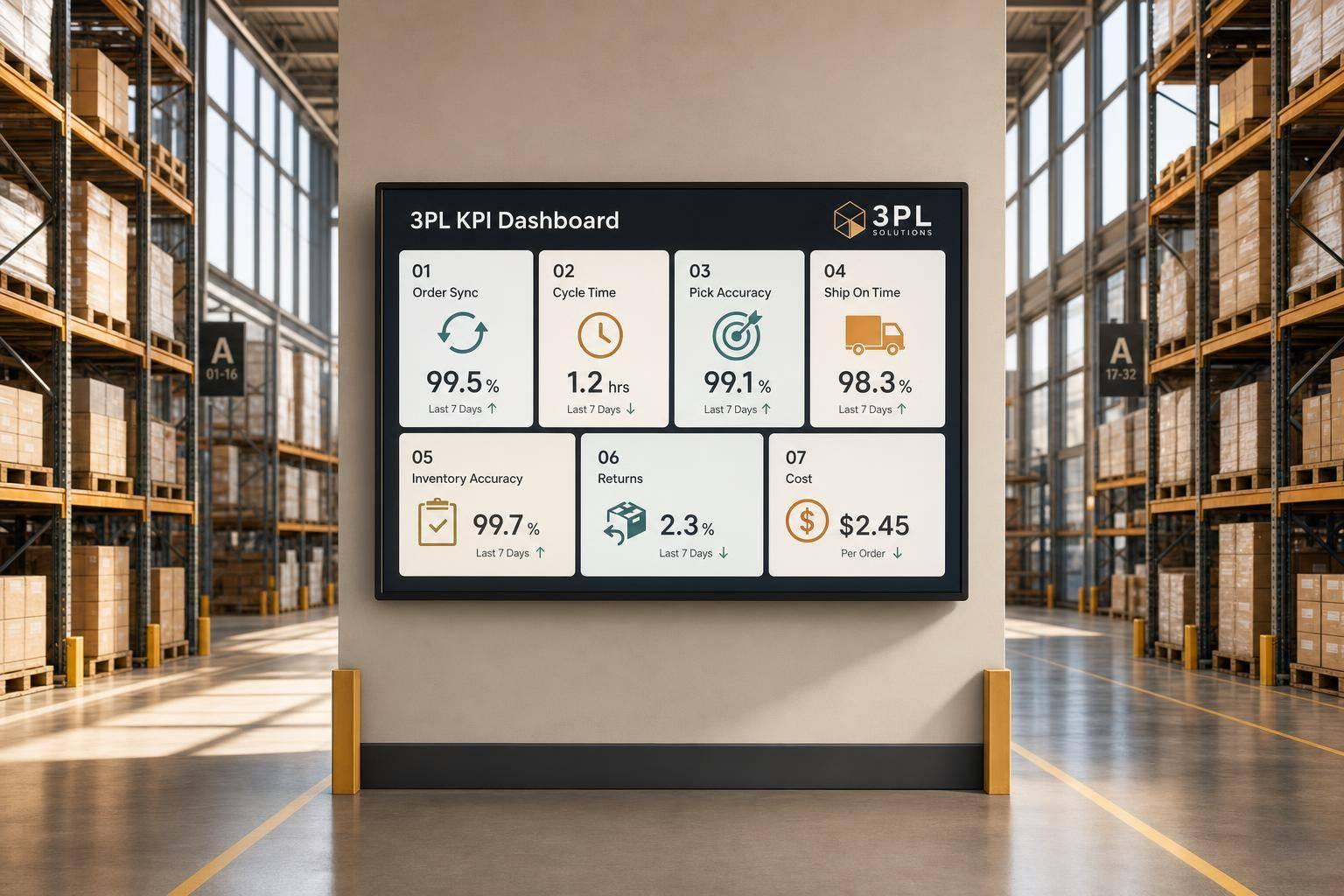
Monthly dashboards are a practical way to turn raw data into actionable insights. Use them to track key metrics like on-time delivery rates, order and inventory accuracy, cost per order, shrinkage, and dock-to-stock times. These benchmarks help you gauge how well your 3PL is performing relative to your SLAs.
Monthly reviews with your 3PL go beyond just looking at numbers - they’re an opportunity for collaboration. Instead of conducting a one-sided audit, work together to identify and address underlying issues. Whether it’s a tech integration that’s not working, a process breakdown, or communication delays, this partnership-based approach ensures both sides stay aligned and address problems before they grow.
"When you hold your 3PL partner accountable for predetermined KPI's, you maintain control over performance and ensure your logistics partner meets your standards consistently."
– PiVAL
Independent Audits and Trend Analysis
While monthly reviews focus on short-term performance, independent audits offer a more objective look at long-term trends. For example, regular cycle counts help maintain inventory accuracy, while documented safety audits and incident logs - including photos of damaged or lost goods - confirm operations are being handled responsibly.
Quarterly trend analyses are especially useful for spotting patterns that might otherwise go unnoticed. For instance, if labor productivity - typically around 40–60 units per hour - starts to drop, it could signal a need for process changes or automation. Similarly, if space utilization dips below the 80–90% range, it might be time to rethink your warehouse layout to avoid inefficiencies.
These insights can also guide adjustments to your SLAs. If performance consistently falls short, you may need to renegotiate terms with more realistic targets, adding penalties for underperformance or rewards for exceeding expectations. And if issues persist despite these efforts, consider increasing review frequency from monthly to weekly until things stabilize.
Conclusion
Evaluating the quality assurance processes of a 3PL requires an ongoing commitment to safeguard both your brand reputation and financial performance. Consider this: 16% of shoppers will abandon a retailer after just one incorrect delivery, and 69% are less likely to shop with a brand again if a delivery is late. With customer acquisition costing 5–7 times more than retaining an existing customer, dependable logistics are not just helpful - they’re essential.
To recap, focus on establishing measurable benchmarks. Aim for order accuracy rates above 99.9% and on-time shipping rates exceeding 99%. Ensure the 3PL’s technology offers real-time tracking and visibility. Also, check that their certifications and compliance standards align with your brand’s values and regulatory needs.
"If you evaluate 3PLs based on vibes, pricing sheets, or a polished demo, you will almost always discover limitations after signing."
– 3PL Bridge
Turn vague promises into enforceable service-level agreements (SLAs). These should include clear thresholds, penalties for underperformance, and rewards for exceeding expectations. Maintain a structured governance routine: weekly meetings for operational updates, monthly KPI reviews for performance tracking, and quarterly reviews for strategic alignment. When metrics fall short, use root cause analysis to identify and address the underlying issues. This approach emphasizes why binding SLAs are critical for sustained success.
"A well-managed 3PL becomes a competitive advantage that enables faster growth, happier customers, and stronger margins."
– Red Stag Fulfillment
By consistently applying these practices, you build the resilience needed to handle growth and seasonal demand spikes. A strong partnership with your 3PL ensures your operational standards are upheld and your business remains scalable.
The best 3PL partnerships feel like an extension of your brand. At JIT Transportation, we embed these rigorous quality assurance practices into everything we do, delivering dependable, efficient supply chain solutions across the United States.
FAQs
What should I include in a 3PL SLA?
A solid 3PL Service Level Agreement (SLA) lays out the expectations and performance metrics needed to maintain quality and reliability. Here are some key elements to include:
- Order Accuracy Standards: Aim for accuracy rates like 99.5%-99.9% to minimize mistakes and ensure customer satisfaction.
- On-Time Delivery Targets: Set clear goals, such as 95%-99%, to guarantee timely fulfillment of orders.
- Inventory Protocols: Incorporate systems like real-time tracking to maintain visibility and control over stock levels.
- Response Times: Define acceptable timeframes for resolving issues to keep operations running smoothly.
- Quality Checkpoints: Implement checks at critical stages to catch and address errors early in the process.
These components help ensure smooth operations while driving consistency and improvement over time.
How can I verify a 3PL’s KPI data is accurate?
To keep a 3PL’s KPI data accurate, blend technology, audits, and validation processes effectively. Leverage real-time tracking tools to minimize manual mistakes, and perform routine inventory audits to catch any discrepancies. Cross-check KPI reports with shipment logs and customer feedback to ensure alignment. Set up clear SOPs for data entry and reporting, and compare outcomes to benchmarks or historical trends to detect any inconsistencies.
Which 3PL certifications matter for my industry?
Certifications such as ISO 9001:2015 and Good Manufacturing Practice (GMP) play a key role in maintaining quality assurance, particularly in highly regulated fields like pharmaceuticals and food. These standards confirm that a 3PL provider adheres to rigorous quality and compliance protocols, ensuring their processes are dependable and meet industry requirements.
Related Blog Posts
Related Articles
7 WooCommerce 3PL KPIs Teams Track

Centralized vs Decentralized Replenishment
