
How 3PL Partners Share Supply Chain Risk

If you ship 3,000+ orders a month, supply chain risk should be split before something goes wrong. I’d keep it simple: the brand usually owns planning, the 3PL usually owns warehouse and shipping execution, and both sides need written rules for service misses, inventory errors, and extra costs.
Here’s the short version:
- Inventory risk: I’d expect the brand to own replenishment and SKU planning. The 3PL should own receiving, storage, count accuracy, and damage handling after goods arrive.
- Transportation risk: I’d put routing, carrier handoff, and shipment execution on the 3PL. But if the brand sends bad forecasts or late promo updates, that risk should be shared.
- Service risk: Order accuracy, OTIF, and turnaround times need hard KPI definitions, shared data, and clear credits or penalties.
- Cost risk: Market-driven fees like fuel and peak surcharges usually stay with the brand. Errors like mis-picks, reships, and rework should sit with the 3PL.
- Control system: I’d lock this into the contract, then track it with weekly ops reviews, monthly scorecards, and quarterly business reviews.
A few numbers make the stakes clear: 65% of U.S. shoppers stop buying after two or three late deliveries, and 69% are less likely to return after just one late order. That means logistics problems don’t stay in the warehouse. They hit repeat sales fast.
- Inventory: The brand typically owns SKU mix, replenishment strategy, and forecasting, while the 3PL manages receiving, storage, inventory counts, and damage checks. Variance rules and claims should be treated as a shared responsibility.
- Transportation: The brand is generally responsible for volume forecasts and promotional timing, while the 3PL handles routing, carrier handoffs, and shipment flow. Both parties share responsibility for delays tied to inaccurate or missed forecasts.
- Service: The brand owns promise dates and accurate order inputs, while the 3PL is accountable for pick-and-pack speed, order accuracy, and OTIF performance. SLA exceptions require coordination between both parties.
- Cost: The brand typically carries costs related to fuel, peak fees, and market surcharges, while the 3PL is responsible for costs caused by mis-picks, reships, and avoidable rework. Volume-based pricing changes should be managed jointly.
Bottom line: I’d never leave risk ownership vague. Put each risk into one of four buckets - inventory, transportation, service, or cost - then assign the owner, the trigger, the data source, and the fix.
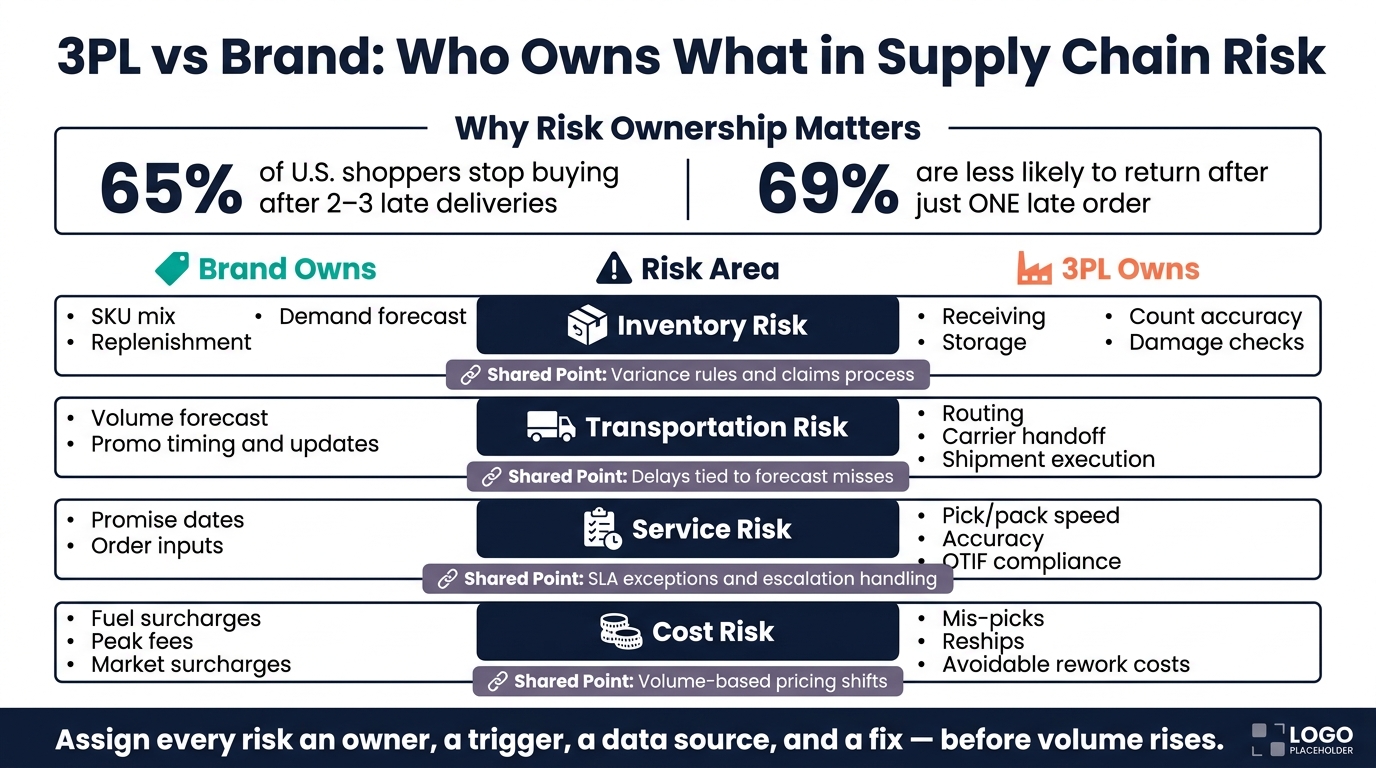
3PL vs Brand: Who Owns What in Supply Chain Risk
Laying the Foundation: How 3PLs Can Deliver More Value in Supply Chains | The 3PL Blueprint (Part 1)
sbb-itb-eafa320
How risk is split across inventory, transportation, service, and cost
Risk touches inventory, transportation, service levels, and cost. If no one owns each piece upfront, small issues can turn into finger-pointing fast.
Inventory risk: ownership, shrinkage, damage, and count accuracy
The brand owns SKU strategy and replenishment. The 3PL owns receiving, storage, and inventory accuracy once the product arrives.
After a shipment is received, the 3PL needs to check in SKUs, confirm quantities, and flag any discrepancies before inventory moves into the pick location. Real-time visibility matters here. It helps keep system counts lined up with physical counts.
Shrinkage, damage, and cycle-count tolerances also need to be written down. If those thresholds and escalation rules aren't clear, every inventory variance becomes a debate.
Once inventory is accurate and visible, the next risk is simple: do orders move on time and in full?
Transportation and service-level risk: delays, routing, order accuracy, and OTIF
Carrier performance, routing decisions, and OTIF targets mostly sit with the 3PL. But the brand shares the risk when its inputs are wrong. A forecast miss or a promo spike can lead to a service miss if the 3PL wasn't staffed or scheduled for the change.
Order accuracy and fulfillment-speed commitments should sit inside SLAs with defined penalties or incentives. OTIF targets should tie back to measurable ownership on both sides. If the 3PL misses a pick, ships the wrong item, or routes a package the wrong way, the contract should spell out the fix. If the miss came from brand forecasting, handle it as a shared exception through a separate exception process.
Dock scheduling is another common pain point. Detention fees from poor inbound coordination often show up as a cost issue, even when the root cause was a planning gap on one side or the other. The contract should state who owns detention charges and when.
When service slips, the next issue is money: who takes the hit?
Cost exposure: surcharges, reimbursements, and volume-driven pricing changes
Fuel surcharges, peak-season fees, accessorial charges, returns handling, and special project costs all shape landed cost. The problem is that many brands don't see the full impact until the invoice lands.
A simple split works best:
- Market-driven surcharges stay with the brand
- Avoidable operational costs - like mispacks, reships, and unneeded rework - stay with the 3PL
- Volume and forecast swings are shared based on the terms in the contract
When errors happen, reimbursement rules and approval thresholds should already be in place. No one wants to argue over a charge after the fact.
Volume changes should also trigger a scheduled pricing review, not a last-minute rate fight. Contracts should include a pricing adjustment method, such as tiered pricing or volume-based discounts, so pricing talks happen on a set schedule instead of during a fire drill.
Shared-risk breakdown by exposure area
Across all of these areas, the split follows the same pattern: the brand owns planning inputs, and the 3PL owns warehouse and carrier execution. Market-driven costs stay with the brand. Operational failures stay with the 3PL. Volume and forecast swings are shared.
That sounds simple on paper. It only works, though, when the contract spells out KPIs, liabilities, and escalation paths.
Contract terms that turn shared risk into enforceable accountability
Once risk is split by function, the contract has to make that split enforceable. This is where things stop being theoretical. When pressure hits, written obligations are what hold up.
Each clause should tie back to one of four exposure areas: inventory, transportation, service, or cost. And before either side ramps volume, opens new sales channels, or adds more fulfillment complexity, they need to agree on the terms that make accountability stick.
Scope of services and KPI definitions
Spell out every service in plain terms: receiving, pick and pack, kitting, returns, carrier management, testing, and white-glove handling. If the scope is fuzzy, invoice disputes and service gaps usually follow.
SLAs also need to be measurable. That includes pick accuracy, OTIF, receiving turnaround, and inventory accuracy. For each KPI, the contract should state how it is measured and which data source is used to calculate it. If one side pulls numbers from a WMS and the other uses a different system, you're setting up an argument before the work even starts.
The goal is simple: define scope tightly enough that each service has one clear owner. That gives both sides a working basis for credits, liability, and escalation.
Liability, credits, penalties, and reimbursement rules
The pricing model should be spelled out up front, whether it's fixed, variable, cost-plus, or hybrid. Service-level terms should connect directly to pricing through credits, penalties, or incentives. If a KPI is missed, the contract should already say what happens next.
The same goes for claims. Damage and shrinkage beyond tolerance need a written claims process. Fault-based costs like mispacks, reships, and avoidable rework should sit with the party that caused them. And the contract should separate pass-through charges from charges that need prior approval.
That sounds simple on paper, but it only works if both sides are reviewing the same data and using the same thresholds.
Escalation, change control, termination, and transition support
As volume grows and fulfillment gets more complex, workflows change too. New channels, new SKUs, or new services can shift the risk split. That means they shouldn't be added casually. The contract should require written approval before any new workflow goes live, and it should explain how labor-heavy changes are priced so scope creep doesn't turn into surprise cost increases.
For repeat service misses, the escalation path needs to be clear: who gets notified, at what threshold, and within what timeframe. No guessing, no scrambling.
Termination terms matter just as much. Clear exit conditions for performance failures and force majeure help both sides avoid getting trapped in a contract that isn't working. Inventory transfer steps and offboarding timelines should also be written into the agreement, not sorted out after notice is given.
Once the contract is set, the next job is making sure the risk split doesn't drift. That comes down to shared data and a steady review cadence.
Data sharing and review cycles that keep risk visible
Once ownership is written into the contract, shared data is what makes that ownership usable day to day. Without it, even a well-written risk split can drift as order volume changes, promos hit, and shipping patterns shift. Both sides need to work from the same numbers.
Forecasts, inventory visibility, and shipment status as a single source of truth
The first step is agreeing on one shared system of record for forecasts, inventory status, order and shipment status, service-level performance, and cost data. The brand should own forecast and order data. The 3PL should own inventory and shipment events. When those systems connect through API or EDI, both teams can work from a single source of truth.
Forecast sharing shapes service risk. A useful forecast should include a rolling SKU-level demand projection, a promo calendar with expected volume lift and timing, and the main assumptions behind demand, such as ad spend, price changes, and assortment shifts. That extra context helps the 3PL plan labor, space, and dock schedules ahead of time instead of scrambling when demand spikes.
Inventory status shapes inventory risk. And inventory status means more than one on-hand number. Available, held, damaged, QC pending, returns, and in transit all point to different risk states, and each one calls for a different response. If 30% of a seasonal SKU is stuck in held - labeling issue right before a launch window closes, that visibility can be the difference between a fast fix and a missed OTIF target.
Shipment data shapes transportation risk. It should cover the full trip, from pick complete and pack complete to trailer departure, carrier scans, and final delivery. It should also include rule-based exception alerts tied to SLA windows. For example, if an order sits in picked, not packed for more than four hours, both the 3PL operations lead and the brand’s customer experience team should get an alert, along with a pre-agreed response playbook. That keeps a warehouse delay from turning into a customer complaint.
From there, review cadence turns alerts into action.
Weekly ops reviews, monthly scorecards, and quarterly business reviews
A three-level review cadence keeps issues visible at the right stage.
A clear cadence stops problems from sitting around until month-end.
Weekly ops reviews are tactical. The agenda should cover the prior week’s OTIF, order accuracy, and cut-off compliance; any open incidents and their current status; the next two to three weeks of volume outlook; and an action log with owners and due dates. If weekly reports show more mis-picks in a certain SKU family, the meeting should end with a clear fix, like re-slotting, added check scanning, or updated training, before the issue turns into marketplace penalties or lost customers.
Monthly scorecards focus on trends. Key inputs include OTIF, fill rate, order accuracy, returns processing time, cost per order, and accessorial charges by type. When metrics move in the wrong direction, the scorecard review should lead to corrective action before another month stacks on top of the problem.
Quarterly business reviews are where the shared-risk model gets reset. Both teams should look at performance trends, upcoming peak seasons, new channel plans, and any contract terms, including KPI targets, pricing tiers, and credit thresholds, that no longer match the brand’s current scale. The QBR is where those updates get agreed on paper instead of surfacing halfway through the quarter.
Shared visibility and a repeatable review cadence keep the risk split from becoming just theory. When both sides trust the numbers and meet on a set schedule, accountability stays clear as the business grows.
Building a shared-risk model that holds up under pressure
Collaborative planning, contingency playbooks, and action plans
Once ownership is clear, the next move is response planning. A shared-risk model only works if both sides plan before disruption hits, using documented playbooks, not scattered email threads.
Start with a shared risk register that maps exposure across inventory, transportation, service levels, and cost. Each risk should include a likelihood and severity score, a named owner, preventive controls, and a clear response path. This register is the operating layer that turns written ownership from the contract and data sections into action.
Each playbook should spell out the trigger, owner, and response. If OTIF falls below a set threshold or a key carrier misses SLA by a set threshold, the playbook should kick in automatically: the 3PL shifts volume to pre-negotiated backup carriers within an approved cost-per-shipment ceiling, and the brand updates site messaging and order cut-off times. For Q4 or launch surges, the plan should state when temp workers come in, how costs are split if volume exceeds forecast by more than 20%, and what SLA relaxations, if any, apply above that threshold.
Running tabletop exercises before peak season puts those same escalation paths and action owners to the test. It’s a simple way to spot gaps early, before a live disruption turns them into expensive problems.
Conclusion: key rules for splitting risk without slowing growth
With ownership, data, and response plans in place, the model can grow without slowing operations. Define ownership by exposure area so there’s no confusion when something goes wrong. Write accountability into contract terms, including KPI definitions, credits or penalties, and escalation rules. Use shared data as the backbone, with integrated systems giving both sides the same real-time view. Maintain the review cadence so terms and targets stay aligned as volume grows.
The goal is simple: agree on ownership, triggers, data, and actions before volume or volatility rises.
FAQs
What should a 3PL risk-sharing contract include?
A 3PL risk-sharing contract should clearly spell out:
- Liability and insurance
- Indemnity
- Service levels
- Scope and payment terms
- Confidentiality and IP
- Data ownership, real-time access, clean data export, and integration costs
- Termination, notice, and transition obligations
It should also define measurable SLAs, credits or chargebacks for missed targets, escalation paths, liability caps, and who is responsible for loss or damage.
How do brands and 3PLs handle forecast-driven service failures?
Brands and 3PLs deal with forecast-driven service failures by sharing visibility and communicating early. When both sides work from 12 months of historical data and connected WMS and TMS systems, they can catch stockouts or late shipments before they turn into bigger problems. That gives them time to adjust labor plans and carrier capacity.
If performance falls short of targets, the agreement should spell out escalation steps and corrective actions. Teams then track OTIF and order accuracy in weekly and monthly reviews, using root-cause analysis to fix issues and keep improving over time.
Which KPIs matter most for shared supply chain risk?
The most important KPIs are OTIF delivery, order accuracy, inventory accuracy, return rates due to 3PL error, non-delivery rates, and inventory turnover. Taken together, they show how well the operation performs across reliability, efficiency, and financial results.
These KPIs should be written into service level agreements in a clear, consistent way. They also need automated reporting, root-cause analysis, and regular review cycles so both parties stay aligned on performance goals.
Related Blog Posts
Related Articles
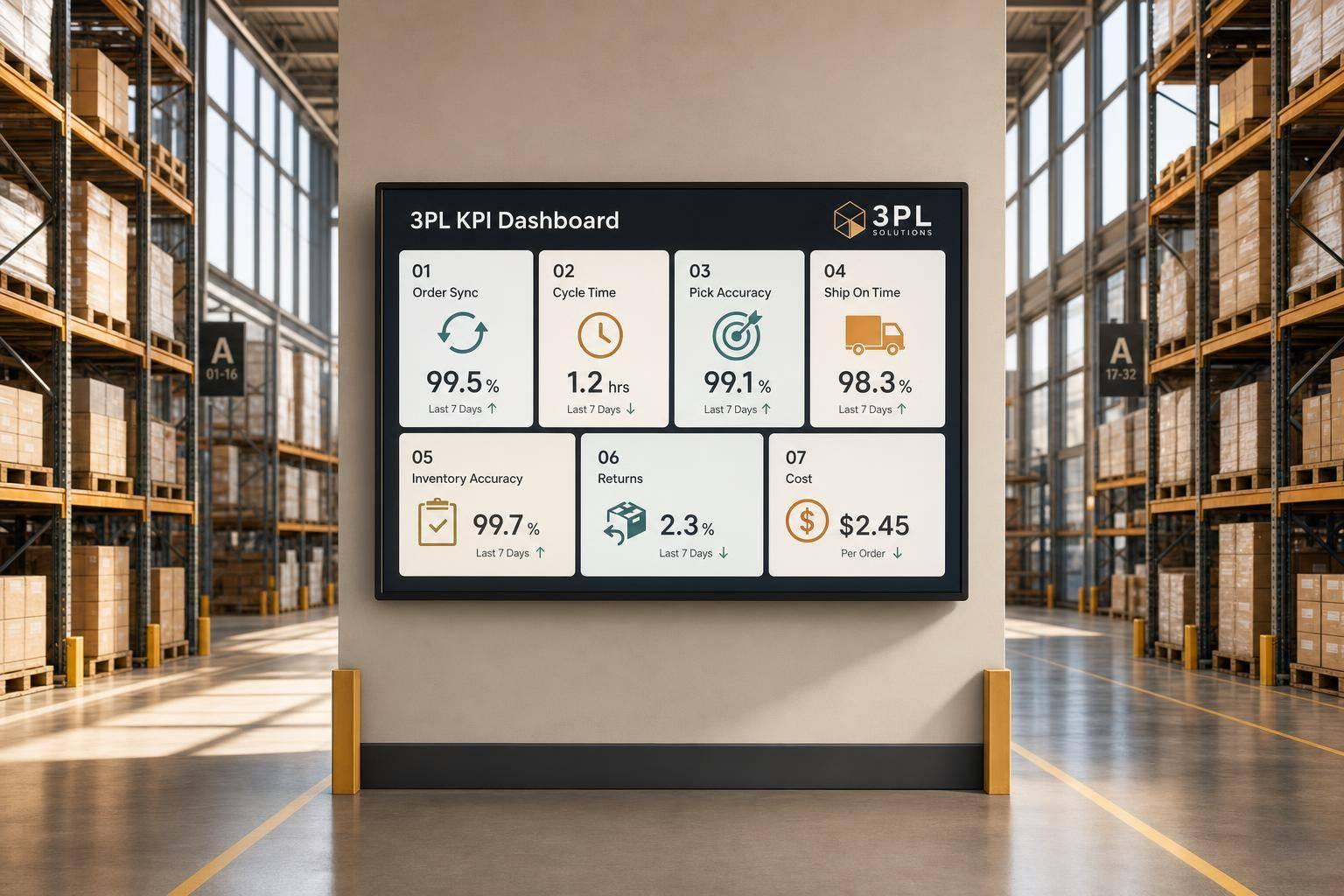
7 WooCommerce 3PL KPIs Teams Track

Centralized vs Decentralized Replenishment
