How 3PLs Solve Urban Delivery Constraints

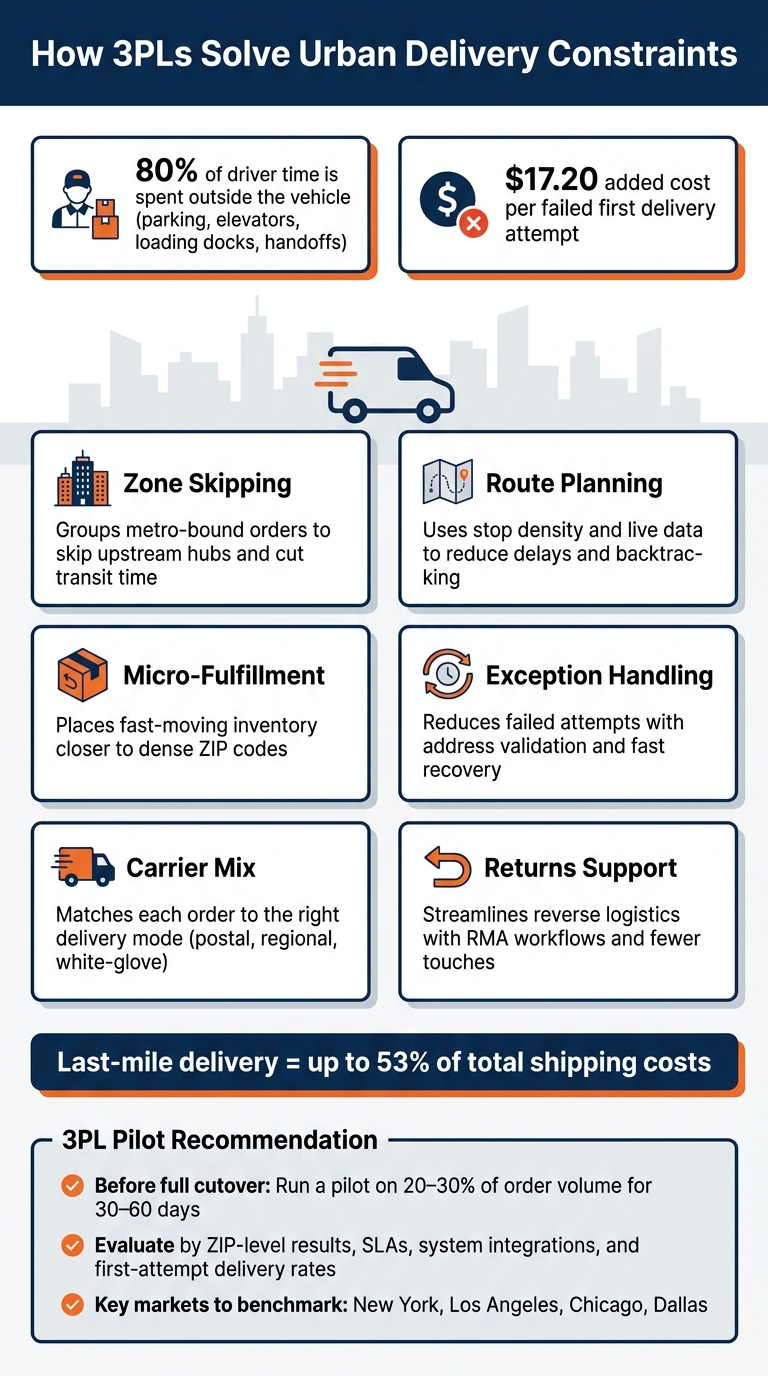
Urban delivery gets expensive fast when stops fail, routes drag, and inventory sits too far from demand. In cities, drivers can spend about 80% of their time outside the vehicle dealing with parking, elevators, loading docks, and handoffs. And each failed first delivery attempt can add about $17.20 in redelivery and support costs.
If I had to sum up the fix in plain English, it would be this: a 3PL helps cut city-delivery waste by moving parcels closer to the customer, choosing the right carrier, planning tighter routes, and handling failures and returns with less drag.
Here’s the short version:
- Zone skipping cuts extra hub moves before parcels reach the destination metro
- Micro-fulfillment puts fast-moving inventory closer to dense ZIP codes
- Carrier mix matches each order to the right delivery method
- Route planning uses stop density and live tracking to cut delays
- Exception handling reduces failed attempts tied to access and bad address data
- Returns support gets items back, checked, and routed with fewer extra touches
- 3PL selection should come down to ZIP-level results, SLAs, system links, and a pilot test on 20%–30% of volume for 30–60 days
What matters most is simple: if you ship into places like New York, Los Angeles, Chicago, or Dallas, you need a 3PL that can show cost, transit, and first-attempt delivery results in those markets - not just network averages.
How 3PLs Solve Urban Delivery Constraints: Key Strategies & Stats
Laying the Foundation: How 3PLs Can Deliver More Value in Supply Chains | The 3PL Blueprint (Part 1)
sbb-itb-eafa320
Zone Skipping Cuts Distance, Handling, and Final-Mile Cost
Standard parcel shipping often sends a package through several carrier hubs before it reaches the destination city. Every extra hub means more time in transit, more handling, and one more spot where things can slip. Zone skipping shortens that route.
How Zone Skipping Works
A 3PL groups orders going to the same metro area - like the New York–New Jersey corridor or Southern California - and combines them into truckload or intermodal freight headed to a facility near the destination. Instead of moving through several upstream sort centers, the freight goes straight to a regional handoff point close to the delivery address. From there, a local carrier takes over for final-mile delivery as a short-zone move.
That setup matters most in dense metros, where each extra handoff can slow things down. In places like Los Angeles or Chicago, fewer touches can mean fewer misroutes, fewer scan errors, and fewer delays.
When Regional Volume Justifies Consolidation
Zone skipping makes the most sense when a brand has steady, concentrated order volume going into the same metro areas.
Before you commit, ask the 3PL to spell out the details:
- minimum daily parcel counts per lane
- order cut-off times
- exact handoff points
- how savings are measured in U.S. dollars per order
A 3PL with hub locations near major U.S. metros can give you more handoff choices and tighter transit windows.
To see if zone skipping fits, review your last three to six months of shipment data. Break it out by destination ZIP code or metro cluster, then calculate average daily orders by region. That number will show which lanes have enough density to support consolidation.
If volume into a metro is still uneven, micro-fulfillment can help place inventory closer to demand.
Micro-Fulfillment Places Inventory Closer to Dense Demand
Micro-fulfillment reduces city friction by placing inventory closer to dense pockets of demand. When metro demand is concentrated but urban delivery still drags, this becomes the next move to test.
Where Micro-Fulfillment Makes Sense
An MFC makes sense when demand is clustered in the same ZIP codes, delivery promises are same-day or next-day, and order volume can support the cost of urban space. In practice, a 3PL can use order heat maps and ZIP code demand data to decide where these nodes should sit. The payoff is pretty simple: a shorter last-mile leg means local couriers can handle more stops per shift, which helps balance out higher city rent.
Not every SKU belongs in an MFC. The best fit is usually:
- fast-moving items
- higher-margin products
- seasonal SKUs with clear local demand
Slow-moving or bulky products are usually better left in regional DCs.
Inventory Placement Risks to Review
Placing inventory across several small nodes adds real day-to-day complexity. The main problem is imbalance. One node can run out while another sits on too much stock. Without real-time inventory visibility across all locations, that mismatch can trigger stockouts, split shipments, and missed service windows.
Replenishment cadence is another pressure point. MFCs don't have much storage space, so they need frequent restocking from regional hubs. That means replenishment has to move fast, and demand forecasting needs to happen before spikes arrive. Skip that step, and brands often end up paying for costly emergency transfers between facilities.
SKU count matters too. Every extra SKU added to an urban node increases carrying cost and makes forecasting harder. A 3PL with a strong warehouse management system can help sort out which products deserve space in the MFC and which ones just add cost without improving service.
Closer inventory only works if carriers and routes can move it without waste.
Carrier Mix and Route Planning Improve Urban Delivery Execution
Once inventory sits closer to demand, the next thing that shapes delivery performance is carrier fit and route quality.
Matching Carrier Options to City Delivery Conditions
A 3PL shouldn't use one delivery mode for every urban order. The right option depends on the item, the destination, and how much care the shipment needs.
For example:
- Lightweight residential parcels often work best with a postal carrier because that can help avoid residential surcharges and other delivery fees.
- Time-sensitive DTC orders in dense metro areas may be better suited to regional carriers.
- High-value or oversized items, especially those that need special care, assembly, or building access coordination, may call for white-glove service.
That choice matters because last-mile delivery already makes up up to 53% of total shipping costs. So carrier selection isn't just a shipping detail. It's a direct cost-control decision.
A 3PL with access to a broad carrier network and dedicated fleet capacity can match each order to the right delivery mode before it leaves the facility.
Carrier choice sets the plan. Route design decides if that plan holds up once the van hits city traffic.
Using Stop Density and Live Data to Build Better Routes
Urban route planning comes down to stop density, access rules, and live rerouting. A 3PL can use stop density data to group deliveries by neighborhood instead of sending drivers out in simple address order. That cuts backtracking across dense areas and helps keep routes tighter.
Real-time tracking and API integrations make delivery windows visible and help teams react when something goes sideways, like a locked loading dock, a missed time window, or traffic that throws off a stop. That visibility helps keep deliveries on schedule and cuts down on costly exceptions.
For scaling brands, three things matter most when judging a 3PL:
- Carrier breadth
- Routing capability
- Real-time visibility
Those three areas directly reduce failed attempts, delays, and final-mile cost in dense urban markets.
Exception Handling and Returns Support Keep City Deliveries Moving
Even the best route plan can fall apart at the front door in city delivery. Strong routing helps, but urban deliveries still fail in dense cities because of access problems and bad address data. That’s why exception handling and returns support are a core 3PL function, not some back-office chore.
How a 3PL Handles Failed Attempts and Access Problems
A solid 3PL works to stop avoidable failures before the package ever goes out. That starts with address validation at order capture. It also means attaching building notes, access codes, and delivery instructions to each shipment so drivers aren’t left guessing at the stop.
If a delivery still fails, the process needs to kick in fast. Drivers should capture proof of failure at the stop, including photos, GPS data, and reason codes. That record should then trigger customer alerts with clear next steps, such as:
- Rescheduling the delivery
- Correcting the address
- Sending the parcel to a nearby pickup point
For high-value orders or repeat failures, the job usually needs more hands-on support. A service team can review scan logs, contact carrier account managers, and sort out disputes using proof-of-delivery records.
Why Returns Management Matters in Dense Urban Markets
When a delivery fails in a dense city, the package often loops back through carrier depots. That adds more handling touchpoints, which also means a higher chance of damage or loss before the item even gets to a returns facility. In other words, every extra handoff can chip away at margin.
A structured returns workflow starts with a Return Merchandise Authorization (RMA). That links each parcel to the original order, the reason code, and the customer account. From there, return routing sends the item to the right facility. Once it arrives, inspection decides what happens next: restock, refurbish, liquidate, or recycle.
Dense-city returns should run through a 3PL that keeps reverse logistics tight, because every extra touch adds cost.
Brands should ask how a 3PL tracks failure data, fixes access issues, and gets inventory back into sellable stock.
What Scaling Brands Should Review Before Choosing a 3PL
Once a brand knows which city-shipping problems it needs to fix, the next step is simple: figure out whether a 3PL can prove it can fix them. For scaling brands, the wrong partner doesn’t just cause a few headaches. It slows delivery and adds cost.
Questions to Ask During Partner Evaluation
Judge each 3PL by one thing: how well it cuts down city-specific friction like distance, building access issues, failed delivery attempts, and returns. These questions help you test whether the partner fits the markets that matter most.
Urban network coverage
- Which fulfillment centers serve your top urban markets - New York, Los Angeles, Chicago, and Dallas?
- What are your ZIP-level on-time rates and transit times into those markets?
Zone skipping
- At what weekly volume per metro do you recommend consolidating for destination injection?
- Can you show cost-per-order results from a comparable metro lane?
Micro-fulfillment readiness
- Which cities have near-urban nodes?
- How are SKU placement decisions made?
- How often is the network rebalanced as demand shifts?
Carrier options
- Which national, regional, and local carriers are available?
- How do you choose the right carrier for a given building type or delivery window?
Route planning
Route planning should use real-time traffic, stop density, and first-attempt success rates. Ask for those KPIs by metro, not network-wide averages.
Operational fit is only part of the test. Systems need to connect cleanly too.
Exception SLAs and returns
- What is the SLA on second attempts and customer alerts after a failed delivery?
- How long does a returned item take to move from receipt to restock?
Value-added services
- Are pick and pack, kitting, testing, and white glove handling available in the facilities serving your key markets, not just at one site?
These services matter most when orders involve building access, special handling, or fast recovery after a failed delivery.
Integration readiness
- Does the 3PL connect through API or prebuilt connectors to your ERP, OMS, and storefront?
- How often are order status and tracking events pushed to customer-facing systems?
Delayed tracking updates can create avoidable order-status tickets.
A 3PL should work like an execution layer, not a black box.
Key Takeaways for Urban 3PL Selection
A 3PL earns the business only if it can show performance in your top ZIP codes. That means asking for real performance data, running a pilot on 20–30% of order volume for 30–60 days before a full cutover, and holding the partner to documented SLAs from day one. The right partner can support growth only when its network, systems, and service model line up with your urban demand.
FAQs
When does zone skipping save money?
Zone skipping cuts shipping costs for high-volume e-commerce brands with steady order volume in specific regions. Instead of paying for long-distance parcel shipping on each package, the brand sends a bulk shipment to a regional hub first. From there, local carriers handle final delivery at lower parcel rates.
It can also reduce touchpoints along the way. That may lower labor costs and cut the chance of package damage.
How do I know if micro-fulfillment fits my order mix?
Review your customer concentration and product velocity. Micro-fulfillment tends to work best when you have dense customer clusters in specific urban areas and a high volume of fast-moving products.
If a large share of your orders comes from concentrated urban regions, placing your top 200–400 SKUs in a local micro-fulfillment center can cut transit distances, reduce last-mile delivery costs, and help you offer same-day or sub-24-hour delivery.
What should I ask when vetting a 3PL for urban delivery?
Ask how the 3PL’s warehouse network lines up with where your customers live, whether it supports zone skipping, and how it handles peak-season volume without slowing service.
Then confirm a few nuts-and-bolts items: system integration, real-time inventory visibility, order routing, performance reporting, returns, value-added services, dedicated account support, and transparent pricing.
Related Blog Posts
Related Articles
Demand-Driven Replenishment for Multi-Node 3PL

3PL Models Compared for Reverse Logistics Carbon