
How 3PLs Use Automation for Returns Management
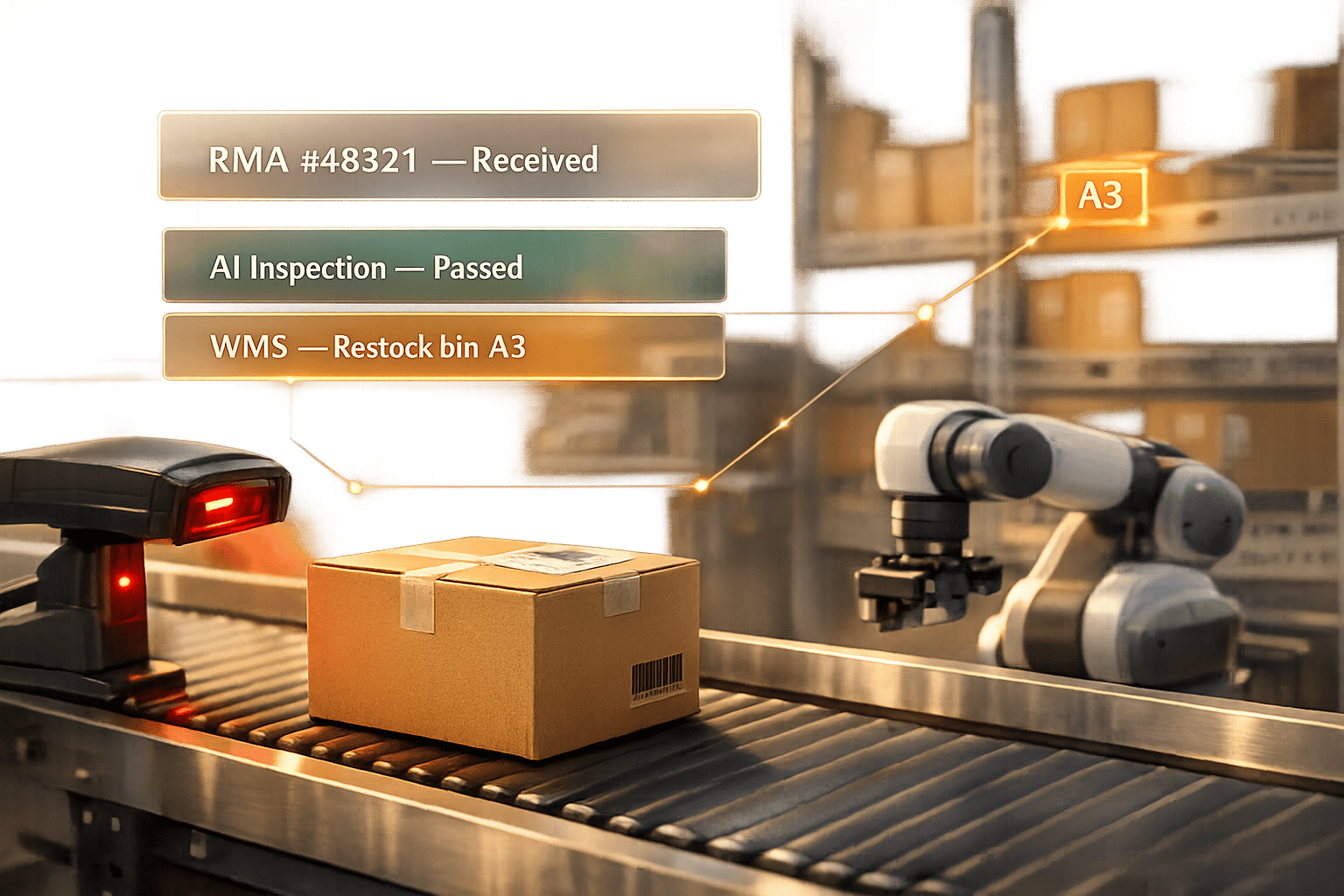
Managing product returns is a growing challenge for logistics providers, especially with e-commerce return rates reaching 30% compared to 8-10% for physical stores. Automation has become a key solution for third-party logistics (3PL) companies to handle this surge efficiently, cut costs, and improve customer satisfaction. Here's how automation is transforming returns management:
- Return Merchandise Authorization (RMA) Systems: Allow customers to initiate returns easily, validate eligibility, and notify warehouses in real-time.
- Cloud-Based Warehouse Management Systems (WMS): Track returned items, update inventory instantly, and reduce delays in restocking.
- AI-Powered Predictive Analytics: Forecast return spikes, assess item conditions in seconds, and optimize routing for faster processing.
Optimize Returns Processing with Warehouse Automation
sbb-itb-eafa320
Core Automation Technologies in Returns Management
To address the inefficiencies of manual returns processing, three key automation technologies have emerged as game-changers for 3PL providers. These tools are designed to handle the increasing volume of returns while tackling specific pain points in the process, making operations smoother and faster.
Return Merchandise Authorization (RMA) systems act as a digital bridge for handling returns. Through self-service portals, customers can generate RMAs instantly. These systems validate return eligibility, create shipping labels, and send notifications automatically. The moment a return is initiated, warehouses receive real-time updates about the incoming item, ensuring the next steps - like inspection and restocking - are already in motion.
Cloud-based Warehouse Management Systems (WMS) function as the operational backbone for returns. These platforms meticulously track every returned item, from the moment it arrives at the dock to its final destination - whether restocked or disposed of. Real-time inventory updates mean that once a returned product clears inspection, it’s immediately available for resale. This eliminates the typical 2–3 day delay caused by dock backlogs.
AI-powered predictive analytics shifts returns management from being reactive to proactive. By examining historical sales and return data, this technology predicts return spikes, such as those following the holiday season in January and February. Advanced vision systems further accelerate the process by grading returned items in under 90 seconds. These systems determine whether an item qualifies for immediate restock (A-grade) or recommerce (B-grade), a task that usually takes 5–10 minutes with manual checks. Additionally, by integrating data from RMA systems and WMS, AI enables smarter routing of returns to regional hubs based on factors like customer location and warehouse availability.
Automated Returns Processing Workflows
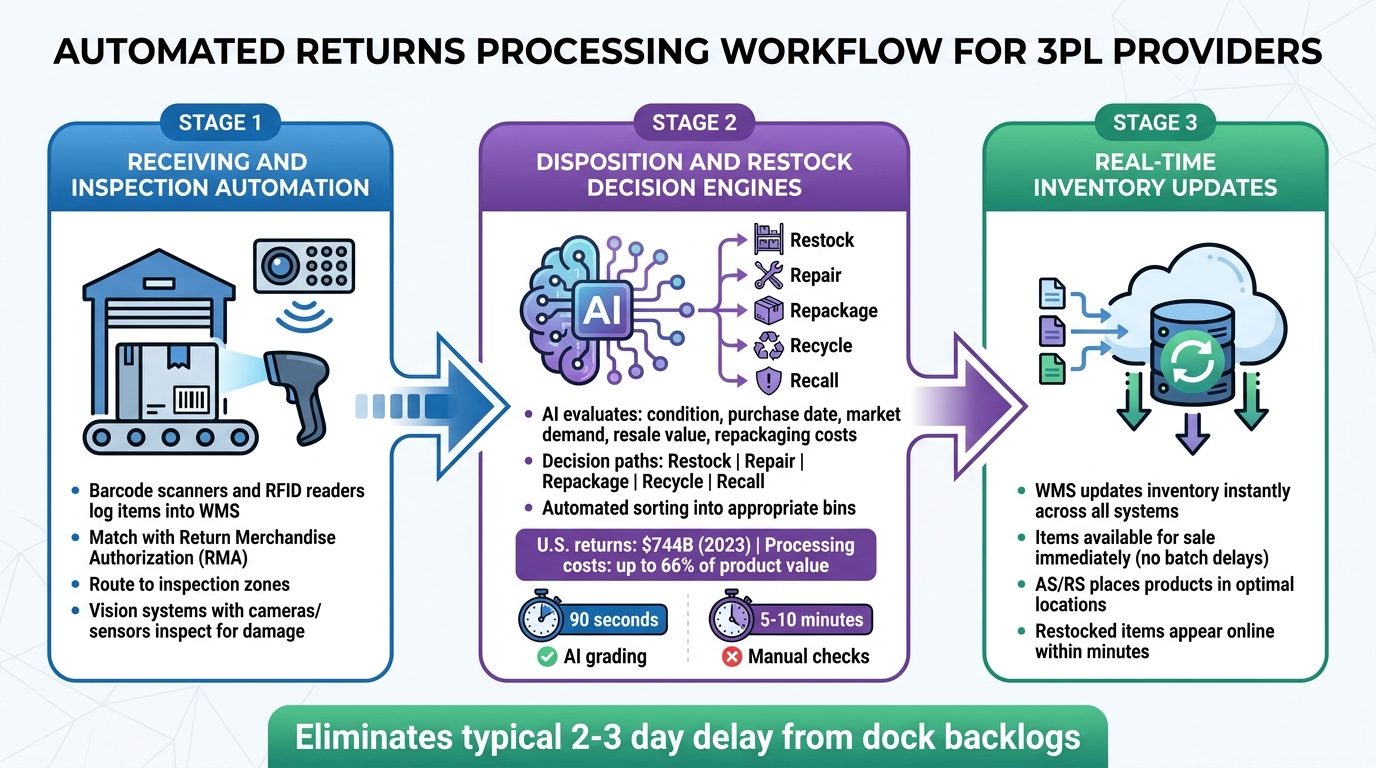
Automated Returns Processing Workflow for 3PL Providers
Building on the technologies previously covered, these workflows highlight how automation simplifies the entire returns process - from receiving items to updating inventory. By automating traditionally labor-intensive steps, businesses can cut down on processing time, reduce errors, and avoid bottlenecks.
Receiving and Inspection Automation
When returned items hit the warehouse dock, automated systems take over. Barcode scanners and RFID readers log each product into the Warehouse Management System (WMS) by capturing key details and matching them with the Return Merchandise Authorization (RMA). From there, items are routed directly to inspection zones. Advanced vision systems, equipped with cameras and sensors, inspect items for damage or missing components. This smooth intake process sets the stage for AI-powered decision-making.
Disposition and Restock Decision Engines
Once inspection is complete, AI-driven decision engines step in to determine the next steps. These systems evaluate factors like the item’s condition, purchase date, market demand, resale value, and repackaging costs. Based on this analysis, the system identifies the most profitable path - whether that’s restocking, repairing, repackaging, recycling, or recalling the item. Automated sorting systems then physically direct items into the appropriate bins, removing the need for manual decisions. Considering that U.S. product returns totaled about $744 billion in 2023, with processing costs reaching as high as 66% of the product's original value, these engines are pivotal for recovering as much value as possible.
Real-Time Inventory Updates and Tracking
After a disposition decision, the WMS updates inventory levels instantly across all connected systems. Items approved for restock are made available for sale immediately, bypassing the delays of end-of-day batch updates. Automated Storage and Retrieval Systems (AS/RS) handle the put-away process, placing products in optimal warehouse locations based on demand forecasts. This ensures restocked items appear online within minutes, helping to avoid overselling while keeping supply chain partners updated on stock levels.
Key Benefits of Automation for 3PL Returns Management
Automation brings measurable improvements to returns management, helping 3PLs streamline operations, cut costs, and enhance customer experiences. With the increasing demands of high-volume returns, these advantages are essential for staying competitive.
Faster Processing with Fewer Errors
Automating returns processes significantly speeds up operations while reducing human error. For example, automating just 20% of tasks can boost productivity by 25%, while automating 75% of tasks leads to a staggering 300% productivity increase, allowing teams to handle three times the workload. This efficiency becomes especially critical during peak times, like the holiday season, when daily returns can surge by as much as 70% between Christmas and New Year's Day. Automated tools, from scanning and inspection to disposition decisions, ensure items are quickly sorted and reintegrated into inventory, minimizing mistakes like misclassifications or incorrect refunds.
Lower Costs Through Efficiency
Labor costs are a major expense in returns management, and automation directly reduces this burden. Tasks such as barcode scanning, generating documentation, and updating inventory are handled faster and more accurately by automated systems, cutting down on labor needs and preventing costly errors. Administrative work, including invoicing and status updates, also becomes quicker and less resource-intensive. Additionally, automation optimizes warehouse operations - automated storage and retrieval systems maximize space usage, while load planning for LTL shipments ensures trucks are filled efficiently. Considering that processing returns can cost up to 66% of a product's original value, these savings play a key role in protecting profit margins.
Improved Customer Experience
Speed and precision in returns processing directly impact customer satisfaction and loyalty. Research shows that 92% of customers are more likely to shop again if the returns process is simple and hassle-free. Automation enhances this experience by offering real-time tracking through customer portals and automated updates via AI-driven chatbots and emails. These tools keep customers informed at every step, from receipt acknowledgment to processing completion, without requiring manual effort. With 39% of European consumers expecting free returns, efficient automation helps 3PLs meet these high expectations while maintaining operational efficiency. Together, these improvements foster trust and encourage repeat business, setting the foundation for long-term success.
Steps to Implement Automation for Returns Management
Implementing automation for returns management takes thoughtful planning and seamless system integration. It’s no small task - returns management is a top challenge for 47% of warehouse decision-makers. It also demands 2-3 times more labor and floor space compared to outbound fulfillment. But the rewards are clear: using a dedicated returns management system (RMS) can boost units per hour (UPH) by 2-3 times with the help of automated workflows. Here’s how to get started.
Integrating Automation with Client Systems
The first step is to connect your automation platform with client ERP and inventory systems to enable smooth data sharing. Many older warehouse management systems handle returns differently, making integration through APIs essential. By using APIs, your RMS can sync return data with the client’s main inventory system, providing real-time visibility and ensuring that all platforms stay updated.
Setting Up Rule-Based Automation
Once the systems are linked, it’s time to establish the rules that will guide your automated processes. Define triggers and actions - for example, when a specific SKU is scanned, the system could automatically assign it to the appropriate return warehouse. Set up clear disposition rules to decide whether items should be restocked, repaired, liquidated, or recycled, based on their condition and pre-set business logic.
Replace outdated paper-based checklists with digital workflows for inspections, ensuring consistency and efficiency. Don’t forget to account for exceptions: create rules to handle damaged goods or items missing original packaging, preventing these cases from disrupting the standard workflow. Finally, configure routing rules to send returns directly to specialized facilities, like repair centers, instead of defaulting to the original fulfillment center.
Monitoring Performance with Analytics
Analytics dashboards are critical for tracking progress and identifying problem areas. Slow restocking is a major pain point for 47% of retail executives, so focus on metrics that directly impact this issue. Monitor key performance indicators like replacement order rates, stockout frequency, and processing times. If inspection delays or other bottlenecks arise, analytics can help you pinpoint and address them quickly. Regularly reviewing these metrics ensures that your automation rules stay effective as return volumes and product types shift over time.
JIT Transportation's Approach to Returns Automation
JIT Transportation has taken returns automation to the next level by focusing on flexibility and smooth integration. Using an API-first approach, the company ensures its system connects effortlessly with various client technology stacks. This enables seamless data flow between e-commerce platforms and ERP systems, allowing businesses to automate returns without the hassle of overhauling their existing setups. The result? Faster processing times and lower costs, all while simplifying integration and cutting down implementation timelines.
What sets their solution apart is its modular design. Clients can pick and choose the features they need - whether it's a customer-facing returns portal or advanced back-end processing. This composable structure makes the implementation process both straightforward and budget-friendly. To top it off, the system integrates quality controls that make managing returns even more efficient.
One standout feature is the configurable grading system. Instead of relying on human judgment, which can vary, the platform uses predefined quality standards tailored to each brand's specifications. This ensures consistent results and minimizes errors when assessing returned items.
JIT Transportation also excels in handling atypical returns, a common pain point for traditional warehouse management systems. By using intelligent dispositioning based on brand-specific rules, the system automatically decides the best course of action for returned items - whether they should be restocked, repaired, liquidated, or recycled. This speeds up decision-making and gets sellable products back on shelves faster.
Adding to its robust capabilities, the platform offers real-time analytics. These dashboards track key metrics like replacement order rates, stockout occurrences, and processing times. But it doesn't stop at operational data - clients also gain actionable insights to refine merchandising strategies and work toward reducing return rates in the future.
Future Trends in 3PL Returns Automation
Automation has already transformed returns management in 3PL, but emerging trends are taking things to the next level. By 2026, the focus isn't on eliminating returns entirely but on managing them strategically. Instead of viewing returns as a problem, they’re now seen as opportunities to retain customers and gain a competitive edge. This shift in perspective is driving 3PL providers to embrace new technologies that refine efficiency and enhance customer loyalty.
One standout innovation is Agentic AI, which is changing the game for revenue retention. These systems actively interact with customers, offering solutions like instant exchanges or discounts (e.g., 50% off) before they even print a return label. The goal? Keep revenue in-house while boosting customer satisfaction.
Meanwhile, robotics and physical AI are stepping in to handle large volumes of returns with unparalleled speed and accuracy. On top of that, digital twins - virtual models of warehouse operations - are helping 3PL providers prepare for return surges. By simulating different scenarios, they can test and refine processes, ensuring resources are allocated effectively and bottlenecks are avoided during busy periods.
Blockchain technology is also making waves, offering tamper-proof records for transactions and tracking that increase transparency and security. This is especially crucial in tackling issues like cargo theft, which saw a 23% spike in 2024, with losses surpassing $455 million. Blockchain also enables tiered return policies, where VIP customers might enjoy free instant returns, while frequent returners could face restocking fees or be limited to store credit - decisions driven by data analysis.
The numbers back up these advancements. A whopping 74% of shippers are open to switching to 3PL providers with stronger AI capabilities. Plus, AI tools that improve accuracy can slash return rates from mis-picks by 20% to 40%. Considering the industry’s average return rate hit 15.8% in 2025, with returned merchandise totaling $850 billion, these technologies are no longer optional - they’re essential for staying competitive.
As one expert put it:
"The main challenge of logistics is pressure. The landscape is very dynamic... Artificial intelligence makes this possible by effectively speeding up every process and supplying you with unseen data that turns the tables on your logistics operations".
Wrapping It Up
Automation has completely reshaped how 3PL providers handle returns. Tasks that once required manual effort are now optimized through tools like AI-powered disposition engines, cloud-based warehouse management systems (WMS), and robotic inspections. Companies leveraging these technologies have seen impressive results: 65% faster processing times, 98% accuracy, and noticeable cost reductions.
But the benefits go beyond efficiency and savings. Automated returns enhance customer satisfaction by enabling quicker refunds, reducing inventory losses, and driving quality improvements through data analysis. With return volumes climbing, these advancements are no longer optional - they’re essential for staying competitive.
JIT Transportation stands out by combining cutting-edge automation with seamless ERP integration, ensuring smooth returns management and dependable supply chains for its clients.
The future promises even more transformation. Innovations like AI-driven predictive tools, blockchain for secure tracking, and IoT-enabled inspections are poised to take returns management to the next level. For businesses working with 3PL providers, the real challenge isn’t deciding whether to embrace automation - it’s figuring out how fast they can adopt it to keep up with the growing demands of the market.
FAQs
What should a 3PL automate first in returns?
Automating Return Merchandise Authorization (RMA) processes should be a top priority for any 3PL. This involves streamlining tasks like verifying and approving return requests, generating prepaid labels, and handling the inspection and categorization of returned items. By automating these steps, businesses can boost efficiency, cut costs, and provide a smoother experience for customers.
How do you integrate returns automation with ERP and e-commerce systems?
Integrating returns automation with ERP and e-commerce systems means linking these platforms to ensure real-time data sharing and automated workflows. By using a cloud-based returns management system (RMS), businesses can effortlessly connect with their existing systems. This setup automates tasks such as processing return requests, updating inventory, and managing restocking. The result? Less manual effort, fewer errors, and smoother operations - all of which translate to quicker, more transparent returns processing and happier customers.
Which KPIs best prove returns automation ROI?
Key performance indicators (KPIs) that showcase the impact of returns automation include the Return Processing Rate and overall processing times. The Return Processing Rate measures how efficiently returns are received, inspected, and restocked. Meanwhile, automation can cut processing times by as much as 75%, emphasizing the efficiency gains and cost savings that come with an automated returns management system.
Related Blog Posts
Related Articles
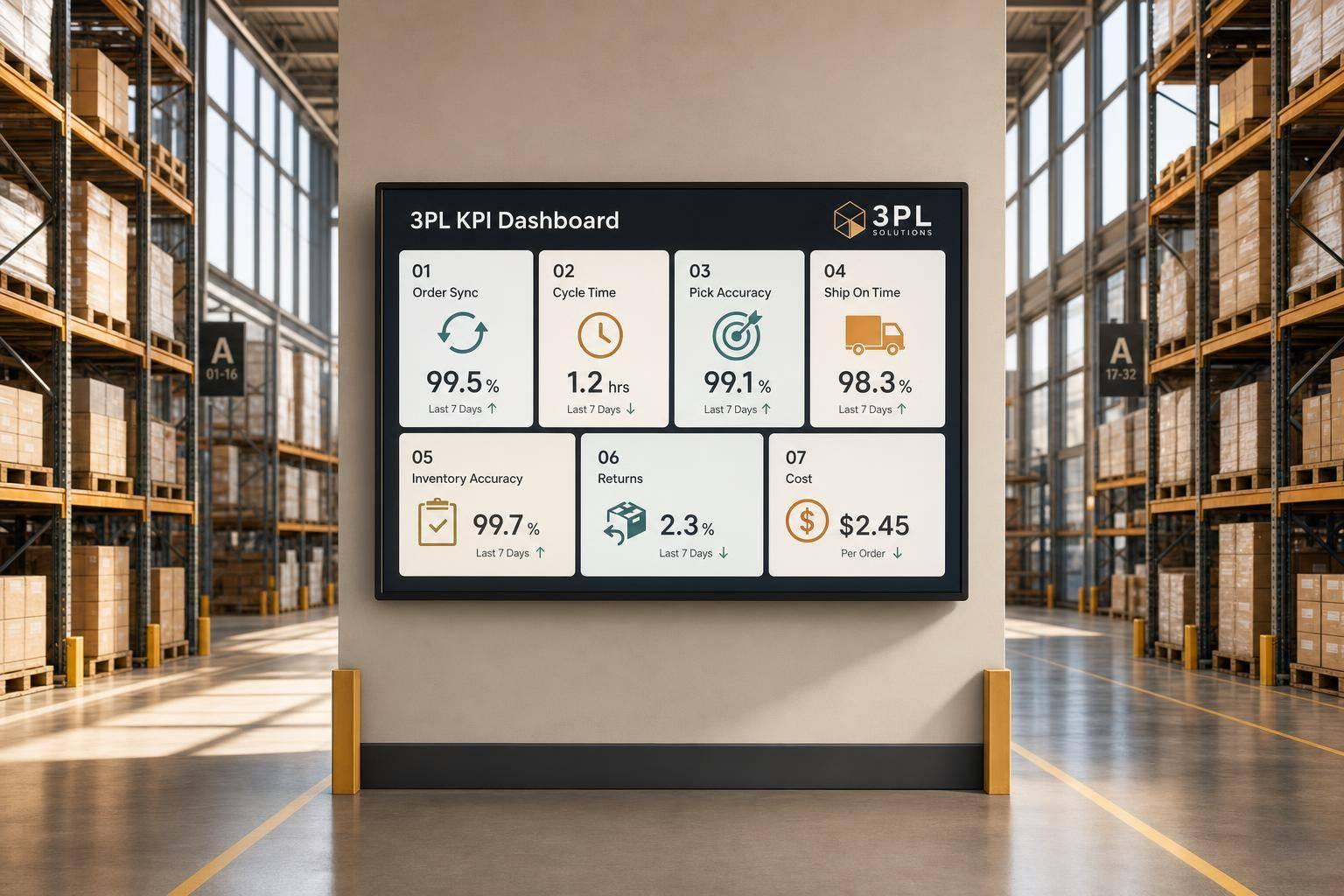
7 WooCommerce 3PL KPIs Teams Track

Centralized vs Decentralized Replenishment
