How IoT Improves Reverse Logistics Efficiency
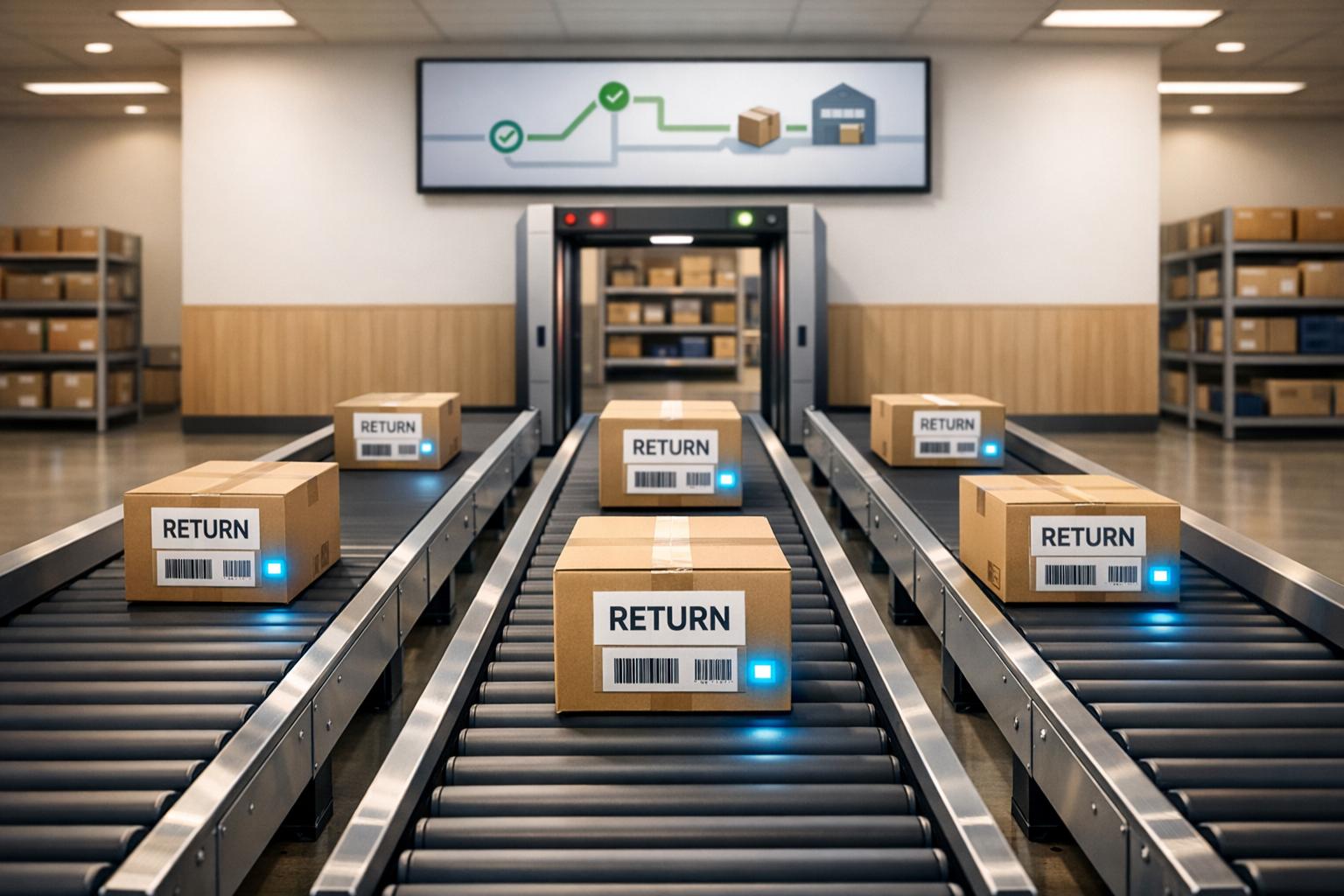
IoT is transforming reverse logistics by tackling inefficiencies in product returns, saving costs, and improving customer satisfaction. Here's how it works:
- Real-time tracking: Using RFID, GPS, and sensors, businesses can monitor returns from the customer to the warehouse, ensuring items are handled properly and arrive in good condition.
- Automated sorting: IoT tags help warehouses decide whether items should be resold, refurbished, or recycled, speeding up the process and reducing errors.
- Cost savings: IoT systems cut transportation costs by optimizing routes and enabling backhauling (handling deliveries and returns in one trip). They also prevent breakdowns with predictive maintenance.
- Customer experience: Faster refunds and transparent tracking build trust, with 73% of shoppers saying the return process influences future purchases.
IoT doesn't just streamline operations; it also reduces waste, cuts costs, and ensures a smooth return process. For businesses facing high return rates - 20-30% in e-commerce - this technology is crucial to stay competitive.
Internet of Things and Reverse Logistics
sbb-itb-eafa320
How IoT Sensors Track Returns in Real Time
IoT sensors transform return logistics by turning physical events into real-time data. Equipped with GPS and RFID technology, these sensors continuously update businesses on cargo location. This means companies can immediately identify delays, route changes, or mishandling as they occur. If damage or improper handling happens en route, alerts are sent right away.
Certain sensors are designed to monitor critical conditions that could impact a product's value. For instance, temperature and humidity sensors ensure that sensitive items like electronics or pharmaceuticals remain in safe conditions during transit. Vibration and shock sensors can detect if an item has been dropped or handled roughly, sending alerts even before the return reaches its destination. These sensors work by converting physical changes into electrical signals, which are then transmitted through WiFi, Bluetooth, or cellular networks to a centralized cloud platform for instant analysis.
IoT geofencing adds another layer of security by flagging unauthorized movements. If a shipment strays from its route or enters a risky area, notifications are immediately sent to managers. In theft scenarios, GPS data can help law enforcement track and recover the stolen items.
Setting Up IoT Sensors for Better Visibility
To improve reverse logistics, it’s essential to set up IoT sensors correctly. Start by selecting the right sensor types for your inventory. For example, temperature sensors are ideal for perishable goods, while vibration sensors are better suited for fragile or high-value machinery. The choice should depend on the type of return, its value, and how long it needs to be monitored.
Sensors can be embedded in packaging or attached as smart tags when a product is shipped or returned. For expensive items, active RFID tags with built-in batteries provide long-range tracking, while passive tags offer a more affordable option for bulk returns. Geofencing, which creates virtual boundaries around warehouses or vehicles, can send alerts if a shipment deviates from its planned route. To ensure everything runs smoothly, start with small pilot projects to test sensor performance and integration into existing workflows.
Once sensors are operational, connecting their data to your ERP system can significantly boost efficiency.
Connecting IoT with ERP Systems
The full potential of IoT sensors is realized when their data is integrated with Enterprise Resource Planning (ERP) and Warehouse Management Systems (WMS). This integration enables automated inventory updates, instant stock adjustments, and centralized decision-making through a single dashboard. For instance, when a returned item is scanned at a collection point, the ERP system updates inventory, processes refunds, and directs the item to the correct lane - whether it’s for restocking, refurbishing, or recycling.
Using IoT Data to Improve Reverse Logistics Operations
IoT sensor data already provides real-time insights, but its true power lies in optimizing reverse logistics. By leveraging this data, businesses can make reverse logistics operations faster, more cost-effective, and easier to predict. IoT plays a key role in improving routing efficiency and enabling predictive maintenance, both of which help cut down reverse logistics expenses.
Transportation costs can account for up to 60% of total reverse logistics expenses. IoT data addresses this challenge by offering the visibility and insights needed to refine every step of the collection process. This enhanced visibility translates into better routing and vehicle upkeep, driving overall operational efficiency.
Optimizing Collection Routes with IoT Data
IoT-equipped vehicles continuously monitor fleet performance, feeding real-time data into AI-powered routing systems. These systems dynamically adjust pickup routes based on live traffic updates, weather changes, and incoming return requests. Instead of following rigid schedules, drivers receive adaptive instructions that respond to real-time conditions.
Backhauling is another strategy made possible by IoT data. This approach allows vehicles to handle both deliveries and returns in a single trip, eliminating empty return legs and reducing fuel expenses. For example, United Parcel Service (UPS) uses its ORION platform, powered by IoT telematics, to optimize delivery and return routes. The results are impressive: over 10 million gallons of fuel saved annually and approximately $300-$400 million in yearly cost reductions.
IoT also improves vehicle utilization. Real-time load sensors monitor weight and volume, preventing overloading while ensuring vehicles operate at full capacity during collection runs. For businesses managing high return volumes, grouping similar return requests within geographic clusters can minimize the number of trips required.
While better routing cuts costs, IoT also protects fleet health through predictive maintenance.
Preventing Vehicle Breakdowns with IoT Monitoring
IoT sensors enable predictive maintenance by continuously monitoring vehicle systems. Data from vibration sensors, brake-temperature probes, oil-quality monitors, tire-pressure sensors, and battery health trackers is sent to cloud platforms. AI algorithms then analyze this data to detect early signs of potential issues.
A great example is Midwest Logistics, a U.S.-based third-party logistics provider, which adopted an AI-driven predictive maintenance system in March 2026. They equipped their fleet with IoT sensors to monitor key metrics like vibration, brake temperature, and oil quality. The results were dramatic: unplanned downtime dropped by 73%, monthly breakdowns fell from 47 to 13, and the company saved around $1.7 million annually. Repair times were reduced from 4.7 hours to 1.8 hours, and on-time delivery rates rose from 87% to 96%.
"By tying continuous sensor data to AI analysis, the company avoided most unexpected failures. This meant trucks stayed on the road, not in the shop – directly boosting revenue and service levels." - Yury Shamrei, IoT Expert
The secret lies in detecting failure signatures - specific patterns that signal potential problems before they happen. For instance, certain engine vibration patterns can indicate a bearing failure up to 150 hours in advance. This gives maintenance teams enough lead time to schedule repairs during non-peak hours, avoiding costly breakdowns during critical operations.
Automating Returns Sorting with IoT Technology
When returned items arrive at the warehouse, the real work begins: figuring out where each product should go. Manual sorting can be slow, expensive, and prone to mistakes. That's where IoT technology steps in, automating the process by categorizing returns in real time. This system determines whether an item should be resold, repaired, recycled, or discarded.
Using RFID smart tags, returned items are linked to cloud servers as soon as they arrive. These tags eliminate the need for manual inventory checks by tracking items as they’re placed on pallets. The warehouse system then evaluates the condition of each product and directs it to its next destination - whether that’s back to store shelves, a repair facility, or a recycling center.
"Smart tagging can eliminate manual inventory counting by monitoring goods placed on each pallet as it arrives into the warehouse."
– Kirti Acharya, General Manager, Digital Transformation and Enterprise Solutions, Happiest Minds Technologies
IoT technology also provides real-time visibility, allowing warehouse managers to track assignments and pallets continuously. This ensures that returns are routed efficiently to the correct destination. With online sales generating 20–30% of returns across nearly every industry, automation is crucial for handling unpredictable return volumes at scale. By leveraging IoT, warehouses can sort returned items with precision and speed.
How IoT Systems Sort Returned Products
IoT systems excel at sorting returns by combining real-time tracking with advanced sensors. RFID tags and Bluetooth beacons monitor item location and movement within the warehouse, while condition sensors assess product quality. This data enables the system to decide instantly where each item should go.
The process starts at pickup. Delivery agents use smart tags to label items - marking them for replacement, reuse, or remanufacture. By the time these products reach the warehouse, their destination is already determined, speeding up processing.
A great example is Samsung's Take Back and Recycling (STAR) program. In the U.S., customers return used printer cartridges via mail, and these items are tracked through a reverse logistics framework. This ensures they’re reprocessed into usable components. Similarly, Komatsu uses sensors on heavy equipment to transmit performance and condition data in real time, helping the company manage returns and optimize maintenance.
UPS has also embraced IoT with its "Returns Flexible Access" program. Bluetooth beacons track returned items from drop-off points to their final warehouse destination. The system automatically routes products based on their type and condition. Meanwhile, smart warehouses equipped with sensors monitor storage capacity in real time, dynamically managing space and sorting priorities to avoid bottlenecks. This level of automation transforms what was once a labor-intensive process into a fast, data-driven operation.
Once sorted, transportation systems like those from JIT Transportation ensure that products are quickly reintegrated into supply chains.
How JIT Transportation Handles IoT-Enabled Returns
JIT Transportation’s returns management services are designed to work seamlessly with IoT-enabled logistics systems. By integrating with ERP platforms, the company uses IoT sensor data to provide real-time updates on return statuses and product conditions.
JIT Transportation’s strategically located U.S. warehouses are equipped to process IoT-tracked returns efficiently. Their value-added services - like pick & pack, kitting & assembly, and testing & revision upgrades - enhance the sorting process. For example, items suitable for refurbishment are sent directly to testing stations, while those flagged for recycling or disposal are automatically sorted. Products ready for resale are moved straight into fulfillment operations.
IoT sensors also monitor return volumes, allowing JIT Transportation to adjust storage and processing capacity as needed. This ensures that even during peak return periods, delays and bottlenecks are minimized, keeping products moving smoothly back into circulation.
Main Benefits of Using IoT in Reverse Logistics

IoT Impact on Reverse Logistics: Before vs After Implementation
IoT isn't just about improving efficiency - it’s also a game-changer for cost reduction and customer satisfaction. By streamlining processes, IoT slashes reverse logistics expenses, speeds up operations, and fosters customer loyalty, delivering results that businesses can measure.
Consider this: 30% of online purchases are returned, compared to less than 9% for in-store purchases. Handling these returns manually is both costly and inefficient. Yet, remanufacturing or refurbishing returned products can cut production costs by up to 50%, compared to making new ones.
Customer satisfaction also gets a major boost. 73% of shoppers say a brand’s return process heavily influences their future purchase decisions. IoT meets these expectations by providing real-time updates and automating the process, reducing the need for customer inquiries and ensuring a smooth experience.
| Metric | Before IoT | After IoT |
|---|---|---|
| Asset Visibility | Manual scans at hubs | Real-time tracking throughout |
| RTI Attrition Rate | High (approx. 10% annually) | Reduced via constant monitoring |
| Sorting Speed | Slow and manual | Fast, automated, and data-driven |
| Transportation Cost | High due to inefficiencies | Lowered through AI-optimized routes |
| Customer Experience | Opaque and uncertain | Transparent with real-time updates |
These advancements directly translate into financial savings and better service.
Lower Costs and Less Waste
IoT doesn’t just streamline operations - it actively reduces costs and waste. Real-time tracking helps prevent theft, misplacement, and transit errors, saving businesses from unnecessary losses. For instance, in the UK alone, £140 million is lost annually due to missing Returnable Transport Items (RTIs) like pallets and containers. IoT sensors monitor these assets continuously, cutting replacement expenses and avoiding emergency purchases.
Transportation costs also drop as IoT optimizes routes for reverse shipments. By analyzing return volumes and locations in real time, companies can create fuel-efficient routes, cutting both costs and emissions. Consolidating returns at regional hubs before bulk-shipping them to central warehouses offers another way to save.
Automation in sorting systems further boosts efficiency. Automated identification and routing of returns reduce bottlenecks, particularly during peak return periods when manual labor would require more resources.
IoT also maximizes value recovery. Instant visibility into the condition of returned items enables quicker decisions - whether to resell, refurbish, or recycle - helping businesses recapture more value from each product. This technology supports sustainability efforts by making recycling and material recovery more efficient.
"Reverse logistics is no longer an afterthought. It is a space for innovation. Let's start treating it that way."
While cost savings are critical, IoT also transforms the customer experience.
Faster Returns Processing Improves Customer Experience
Automating returns processes not only saves time but also builds trust. IoT enables instant refunds, crediting customers as soon as their return is scanned at a drop-off point. This eliminates long waits for refunds and strengthens loyalty.
Real-time tracking replaces uncertainty with transparency, offering automated updates at every step. This reduces the need for customers to contact support. As Gaurav Saran, CEO of ReverseLogix, puts it:
"The moment a customer decides to return something, their trust in the brand is tested. That moment sets the tone for how they feel - whether they stay loyal or walk away."
IoT also allows for flexible return options. Customers can choose from lockers, in-store drop-offs, or mail, all integrated into a single tracking system. For high-tech items, IoT ensures swift exchanges, minimizing downtime for customers.
Sustainability is another selling point. Searches for sustainable products have grown by 71% globally. IoT reduces the carbon footprint of reverse logistics by optimizing routes and resource use. By combining speed, transparency, and eco-consciousness, IoT creates a returns process that encourages repeat business.
"A positive returns experience is the primary factor in determining whether a customer will purchase from a brand again."
- ReverseLogix
How to Implement and Scale IoT in Reverse Logistics
Bringing IoT into reverse logistics requires careful planning and execution. With $220 billion in returns processed in the U.S. in 2024 alone, and processing costs running between 20% and 39% of a product's original price, it's clear that the stakes are high. To get started, map out your current return processes. Break down each step - from return initiation to reintegration - to uncover bottlenecks and inefficiencies that IoT can help resolve.
Next, take a close look at your data infrastructure. Ensure that your Warehouse Management System (WMS), Transportation Management System (TMS), and customer portals are capturing key data points like volume history, item conditions, and processing times. This information is critical for building IoT models. Also, confirm that your IoT solutions can integrate smoothly with your Enterprise Resource Planning (ERP) systems through APIs or network compatibility. Without proper integration, you risk creating isolated data silos instead of achieving the real-time visibility IoT promises.
Start small by selecting a high-impact area for a pilot program. Focus on a high-return center or a product category with frequent returns, such as electronics or apparel. Test during peak periods to establish baseline KPIs like return cycle time, labor costs, and asset recovery rates. This initial step sets the stage for a data-driven reverse logistics system, building on the real-time tracking and automation discussed earlier.
Evaluating Your Business Needs and IoT Readiness
After mapping your processes and auditing your data, assess your team’s and system’s readiness for IoT. Before committing to IoT hardware, determine whether your team has the skills to manage advanced tools like digital twins or automated sorting systems. Gaurav Saran, CEO of ReverseLogix, highlights the value of digital twins:
"A digital twin doesn't just show what's happening - it simulates what could happen".
This simulation capability allows you to test scenarios like return routes or warehouse layouts before making physical changes.
For high-value items, consider implementing serialized tracking using IoT-enabled serial number verification. This matches returned items with their original shipments, helping to prevent fraud like "wardrobing" and counterfeit returns. With fraudulent returns accounting for 15% of retail losses, or about $103 billion, this step can quickly justify itself. To further enhance accuracy, combine RFID tags with machine vision for automated defect detection.
Tracking KPIs and Making Ongoing Improvements
Once IoT tools are in place, tracking performance metrics becomes essential. Focus on financial metrics like reverse logistics profit and ROI, operational metrics like intake speed and processing time, and customer service metrics like backorder fulfillment rates. Studies show that IoT-enabled reverse logistics processes deliver higher profits compared to traditional methods.
Use IoT data to monitor the average value of returned products and make smarter sorting decisions. For example, identifying items that can be refurbished instead of recycled can save retailers up to 32% of total product costs. Fraud prevention is another key area - verification systems like RFID and machine vision can significantly reduce losses from counterfeit or stolen goods.
Leverage real-time condition data to route returns to their most profitable outcomes, whether that’s restocking, refurbishment, or recycling. Root cause analysis from RFID and sensor data can also reveal why items are being returned - whether due to defects or misleading product descriptions - helping you address issues at their source. Considering that 97% of consumers make repeat purchases after a positive return experience, while 89% avoid retailers after a negative one, continuous improvement in your reverse logistics process is crucial for long-term success.
Conclusion
The Internet of Things (IoT) is reshaping reverse logistics by introducing real-time tracking through GPS and RFID technologies. This level of visibility allows businesses and customers to monitor returns with precision. Automated sorting systems, powered by smart tagging, determine whether products should be restocked, refurbished, or recycled - processes that can help retailers cut up to 32% of total product costs. Considering that 20% to 30% of online sales result in returns, these advancements have a direct and measurable impact on profitability.
Beyond tracking and sorting, faster processing reduces costs and enhances customer satisfaction by offering transparency and quicker resolutions. JIT Transportation exemplifies this by using IoT-enabled supply chain platforms to streamline reverse logistics for e-commerce. By integrating real-time tracking data and inventory metrics, they minimize delays caused by manual processes. This approach highlights how IoT and advanced logistics work hand-in-hand to tackle the challenges of modern e-commerce. As Kirti Acharya from Happiest Minds Technologies aptly states:
"A strong reverse logistics strategy is indispensable for companies to sustain and grow themselves in this era of sharing economy".
FAQs
What IoT tools work best for tracking returns?
Real-time tracking systems, when integrated with ERP and WMS platforms, stand out as some of the most effective tools for managing returns in the IoT space. These systems offer automated updates, smart routing, and end-to-end visibility, which help simplify the reverse logistics process while boosting overall efficiency.
How do you connect IoT return data to an ERP or WMS?
Integrating IoT return data with an ERP or WMS means connecting real-time data from IoT devices to automate and simplify return processes. This connection allows for accurate inventory updates, improved tracking, and quicker refunds. By aligning these systems, businesses can boost operational efficiency and provide a smoother experience for their customers.
What KPIs show IoT is improving reverse logistics?
Some key performance indicators (KPIs) to watch for include:
- Higher recovery value of returned products: IoT helps identify and assess the condition of returned items more accurately, ensuring they can be resold or reused at the best possible value.
- Improved inventory management: With IoT, businesses can better track returned goods, ensuring they are quickly processed and reintegrated into inventory.
- Faster return processing times: IoT streamlines the return process, reducing delays and getting products back into circulation more efficiently.
- Better tracking and visibility of returns: IoT provides real-time data, offering clear insights into the status and location of returns throughout the process.
These KPIs highlight how IoT-driven solutions can streamline reverse logistics, cutting costs while boosting operational efficiency.
Related Blog Posts
Related Articles

Demand-Driven Replenishment for Multi-Node 3PL

3PL Models Compared for Reverse Logistics Carbon