
Port of Los Angeles Fulfillment Services for Retail Distribution
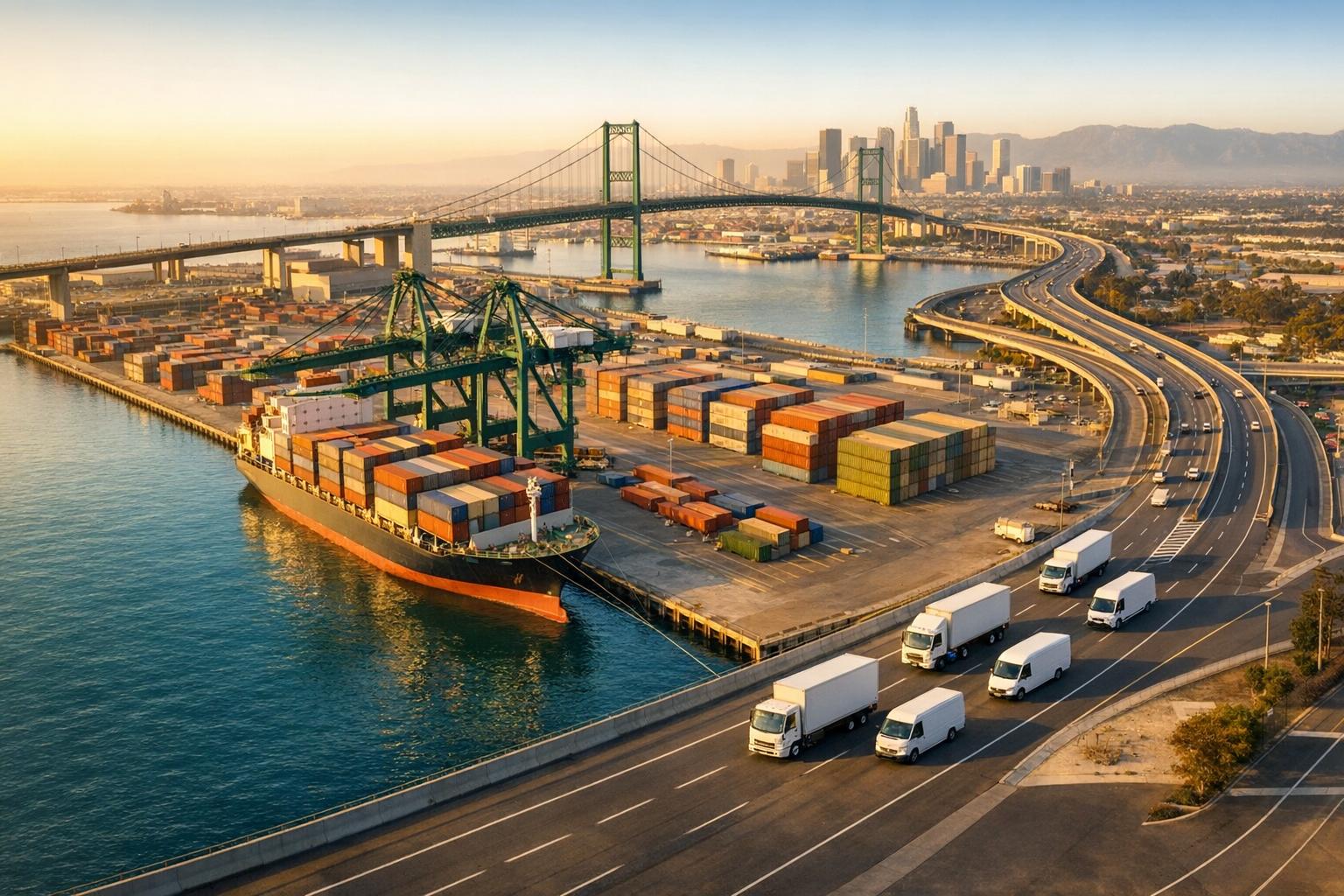
The Port of Los Angeles plays a key role in retail distribution by handling 40% of U.S. containerized imports. Its location offers faster transit times for goods from Asia - 12 to 16 days compared to East Coast ports - and access to major highways and rail networks that connect to millions of consumers in Southern California and beyond. Retailers benefit from reduced transportation costs, quicker delivery, and efficient logistics solutions like port-centric fulfillment and advanced warehousing.
Key highlights:
- Transit Times: Goods from Asia arrive in 12–16 days.
- Port-Centric Fulfillment: Distribution centers near the port save 1–2 days in processing and cut drayage costs by 30–50%.
- Infrastructure: Seven container terminals, 65 miles of rail, and facilities like the Intermodal Container Transfer Facility (ICTF) streamline operations.
- Logistics: Services include transloading, inventory management, and value-added services like labeling and kitting.
- Delivery Speeds: Same-day delivery in Los Angeles, 2-day shipping across the Western U.S.
Retailers can scale operations efficiently by leveraging the port's infrastructure, minimizing costs, and ensuring faster delivery to customers.
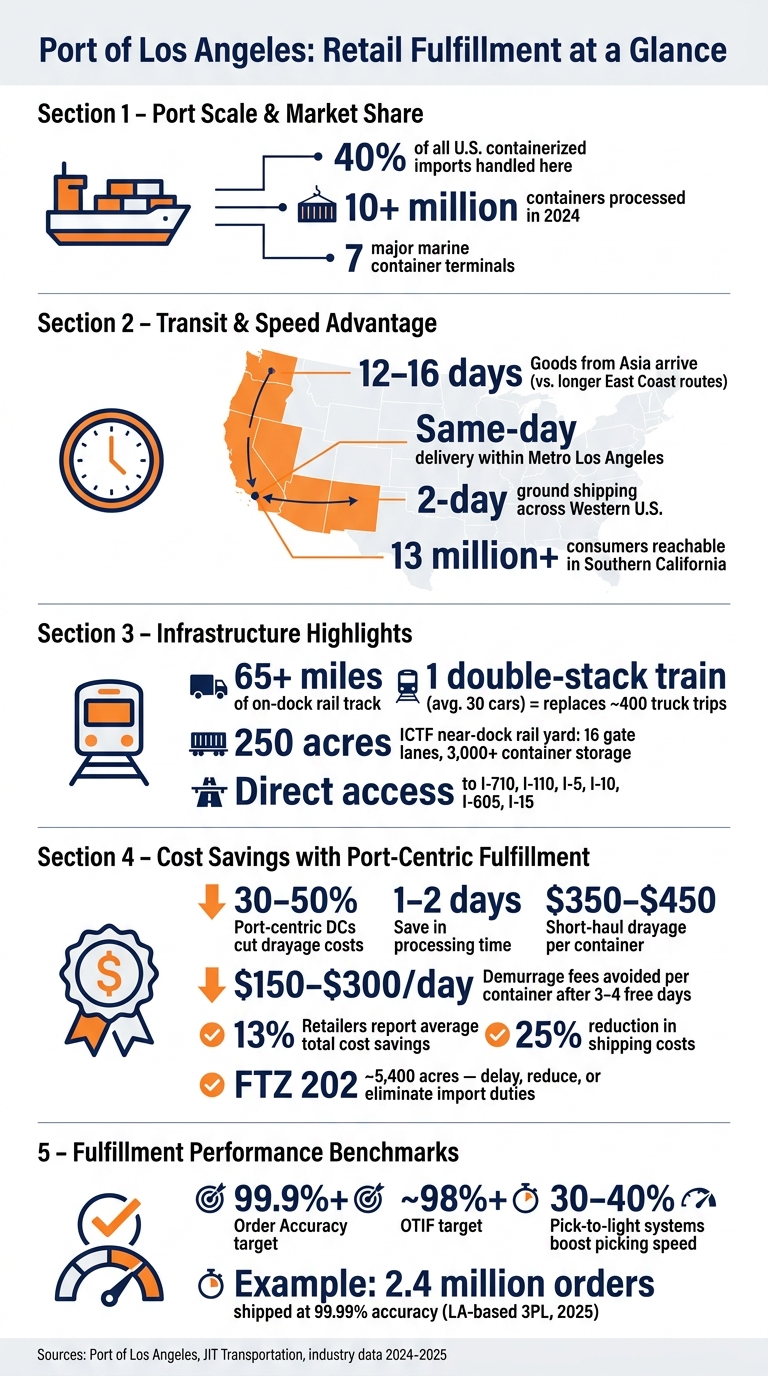
Port of Los Angeles Fulfillment: Key Stats & Delivery Zones
Infrastructure and Capabilities at the Port of Los Angeles

Port Infrastructure Overview
The Port of Los Angeles is built to handle massive freight volumes efficiently. It boasts seven major marine container terminals, including Pier 400, which spans 484 acres and is among the largest container terminals in the Western Hemisphere. Pier 300, covering 292 acres, is another key facility. These terminals are equipped with automated cranes and deep-water berths, ensuring fast container handling, even during peak shipping periods.
A standout feature is the port's rail connectivity. It operates over 65 miles of on-dock track, enabling the assembly of double-stack trains that seamlessly connect to the national rail system through the Alameda Corridor. This 20-mile, below-grade expressway significantly improves rail traffic flow. To put it into perspective, a single double-stack train with an average of 30 cars can replace about 400 truck trips.
"The Port of Los Angeles has America's most extensive and modern network of on-dock and near-dock rail services connecting the U.S. imports and exports to international markets." - Port of Los Angeles
Adding to the infrastructure is the Intermodal Container Transfer Facility (ICTF), located just five miles from the port. This 250-acre near-dock rail yard features 16 gate lanes and storage for over 3,000 containers. For retailers, the ICTF serves as a high-capacity solution for near-dock rail operations, offering overflow options when needed. The port also benefits from direct highway access to major interstates like I-710, I-110, I-5, I-10, I-605, and I-15, creating a freight network that's hard to rival in the U.S.
This extensive infrastructure forms the backbone of the port's logistics capabilities, enabling smooth and efficient retail fulfillment.
Logistics Capabilities for Retail Fulfillment
The Port of Los Angeles offers a logistics ecosystem that provides retailers with flexibility and cost-saving opportunities. Foreign-Trade Zone (FTZ) 202 spans roughly 5,400 acres of port property and includes over 35 general-purpose sites across Southern California. Retailers using FTZ status can delay, reduce, or even eliminate duties on imported products until they enter the domestic market. This, paired with the port's expedited transit services, helps businesses lower duty-related expenses.
Nearby warehouse hubs, such as those in Montebello (just 7 miles away) and the Inland Empire (Riverside and San Bernardino counties), further enhance logistics efficiency. These areas support inventory deconsolidation and transloading - where goods are transferred from ocean containers into domestic 53-foot trailers. This process not only accelerates distribution but also avoids the cost of repositioning ocean containers inland. For time-sensitive retail needs, cross-docking is another common approach. Here, goods are unloaded and immediately reloaded onto outbound trucks, minimizing storage time and speeding up replenishment cycles.
Common Port Challenges and How to Address Them
While the Port of Los Angeles offers many advantages, challenges can arise that disrupt even well-established supply chains. For example, when East Coast ports face disruptions like labor disputes, redirected shipments can overwhelm West Coast terminals, causing bottlenecks that delay fulfillment timelines. Another issue is drayage fees, which can add up quickly due to fuel costs, driver wages, and per diem charges for containers not returned on time.
To address these issues, retailers can strategically locate fulfillment centers within 7 to 10 miles of the port. This proximity allows same-day container devanning upon release, reducing drayage fees and avoiding delays. In contrast, facilities located 30 to 50 miles inland often face higher costs and longer turnaround times. By taking these steps, businesses can maintain consistent and scalable fulfillment operations - critical for meeting the demands of fast-paced e-commerce.
sbb-itb-eafa320
Core Fulfillment Services Available Near the Port
Inbound Receiving and Transloading
Once customs clearance is complete, acting quickly becomes essential. Port terminals generally allow only 3–4 free days of storage, after which demurrage fees - ranging from $150 to $300 per day per container - start piling up. To sidestep these costly charges, 3PLs situated within 7 to 15 miles of the port, like those in Paramount or Montebello, focus on same-day container pickup and devanning.
Transloading is the first key step after a container arrives. This process involves transferring cargo from ocean containers (20 ft, 40 ft, or 40 ft high-cube sizes) into domestic 53-foot trailers or directly onto warehouse racking. During this stage, teams sort by SKU, perform quality checks, and repalletize goods to meet domestic distribution or Amazon FBA compliance standards. Short-haul drayage from the port to nearby facilities typically costs $350 to $450 per container, making it a cost-effective option that scales well with larger operations. Keeping transloading close to the port not only reduces these fees but also minimizes transit time, ensuring goods move efficiently to the next stage.
Warehousing and Inventory Management
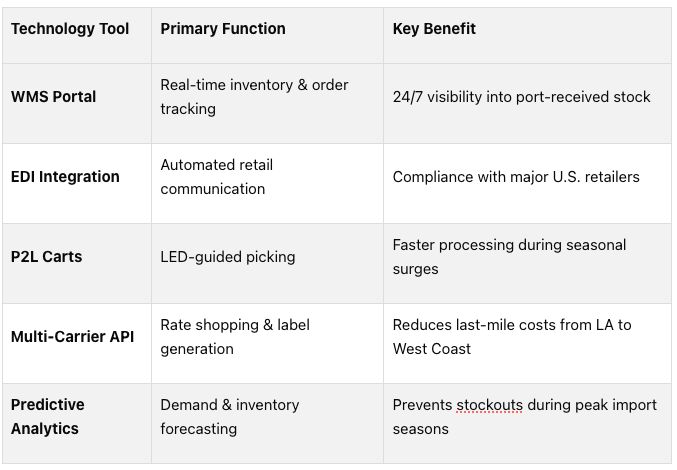
After transloading, effective warehousing solutions ensure smooth inventory management and order fulfillment. Warehouses near the port provide retailers with real-time inventory, order, and tracking visibility using advanced WMS (Warehouse Management Systems). This level of transparency helps avoid overselling and ensures better inventory control during peak demand.
Technology plays a big role in improving efficiency. For example, pick-to-light systems - which use visual cues to guide workers - can boost picking speeds by 30–40% and achieve order accuracy rates exceeding 99.9%. Many facilities also cater to businesses operating across multiple sales channels, offering both direct-to-consumer (DTC) fulfillment and B2B pallet distribution from a shared inventory pool. Retailers in sectors like health, beauty, or food should confirm their warehouse partner supports FEFO (First Expired, First Out) inventory rotation to reduce waste and meet compliance standards.
Order Processing and Value-Added Services
Fulfillment centers near the port go beyond basic pick-and-pack services by offering value-added services (VAS) that prepare products for retail or e-commerce shipping without requiring additional facilities. Key services like FNSKU labeling, kitting, and pre-shipment inspections are often completed during or right after receiving, ensuring goods are ready for sale immediately.
For instance, JIT Transportation provides services such as kitting and assembly, testing and upgrades, and white-glove handling. These offerings are particularly beneficial for electronics, subscription boxes, or items needing thorough inspection before shipment. By consolidating these services under one roof, businesses eliminate the need for facility transfers, speeding up the process from port arrival to customer-ready inventory. This streamlined approach supports faster last-mile delivery and efficient outbound distribution.
Last-Mile Delivery and Outbound Distribution
Once inbound operations, warehousing, and order processing are streamlined, the focus shifts to fast delivery to end customers. Fulfillment centers in the Los Angeles area offer same-day delivery within the metro area and next-day ground shipping to regions like Orange County, the Inland Empire, and San Diego. Beyond that, 2-day ground shipping covers much of the Western U.S., including California, Nevada, Arizona, Oregon, Washington, and Utah.
- Same-Day Delivery: Covers the greater Los Angeles metro area, including Downtown LA, Long Beach, Pasadena, and Santa Monica, making it ideal for urgent local shipments
- Next-Day Ground: Extends across Southern California, reaching areas such as Orange County, the Inland Empire, San Diego, and Ventura for fast regional fulfillment
- 2-Day Ground: Provides coverage throughout the Western United States, including California, Nevada, Arizona, Oregon, Washington, Utah, and New Mexico
- National Delivery: Supports distribution across the continental United States through multi-hub logistics networks spanning the Midwest and East Coast
For high-value or fragile items, white glove delivery provides extra care and attention. Retailers working with major chains like Walmart, Target, or Costco benefit from EDI-compliant outbound shipping that adheres to strict OTIF (On-Time, In-Full) standards. Meeting these requirements helps brands avoid penalties and maintain strong vendor relationships.
How to Scale E-Commerce Fulfillment Using the Port of Los Angeles
Building a Port-Centric Distribution Network
To scale your retail distribution effectively, consider using the Port of Los Angeles as more than just a point of entry - it can be your primary inventory hub. Setting up a gateway distribution center (DC) within 15–20 miles of the port is a smart move. Cities like Gardena, Carson, or Paramount are excellent options. This proximity minimizes drayage costs and ensures your containers are unloaded the same day they clear customs.
From this central hub, a multi-node strategy can help you achieve nationwide 2-day shipping. Inventory flows from the Los Angeles gateway to secondary DCs in key regions like the Midwest or East Coast, bringing you closer to major markets. As Courtney Lee, Founder of Prymal, puts it:
"Keeping our inventory in Chicago and Los Angeles has brought cost savings since we ship from the locations that are closest to the customer."
If leasing space is too expensive (L.A. County rates typically range from $1.50–$2.00 per square foot/month), partnering with a 3PL can provide an easier, more cost-effective solution. This gateway strategy not only supports rapid scaling but also helps manage seasonal demand spikes and integrate advanced fulfillment technologies.
Managing Seasonal Surges and Scaling Capacity
Once your distribution network is set up, it’s time to prepare for seasonal peaks. The holiday season, especially Q4, can overwhelm fulfillment operations if you're not ready. To avoid issues, complete all e-commerce platform integrations at least 2–3 weeks before peak season. This ensures automated order processing between your storefront and the 3PL's warehouse management system (WMS). Relying on manual syncing during high-demand periods like Black Friday can lead to bottlenecks.
Inside the warehouse, pick-to-light (P2L) systems can significantly increase picking speeds while cutting down on errors and reducing the time needed to train seasonal staff. For businesses handling perishable or time-sensitive products, confirm that your 3PL supports FEFO (First Expired, First Out) inventory rotation through their WMS. This ensures that stock moves efficiently and minimizes waste during high-velocity periods.
Using Technology to Improve Fulfillment Performance
Technology is the final piece of the puzzle when it comes to enhancing fulfillment performance. Advanced tools allow you to move from reactive operations to proactive efficiency. A robust WMS with a 24/7 client portal provides live updates on inventory, inbound shipments, and order statuses - no need to wait for manual reports. Multi-carrier API integrations make rate shopping easier and help reduce last-mile costs when shipping from the LA hub.
For multi-channel retailers selling on platforms like Shopify, Amazon, Walmart, or TikTok Shop, direct API integrations eliminate manual data entry and speed up the time between order placement and shipment. If you're distributing to major retailers like Target or Costco, EDI compliance tools automate tasks like adhering to routing guides and generating advance ship notices (ASNs). This helps protect your vendor scorecard and avoid costly chargebacks. Brands that use data-driven placement algorithms to distribute inventory across regional hubs have reported a 25% reduction in shipping costs.
Managing Fulfillment Operations and Measuring Performance
Meeting Retailer Compliance Requirements
Retailers like Walmart, Target, Costco, and Amazon have strict guidelines for packaging, labeling, and delivery, and failing to meet these standards can result in chargebacks that negatively affect your vendor scorecard. Each retailer has specific labeling requirements - whether it’s GS1 barcodes, UCC labels, or Amazon FNSKU stickers - and submitting accurate Advance Ship Notices (ASNs) before delivery is essential. Mistakes in labeling or ASNs can quickly damage your standing with retailers.
For businesses dealing with FDA-regulated products, facilities must be FDA-registered and capable of lot tracking and serialization. Additionally, warehouses operating in California must adhere to the state’s environmental standards and labor laws. Choosing a 3PL with strong compliance systems already in place can greatly ease these operational challenges.
Cost Breakdown and Trade-Offs in Fulfillment
Keeping fulfillment operations cost-effective is just as important as meeting compliance standards. In areas like the Port of Los Angeles, costs go beyond storage fees - retailers must find the right balance between speed, location, and operational complexity. One key cost to manage is drayage, the short-distance trucking that moves goods from the port terminal to a warehouse. Facilities closer to the port help reduce fuel, labor, and detention costs.
Warehouse leasing in Los Angeles County typically costs $1.50–$2.00 per square foot per month, while purchasing space near the port can exceed $300 per square foot. For growing retailers, partnering with a 3PL offers a flexible option. Instead of fixed costs like earthquake insurance, equipment, and compliance expenses, 3PLs provide variable costs that scale with your business.
Storage fees through a 3PL are usually calculated per bin or pallet. For example, a large bin might cost around $1.00 per week, while a pallet position costs about $7.25 per week. Zone skipping is another way to cut costs - fulfilling West Coast orders from an LA hub via ground shipping avoids the high rates associated with cross-country Zone 8 shipments. Retailers using port-centric inventory strategies have reported an average of 13% savings on total costs and a 25% reduction in shipping expenses. These savings align with the broader port-centric strategies discussed earlier, ensuring fulfillment operations are optimized across the board.
Key Metrics and Continuous Improvement with a 3PL Partner
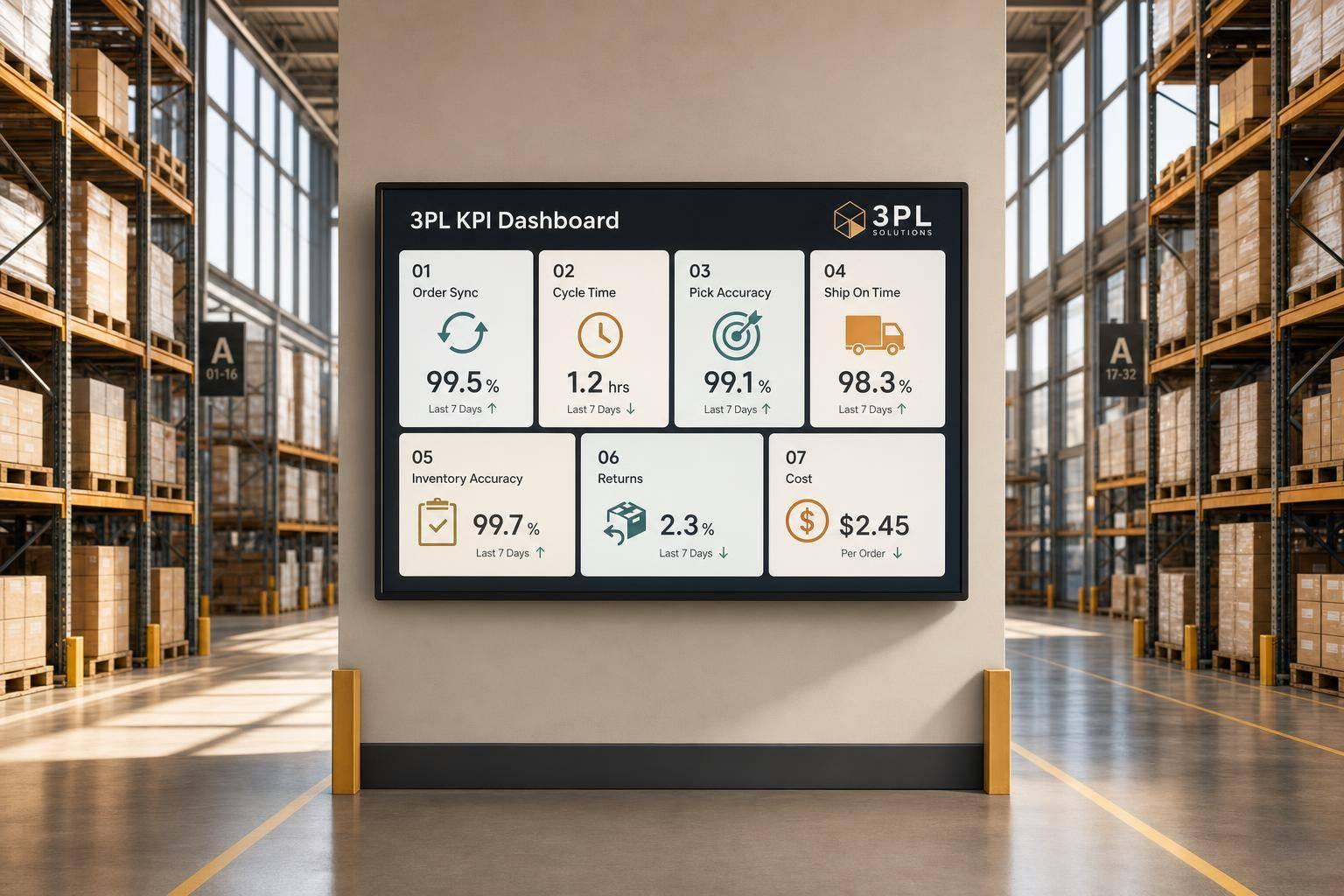
Tracking key performance metrics is vital for improving efficiency and controlling costs in fulfillment operations. Important metrics include Order Accuracy, On-Time In-Full (OTIF) delivery, Order Cycle Time, Pick Rate, and compliance-related chargebacks. Here’s a quick breakdown:
- Order Accuracy: Measures the percentage of orders shipped with the correct items and quantities; leading benchmarks are typically 99.9% or higher
- OTIF (On Time In Full): Tracks how often orders are delivered complete and within the promised delivery window; top-performing operations generally target around 98% or higher depending on retailer requirements
- Order Cycle Time: Measures the elapsed time between order placement and shipment; same-day processing is the preferred benchmark whenever operationally feasible
- Pick Rate: Evaluates the number of units picked per hour within the warehouse; technology-enabled workflows help improve efficiency and throughput
- Compliance Chargebacks: Tracks costs associated with retailer non-compliance issues such as routing guide violations or ASN errors; the ideal target is zero chargebacks
A dependable 3PL doesn’t just monitor these metrics - they actively work to improve them. For example, multi-layer verification processes like barcode scans during picking and packing, combined with weight checks, help prevent errors before shipments leave the warehouse. Real-time access to WMS (Warehouse Management System) portals allows for proactive issue resolution.
As Fulfillment Express aptly states:
"Accuracy isn't accidental - it's systematic." – Fulfillment Express
In 2025, a Los Angeles-based 3PL demonstrated this principle by shipping 2.4 million orders with an impressive 99.99% accuracy rate across facilities in Rancho, Commerce, and Carson. This success highlights the importance of well-designed systems, regular audits, and a commitment to measurable results.
Port of LA & Long Beach Logistics Facility | Inside PCC Logistics
Conclusion: Making the Most of the Port of Los Angeles for Retail Fulfillment
The Port of Los Angeles isn’t just a gateway - it’s a powerful resource for retailers aiming to optimize their supply chain. In 2024, the port managed over 10 million containers, and together with the Port of Long Beach, it accounted for approximately 40% of all containerized imports into the U.S..
Being close to the port significantly reduces drayage and demurrage fees while speeding up delivery times. With efficient ground transportation networks, retailers can serve over 13 million consumers in Southern California with same-day deliveries, and the majority of the Western U.S. can receive shipments within two days. These advantages make the port a key component of a fulfillment strategy that aligns with e-commerce scalability, cutting both delivery times and operational expenses.
To fully leverage these benefits, partnering with an experienced 3PL is crucial. JIT Transportation offers the infrastructure, technology, and expertise needed to turn port access into a competitive edge. From seamless transloading and EDI-compliant routing to flexible warehousing and last-mile solutions, they provide the tools to handle everything from seasonal demand spikes to market expansion. A port-centric fulfillment strategy, backed by a capable 3PL, ensures growth while maintaining control over your supply chain.
FAQs
How close should my 3PL warehouse be to the Port of Los Angeles?
To keep drayage costs low, cut down transit times, and offer same-day or next-day delivery, it's best to have your 3PL warehouse located within 7 to 15 miles of the Port of Los Angeles. Being this close allows for smoother operations and helps optimize your supply chain for e-commerce distribution.
What’s the best way to avoid demurrage and per diem fees at the port?
To steer clear of demurrage and per diem fees, it's all about staying ahead in your import logistics and having adaptable warehousing solutions. Work closely with a 3PL provider located near the port to facilitate quick transfers of your goods and maintain real-time oversight of your inventory. Look for vendors offering month-to-month warehousing options, so you can adjust as your needs change. By teaming up with seasoned logistics providers, you can streamline your supply chain, minimize port delays, and avoid extra fees.
Which integrations do I need for Amazon and big-box retail compliance?
Integrating with Amazon Seller Central for FBA is a smart way to ensure compliance and manage fulfillment efficiently. Pair this with connections to major eCommerce platforms like Shopify, WooCommerce, BigCommerce, and Magento for seamless order processing. These integrations simplify your operations and make it easier to meet retail distribution standards without unnecessary hassle.
Related Blog Posts
Related Articles
7 WooCommerce 3PL KPIs Teams Track

Centralized vs Decentralized Replenishment
