
How to Reduce Drayage Costs with LA-Based Warehousing

If your business ships goods through Los Angeles, drayage costs can quickly add up. Drayage refers to the short-haul trucking of containers from ports to warehouses, and in LA, these costs are influenced by factors like distance, congestion, and fees. A single container move can cost $350–$900, with additional charges like demurrage and detention fees adding $150–$300 per day after free time.
To cut these expenses, consider these key strategies:
- Choose the right warehouse location: Near-port facilities keep drayage costs lower ($350–$450/container) compared to Inland Empire options ($500–$650/container).
- Match storage to product demand: Store fast-moving items near the port and slower-moving inventory inland to balance costs.
- Plan container pickups efficiently: Align schedules with warehouse readiness to avoid delays and extra fees.
- Use transloading: Transfer goods quickly from containers to domestic trailers to stay within free-time windows and avoid penalties.
- Leverage technology: Tools like TMS and WMS provide real-time tracking and help prevent costly delays.
Understanding Drayage Costs in Los Angeles
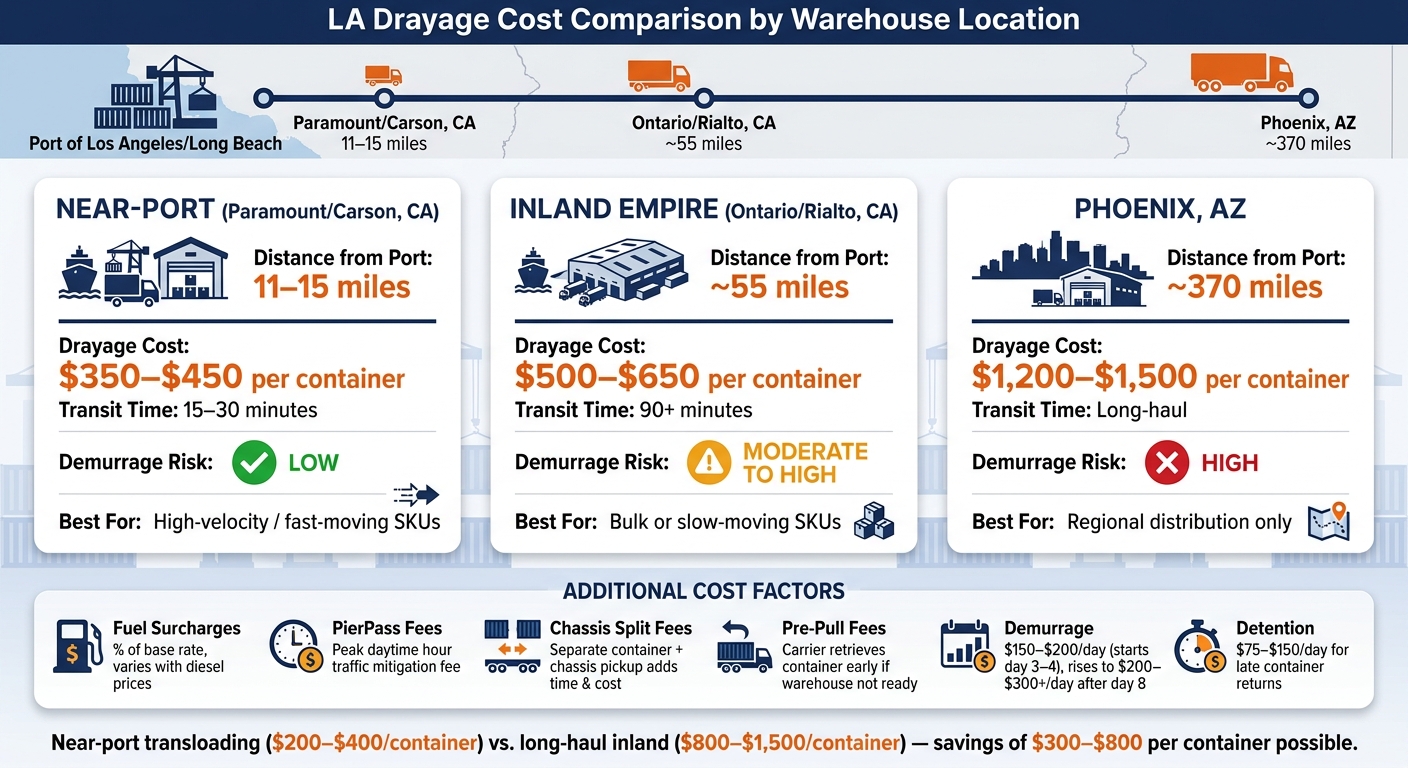
LA Drayage Costs by Warehouse Location: Near-Port vs. Inland Empire vs. Phoenix
What Is Drayage?
Drayage refers to the short-haul trucking that transports shipping containers from a port terminal to a nearby warehouse or transloading facility, typically covering distances between 15 and 50 miles. Often called the "first mile" of a domestic supply chain:
"Drayage is the short-distance transportation of shipping containers... that connects major transportation modes. It's the critical first handoff that sets everything else in motion."
At major ports, this initial handoff happens on a massive scale. For instance, in 2025, the Port of Long Beach processed a record 9.9 million TEUs, highlighting the immense volume and pressure on drayage operations.
Now, let’s take a closer look at the main factors driving drayage costs in Los Angeles.
Key Cost Drivers in LA Drayage
The base drayage fee is just the beginning. Additional charges can quickly stack up, making it essential to understand the factors influencing these costs.
Distance plays the most significant role. Here's a breakdown of typical costs based on location:
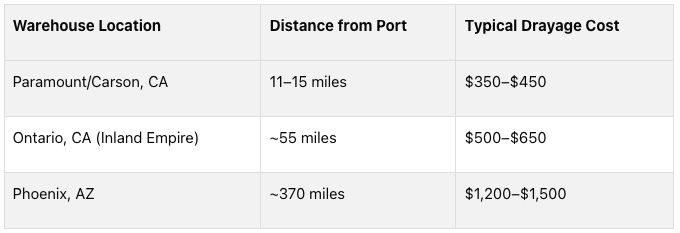 Beyond distance, several other charges can increase your drayage bill:
- Fuel surcharges: These vary with diesel prices and are calculated as a percentage of the base rate.
- PierPass fees: A Traffic Mitigation Fee applied to containers moved during peak daytime hours at the LA/LB terminals, aimed at reducing congestion.
- Chassis fees: In Los Angeles and Long Beach, the "pooled chassis" system can require drivers to retrieve the container and chassis from separate locations. This "chassis split" adds both time and cost.
- Pre-pull fees: If your warehouse isn’t ready to receive a container, carriers may retrieve it from the terminal and store it temporarily in their yard to avoid port demurrage fees.
How E-Commerce Brands Are Affected
These cost factors have a direct impact on e-commerce operations, especially when speed and efficiency are critical. For brands with high SKU turnover, delays in drayage can lead to slower inventory movement, delayed fulfillment, and even stockouts.
Seasonal peaks, like the Q4 holiday rush, amplify these challenges. Increased competition for terminal appointments and truck gates can lead to missed pickup windows. This doesn’t just mean paying a demurrage fee - it can disrupt your entire replenishment cycle during the busiest time of the year. For lean inventory strategies, even a short delay in drayage can ripple through your fulfillment process.
Product launches face similar risks. New SKUs often require rapid distribution, and any delay at the drayage stage leaves no room for error. Understanding the factors that influence your drayage costs in Los Angeles - and identifying ways to manage them - can help stabilize your supply chain and keep operations running smoothly.
sbb-itb-eafa320
Using LA-Based Warehousing to Cut Drayage Costs
Where you store your inventory in the LA area has a direct impact on your shipping costs. Choosing the right warehouse location can help lower per-container drayage costs, reduce demurrage and detention fees, and speed up product availability. To make the best decision, it’s important to weigh the benefits of near-port versus Inland Empire options based on your SKU profile.
Near-Port vs. Inland Empire Warehousing
The main trade-off here is straightforward: lower drayage costs near the port versus lower rent in the Inland Empire. Warehouses near the port, in areas like Carson and Long Beach, are typically 11–20 miles from the terminals. This proximity keeps drayage costs between $350 and $450 per container. Meanwhile, Inland Empire locations like Ontario and Rialto are about 55 miles away, with drayage costs ranging from $500 to $650 per container. If you’re moving a large number of containers every month, these cost differences can add up fast.
But drayage costs aren’t the only factor to consider. Near-port facilities generally come with higher real estate and labor costs, while Inland Empire warehouses often offer larger, newer spaces at more competitive rates. Your choice will largely depend on how quickly your products sell.
- Drayage Cost: Near-port facilities in South Bay and Long Beach typically see lower drayage costs of approximately $350–$450 per container, while Inland Empire locations average closer to $500–$650 per container
- Rent & Labor Costs: Near-port operations generally face higher rent and labor expenses, whereas Inland Empire facilities benefit from lower operating costs overall
- Transit Time from Port: South Bay and Long Beach facilities are usually within 15–30 minutes of the ports, while Inland Empire locations often require 90 minutes or more of transit time
- Demurrage Risk: Near-port facilities carry a lower risk of demurrage due to faster container retrieval, while Inland Empire operations face moderate to high risk because of longer transit and congestion delays
- Best Fit: Near-port facilities are best for high-velocity SKUs and rapid inventory turnover, while Inland Empire warehouses are better suited for bulk storage and slower-moving inventory
Matching Warehouse Location to SKU Velocity
Not all inventory benefits from being stored in the same location. The trick is to categorize your products by how quickly they sell and align their storage location accordingly.
Fast-moving SKUs, like bestsellers or seasonal items with short replenishment cycles, benefit from near-port storage. Keeping these products close to the port minimizes delays, reduces drayage costs, and supports frequent shipments. On the other hand, slower-moving or bulk inventory doesn’t justify the higher rent of near-port facilities. For these items, Inland Empire warehouses are a better fit, as they help keep holding costs in check.
A hybrid approach can also work well. For instance, you could use a near-port facility as your main hub for receiving and fulfilling high-turnover products, while maintaining a secondary inland location for overflow or slower-moving inventory. This strategy can help optimize your total landed cost by balancing storage and shipping expenses.
Total Landed Cost: What to Factor In
Warehouse rent is just one piece of the puzzle. The total landed cost includes every expense from the moment your inventory leaves the port to when it reaches your customer. This means factoring in drayage fees, fuel surcharges, chassis rentals, warehouse rent, labor rates, and outbound shipping zones.
For example, a warehouse in Ontario might have lower rent, but higher drayage costs and longer outbound transit times could cancel out those savings. By analyzing total landed costs, you can ensure that every decision - whether it’s choosing a location or planning shipments - supports smoother operations. A full landed cost analysis provides a clearer picture of which location will actually save you money, rather than focusing solely on rent.
"When your LA warehouse is 11 miles from the Port... drayage costs go down. Demurrage exposure shrinks. And your freight gets into the warehouse faster." - GEODIS
JIT Transportation’s strategically located warehouses in the LA region are designed to give e-commerce brands this level of cost transparency. By understanding the full supply chain cost - not just the price of rent - you can make smarter, more informed decisions about where to store your inventory.
Improving Drayage Operations with LA-Based 3PL Warehousing
Even with a prime warehouse location, poor coordination between drayage carriers and warehouse teams can drive up costs. The gap between choosing the right storage spot and ensuring efficient movement is where many fees pile up.
Syncing Port Pickups with Warehouse Capacity
One often-overlooked reason for detention fees isn’t just port congestion or traffic - it’s the mismatch between when containers arrive and when the warehouse is ready to receive them. If a container arrives at the dock and there’s no labor available or no open bay, the driver’s waiting time quickly adds up, leading to extra charges.
The fix? Plan your port pickup schedule around your warehouse’s daily receiving capacity before dispatching a drayage truck. A 3PL with plenty of dock positions and trailer staging areas can handle volume surges without causing delays. Flexible receiving windows - like early morning or weekend slots - can also be a lifesaver when terminal appointments shift unexpectedly at the Ports of Los Angeles and Long Beach.
"A warehouse 20 minutes from the port can pick up your container the same day it's available. A warehouse hours away may need an extra day or two to schedule the pickup - and those days can easily push you past free time."
Transloading is another key tactic. By moving goods from ocean containers into warehouse storage within 24–48 hours, you can return equipment to the depot faster, staying well within the shipping line’s 4–5 day detention window.
How to Reduce Detention and Demurrage Fees
At the Long Beach terminals, you typically get only 3–4 free days before demurrage fees start piling up. These charges often begin at $150–$200 per day and can climb to $200–$300 or more after day 8. Detention fees for late container returns can tack on another $75–$150 per day.
To sidestep these fees, preparation is key. Handle customs clearance, ISF filings, and terminal appointments before your vessel arrives to ensure timely container pickups. Regularly auditing your drayage invoices can also help catch billing errors, duplicate charges, or inaccurate weight assessments - issues that are much harder to dispute later.
Using Technology to Track and Manage Drayage
Coordinated scheduling is crucial, but technology takes drayage management to the next level. In a port complex that handles about 40% of all containerized U.S. imports, relying on spreadsheets and phone calls just doesn’t cut it. A Transportation Management System (TMS) offers real-time visibility into container locations, free time remaining, and carrier performance. Automated alerts can warn you when a container is nearing its demurrage window, allowing for proactive action.
When paired with a Warehouse Management System (WMS), a TMS provides your warehouse team with real-time updates on incoming containers. This makes it easier to allocate labor and dock space effectively. Built-in data analytics also help identify patterns - like which carriers have frequent detention issues or which terminals consistently cause delays - so you can refine your routing strategies. Companies using AI-powered logistics tools have reported drayage cost reductions of 10–15%, and better coordination can prevent unnecessary delays that might cost $200 or more per container.
"The difference between reactive and proactive drayage management often comes down to visibility." – M2 Logistics
JIT Transportation’s integrated 3PL approach combines warehousing, drayage coordination, and technology to eliminate inefficiencies that lead to fees. This proactive strategy not only reduces costs but also sets the stage for optimizing container usage and network design.
Optimizing Container Use and Network Design
Streamlining drayage operations is just the beginning. By rethinking container movements and network design, businesses can significantly cut costs and speed up fulfillment.
Transloading and Cross-Docking to Reduce Drayage Costs
The key to savings lies in how containers move through your supply chain. Transloading - the process of transferring goods from an ocean container to a domestic trailer or warehouse - helps return equipment to the terminal quickly, often within 24–48 hours. This approach keeps operations well within the free-time window, eliminating per diem and detention charges entirely.
The financial benefits are clear. Near-port transloading typically costs $200–$400 per container for drayage, compared to $800–$1,500 or more for long-haul trips to inland warehouses. Add in the avoidance of demurrage and storage fees, and the savings per container can range from $300–$800.
Cross-docking, on the other hand, is all about speed. Goods move directly from one truck to another with minimal handling, making it ideal for pre-sorted shipments heading quickly to specific destinations. Unlike transloading, which allows for splitting a single container across multiple locations or repalletizing for retail compliance, cross-docking prioritizes rapid movement over load optimization.
Consolidating Shipments with Pool Distribution
Pool distribution - a strategy where goods from multiple inbound containers are combined into full truckloads by destination - offers another way to cut costs. Instead of sending out partial loads, shipments are consolidated at the transload facility into full outbound loads.
Consider this example: A home goods importer managing 60 containers monthly from various Asian suppliers implemented pool distribution at a Los Angeles transload facility. By consolidating shipments into full truckloads by region, they eliminated 200 partial shipments annually. This change resulted in $240,000 in consolidation savings and $320,000 in reduced per diem charges, totaling $1,330,000 in annual savings with a 278% ROI. Consolidating partial loads during transloading can lower per-unit shipping costs by 20–40%.
This strategy not only reduces costs but also ensures faster inventory turnover, keeping supply chains agile and responsive.
Linking Drayage to Fulfillment Performance
Speeding up container turnaround has a direct impact on inventory availability and fulfillment timelines. Near-port transloading can shrink the timeline from port arrival to customer delivery to just 5 days, compared to the 35+ days typical of inland warehousing models.
For fast-growing e-commerce brands, this speed is essential. Leveraging a near-port third-party logistics (3PL) provider to inspect, label, and palletize goods for FBA (Fulfilled by Amazon) reduces the chances of Amazon rejections. It also allows for flexible inventory routing, splitting stock across multiple fulfillment centers based on demand. High-velocity SKUs can remain near the port for frequent restocks, while slower-moving items ship directly to FBA as needed. This SKU-based routing ensures top-selling products stay in stock without overinvesting in safety stock, keeping costs and drayage expenses in check while maintaining inventory flow.
Conclusion: Steps to Lower Your Drayage Costs
Drayage costs can be managed effectively, but it requires intentional choices about where to locate your warehouse, how you handle operations, and who you partner with. For example, placing your facility just 15–30 minutes from the Port of Los Angeles or Long Beach can significantly reduce base drayage rates compared to inland locations.
Once you’ve secured a well-positioned facility, the next priority is avoiding operational delays. Demurrage and detention fees can pile up quickly if container pickups and returns aren’t well-coordinated. Combining near-port warehousing with fast transloading ensures containers stay on the move within free-time windows, helping you sidestep these extra charges.
Streamlining operations further reinforces these savings. Consider strategies like scheduling pickups during off-peak hours, ensuring accurate weight declarations on the Bill of Lading, and auditing invoices regularly. Proactively working with your 3PL - well before the vessel docks - helps secure terminal appointments and clear customs, so containers don’t sit idle.
Partnering with an asset-based 3PL, such as JIT Transportation, can also make a big difference. They eliminate chassis split fees and provide reliable equipment availability, even during peak seasons, which helps cut costs and improve efficiency. Consolidating services like drayage, transloading, warehousing, and FBA prep under a single provider closes the gaps that often lead to delays and missed delivery deadlines.
"Getting cargo off the port efficiently can make or break your supply chain performance." - Jon Deritis, Precision Worldwide Logistics
FAQs
How do I decide near-port vs. Inland Empire warehousing for my SKUs?
Choosing between near-port warehouses and Inland Empire warehouses comes down to your specific priorities.
Near-port warehouses are perfect if you're managing import-heavy operations. They help cut down on drayage costs, minimize the risk of demurrage fees, and speed up container processing. This setup keeps your supply chain moving efficiently, especially when dealing with high volumes of imports.
On the other hand, Inland Empire warehouses tend to offer more affordable real estate, flexible space for scaling, and access to a larger labor pool. These factors make them an excellent choice for businesses focused on broader distribution needs.
When making your decision, think about key factors like how close you need to be to ports, suppliers, and customers, as well as how much importance you place on costs and the ability to scale.
What can I do to avoid demurrage and detention fees in LA?
To steer clear of demurrage and detention fees in Los Angeles, focus on cutting down container dwell time and speeding up port-to-warehouse transfers. Opting for a warehouse or 3PL provider near major ports like Long Beach helps minimize storage time and avoid unnecessary delays. Additionally, refining transportation operations and taking advantage of direct access to key routes such as the 405, 91, and 103 highways can boost efficiency and trim costs.
When does transloading make sense for my inbound containers?
Transloading works well when flexibility in distribution is a must, especially for shipments headed to multiple destinations or when cutting down on container movement costs is a priority. It's commonly used near ports, where freight can be shifted into domestic trailers to streamline multi-destination deliveries. This method also helps sidestep delays and extra costs, such as chassis shortages or detention fees, and is a practical solution for dividing shipments across various locations.
Related Blog Posts
Related Articles
7 WooCommerce 3PL KPIs Teams Track

Centralized vs Decentralized Replenishment
