Ultimate Guide to Green Fulfillment Regulations
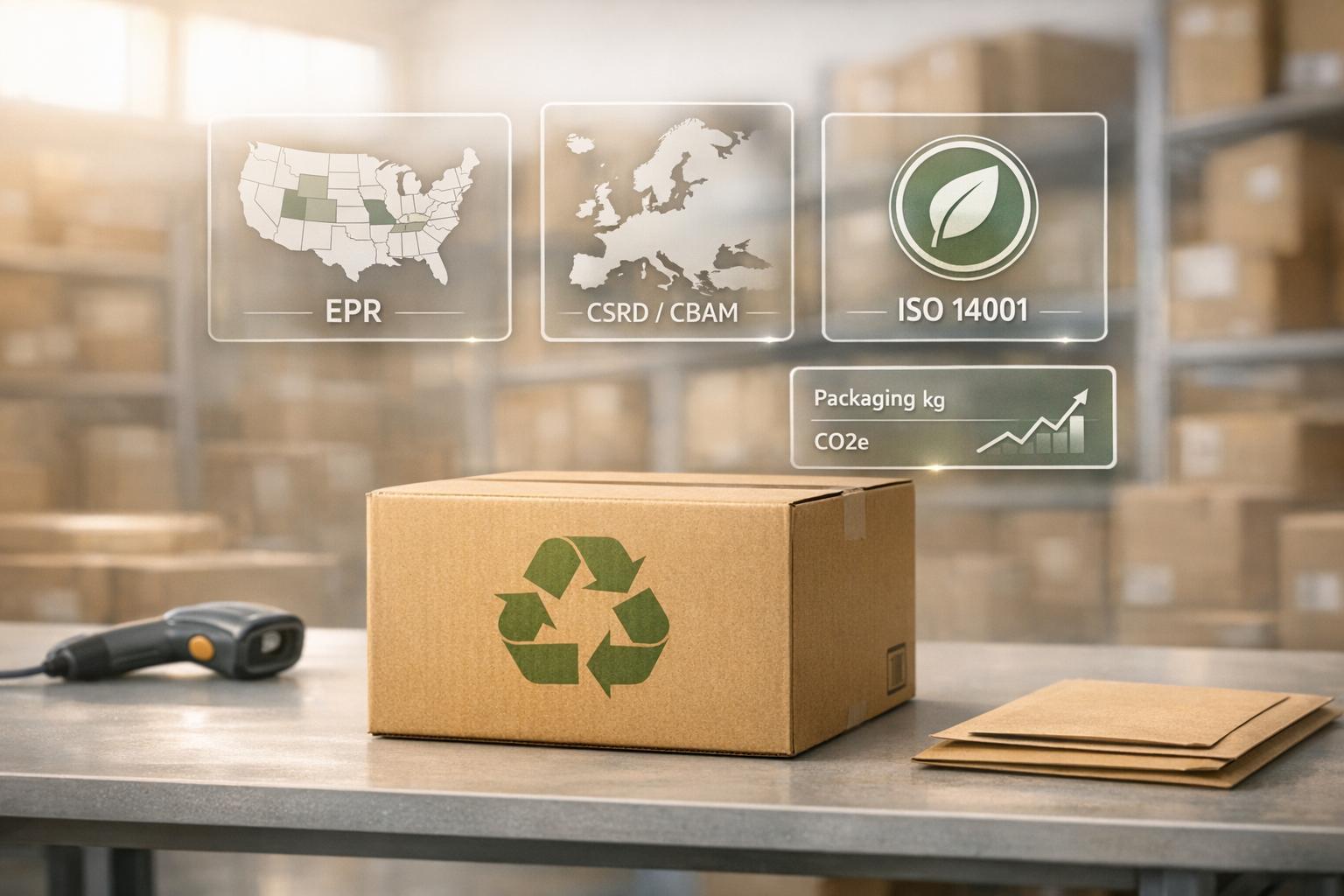
Green fulfillment regulations are reshaping how e-commerce operates, focusing on reducing waste, cutting emissions, and managing product lifecycles. These laws are mandatory and impact packaging, transportation, and reporting. Here's what you need to know:
- Extended Producer Responsibility (EPR): Shifts recycling costs from taxpayers to companies, with laws active in eight U.S. states like California and Oregon.
- Compliance Deadlines: States like Maine and Washington require businesses to join recycling programs (PROs) or submit plans by mid-2026.
- Penalties: Fines for non-compliance can reach $25,000 per day, with restrictions on selling in certain states.
- Consumer Trends: 85% of buyers prefer sustainable packaging, making compliance a business advantage.
- Global Impact: EU laws like CSRD and CBAM require emissions tracking and carbon cost reporting for U.S. companies operating internationally.
- ISO Standards: ISO 14001 certification helps businesses reduce environmental impact while meeting legal requirements.
To comply, businesses must track packaging data, monitor emissions, and invest in eco-friendly practices. Partnering with third-party logistics (3PL) providers and using advanced tracking systems can simplify the process.
US State Extended Producer Responsibility (EPR) Requirements

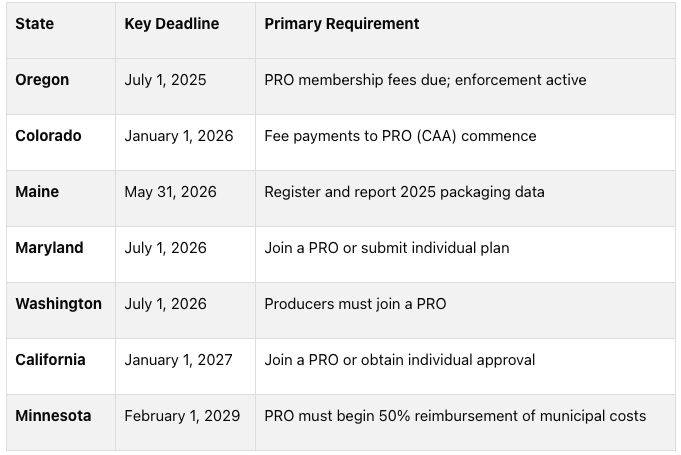
US State EPR Compliance Deadlines and Requirements 2025-2029
By early 2026, eight states - California, Colorado, Maine, Maryland, Minnesota, Oregon, Vermont, and Washington - have enacted comprehensive EPR packaging laws. These laws shift the financial responsibility for recycling programs from taxpayers to the companies that bring packaging into the market.
The term "producer" follows a specific hierarchy. First, the brand owner or manufacturer is responsible. Second, if the brand owner isn't reachable, responsibility transfers to the licensee or importer. Third, if neither applies, the retailer or the entity making the first sale in the state takes on the responsibility. For e-commerce businesses, it's essential to identify where you fit into this chain for each state you operate in.
EPR Packaging Laws by State
While each state has its own take on EPR, there are shared themes. California's SB 54 is considered one of the toughest, requiring 100% of packaging to be recyclable or compostable by 2032 and a 25% reduction in plastic packaging by the same year. It also sets ambitious recycling targets: 30% by 2028, 40% by 2030, and 65% by 2032.
Oregon's SB 582 covers packaging, printing and writing paper, and food service ware. Non-compliance can result in penalties of up to $25,000 per day. Oregon and Colorado have also adopted "no-report, no-sale" rules, which prohibit non-compliant companies from selling their products starting July 1, 2025.
Maine's LD 1541 takes a different route with a municipal cost-reimbursement model. Producers pay fees to a state-selected organization, which reimburses towns for their waste management expenses. This reduces the operational burden on producers but still requires detailed reporting and fee payments.
Minnesota's HF 3911 gradually phases in producer responsibility. By February 2029, producers must cover 50% of net recycling costs, increasing to 90% by 2031. Meanwhile, Washington's SB 5284 mandates that Producer Responsibility Organizations (PROs) fund a reuse assistance program with at least $5 million annually starting in 2029.
Colorado's HB 22-1355 takes a broader approach, including printed paper such as newspapers, magazines, and brochures. This means e-commerce businesses sending catalogs or promotional materials need to factor these items into their compliance plans.
Most states require companies to join a Producer Responsibility Organization (PRO) to manage recycling efforts, reporting, and fee collection. The Circular Action Alliance (CAA) is currently the approved PRO for California, Colorado, Oregon, Minnesota, and Maryland. While individual compliance is technically an option, the complexity and cost make joining a PRO the practical route for most businesses.
Data Reporting and Fee Structures
Compliance with EPR laws requires detailed data tracking. Companies must report the weight and material type (plastic, paper, glass, metal) of all packaging introduced into each state. Reporting is not a one-time task; it’s ongoing, with deadlines varying by state.
For instance, Maine requires producers to report 2025 packaging data by May 31, 2026, while California mandates a full year’s data report by January 2026. Missing these deadlines can result in penalties or restrictions on sales. In California, the deadline to join a PRO or secure individual approval is January 1, 2027.
Fees are calculated based on the weight and type of material introduced into the state. Many states use "eco-modulated" fee structures, where fees are higher for non-recyclable materials and lower for packaging with high post-consumer recycled (PCR) content. This system encourages companies to adopt more sustainable packaging options.
California's CAA fee schedule is expected to roll out in April 2026. Maine requires a start-up registration fee by September 2026, and Minnesota imposes fines between $25,000 and $100,000 for failing to register or meet reporting requirements.
 Most states include "de minimis" thresholds to ease the burden on small businesses. These thresholds are typically based on annual revenue (under $1 million or $5 million) or the volume of packaging (under 1 ton). Check each state's specific rules to see if your business qualifies for exemptions.
To manage compliance, invest in systems that capture SKU-level packaging data through your ERP or warehouse management software. This upfront effort will simplify reporting and help avoid penalties. Plus, accurate data supports a smoother, more efficient fulfillment process.
sbb-itb-eafa320
Global Regulations Affecting US Fulfillment
Even if you're running a US-based e-commerce business, selling or partnering in the EU means following their rules. Two major EU policies now shape how US fulfillment providers handle emissions tracking and carbon costs: the Corporate Sustainability Reporting Directive (CSRD) and the Carbon Border Adjustment Mechanism (CBAM).
EU Corporate Sustainability Reporting Directive (CSRD)
The CSRD is all about transparency. It requires large companies operating in the EU to report sustainability data with the same level of detail as financial statements. Starting in March 2026, this applies to companies with over 1,000 employees and net annual turnover above €450 million. For non-EU companies, the rules kick in if they generate over €450 million in EU net turnover for two consecutive years and operate an EU branch or subsidiary earning more than €200 million.
For US fulfillment providers, compliance means tracking Scope 3 emissions throughout the entire value chain - covering everything from suppliers and transportation to warehousing and distribution. Even if your business doesn't meet the CSRD thresholds, your larger clients might still demand detailed emissions data. The directive also requires a double materiality assessment, meaning you must consider both how environmental issues affect your company and how your operations impact the environment and society.
Reports must be submitted in machine-readable XHTML format for the European Single Access Point (ESAP) and will need external audits. Failing to meet these obligations could result in fines as high as 3% of global net turnover. For US providers, aligning with these standards can strengthen overall compliance efforts.
To get ready, businesses should focus on these steps:
- Build a greenhouse gas (GHG) inventory to track emissions by shipment and fulfillment activity.
- Update contracts with logistics providers to include environmental, social, and governance (ESG) clauses.
- Move away from manual spreadsheets by adopting transportation management systems that calculate carbon intensity automatically.
But that's not all - US fulfillment providers also need to consider the financial impact of CBAM on imported goods.
Carbon Border Adjustment Mechanism (CBAM)
CBAM introduces a direct carbon cost for imports entering the EU. It's designed to level the playing field by ensuring importers pay the same carbon price as EU producers. As of January 1, 2026, CBAM transitioned from a reporting phase to requiring importers to purchase carbon certificates to cover the emissions embedded in specific goods like steel, aluminum, cement, fertilizers, hydrogen, and electricity.
The price for these certificates is tied to the EU Emissions Trading System, currently ranging between $77 and $110 per ton of CO₂. For example, aluminum importers may face liabilities nearing $545 million in 2026. A 50-ton annual threshold applies to products like steel and aluminum, exempting smaller importers but still covering nearly all emissions.
If importers can't provide verified emissions data, the EU applies default values with increasing markups - 10% in 2026, 20% in 2027, and 30% in 2028. For instance, a ton of steel from a coal-fired blast furnace could have a CBAM liability exceeding $163, while steel from a renewable-powered furnace might incur costs under $22.
To navigate CBAM, US fulfillment providers should:
- Review their product catalog to identify which items fall under current CBAM sectors or the proposed 2028 expansion to finished goods like heavy machinery.
- Register as an authorized CBAM declarant to assist EU partners.
- Use the CBAM Registry to share verified emissions data with multiple importers.
- Update supplier contracts to include carbon-data-sharing clauses.
- Model total landed costs to weigh sourcing options based on carbon intensity.
Key sustainability regulations are evolving rapidly, with major implications for reporting and compliance. The Corporate Sustainability Reporting Directive (CSRD) requires companies to report Scope 1, 2, and 3 emissions across their full value chain and currently applies to large organizations with 1,000 or more employees, with reporting set to begin in 2028/2029. The Carbon Border Adjustment Mechanism (CBAM) mandates the purchase of carbon certificates based on embedded emissions, with its definitive financial phase taking effect on January 1, 2026. Looking ahead, a proposed expansion of CBAM is expected to extend requirements to downstream and finished goods, with a legislative proposal anticipated in late 2025 and implementation targeted for 2028.
ISO Standards for Environmental Compliance
ISO 14001 provides a globally recognized framework for managing environmental responsibilities, particularly in fulfillment operations. While voluntary, this standard allows logistics providers to systematically minimize their environmental impact while building trust with customers and regulators. It bridges the gap between policy and practice, offering a structured approach to sustainability.
ISO 14001:2015 focuses on identifying how activities like energy use in warehouses and packaging waste affect the environment. It applies to key areas such as transport fleets, warehouse depots, energy consumption, fuel usage, and waste management. The framework operates on a "Plan-Do-Check-Act" cycle, ensuring that controls are tailored to specific risks and operations.
For e-commerce fulfillment, the standard emphasizes tracking last-mile delivery emissions and analyzing the lifecycle of packaging materials. It also requires performance assessments across the supply chain. Looking ahead, the updated ISO 14001:2026 version, effective April 15, 2026, will place greater focus on climate change, biodiversity, and resource efficiency, urging organizations to adapt their systems to align with these evolving priorities.
"ISO 14001 certification demonstrates your commitment to environmental stewardship. It opens doors to new markets, satisfies stakeholder expectations, and reduces operational costs through better resource management." - Effivity Technologies
Since its introduction in 1996, over 300,000 organizations worldwide have adopted ISO 14001. For logistics companies, certification is increasingly seen as a must-have. Shippers often demand documented environmental practices, and companies without certification risk being excluded from sustainable supply chains.
Implementing ISO 14001 in Fulfillment Operations
Adopting ISO 14001 involves a detailed, phased approach that starts with defining your scope and securing management buy-in to establish an environmental policy. A key step is locating environmental data within fleet systems, energy bills, and ERP platforms to prepare for third-party audits. The implementation process typically unfolds in three stages: planning and documentation, operational changes, and performance evaluation.
Identifying key environmental aspects is crucial. For fulfillment centers, these often include packaging waste, energy use in warehouses, and transportation emissions. A practical example comes from Enconnex, which achieved ISO 14001:2015 certification in August 2023 through TUV Rheinland of North America. Their approach centered on regulatory compliance, sustainability efforts, waste management programs, and raising environmental awareness. Led by VP of Product Management Duke Robertson, the initiative engaged employees to set measurable goals aimed at reducing negative environmental impacts.
"Compliance means more than passing an audit. It requires embedding environmental thinking into daily operations, from procurement decisions to waste disposal." - Effivity Technologies
Operational controls are also essential. These may include fuel-efficient routing, energy-saving protocols in depots, and regular audits of waste disposal contractors to ensure proper licensing and adherence to agreements. For example, reviewing HVAC maintenance schedules based on actual usage rather than fixed timelines can cut down on waste and costs.
ISO 14001 integrates seamlessly with ISO 9001 quality systems, thanks to its shared "High Level Structure." This allows businesses to streamline documentation and internal audits. Implementing a centralized ESG platform for ISO 14001 reporting can reduce reporting time by 70%. When new versions of the standard are released, organizations typically have three years to transition, providing ample time to update their systems.
- Clause 4: Context: Address internal and external factors such as local packaging regulations and stakeholder expectations
- Clause 6: Planning: Identify environmental aspects like shipping emissions and establish measurable sustainability goals
- Clause 8: Operation: Implement controls for warehouse processes and ensure emergency preparedness measures are in place
- Clause 9: Performance: Conduct audits and evaluate compliance with applicable legal and regulatory requirements
- Clause 10: Improvement: Resolve non-conformities and drive continuous improvement efforts
"The standard isn't asking you to eliminate waste - it's asking you to think about it systematically and improve where you can." - Kaizen ISO Consulting
How to Achieve Compliance in 3PL Fulfillment
Complying with green fulfillment regulations means having structured systems in place to track, verify, and improve environmental performance across the supply chain. For third-party logistics (3PL) providers, this involves embedding compliance into daily operations by holding suppliers accountable, building strong data systems, and scaling processes effectively.
Supplier Scorecards and ESG Clauses
Supply chain emissions often make up as much as 90% of a company’s total greenhouse gas output. Regulations like the EU Corporate Sustainability Due Diligence Directive (CSDDD) and California’s SB 253/SB 261 now require businesses to monitor and improve their suppliers' environmental performance.
Supplier scorecards are a powerful tool for integrating sustainability into sourcing decisions, contracts, and performance evaluations. For example, Schneider Electric reported in 2025 that 85% of its strategic suppliers, representing 70% of its procurement spend, had active EcoVadis assessments with a minimum score of 45 for onboarding. Similarly, Nestlé assessed over 16,000 suppliers, covering 95% of its direct material spend. L'Oréal’s Together for Sustainability (TfS) initiative incentivized suppliers with top-quartile scores by offering a 30-day payment cycle instead of the standard 60 days, boosting assessment completion rates by 28% by 2025. These efforts reflect a growing trend, with 73% of chief procurement officers at Fortune 500 companies now factoring sustainability scores into supplier selection. Companies with mature scoring systems also see 38% fewer supply chain disruptions.
Environmental, Social, and Governance (ESG) clauses further strengthen compliance by requiring corrective actions from underperforming suppliers and linking sustainability performance to contract renewals. Given that only 31% of supplier-reported Scope 1 and 2 emissions are independently verified, it’s essential to demand verified data from key suppliers. Once supplier performance is on track, using precise technology to monitor emissions and packaging becomes the next step.
Technology for Emissions and Packaging Data Tracking
Technology plays a critical role in tracking emissions and ensuring packaging compliance. Transportation alone accounts for 28% of greenhouse gas emissions in the United States, and stricter regulations aim to cut emissions by 1 billion metric tons over the lifetime of affected vehicles. To meet these goals, 3PL providers need carbon accounting systems capable of tracking Scope 1 (direct), Scope 2 (indirect energy), and Scope 3 (value chain) emissions.
The Global Logistics Emissions Council (GLEC) Framework provides a standardized approach to calculating emissions across different transport modes. Tools like route optimization software help reduce fuel use by identifying efficient routes, minimizing idling, and consolidating loads. In warehouses, switching to LED high-bay lighting can lower energy use by 50% to 75%, while rooftop solar panels can offset 20% to 40% of energy needs. Smart building systems and high-volume, low-speed (HVLS) fans also improve energy efficiency, allowing thermostat settings to rise by 4°F to 5°F without sacrificing comfort. For facilities around 200,000 square feet, with annual electricity costs between $180,000 and $300,000, these upgrades typically pay off in 3 to 5 years.
Packaging compliance can be addressed through "right-sizing" techniques that reduce material waste and by tracking the use of recyclable or biodegradable materials. Circular logistics programs, such as reverse logistics for product refurbishment and recycling warehouse waste like cardboard and stretch wrap, further enhance sustainability efforts.
JIT Transportation's Scalable 3PL Solutions
Combining advanced technology with strategic logistics partnerships is key to meeting compliance goals. JIT Transportation exemplifies this by leveraging its extensive network and technology infrastructure to streamline compliance throughout the fulfillment process.
Their robust ERP systems allow for real-time tracking of emissions and packaging data, which is critical for detailed reporting on Scope 3 emissions and state-level Extended Producer Responsibility (EPR) requirements. Vendor-managed inventory (VMI) programs help optimize stock levels, reducing waste, while pool distribution and consolidation strategies cut transportation miles and fuel use.
Energy-efficient warehouses in strategic locations support circular logistics by enabling efficient returns management for product refurbishment and recycling of packaging materials. JIT Transportation’s integrated technology platform and widespread carrier network ensure environmental standards are upheld, even during last-mile delivery. With global electric truck sales surging nearly 80% in 2024 - accounting for about 2% of total truck sales - JIT Transportation continues to evolve its operations to meet new sustainability demands.
Conclusion
Green fulfillment regulations have evolved from being voluntary measures to becoming mandatory rules that are transforming e-commerce operations. As Productiv aptly stated, "Sustainability in logistics has moved from optional to essential, reshaping how businesses evaluate 3PL partnerships and their benefits".
The financial implications of non-compliance are enormous. Companies risk fines of up to $100,000 per day, alongside the potential to derail global efforts to cut billions of metric tons in emissions. But compliance isn’t just about avoiding penalties - it’s also an opportunity to improve operational efficiency. Upgrades like installing LED lighting or solar panels can significantly lower energy use and offer quick returns on investment. Achieving these improvements hinges on strong data transparency and effective supplier management.
To meet these demands, businesses must focus on thorough tracking and supplier performance evaluations. Tools like supplier scorecards and unified tracking systems simplify compliance with regulations ranging from state-level EPR to international frameworks like CSRD and CBAM. These systems ensure accountability and streamline the fulfillment process.
Collaborating with certified 3PL providers is another key strategy for scaling compliance efforts. For example, JIT Transportation offers a nationwide network, ERP integration, and energy-efficient solutions that help businesses monitor Scope 3 emissions, optimize delivery routes, and implement circular logistics programs. With global electric truck sales expected to grow by nearly 80% in 2024 and regulations becoming stricter, choosing a 3PL that prioritizes sustainability isn’t just environmentally responsible - it’s also a smart move to stay competitive.
FAQs
Am I the “producer” under EPR for each state I sell into?
Yes, you need to confirm your producer status and register in every state where you operate under EPR laws. Since each state has its own set of rules, it's crucial to familiarize yourself with the specific requirements in each jurisdiction to ensure you stay compliant with Extended Producer Responsibility (EPR) regulations.
What packaging data do I need to track to file EPR reports?
To submit EPR reports in the U.S., you’ll need to keep detailed records of your packaging materials. This includes tracking the weight, types, and volumes of materials you use. Accurate data is essential to ensure compliance with regulations aimed at promoting sustainable practices.
How can a 3PL help me manage EPR and emissions reporting?
A third-party logistics provider (3PL) plays a key role in handling Extended Producer Responsibility (EPR) and emissions reporting by using advanced technology and flexible infrastructure. They monitor emissions throughout the supply chain, streamline routes, and implement environmentally conscious practices to lower carbon emissions. On top of that, 3PLs consolidate data to ensure precise reporting, helping businesses stay compliant with EPR regulations and meet sustainability objectives, all while offering real-time visibility and actionable insights.
Related Blog Posts
Related Articles

Why ISO 27001 Matters for E-commerce 3PL

Top 10 Fulfillment Metrics for E-commerce 3PLs