Ultimate Guide to Lean Logistics Training
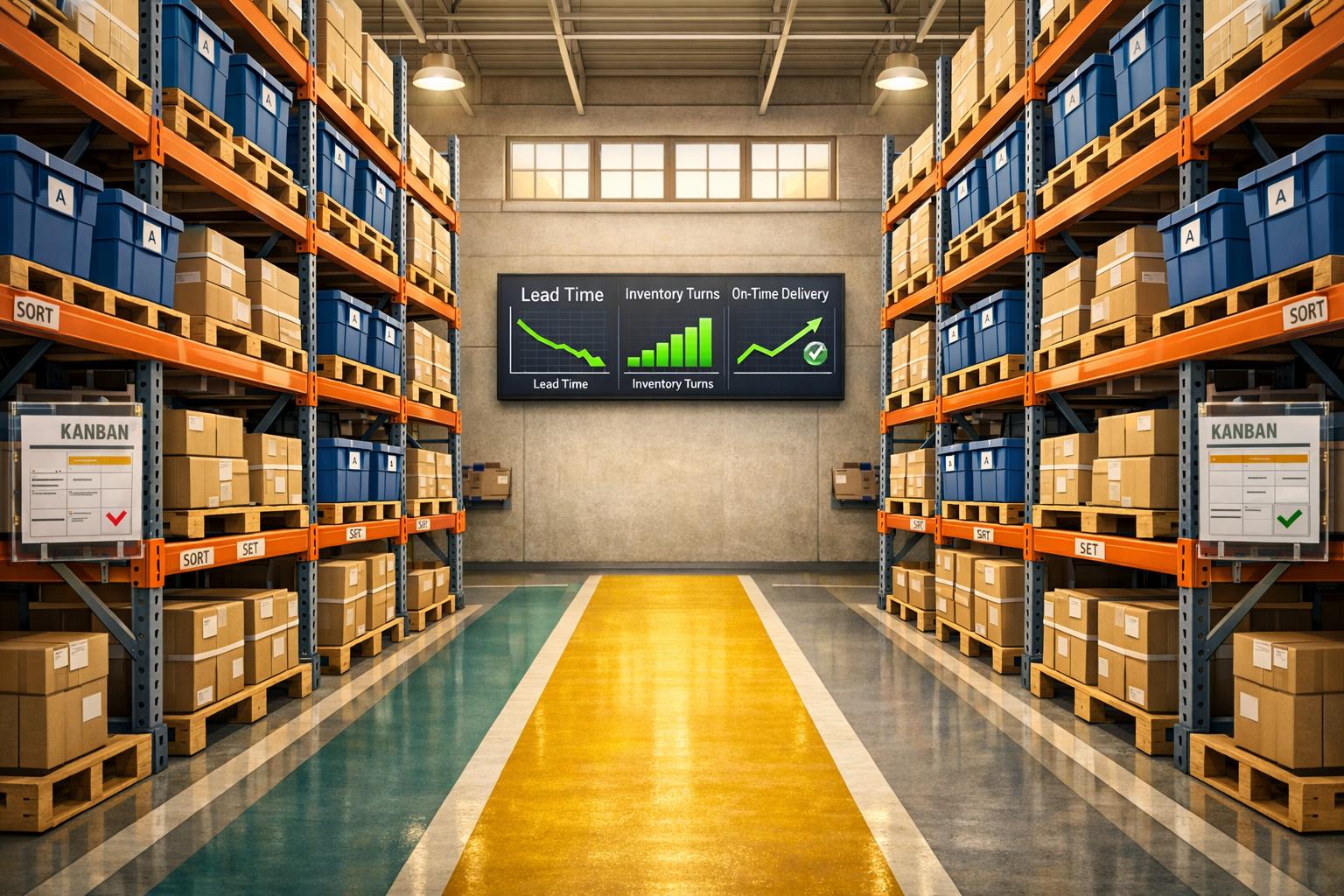
Lean logistics focuses on reducing waste, improving efficiency, and delivering value to customers at the lowest cost. Inspired by Toyota's manufacturing principles, this approach optimizes transportation, warehousing, inventory, and information flow.
Key takeaways:
- Companies report 50%+ productivity boosts and inventory cost reductions of 30–50% using lean methods.
- Tools like Value Stream Mapping (VSM) cut lead times by 44.84% and inventory levels by 87.50%.
- Lean logistics replaces forecast-based systems with demand-driven "pull" models, reducing overproduction and excess inventory.
This guide explains how to:
- Assess current workflows using tools like VSM and Gemba walks.
- Create role-specific training programs with methods like 5S, Kaizen, and Kanban boards.
- Measure success through KPIs, including order accuracy, inventory turnover, and ROI.
Lean logistics training is not a one-time event but a continuous process, incorporating technology like AI and VR for better results. With the right approach, businesses can cut operating costs by 15–30% and build more efficient supply chains.

Lean Logistics Training Impact: Key Statistics and ROI Metrics
Lean Logistics Principles Explained
Core Principles of Lean Logistics
Lean logistics is built on seven key principles that reshape how supply chains function. It begins with a clear focus on defining customer value - pinpointing what matters most to customers, whether that's speed, precision, or adaptability. From there, the goal is to cut out activities that don’t add value. Tools like Value Stream Mapping (VSM) help visualize the entire flow of materials and information, making it easier to identify bottlenecks and inefficiencies.
A pull system is central to optimizing flow, ensuring that products move smoothly from production to delivery. Instead of relying on forecasts, logistics activities are triggered by actual customer orders, which helps avoid overproduction and excess inventory. Standardization plays a vital role in reducing variability and minimizing errors, while continuous improvement (Kaizen) encourages ongoing, small-scale adjustments to improve processes.
Finally, waste elimination is achieved through the DOWNTIME framework, which targets eight specific types of waste: Defects, Overproduction, Waiting, Non-utilized Talent, Transportation, Inventory, Motion, and Excess Processing.
"Lean logistics is a strategic approach to supply-chain management based on a set of techniques and strategies that aim to reduce waste by eliminating every process that adds no value to the company's workflow." – ShippyPro Team
These principles underscore why lean logistics offers a more efficient alternative to traditional supply chain methods.
Lean vs. Conventional Logistics Methods
One of the biggest differences between lean and conventional logistics lies in how actions are triggered. Lean logistics operates on actual demand, while conventional systems depend on forecasts. Traditional systems follow a push model, producing goods based on predictions and often leading to high buffer stocks kept "just in case" demand increases. Lean logistics, by contrast, uses a pull model, maintaining minimal inventory through Just-in-Time practices.
Conventional logistics often struggles with inefficiencies - large batch processing can cause delays and tie up cash in surplus stock. Lean systems prioritize continuous flow and quick adaptability, making them far more responsive to market shifts. Where traditional methods might accept some waste as a cost of doing business, lean logistics works to systematically eliminate it.
The financial impact of lean logistics is substantial. By cutting operating costs by 15–30%, companies can significantly reduce expenses in a domain that typically accounts for 25–45% of their total operating costs. This efficiency makes lean logistics a compelling choice for modern supply chains.
sbb-itb-eafa320
Assessing Your Training Needs
Evaluating Current Operations
Before diving into lean logistics training, it’s crucial to take a close look at your current operations through the lens of lean principles. Start with a needs assessment to identify key skill gaps. Compare the current skill levels of your team with where they need to be. This gap analysis will highlight the areas where training can make the biggest impact and deliver measurable results.
One powerful tool for this process is Value Stream Mapping (VSM). By visually mapping your entire workflow - from raw materials arriving at your facility to the final delivery - you can pinpoint areas of waste and opportunities for value creation. When applied to training, VSM isn’t just theoretical; it has real-world impact. For example, it has been shown to reduce lead times by 44.84% and cut inventory levels by 87.50%.
Another hands-on method is conducting a Gemba walk during peak hours. This involves observing operations directly on the floor and using a checklist to identify waste in categories like transportation, motion, waiting, and defects. For instance, you might count how often pickers cross paths in a busy aisle or track how much time they spend searching for items. Did you know that travel distance can take up 50–70% of a picker’s total task time?
Leverage data from your warehouse management system to create heat maps of high-traffic areas. These visuals can reveal inefficiencies, such as high-demand items being stored in poorly optimized locations. Dive deeper by analyzing 13 weeks of On-Time-In-Full (OTIF) data to uncover patterns in late deliveries. For example, are delays caused by inventory shortages, carrier issues, or paperwork errors? You can also sample outbound trailers to measure cube utilization - boosting this metric by just 10 points can lower freight costs by 5–8%.
Finally, develop a skills matrix to assess task coverage and identify any single points of failure. Establish baseline metrics for key areas like lead times, inventory levels, and transportation costs. These benchmarks will serve as a foundation for measuring the success of your training efforts.
Setting Training Goals and Metrics
Once you’ve analyzed your operations, it’s time to set clear training goals based on the gaps you’ve identified. These objectives should directly tie to measurable business outcomes. For example, focus on reducing dock-to-stock time, improving picking productivity, or increasing trailer cube utilization to exceed 80% efficiency. Implementing Just-in-Time systems can lead to impressive results, such as cutting stock costs by 30–50% and increasing productivity by 20–40%.
"The success of Lean implementation relies heavily on the improvement competence of the workforce." – Sarah Wooledge, Lean Competency System
Set specific, role-based goals tailored to the daily challenges of each department. For instance, warehouse pickers might aim to reduce search times per pick, while transportation coordinators could focus on optimizing load planning. Calculate your Takt time - the available shipping minutes divided by the target number of loads per shift - to ensure your operations align with customer demand.
Define clear KPIs (Key Performance Indicators) before training begins. These might include metrics like order accuracy, delivery speed, cost per shipment, and inventory turnover. By linking each training objective to tangible benefits, employees can see how their efforts contribute to personal and company success. Transparency like this not only builds trust but also eases concerns about job security.
As part of the training, require participants to create action plans. These plans should outline how they’ll apply their new skills, complete with specific and measurable steps to track progress. When training addresses the real challenges employees face every day, they’re more likely to embrace it - and the results will speak for themselves.
Creating Your Training Program
Building Role-Based Training Content
Craft training materials that address the specific challenges faced by each role. For example, warehouse staff benefit from practical lessons on 5S methodology, forklift safety, and efficient order handling. Drivers need training in defensive driving, vehicle inspections, and handling hazardous materials safely. Meanwhile, managers and logistics coordinators thrive with tools like Value Stream Mapping, data analysis, Gemba walks, and Hoshin Kanri for policy deployment.
The complexity of training should match the role. A forklift operator doesn’t need to master strategic planning frameworks but must recognize how the 8 Wastes appear in daily tasks, such as unnecessary movement due to poorly organized storage. On the other hand, managers should understand strategy and also have enough practical knowledge to lead effectively during Gemba walks.
"Lean management is about eliminating wasteful work so that employees can focus their efforts on work that adds value to the customer and the organization." – Maggie Millard, KaiNexus
A shared Lean vocabulary is essential for smooth collaboration. Terms like Muda (waste), Kaizen (continuous improvement), Gemba (the place where work happens), and Takt time (production rhythm) should be part of everyone's training. Using consistent terminology bridges communication gaps between departments.
Set SMART objectives for each training module - Specific, Measurable, Achievable, Relevant, and Time-bound. For instance, "Reduce late deliveries by 30% by the end of Q4" gives employees a clear goal to work toward. Before rolling out the program company-wide, test it through a pilot program with employees from different departments. This feedback loop helps refine the materials before full implementation.
Once the content is ready, focus on delivery methods that make the material engaging and applicable.
Selecting Training Delivery Methods
With role-specific content in place, choose delivery methods that best support the learning objectives.
- Hands-on workshops are perfect for teaching manual skills like forklift operation, load securing, or setting up 5S systems. These sessions allow trainees to practice in a controlled environment where mistakes turn into learning moments. However, they require physical equipment and space, which can limit participation.
- Online learning brings flexibility and scalability, making it ideal for theoretical topics like Lean principles or compliance training. It’s cost-effective, especially for large teams or high-turnover settings, as employees can learn at their own pace without travel costs. The downside? It lacks hands-on practice and depends on individual discipline.
- Microlearning delivers short, targeted lessons (under five minutes) that fit into busy schedules. This method is great for quick refreshers but may fall short for complex topics.
- Instructor-led classroom sessions shine when tackling complex theories or facilitating group discussions. They allow for immediate feedback and are excellent for exploring strategic Lean principles or problem-solving exercises. However, scheduling these sessions without disrupting daily operations and covering facility costs can be tricky.
The most effective training often combines multiple methods through blended learning. This approach integrates online modules for foundational knowledge, hands-on workshops for practical skills, and microlearning for ongoing reinforcement. For example, logistics coordinators could complete an online course on identifying bottlenecks, then participate in an instructor-led workshop to analyze real warehouse data. This layered method ensures that training aligns with Lean logistics principles, building a more efficient and waste-free operation.
Launching and Maintaining Training Programs
Rolling Out Your Training Program
Once your training content is ready, the next big step is ensuring a smooth implementation and ongoing success. Start by drawing insights from your pilot program. A cross-department pilot is a great way to fine-tune your content and delivery methods before launching across the entire organization. This process can uncover potential scheduling conflicts or resource gaps that might otherwise disrupt the full rollout.
Strategic scheduling plays a key role here. Training sessions should be planned to accommodate all shifts without interfering with daily operations. For example, in a distribution center with multiple shifts, you could stagger training over several weeks to maintain adequate coverage for each shift. Working closely with supervisors to identify slower operational periods can further reduce disruptions.
Another important aspect is empowering your team members, which aligns with Lean principles. Identify and train local champions who can embody Lean practices and mentor their peers. These champions can act as on-the-floor trainers, answering questions and demonstrating techniques in real time. This approach fosters collaboration and helps the team embrace Lean practices. It's also essential to clearly communicate that Lean training focuses on eliminating waste - not cutting jobs - so employees understand its goal is to enhance value-added work. When staff see how Lean methods remove obstacles and streamline their tasks, they’re more likely to get on board.
Creating a Continuous Improvement Culture
After the initial rollout, the focus shifts to embedding Lean practices into your workplace for long-term impact. Start by establishing standard work - documented best practices for every process. This serves as a baseline for measuring future improvements.
Encourage daily progress through Kaizen Teian, where employees are empowered to suggest and implement small, incremental changes. Having a clear system for these suggestions - like regular team huddles - reinforces a culture of continuous improvement. For instance, if an employee notices that rearranging pallet positions could save time, they should feel confident proposing the change right away.
"The Lean Journey of Continuous Improvement never ends." – Charles M. Intrieri
To keep the momentum going, schedule follow-up sessions at 3, 6, and 12 months. These check-ins allow teams to address any challenges, share their successes, and refine their skills. Regular 5S audits and workstation inspections - techniques introduced earlier - help ensure Lean standards remain intact over time. Finally, leadership involvement through Gemba walks, where managers visit the workplace to observe and engage with staff, reinforces the message that continuous improvement is a top priority.
Measuring Training Results
Key Performance Indicators for Lean Logistics
The success of any training program often hinges on the metrics you choose to track. By focusing on metrics aligned with Lean logistics principles, you can ensure your training efforts lead to tangible, waste-reducing outcomes. Start with inventory turnover - a key indicator of how effectively employees are applying Just-in-Time practices. This metric shows how often your entire inventory is sold or replaced annually, helping identify inefficiencies in stock management.
Another critical metric is order lead time, which measures the time between placing an order and the customer receiving it. Shorter lead times often point to improved flow efficiency. Picking accuracy, a must-track for warehouses, highlights operational precision. Top-performing facilities achieve nearly 99.9% accuracy, while others average closer to 97%, leaving room for improvement. Similarly, tracking inventory and receiving accuracy can provide insight into employees' attention to detail and adherence to Lean principles.
To evaluate overall training effectiveness, the Kirkpatrick Model is widely used. It measures success across four levels: Reaction, Learning, Behavior, and Results. For financial accountability, consider calculating Return on Investment (ROI) using the Phillips ROI methodology. Research shows that organizations measuring ROI report a return of $4.53 for every $1 invested in training. When assessing ROI, account for all costs - development, delivery, and participant time, which can make up 60–70% of total expenses. Establishing baselines before training begins ensures you can accurately measure improvement.
Using methods like control groups or trend line analysis can help isolate the effects of training from other variables, such as new tools or market changes. As Konstantly notes:
"Training is rarely the only variable affecting performance. Isolating training's specific contribution requires rigorous methodology." – Konstantly
By consistently tracking these metrics, you can refine your training programs to better align with Lean logistics goals.
Using Feedback to Improve Training
While metrics provide hard data, employee feedback offers a window into how training impacts day-to-day operations. Gathering feedback at various stages - before, during, and after training - helps assess baseline knowledge, engagement levels, and long-term behavior changes. Use tools like post-training surveys, interviews, focus groups, and LMS data to get a well-rounded view of the program's effectiveness.
Net Promoter Scores (NPS) can serve as a quick gauge of training quality by showing how likely employees are to recommend the program to their peers. To validate whether Lean logistics skills are being applied effectively, combine self-assessments with manager observations at 30, 60, and 90-day intervals after training. If feedback reveals challenges in grasping concepts like 5S or Just-in-Time, consider simplifying the material, adding practical examples, or using interactive simulations to deepen understanding.
Transparency is key - communicating changes based on feedback shows employees that their input matters. Identifying top performers through LMS activity reports and engaging them as mentors can further enhance training outcomes. Interestingly, only 8% of organizations currently measure the business impact of their training programs, meaning robust feedback mechanisms can give you an edge.
At JIT Transportation, these measurement strategies allow us to continuously refine our Lean logistics training, ensuring our operations remain among the most efficient in the industry.
What is Lean Logistics | Key Principles Of Lean Logistics | How It Streamlines Warehouse Operations
Common Training Challenges and Solutions
Even the most carefully designed lean logistics training programs can run into challenges. A frequent issue is resistance to change. Employees may worry about job security or feel more comfortable sticking to familiar routines. However, lean training is about eliminating waste, not jobs - it clears the way for employees to focus on work that adds real value. As Prosci points out, resistance often indicates engagement, offering insights into concerns that deserve attention. One effective way to address this is by involving front-line staff in shaping new workflows. When employees have a hand in designing changes, they are more likely to support and adopt them. Tackling resistance early also strengthens the foundation for solid management backing.
Another common hurdle is a lack of involvement from management. Lean initiatives can falter when leadership delegates the transformation process without providing the necessary resources or setting an example. Research shows that visible and active sponsorship from senior leaders is critical for successful change management. Leaders can demonstrate their commitment by participating in Gemba walks and joining their teams during training pilots.
Limited resources can also complicate training efforts, particularly for smaller organizations. Lean training requires both time and financial investment, and finding a balance between training schedules and day-to-day operations can be tricky. E-learning platforms and mobile apps offer a flexible solution, allowing employees to complete training during slower periods without interrupting daily workflows. Scheduling training during work hours is another way to prevent fatigue and frustration among staff. Beyond scheduling, inconsistent application of lean principles across departments can further disrupt progress.
When different teams adopt lean practices at varying speeds, it can lead to silos and inefficiencies in the supply chain. Standardizing lean practices with a unified playbook, forming cross-functional teams to align objectives, and starting with a foundational 5S system - Sort, Set in Order, Shine, Standardize, and Sustain - can help streamline efforts and deliver quick, visible improvements in workplace organization.
At JIT Transportation, we've learned that directly addressing these challenges with practical strategies can turn potential obstacles into opportunities. These proactive steps help foster the culture of continuous improvement that lies at the heart of lean logistics. Companies that successfully implement lean practices often see productivity gains of 20% to 40% within the first few years, along with production cost reductions of up to 30%. The key is to treat lean training as an ongoing process, not a one-and-done project.
What's Next for Lean Logistics Training
The future of lean logistics training is evolving with new technologies that make learning more interactive, tailored, and data-focused. Tools like virtual and augmented reality are no longer futuristic concepts - they’re being used today to train warehouse teams in forklift operation, vehicle handling, and emergency response scenarios. Artificial intelligence is also playing a key role, analyzing learning behaviors to create personalized training paths while improving warehouse processes. For example, companies using AI-driven scheduling have reported a 15–25% reduction in travel time and 10–20% faster put-away speeds within just three months. In 2025, Unilever implemented AI-powered systems alongside lean logistics, cutting stock waste by 30% and significantly boosting order fulfillment.
In addition to technological shifts, sustainability is becoming a cornerstone of lean logistics training. It's no longer just an add-on - it’s now integrated into core training practices. Programs are adopting "Lean and Green" principles, merging cost-cutting strategies with environmental efficiency. This means teaching employees how to reduce carbon emissions, lower fuel consumption, and adopt electric or hybrid fleets.
"By integrating lean principles with sustainability practices, businesses can achieve collaborative benefits including improved operational efficiency, reduced environmental impact, enhanced stakeholder value, and long-term resilience in a rapidly changing world." – Travis Gibbs, Packaging Engineer at DISHER
Training now focuses on the Triple Bottom Line - people, profit, and planet - to ensure that efficiency and sustainability go hand in hand.
Another major trend is the rise of data-driven training methods, which replace guesswork with actionable insights. Analytics are being used to pinpoint skill gaps, monitor real-time performance, and measure training ROI. Predictive analytics, for example, help managers anticipate demand changes and potential disruptions, shifting training from reactive fixes to proactive planning. Visual dashboards tracking metrics like fuel efficiency and cost per mile give employees immediate feedback on how their actions affect operations. This data-focused approach enables companies to set realistic goals and refine training based on actual outcomes.
Meanwhile, microlearning and mobile-first training are making lean education more practical and accessible. Instead of pulling workers away for long training sessions, companies are using short, focused modules that employees can access on their phones during downtime. Gamification is also being incorporated into digital training to increase engagement and retention.
"Logistics training is about preparing SCM teams and industry professionals to adapt to the biggest today's logistics training challenges, arming them with the skills needed to stay one step ahead of the competition." – Zach Caronongan, Training Orchestra
A good starting point? Launch 90-day pilot programs with technologies like VR for forklift safety or AI for inbound handling to demonstrate ROI. These digital strategies help lean operations stay efficient and ahead of market demands.
At JIT Transportation, these trends are already reshaping how logistics training is approached. The focus is shifting from simply teaching lean principles to equipping employees with the digital skills and flexibility needed to work alongside automation. This includes preparing workers for higher-value roles, such as robotics supervision, exception handling, and quality control. Companies that integrate lean training with these emerging technologies are setting themselves up not just for short-term efficiency, but for long-term success in an increasingly complex supply chain environment.
Conclusion
Lean logistics training isn't just a task to check off a list - it reshapes how an organization operates. The aim is straightforward: cut out waste, empower employees to identify inefficiencies, and cultivate a mindset of ongoing improvement that becomes second nature. When implemented effectively, the results are undeniable. Industry leaders consistently demonstrate the power of lean training to drive meaningful change.
The process begins with a Value Stream Audit to pinpoint bottlenecks. From there, develop targeted, role-specific training programs. Incorporate practical tools like hands-on simulations and visual aids such as Kanban boards to streamline and standardize operations.
Technology also plays a crucial role in supporting lean practices. Tools like Warehouse Management Systems (WMS), Transportation Management Systems (TMS), and IoT sensors provide real-time data that enhances decision-making and efficiency. But technology alone isn’t enough. The human element remains vital. Employees working in clean, organized spaces that follow 5S principles can see productivity gains of up to 15%. Building strong supplier relationships and using feedback loops to track metrics like lead time, order accuracy, and inventory turnover are equally important for sustaining progress.
Each step in this process contributes to creating a resilient and efficient operation. At JIT Transportation, these principles are part of our daily routine, helping us tackle today’s challenges while preparing for future opportunities. Whether you're starting with a small pilot project or refining an ongoing initiative, the key is to start small, measure your progress, and continuously improve. Successful companies know that lean is not a one-time effort - it’s a long-term commitment.
FAQs
How do I choose which lean tool to train first?
Choosing the right lean tool to start with depends on what your organization aims to achieve and its current challenges. Many companies kick things off with 5S (Sort, Set in Order, Shine, Standardize, Sustain) to establish a clean and organized workspace. Others might opt for Standard Work, which focuses on documenting and standardizing best practices. These initial steps often deliver quick, visible results, helping to build momentum and prepare the team for more advanced methods like Kanban or Kaizen.
What KPIs show lean logistics training is effective?
Key performance indicators (KPIs) that showcase the impact of lean logistics training include measurable boosts in productivity. For example, picking accuracy can reach up to 99.9%, order fill rates often improve, labor costs per unit decrease, and cycle times become noticeably shorter. Together, these metrics highlight gains in efficiency and overall operational performance.
How do we reduce resistance to lean changes?
Resistance to lean changes often stems from the way they're introduced and communicated. To reduce pushback, it's important to involve employees from the start, clearly outline the purpose behind the changes, and encourage open, honest communication. Assume that concerns come from a place of good intent, and respond with empathy to address them. Providing regular training - woven into everyday tasks - can boost both confidence and skills. Building a workplace culture centered on continuous improvement and shared objectives can also help maintain momentum, easing fears and minimizing misunderstandings.
Related Blog Posts
Related Articles

Demand-Driven Replenishment for Multi-Node 3PL

3PL Models Compared for Reverse Logistics Carbon