Top 6 Trends in Technology-Driven 3PL Solutions
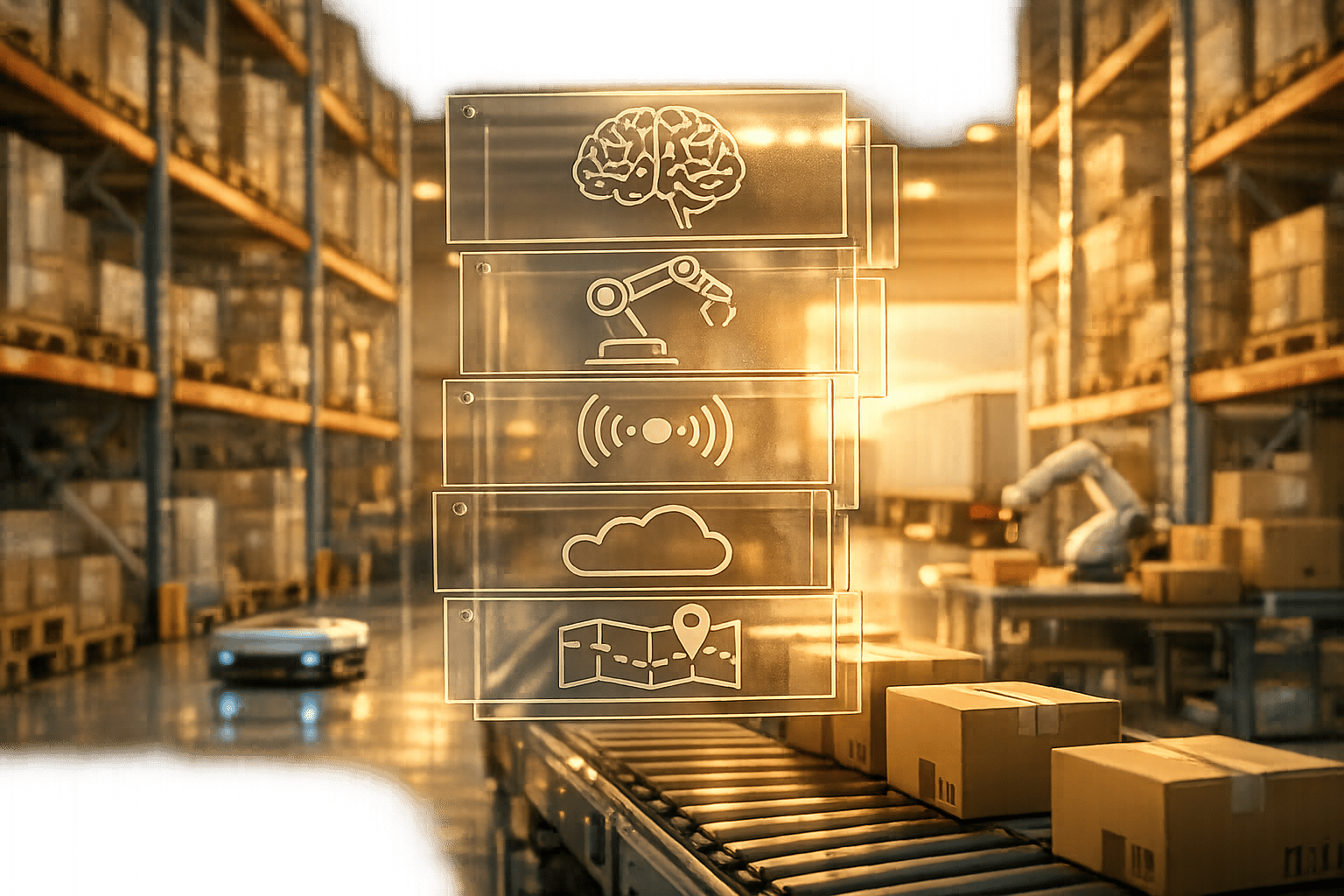
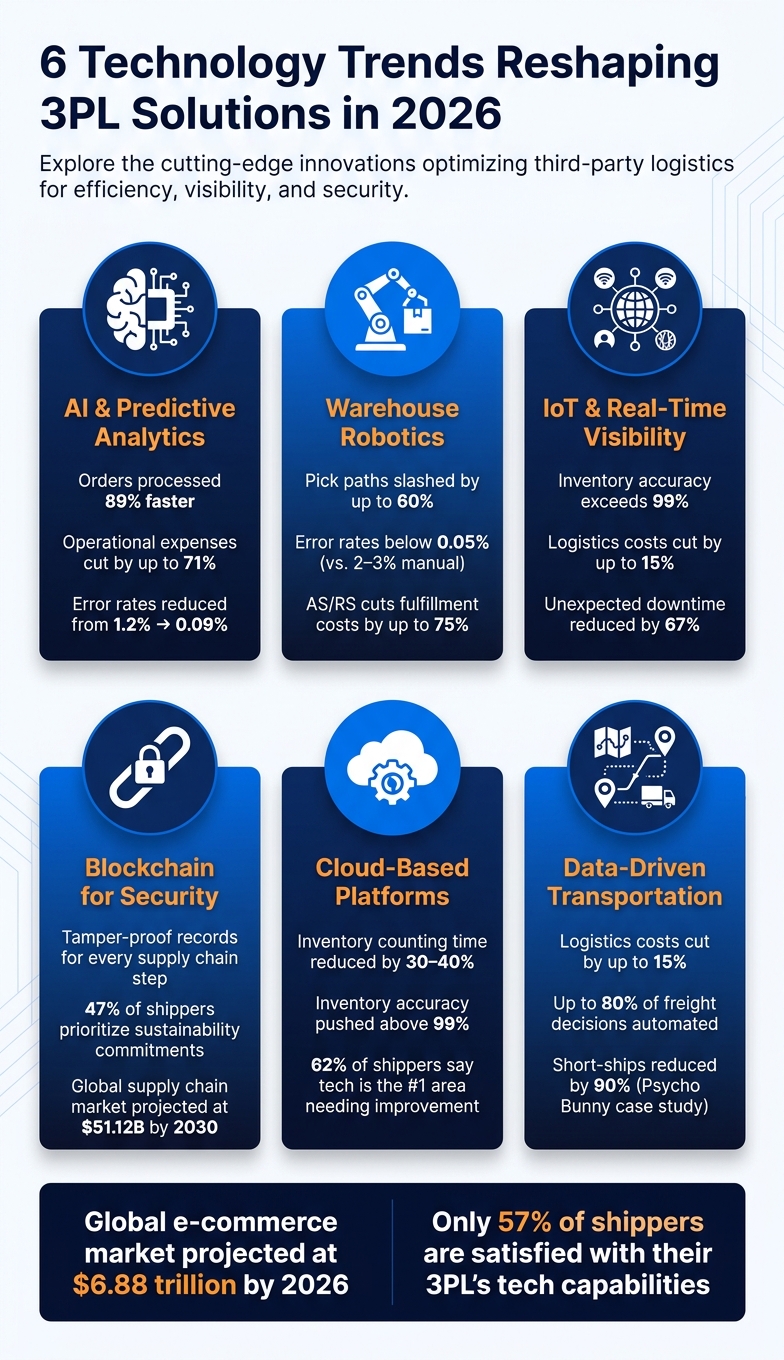
The logistics industry is being reshaped by six major trends that are critical for meeting the demands of a $6.88 trillion global e-commerce market by 2026. Third-party logistics providers (3PLs) are moving beyond basic operations to adopt advanced tools and systems that improve efficiency, cut costs, and enhance customer experience. Here's a quick rundown of the key trends driving this transformation:
- AI and Predictive Analytics: Automating decisions to optimize inventory placement, labor, and freight routing, cutting operational expenses by up to 71%.
- Warehouse Robotics: Using robots like AMRs and cobots to improve order picking speed and reduce error rates.
- IoT for Visibility: Real-time tracking with sensors and RFID, boosting inventory accuracy to over 99%.
- Blockchain for Security: Creating tamper-proof records for supply chain transparency and faster processes.
- Cloud-Based Systems: Centralizing operations with flexible platforms that integrate AI, robotics, and IoT.
- Data-Driven Transportation: Using real-time data to refine routes, consolidate shipments, and reduce logistics costs by up to 15%.
These trends are reshaping how 3PLs operate, offering faster, more precise, and cost-effective solutions for e-commerce brands. The stakes are high, with only 57% of shippers satisfied with their 3PL providers' tech capabilities. Businesses must act now to stay competitive.
6 Tech Trends Reshaping 3PL Solutions in 2026
AWS re:Invent 2024 - Warehouse automation with cutting-edge supply chain solutions (PRO205)
sbb-itb-eafa320
1. AI and Predictive Analytics in 3PL
In logistics, AI has moved beyond being just a trendy term. It now serves as a "system of action", actively resolving issues rather than simply identifying them. Modern third-party logistics providers (3PLs) are embracing automated decision-making, enabling tasks like inventory positioning, labor allocation, and freight routing to happen seamlessly - often before a human even reviews the data. This evolution is setting the stage for more advanced predictive analytics and automation.
AI-powered facilities operate with impressive efficiency. They process orders 89% faster, nearly doubling employee productivity (1,543 orders per day compared to 847) and significantly lowering error rates from 1.2% to just 0.09%.
Predictive analytics plays a crucial role in this transformation. By examining past sales and current market trends, it positions inventory closer to where demand is expected - often days ahead of actual orders. A great example is FulfillmentMax, a mid-sized 3PL that implemented such a system in 2026. The results were striking:
"Our AI system predicts where products need to be three to five days before orders come in, which has cut our average shipping distances by 43% and reduced our transportation costs accordingly." - Jennifer Martinez, VP of Operations, FulfillmentMax
Early adopters of these technologies have seen dramatic improvements in efficiency. Operational expenses dropped by 71%, with labor costs reduced by $2.34 per order and packaging costs cut by 34%. Sarah Williams, Senior Analyst at Supply Chain Intelligence Group, highlighted the competitive edge this provides:
"E-commerce businesses that fail to leverage these AI capabilities risk falling behind competitors who are achieving 70% lower fulfillment costs."
The key to maximizing returns lies in integrating AI with warehouse management systems, transportation platforms, and robotics. This approach eliminates data silos and streamlines operations, delivering unmatched efficiency and cost savings.
2. Warehouse Robotics and Automation in Fulfillment
AI might make the key decisions, but it's warehouse robotics that handle the heavy lifting - literally. These systems are transforming fulfillment by cutting down on manual labor and boosting efficiency. For instance, goods-to-person systems can slash average pick paths by as much as 60%, while pick-to-bot robotics reduce warehouse travel time by 50% to 60%. The result? More labor hours are freed up during each shift.
A broad range of robotic technologies is now reshaping how 3PLs operate. Autonomous Mobile Robots (AMRs), guided by AI and sensors, zip around at speeds nearly three times faster than the average human. Automated Storage and Retrieval Systems (AS/RS) utilize vertical space, allowing warehouses to store three to five times more products in the same area while cutting fulfillment costs by up to 75%. Meanwhile, collaborative robots (cobots) safely work alongside human staff, handling repetitive tasks like picking and palletizing. When paired with AI-driven analytics, these robotic tools significantly enhance fulfillment efficiency.
One development making these technologies more accessible is Robotics-as-a-Service (RaaS). Instead of spending $250,000 to $750,000 on an AMR fleet - or up to $2 million for an AS/RS installation - 3PLs can now opt for a pay-as-you-go model, paying per pick or per month. For e-commerce brands embracing this model, it often means a per-order fulfillment fee of just $2 to $5.
Recent examples showcase how quickly this technology is advancing. In January 2026, Dallas-based 3PL Productiv was operating 13 cobots, 2 humanoid robots, and 1 palletizing robot. This marked one of the first uses of humanoid robots in commercial fulfillment, addressing labor shortages and rising costs. Similarly, DHL Supply Chain introduced the Locus Array at its Columbus, Ohio facility. This system combines mobile robotics with an AI-powered robotic picking arm, automating piece-picking even in narrow aisles. These deployments highlight how robotics and AI are being seamlessly integrated to drive efficiency gains.
"The intersection of software, AI, [and] analytics capabilities with physical robotics and automation … is really exciting. I think we're hitting that inflection point where you can bring intelligence into those physical solutions." - Omer Rashid, Vice President of Operations Development, DHL Supply Chain
Robotics also bring precision to the table. For example, computer vision-based quality control reduces error rates to below 0.05%, a stark contrast to the 2% to 3% error rates often seen in manual processes. With 74% of shippers saying they'd switch 3PL providers based on their AI and automation capabilities, modernizing fulfillment operations isn't just about staying competitive - it’s about thriving in an increasingly automated world.
3. IoT and Real-Time Supply Chain Visibility
IoT technology is revolutionizing supply chain management by providing real-time insights far beyond warehouse automation. Tools like sensors, RFID tags, GPS trackers, and connected scanners feed continuous data into centralized platforms, turning every action - whether it's picking, packing, or loading - into measurable information. Ashley Taylor, Product Manager at Cleverence, captures this perfectly:
"IoT isn't just another tech buzzword for 3PLs - it's the connective tissue that turns daily warehouse activity into measurable, actionable data."
This constant data stream powers real-time dashboards, helping supervisors spot bottlenecks as they happen and enabling customer service teams to provide instant updates on order statuses. For e-commerce companies juggling multiple sales channels, automated inventory tracking is a game-changer, helping to avoid stockouts and overselling. With disciplined use of RFID and barcode systems, inventory accuracy can exceed 99%. This level of precision doesn’t just prevent inventory issues - it also supports advanced tools for billing and operational simulations.
IoT also delivers financial and operational benefits. Logistics orchestration powered by IoT can slash costs by up to 15%, while predictive maintenance sensors reduce unexpected downtime by 67%. Environmental sensors play a critical role in safeguarding sensitive goods, particularly in cold chains. By monitoring temperature and humidity levels, these sensors can trigger alerts to prevent spoilage, ensuring product integrity.
On the administrative side, IoT simplifies billing by linking scans and workflow events directly to client tariffs. This eliminates the need for error-prone manual spreadsheets, replacing them with automated, accurate invoicing. The growing demand for such visibility tools is evident, with the supply chain visibility software market valued at $2.4 billion in 2023 and projected to grow at an annual rate of 13% through 2032.
Taking visibility a step further, digital twin technology is emerging as a practical application. By creating 3D replicas of warehouses, businesses can simulate layout changes and automation scenarios before implementation. This evolution from simple tracking to actionable intelligence highlights how IoT is reshaping supply chain operations, as noted by Keith Biondo, Publisher of Inbound Logistics.
4. Blockchain for Secure Supply Chain Data
Blockchain adds a powerful layer of security and trust to supply chain operations by creating a tamper-proof ledger that records every step of a product's journey. While IoT generates a steady flow of operational data, blockchain ensures that this data is reliable and accessible to all stakeholders. From loading and packaging to customs clearance and delivery, every movement is documented in a way that can't be altered. This shared record reduces disputes and speeds up processes by cutting down on administrative delays.
"Blockchain and collaborative logistics allow for more transparent and accountable solutions." - Ashwani Sharma, AI Engineer & Technology Specialist, Signity Solutions
One standout feature of blockchain is the use of smart contracts. These automated workflows execute specific actions when certain conditions are met. For instance, a smart contract can automatically release payment to a carrier once delivery is confirmed, streamlining operations and improving efficiency. Blockchain also plays a crucial role in verifying the origin of goods, which is especially important in industries where tracking the chain-of-custody is non-negotiable.
That said, blockchain isn't always the best fit for every operation. For simpler domestic supply chains with trusted partners, a well-designed cloud database can often achieve similar results with less complexity and cost. Blockchain shines in scenarios involving multiple parties with varying levels of trust - like cross-border trade, customs documentation, or ESG reporting. For example, as sustainability gains importance, 47% of shippers now prioritize meeting sustainability commitments. However, data accuracy is critical. Errors like duplicate SKUs or incorrect unit entries can become permanent once recorded on the blockchain.
When combined with IoT, blockchain takes supply chain monitoring to the next level. IoT sensors can feed data - such as temperature readings for sensitive shipments - into the blockchain, creating a fully auditable and accurate trail from start to finish. With the global supply chain market projected to reach $51.12 billion by 2030, the push for secure and transparent systems is only expected to grow further.
5. Cloud-Based Platforms and System Integration
Cloud-based platforms are transforming how supply chains operate, combining AI, robotics, and IoT into a single, cohesive system. These platforms, especially a cloud Warehouse Management System (WMS), act as the central hub for operations, ensuring everything runs smoothly and efficiently. As Chipper Farley, President of 3PL Solutions at Made4net, explains:
"A good WMS isn't just another tool in the stack - it's the brain and backbone of your operations." - Chipper Farley
What makes these platforms so effective is their adaptability. Thanks to open architectures and standardized APIs, businesses can add features like AI-driven picking or IoT sensor integration without overhauling their entire system. This flexibility allows 3PLs to fine-tune workflows - whether it's updating labeling rules or adjusting carrier preferences - without lengthy delays or engineering bottlenecks. This kind of seamless integration is a cornerstone of digital transformation in logistics.
The benefits are hard to ignore. For example, adding a mobile warehousing layer to a cloud WMS can reduce inventory counting time by 30% to 40% and uncover 1% to 2% of "phantom stock" within just a week. On-device validations catch errors early, pushing inventory accuracy above 99%. These improvements not only cut labor costs but also help avoid expensive mistakes during fulfillment.
Another shift is happening in how these systems are priced. Many 3PLs are moving away from hefty upfront costs and adopting Robotics-as-a-Service (RaaS) or modular software subscriptions. This model turns unpredictable capital expenses into manageable monthly fees, making advanced technologies more accessible.
With 62% of shippers highlighting technology as the area most in need of improvement in their 3PL partnerships, cloud integration is no longer optional - it's essential. These platforms connect innovations like AI, robotics, IoT, and blockchain, creating a competitive edge for businesses that embrace them. As Farley puts it, "The 3PLs that really win are the ones that treat their WMS as a platform - something they can build on".
At JIT Transportation, cloud-based platforms play a key role in driving efficiency and flexibility in today’s fast-paced e-commerce logistics environment.
6. Data-Driven Transportation Management
Moving freight efficiently starts with smarter decisions before the journey even begins. Data-driven transportation management uses real-time insights - like traffic conditions, weather updates, vehicle capacity, and driver availability - to continuously refine routes. This approach helps cut fuel costs, speed up deliveries, and minimize unexpected delays.
Beyond route optimization, another major cost saver is load planning and shipment consolidation. By combining smaller orders into Less-Than-Truckload (LTL) shipments, 3PLs can make better use of truck space and significantly lower carrier fees. Add to this the power of AI-driven carrier selection through digital freight auction platforms, and shippers can benefit from competitive, market-based rates instead of relying on fixed tariffs.
AI is also stepping up its game by not just identifying issues but solving them. As Loadsmart explained:
"In 2026, we are focused on 'closing the loop' - enabling our AI agents not just to recommend actions (like rescheduling a late load) but to execute them autonomously within pre-set guardrails."
This proactive approach is already making waves. For instance, apparel brand Psycho Bunny began using Deposco's Causal AI in early 2026. The system automatically adjusted warehouse management system (WMS) operations in response to rising cost signals, reducing short-ships by an impressive 90%. These kinds of automated solutions pave the way for scalable improvements.
Scalability is a key factor, especially for growing e-commerce companies. AI-powered decision-making can cut logistics costs by up to 15% while automating as much as 80% of freight-related decisions. This means businesses can handle increasing shipment volumes without adding significant overhead. Just as AI and robotics have transformed other industries, data-driven transportation management is becoming a cornerstone of modern, tech-enabled logistics. At JIT Transportation, this approach plays a crucial role in meeting the speed, reliability, and cost expectations of today’s e-commerce-driven supply chains.
Conclusion
The six trends - AI, robotics, IoT, blockchain, cloud integration, and data-driven transport - are reshaping how 3PL operations function today. Together, these technologies are crafting smarter, more efficient supply chains that elevate fulfillment processes and improve the overall user experience. This shift is especially crucial as e-commerce brands face mounting competitive pressures.
With global e-commerce sales projected to reach $6.88 trillion by 2026, consumers now demand faster, more accurate, and transparent delivery services. However, only 57% of shippers report satisfaction with their 3PL provider's technological capabilities, highlighting a clear divide between tech-savvy and traditional, manual operations.
"Expectations for 3PLs have grown. It's no longer sufficient to simply move freight from Point A to Point B. Shippers now expect continuous improvement, value creation, and the strategic use of technology and expertise to drive efficiency and insight."
Adopting new technology doesn’t require an all-in approach. Begin with targeted pilot programs - such as automating cycle counts or streamlining receiving workflows - to quickly see ROI and improve accuracy. From there, prioritize 3PL partners that offer open-API warehouse management systems capable of integrating smoothly with your e-commerce platform and scaling alongside your business.
As fulfillment demands continue to rise, ongoing technological integration will be essential. JIT Transportation already leverages these advancements to deliver scalable and efficient support for e-commerce operations.
FAQs
Which 3PL tech upgrade should I implement first for fastest ROI?
If you're aiming for a fast return on investment, consider implementing an AI-powered, cloud-based Warehouse Management System (WMS). This type of system improves key operations like inventory forecasting, pick-path optimization, and real-time visibility.
A cloud-based WMS also makes it easier to integrate with advanced tools, such as autonomous robots and AI analytics, as your business grows. Companies like JIT Transportation use this cutting-edge infrastructure to provide reliable, efficient, and scalable fulfillment solutions. This approach ensures your supply chain stays flexible and ready to adapt to shifting market demands.
How can I connect AI, robotics, and IoT without replacing my WMS?
Integrating AI, robotics, and IoT into your existing Warehouse Management System (WMS) is simpler with the help of a Warehouse Execution System (WES) or orchestration platforms. These tools function as middleware, connecting your WMS to devices while handling real-time tasks efficiently. By using modern, device-agnostic platforms, you can achieve smooth integration through APIs or EDI, making it possible to boost automation without the need for a complete system overhaul.
When is blockchain actually worth using in a 3PL supply chain?
Blockchain proves its worth in a 3PL supply chain when transparency, traceability, and trust are critical across a network involving multiple parties. By using a tamper-proof, shared ledger, it records shipment histories, handoff details, and audit trails. This not only reduces disputes and ensures authenticity but also simplifies compliance and accelerates the movement of goods by allowing authorized stakeholders to access coordinated data seamlessly.
Related Blog Posts
Related Articles

Demand-Driven Replenishment for Multi-Node 3PL

3PL Models Compared for Reverse Logistics Carbon