
How 3PLs Train White Glove Delivery Teams
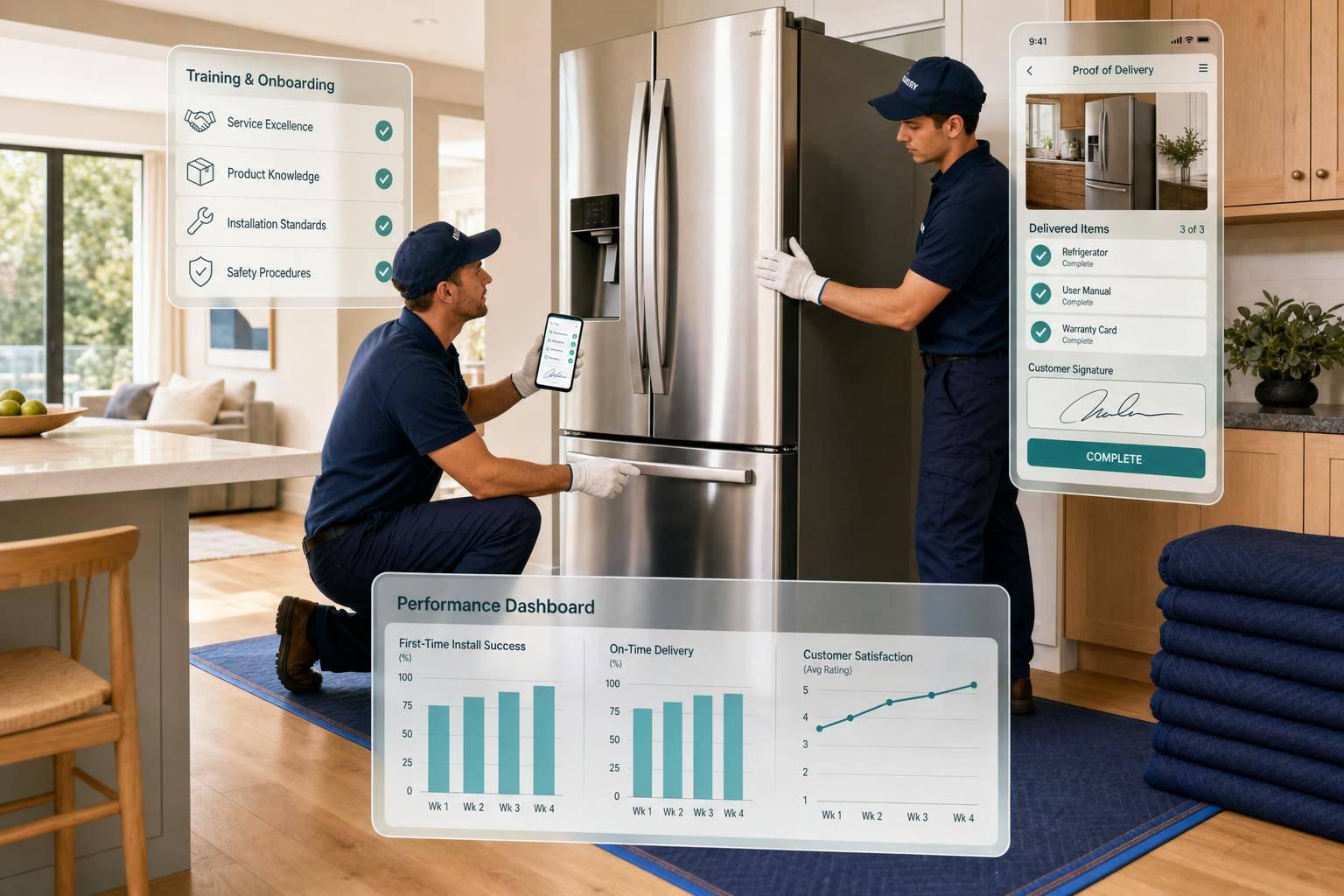
White glove delivery teams are trained to do far more than drop off a package. I’d sum it up like this: 3PLs need a set onboarding process, hands-on handling and safety drills, in-home service training, mobile proof-of-delivery habits, and regular KPI-based coaching.
Here’s the short version:
- Onboarding sets the base: hiring checks, SOPs, product guides, route prep, and photo/document rules
- Field skills cut claims: crews train on lifting, carrying, assembly, home protection, and incident reporting
- Customer service training shapes the visit: how crews speak, enter the home, explain setup, and handle delays
- Mobile tools close the loop: photos, notes, signatures, and dispatch updates help track each stop
- Review cycles keep quality in line: damage claims, OTIF, CSAT, repeat visits, and install success show where crews need more work
A few numbers make the point fast:
- Furniture damage claims often cost $800 to $2,500
- Some carriers get dropped when claim rates go above 2%
- One case study showed OTIF rising from 17.3% to 73.4%
- 46% of retailers reported better repeat purchase rates when delivery precision improved
If I were to boil the article down to one idea, it’s this: white glove training is a repeatable system, not a one-time lesson. The goal is simple - move the item safely, protect the home, finish setup, document the stop, and leave the customer with no loose ends.
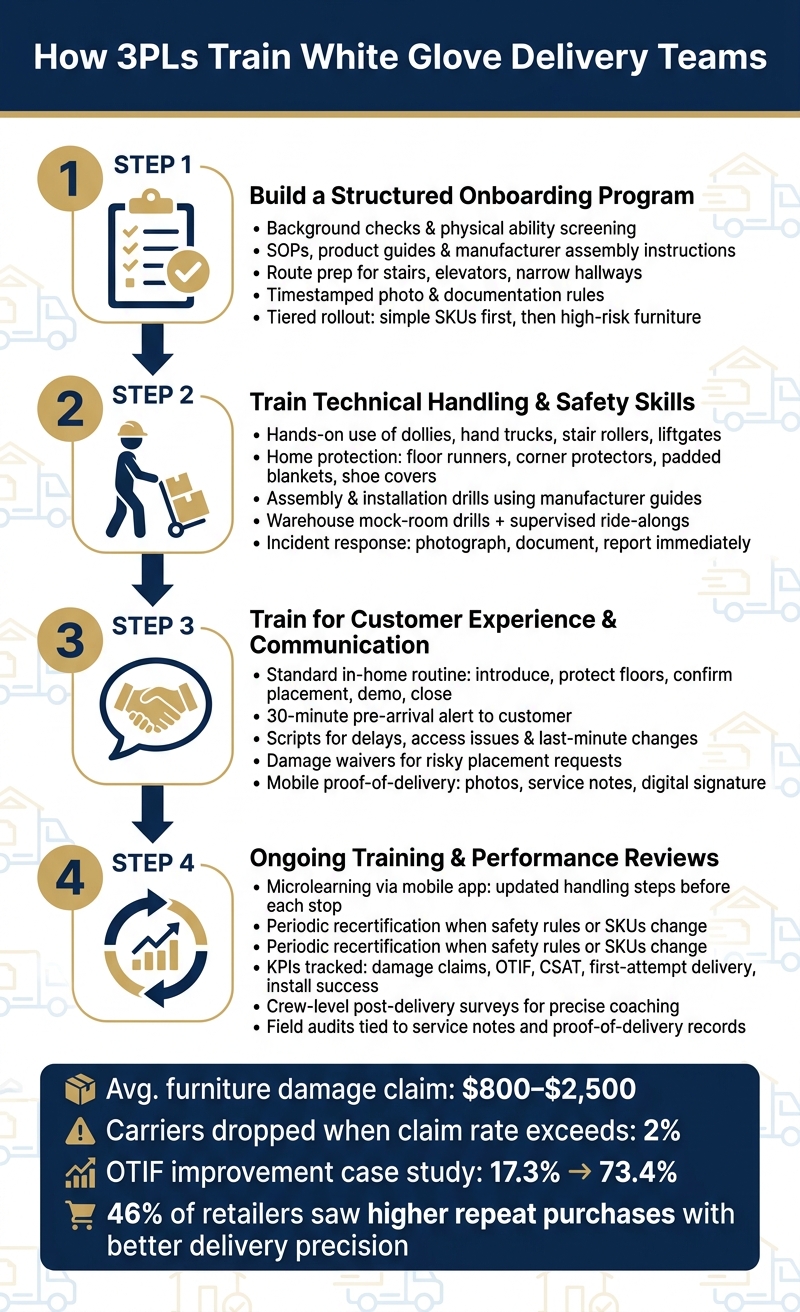
How 3PLs Train White Glove Delivery Teams: A 4-Step System
Step 1: Build a Structured Onboarding Program
White glove onboarding needs to work the same way in every market. If it doesn't, quality starts to drift. And that problem gets worse when crews are spread across different regions.
After hiring, onboarding should set the exact habits crews will repeat in the field. Strong 3PLs set hiring standards early: background checks, the physical ability to handle heavy lifting, and the level of professionalism required for in-home service.
"The key differentiator from standard delivery is customer interaction - you are inside someone's home, so professionalism, clean uniforms, and floor protection are non-negotiable." - Ahmad Qazi, Founder, USATruckerChoice
And it's not just about how crews look or speak. Documentation matters just as much. New hires need to learn the rules from day one, including timestamped photos at the warehouse, at the customer's door, and after final placement. Put those rules directly into onboarding so there's no guesswork later.
Crews also need route and product training that reflects what happens on actual deliveries. U.S. routes can look very different from one stop to the next. A team might deal with narrow hallways, stairs, elevators, or gated access. Training should prepare them for all of it, not just the easy jobs.
Product training matters too. White glove teams handle furniture, major appliances, fitness machines, and medical equipment. Each category comes with its own handling and assembly rules. New hires should train with manufacturer instructions and assembly guides for the product types they'll see on the job. A tiered rollout helps here: start crews with simpler product categories, then move them into higher-risk furniture deliveries.
This is where many operators slip. If each market runs onboarding its own way, consistency falls apart fast. Strong providers centralize SOPs and digital training content so service standards stay the same across markets. That way, new hires show up for their first solo delivery already knowing the service standards, documentation rules, home protection steps, and product types they'll handle. With onboarding standardized, the next step is hands-on technical and safety training.
sbb-itb-eafa320
Step 2: Train Technical Handling and Safety Skills
With onboarding done, training moves from policy to what happens in the field. Crews now need to learn how to move high-value items without damaging the product or the customer’s home. In white glove delivery, avoidable damage turns into claims fast. The average furniture damage claim costs $800 to $2,500, and carriers are often dropped if their claim rate goes above 2%. That’s the kind of number that makes technical training a must.
Cover Handling, Assembly, and Home Protection
White glove crews need hands-on practice with the tools and movements they’ll use on actual jobs. That includes learning how to use furniture dollies, appliance hand trucks, stair rollers, liftgates, and other specialized equipment - and knowing which tool makes sense for each situation.
They also need to learn home protection before the first delivery. That means:
- Laying floor runners before moving anything
- Placing corner protectors on doorframes
- Using padded blankets on walls
- Putting on shoe covers at the front door
Assembly and installation matter just as much. Crews should work through manufacturer-specific guides for the product types they handle, whether that’s a sectional sofa, a treadmill, or a refrigerator with a water line hookup. Debris removal is part of the job too. All cardboard, foam, and pallet material should leave with the crew. It helps to build debris removal into digital closeout checklists.
Once crews can protect both the product and the home, it’s time to move into supervised drills.
Use Hands-On Practice and Ride-Alongs
A manual won’t prepare someone for moving a treadmill at the top of a narrow staircase. That’s why hands-on practice sits at the center of technical training. Warehouse drills should look like real deliveries, with mock rooms, tight hallways, stairs, and supervised item handling.
Supervised ride-alongs with experienced crew leads help close the gap between warehouse practice and solo field work. New hires should watch how veteran crews deal with tight access points, talk customers through setup, and make in-the-moment calls when the job site doesn’t match the original plan.
Reinforce Safety Practices and Incident Response
After handling skills, the focus shifts to safety habits and incident reporting. Safety training can’t be a one-time session. It needs to show up in daily practice. Cover safe lifting, PPE, and loading and unloading. Require two-person teams for oversized or high-value items to help prevent injury and cut fatigue on long carries.
If something goes wrong, crews should act right away:
- Photograph the issue immediately
- Document the product, nearby surfaces, and property
- Report it through the incident channel
That kind of fast, clear reporting helps protect the customer, the crew, and the carrier.
Step 3: Train for Customer Experience and Delivery Communication
Technical training helps crews get the product into the home safely. Customer-experience training shapes how the whole visit feels to the customer. Once the team can handle the item the right way, the next job is simple: teach them how to enter the home, speak with the customer, and wrap up the delivery without confusion.
Set Standards for In-Home Communication and Conduct
Crews should follow the same in-home routine on every stop. That means introducing themselves, protecting floors before entry, confirming placement, completing setup or a product demo, and ending with a clean close plus signed proof of delivery.
If something goes wrong, the crew shouldn't just mention it and move on. Training should show them how to document the issue clearly and contact dispatch before leaving the home, so the exception is logged while the details are still clear. The same rule applies when the delivery plan changes in the middle of the visit.
Prepare Crews for Delays, Changes, and Exceptions
Delays are part of delivery work. So are access problems, last-minute placement changes, and homes that look easy on paper but turn tricky at the front door. Crews should be trained to send an arrival alert 30 minutes before delivery, log placement changes with dispatch before leaving the home, and use a damage waiver for any risky placement request.
Pre-delivery checks should also cover the basics that often trip teams up:
- Clearances
- Stairs
- Narrow access points
- Equipment needed to protect the home during the move
Standard scripts help here. If a truck is late, a hallway is too tight, or the customer wants the item moved to a new room, crews shouldn't have to improvise every word. A clear script keeps the message calm, direct, and consistent.
That matters more than it may seem. Delivery precision doesn't just affect the stop itself; it can shape whether someone buys from that retailer again. In fact, 46% of retailers report higher repeat purchase rates when delivery precision improves.
Train on Mobile Tools for Proof of Delivery and Service Notes
Every white glove delivery should end with a clear record. Crews need to know how to capture the required delivery record, log exceptions with real-time service notes, and collect a digital signature showing the delivery is complete.
That kind of visibility can change day-to-day performance in a big way. One appliance manufacturer used a single control tower with real-time visibility and two-way messaging between drivers and homeowners. The result: its On-Time-In-Full (OTIF) rate went from 17.3% to 73.4%, and NPS improved by 60%.
Those records also give supervisors something concrete to work with. Instead of guessing where a crew needs help, they can review service notes, spot patterns, and coach the team on the exact moments where delivery quality slips.
Step 4: Keep Standards High With Ongoing Training and Performance Reviews
Good onboarding gets crews ready for day one. What keeps them sharp after that is a clear system: regular updates, simple scorecards, and coaching tied to what happens in the field.
Update Training as Products, Policies, and Risks Change
White glove delivery moves fast. New SKUs show up, install steps shift, and connected appliances may mean crews need to help customers with Wi-Fi syncing or firmware checks. Training has to move with those changes.
One smart way to do that is through microlearning. Mobile apps can send updated handling steps, placement notes, and live job details straight to a crew member’s phone before they reach a stop. That keeps training tied to the job in front of them, without pulling crews off the road for an all-day class.
Periodic recertification matters too. That’s especially true when safety rules change, job hazard analyses are updated, or crews handle tasks like disposing of hazardous parts such as refrigerants. If damage claims jump, treat that as a direct signal to retrain handling procedures right away. It also helps to cross-train crews on minor troubleshooting and system setup, since that can cut down on first-use failures and support calls.
After those updates roll out, the next step is simple: check whether they’re changing field results.
Track KPIs and Coach to Close Training Gaps
Track damage claims, OTIF, CSAT, first-attempt delivery, and first-time installation success. Re-delivery rates and repeat service calls matter too. Those numbers often point to exact weak spots in assembly or installation training.
"Every flawless last mile white glove delivery eliminates a costly service call and secures positive reviews, creating a feedback loop that accelerated adoption." - Komal Puri, AVP Marketing, FarEye
Crew-level post-delivery surveys add direct accountability. Instead of getting broad team feedback, managers can see which stops had issues and coach around those moments. That makes coaching a lot more precise.
Use those metrics to focus audits where they’re needed most:
- Crews with higher damage claims or repeat service calls
- Stops with poor survey feedback
- Jobs where service notes or proof of delivery show install or handling issues
Field audits backed by service notes and proof of delivery give supervisors something concrete to review. That turns coaching from guesswork into something clear and specific.
Conclusion: What a Strong White Glove Training Program Should Deliver
A strong white glove training program brings together periodic recertification, short refresher training, product-specific updates, and performance coaching based on customer feedback and field audits. For organizations using JIT Transportation, that means steady white glove handling, kitting and assembly, testing, and nationwide execution.
FAQs
How long should white glove team training take?
There’s no one-size-fits-all timeline for white glove team training. How long it takes depends on the provider, the complexity of the goods, and the shipper’s exact requirements.
In most cases, training is thorough and doesn’t stop after onboarding. Teams usually train in assembly, specialized handling, and customer service, since the job often calls for all three. Some shippers also require proprietary training, while others rely on certification programs or internal learning systems to get drivers ready.
Which KPIs show training is working best?
Track KPIs linked to service reliability and customer satisfaction. The clearest signs show up in fewer insurance claims and damage reports. That usually means handling protocols are being followed the way they should.
Customer satisfaction scores tell you something else: how well teams put their training into practice, especially in communication and service. JIT Transportation backs this up with data-validated planning and steady service quality audits.
How often should white glove crews be retrained?
There’s no one-size-fits-all retraining schedule for white glove crews. Most teams stay sharp through certification renewals and regular refreshers that cover assembly, installation, equipment use, handling protocols, and customer service.
How often that happens depends on the client’s rules or the certification program in use. Still, steady training matters. It helps crews stay ready to handle high-value goods safely and efficiently.
Related Blog Posts
Related Articles
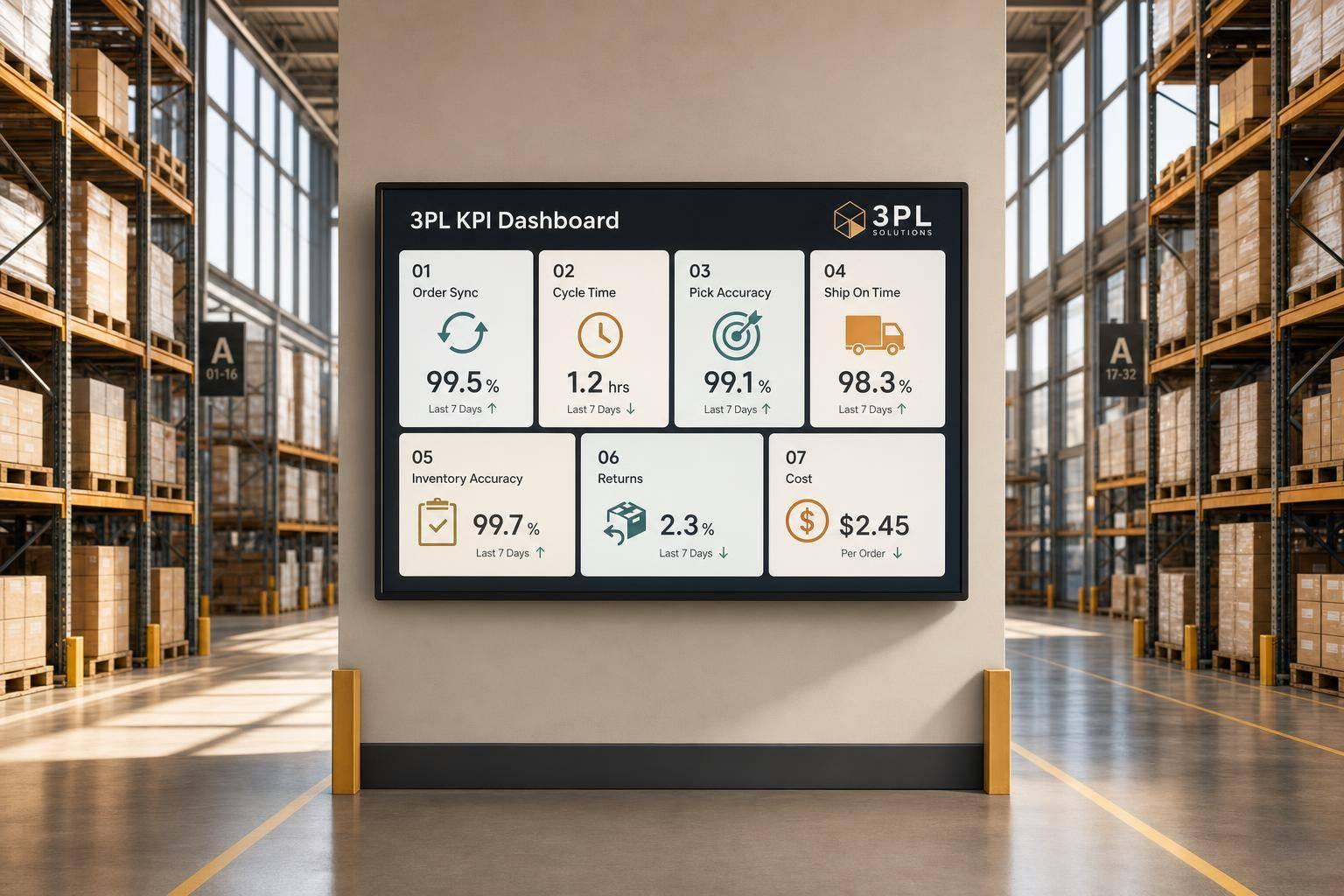
7 WooCommerce 3PL KPIs Teams Track

Centralized vs Decentralized Replenishment
