
Ultimate Guide to IoT Sensors in Cold Chain Logistics
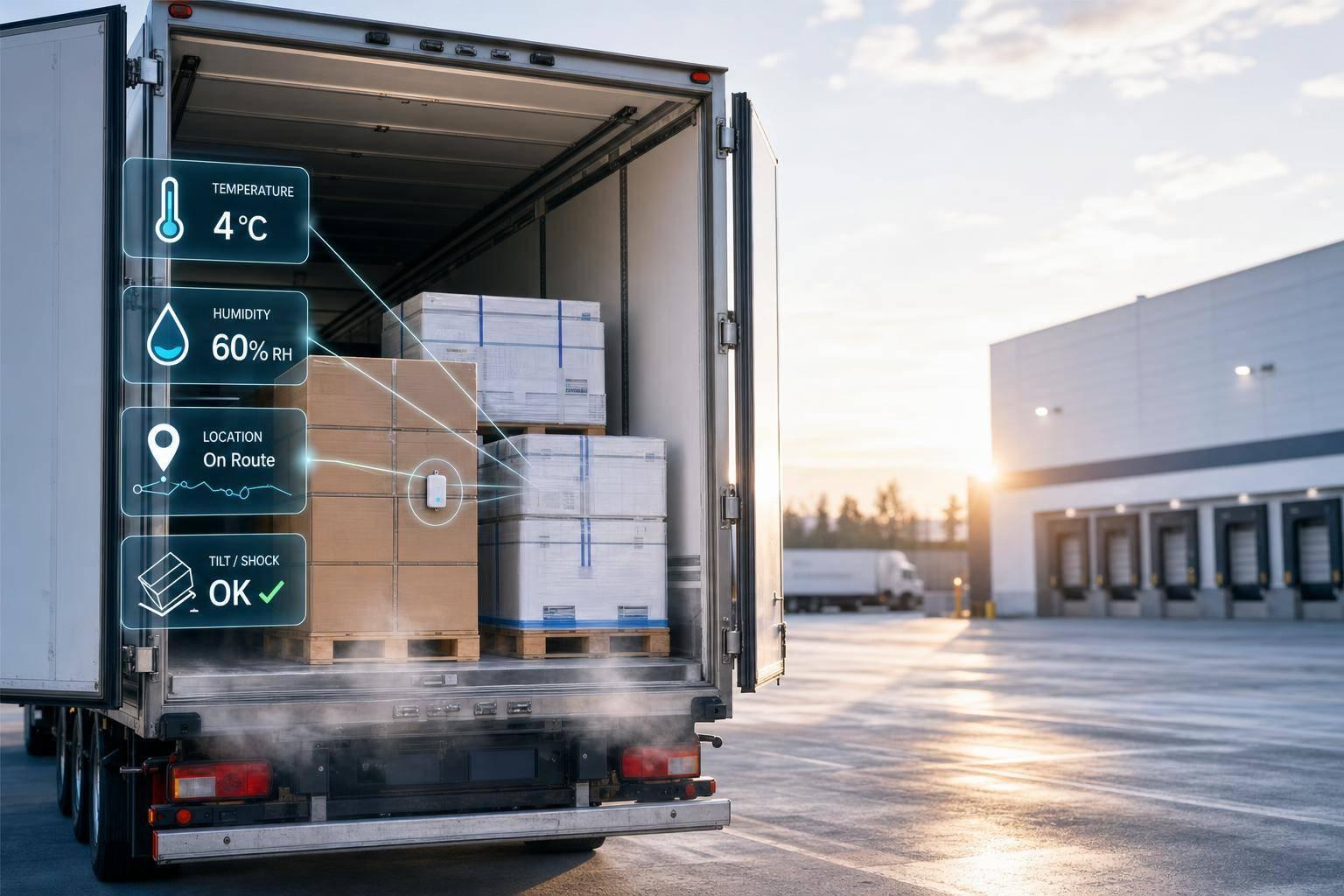
One missed temperature alert can turn into a lost load, a failed audit, or a claim worth thousands of dollars. My takeaway is simple: IoT sensors help cold chain teams spot temperature, humidity, location, light, door, and shock problems while freight is still moving, not after delivery.
Here’s the short version:
- Real-time IoT sensors beat old loggers because teams can see issues during transit instead of after the truck arrives.
- Fast alerts matter. Many systems can notify teams in 60 to 90 seconds, which gives dispatch time to check reefer power, door status, or routing.
- Cold chain failures are expensive. Pharma temperature failures cost more than $35 billion per year, and even a 2-hour excursion can cut shelf life by 10% to 40%.
- You need more than temperature sensors. Good setups also track humidity, GPS location, shock, tilt, door opens, and light exposure.
- Compliance depends on records. U.S. teams need audit trails that support FDA 21 CFR Part 11, FSMA 204, and ALCOA+ recordkeeping.
- Placement and workflow matter. Sensors should sit near product, alerts should route into TMS/WMS, and gateways should store data during signal loss.
- The main KPIs are simple: time in range, time to detect, time to acknowledge, claims rate, spoilage cost, and report retrieval time.
- Where this is going next: more shipment-level tracking and models that warn teams before reefer or handling issues turn into product loss.
In other words: this is not just about data. It’s about using sensor data to protect product, prove shipment condition, and respond before a small issue becomes a $90,000 or $120,000 problem.
The rest of the article walks through the sensor types, network options, rules, rollout steps, and ROI signals that matter most.

IoT Cold Chain Sensors: Key Data Points, Costs & Compliance at a Glance
How IoT is Transforming the Cold Chain with SmartSense by Digi
sbb-itb-eafa320
Core IoT Sensor Types and How They Work
Cold chain monitoring relies on more than one kind of sensor. Different products fail in different ways, so the smart move is to start with the failure mode and then pick the device that can catch it. That’s the point of the setup: spot the problem before it turns into spoilage, rejection, or an insurance claim.
Temperature, Humidity, Location, and Handling Sensors
Temperature sensors sit at the center of any cold chain system. They cover validated temperature ranges from -112°F (-80°C) for ultra-cold biologics to 77°F (25°C) for controlled room-temperature products. Pharma-grade sensors are calibrated to about ±0.1°C to meet FDA and WHO standards, while general-purpose units are more common for frozen food and ambient storage. In a standard refrigerated trailer, it’s common to place 4 to 8 temperature and humidity sensors across the load to catch both warm and cold spots.
Humidity sensors track relative moisture levels. They matter most for biologics, some electronics, and food products that react badly to excess moisture. Location trackers add the missing piece: where the shipment is right now. They use GPS, cellular triangulation, or Wi-Fi positioning to provide real-time visibility across trucks, trailers, and multimodal transit legs.
Handling sensors help fill in the story behind a damaged load. Shock sensors measure G-force impacts during loading and unloading, which helps flag rough handling. Tilt sensors show whether a pallet or container was rotated or tipped, which matters for liquid pharmaceuticals and equipment that must stay upright. Door and light sensors are simple, but they do useful work. Door sensors log open and close events on a reefer trailer, while light sensors catch sudden changes in light levels that can point to a container breach. Put together, these sensors show what happened to the shipment, not just what temperature it reached.
Connectivity, Battery Life, and Cloud Dashboards
The path from sensor to dispatcher screen depends on where the asset is and how much data it needs to send. Most setups use BLE to connect to a truck or warehouse gateway, which then sends data to the cloud over 4G/5G or LTE-M. BLE works well at short range inside a trailer or warehouse bay. LoRaWAN fits larger sites like yards and large distribution centers. Cellular is the standard choice for long-haul transit and direct-to-cloud parcel trackers, while Wi-Fi works well in indoor cross-dock and fulfillment center settings where the network is already in place.
Battery life can make or break day-to-day use. Well-designed IoT sensors can run for up to 5 years on a single charge by using motion-based power saving. In plain English, an accelerometer can cut transmission frequency when the asset isn’t moving. Gateways should also buffer at least 24 hours of data offline so trucks don’t lose records when they pass through cellular dead zones.
On the software side, the best dashboards do more than show a line graph of temperature readings. They track time out of range - for example, 30 minutes over a 24-hour trip - and keep immutable audit trails. Alerts sent by SMS, WhatsApp, or email give dispatchers a chance to step in while the load is still moving. Data by itself doesn’t fix anything. It only becomes useful when thresholds, alerts, and records are tied to a clear operational response.
Regulatory Requirements, Risk Control, and Product Protection
U.S. cold chain operations have to do two things at once: keep products within tight temperature limits and prove that happened with records that can stand up to audits, claims, and buyer checks. Once sensors are in place, that’s the next hurdle. The data has to satisfy regulators, auditors, and customers. Used well, IoT sensors create a live record that helps protect product and show its condition.
U.S. Temperature Standards and Documentation Requirements
Different products need different temperature ranges, and there isn’t much room for error. Vaccines must stay between 35.6°F and 46.4°F (2°C to 8°C). Standard frozen goods are kept at -4°F (-20°C) or below. Controlled room-temperature pharmaceuticals sit in the 68°F to 77°F (20°C to 25°C) range. Ultra-cold biologics shipped on dry ice need -130°F to -76°F (-90°C to -60°C). When a load drifts outside those limits, even for a short time, it can lead to a total-loss call.
Documentation matters just as much as temperature control. FDA 21 CFR Part 11 requires electronic systems to keep complete, immutable audit trails for record changes and use unique, non-transferable electronic signatures. That’s why spreadsheets don’t meet the rule. FSMA 204, the Food Traceability Final Rule, adds another layer. It requires standardized records for foods on the Food Traceability List and centers those records on Critical Tracking Events and Key Data Elements. The FDA pushed enforcement to July 20, 2028, but many buyers already ask for GS1 barcodes and Advanced Ship Notices.
Audit-ready records also have to meet ALCOA+: attributable, legible, contemporaneous, original, accurate, complete, consistent, enduring, and available. Calibration is part of that picture. A three-point NIST-traceable calibration certificate is the standard proof that a sensor reads correctly across the low, middle, and high points of its operating range. Teams are also expected to keep unbroken condition records at 15–30 minute intervals. If there are unexplained gaps, auditors may treat that as proof that monitoring was not adequate.
Common Cold Chain Risks and How Sensors Address Them
These rules aren’t paperwork for the sake of paperwork. They exist because most cold chain losses come from a short list of failures that can often be prevented. Temperature excursions are still the biggest risk in cold chain logistics. The global pharmaceutical industry loses more than $35 billion each year to temperature-related failures, and about 20% of temperature-sensitive pharmaceutical products are compromised during transport.
And the cause isn’t always a failed reefer unit. Loads often go off track during tarmac holds, cross-dock transfers, and carrier handoffs. Those are the blind spots. They’re the moments when passive data loggers go quiet and no one knows there’s a problem until delivery.
Reefer failures, door breaches, shock, delays, and humidity exposure can all lead to fast, expensive losses. That’s why temperature, door, shock, and humidity sensors matter. They don’t just record what happened after the fact. They support a response loop: spot the issue, act on it, and keep the record.
In June 2026, Alpine Fresh used real-time temperature alerts to save a $120,000 blueberry shipment bound for New Jersey and a $90,000 asparagus shipment headed to Miami - interventions that a passive logger downloaded at delivery would never have enabled.
E.T.H. Cargo, a pharmaceutical 3PL operating out of Puerto Rico, used tracker records to verify shipment conditions in a pharma claim, with a recorded temperature of -19.67°C proving the load stayed within its validated range despite a transit delay, ending the claim.
That’s the key difference. Real-time alerts can help stop losses while a shipment is still moving, and the same records can settle disputes later.
How to Deploy IoT Sensors Across 3PL Operations
Cold chain monitoring doesn't stop at buying sensors. The hard part is putting them in the right spots, tying them into the right tools, and checking if the rollout is doing its job. Start with the highest-risk control points, then route alerts into the systems your team already uses.
Build a Monitoring Plan Around Critical Control Points
Begin by mapping every point in the supply chain where temperature is most likely to drift. Critical control points often include production handoff, cross-docks, distribution centers, and last-mile delivery. Last-mile is often the most vulnerable segment, so it needs close monitoring. This mapping should focus on the failure points covered earlier: temperature drift, door breaches, and transit delays.
Sensor placement matters. Put sensors near the product, not near doors or vents, where readings can get skewed. For refrigerated trucks, a 4-sensor BLE setup with a 4G gateway typically costs $300 to $660 per truck.
You also need clear thresholds and clear next steps. Set warning and critical limits, then tie each one to a response step. Configure the system to send SMS alerts to dispatchers within 60 to 90 seconds of a detected excursion. Each alert should include a short diagnostic checklist, such as checking door status and verifying reefer power, so no one is left guessing at 2 a.m.
Backend systems need to ingest readings fast enough to trigger alerts within 90 seconds.
One tactic that works well is motion-based sampling. Using accelerometer and GPS data, sensors can switch into a higher-frequency measurement mode during transit and a lower-frequency mode during staging. That helps conserve battery life without leaving blind spots in monitoring.
Connect Sensor Data to Transportation and Fulfillment Workflows
Once sensors are in place, the next step is pushing alerts into TMS and WMS workflows. The aim is simple: pipe sensor telemetry into the systems your team already works in, using APIs or MQTT, so alerts show up inside normal workflows instead of forcing someone to watch a separate dashboard.
This is where the day-to-day value starts to show. When a temperature alert fires, the TMS or WMS can flag the shipment so coordinators can respond without jumping between tools. And what happens when a truck hits a cellular dead zone? Edge gateways should buffer data locally and replay it to the cloud once connectivity comes back. That keeps the audit trail intact and helps support compliance under FDA 21 CFR Part 11 and ALCOA+ principles.
Track Rollout Success with Clear KPIs
Track rollout impact with a short list of operational KPIs:
- Temperature compliance over time
- Time to detect
- Time to acknowledge
- Alert resolution rate
- Claims rate
- Spoilage cost in USD
- Report retrieval time
In many cases, the payoff shows up fast. IoT implementations can reduce manual checks by up to 70%.
Use telemetry to trigger action, not just reporting. These metrics also feed the ROI analysis in the next section.
Analytics, ROI, and Where Cold Chain Technology Is Heading
Use Data to Cut Spoilage and Improve Lane Performance
Track rollout KPIs to spot repeat failure points by lane and facility. If the same lane or site keeps producing excursions, the data shows where things keep going wrong and points to the root causes you can fix before they lead to lost product. That moves cold chain monitoring from a post-event review into a more preventive system.
The money side is pretty clear. In pharma, temperature excursions cost the global market more than $35 billion per year. In food logistics, a temperature break of only 2 hours during transit can cut shelf life by 10% to 40%.
Live dashboards also help teams move faster on claims and customer updates.
One more thing: alerts should match the product class, not every small fluctuation. Set service targets tied to the product. For example, "99.9% of time in range must stay within the approved window". Then trigger alerts when a shipment starts burning through its allowed out-of-range time too fast.
What's Next: Predictive Monitoring and Shipment-Level Visibility
This changes the job. Instead of reacting after an excursion happens, teams can work to stop it before it starts.
AI-driven predictive models can flag rising compressor strain or door-cycle anomalies 30 to 60 minutes before a failure. More advanced models can predict equipment issues 24 to 72 hours ahead. That's a big shift for teams that need time to reroute, intervene, or protect product in transit.
Visibility is also getting more detailed. The industry is moving from truck-level tracking to shipment-level visibility with BLE beacons and smart packaging that includes embedded sensors. Battery-free sensors that draw energy from vibration, light, or thermal gradients are starting to look like a practical option. On the connectivity side, LTE-M and 5G support real-time telemetry on long-haul routes, while edge gateways can buffer data when trucks pass through dead zones.
For the data stack, store recent data in a fast time-series database for live dashboards. Then archive raw events in low-cost object storage for long-term compliance retention.
Conclusion: Key Points for Scaling Cold Chain Operations
As monitoring becomes more predictive, the day-to-day goal doesn't change: protect product, prove condition, and act faster. Rules such as FSMA 204 and FDA 21 CFR Part 11 require a defensible audit trail, and real-time sensor data is what makes that possible.
To scale, connect sensor data to TMS and WMS workflows, review lane performance every month or quarter, and set service targets by product class.
FAQs
How many sensors does a cold chain shipment need?
There’s no set sensor count that works for every shipment. The right number depends on your cargo, where it is in transit, and how closely you want to track conditions.
A solid cold chain setup usually includes sensors for temperature, humidity, shock, light, and door status. Industry guidance puts the focus on checking temperature-critical points and picking sensors based on cargo risk.
What should my team do first when an alert fires?
When an alert fires, your team needs to act right away and follow the preset protocol for that specific issue. Those steps spell out what to do to get conditions back where they should be and keep the product safe.
Fast action can limit or stop temperature excursions before they turn into spoilage. JIT Transportation helps support that response with the visibility and reliability teams need when thresholds are crossed.
How do IoT sensors help with FDA and FSMA compliance?
IoT sensors help with FDA and FSMA compliance by replacing manual, error-prone records with continuous, automated, tamper-evident electronic data.
That matters because compliance often comes down to one thing: clear records you can trust.
These sensors support compliance by logging temperature at frequent intervals, building audit trails tied to shipments, lot codes, and key events, and providing documentation such as calibration certificates and electronic signatures for audits.
Related Blog Posts
Related Articles
7 WooCommerce 3PL KPIs Teams Track

Centralized vs Decentralized Replenishment
