
AI Inventory Optimization for Demand Volatility
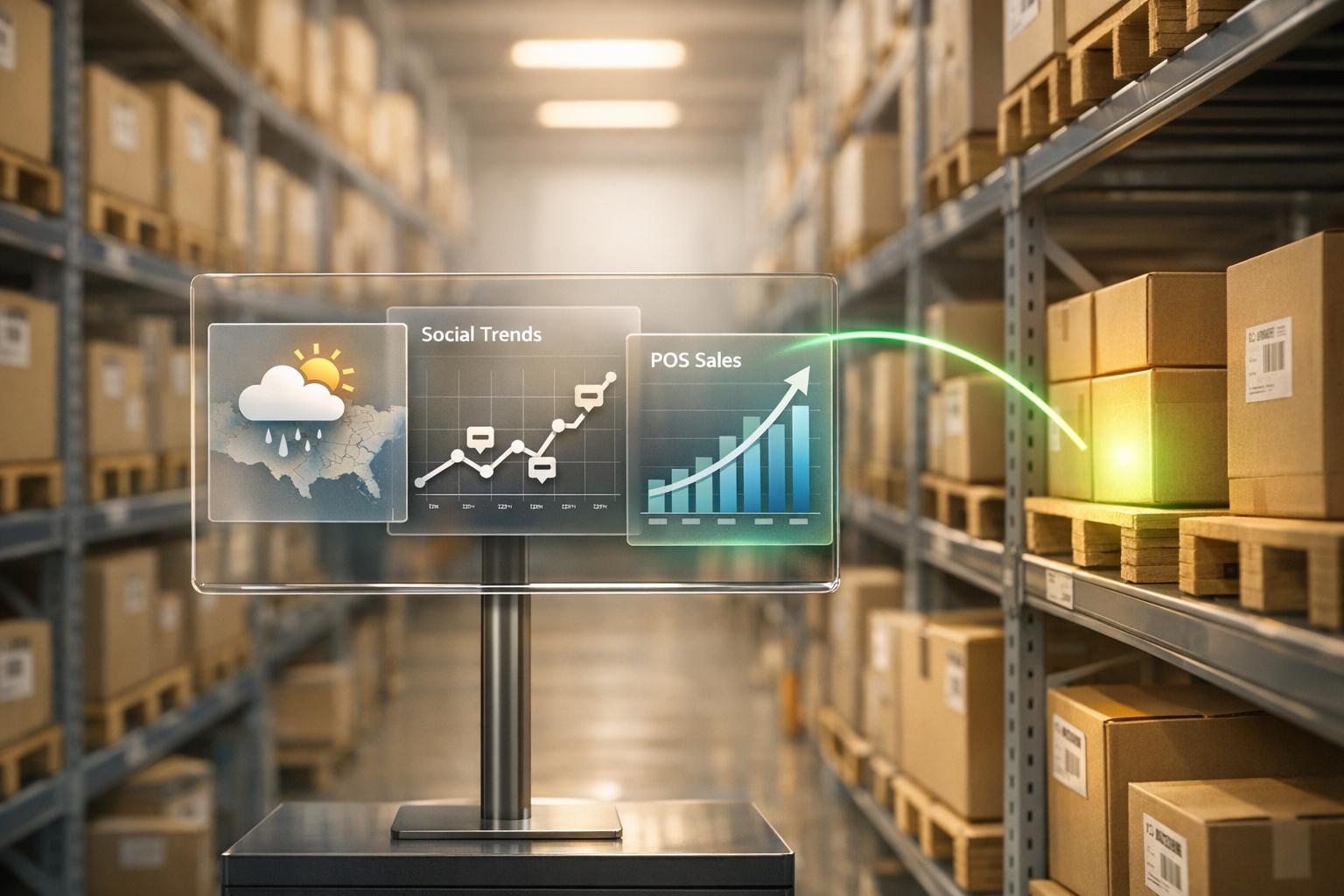
Managing inventory during unpredictable demand changes is one of the biggest challenges in e-commerce. AI is transforming how businesses handle this by using real-time data from sources like social media, weather, and sales systems to predict demand shifts more accurately. This reduces stockouts, overstocking, and operational inefficiencies.
Key Takeaways:
- AI improves demand forecasting: Reduces errors by 20–50% and increases accuracy with advanced models like LSTM.
- Dynamic inventory management: AI adjusts safety stock levels and triggers automated replenishments based on real-time insights.
- Faster response to disruptions: AI detects supply chain issues quickly and reroutes inventory to prevent delays.
- Cost and time savings: AI-powered systems cut inventory levels by up to 35% and reduce manual planning time by 96%.
- Enhanced customer satisfaction: Ensures products are available when needed while optimizing delivery routes for speed and efficiency.
AI-powered inventory systems are not just tools - they’re reshaping how e-commerce businesses operate, saving costs, and boosting customer satisfaction in highly unpredictable markets.
AI Inventory Management: Predict Demand, Prevent Stockouts
sbb-itb-eafa320
What Is Demand Volatility and Why It Matters

Traditional vs AI-Driven Inventory Management Comparison
Grasping the concept of demand volatility is crucial when using AI to fine-tune inventory management in e-commerce.
In e-commerce, demand volatility refers to sudden, unpredictable changes in consumer buying habits that deviate from historical trends. Unlike seasonal patterns - like the consistent back-to-school rush or holiday shopping spikes - e-commerce demand can shift dramatically due to real-time events.
For instance, while traditional retail may experience gradual seasonal increases, e-commerce often faces abrupt surges. Viral trends, flash sales, or influencer endorsements can cause thousands of orders to roll in almost instantly. These unpredictable changes lead to serious forecasting errors, which can result in costly stockouts (causing lost sales and unhappy customers) or excessive overstock (tying up cash and increasing storage expenses). The problem is even more pronounced in fashion e-commerce, where return rates can hit 25–40%, further complicating inventory planning and sell-through metrics.
What Causes Demand Volatility in E-Commerce
A mix of factors fuels these erratic demand patterns:
- Marketing and Social Media Trends: A viral post or a shoutout from a popular influencer can create a tidal wave of demand within hours. These surges are nearly impossible to predict using just historical sales data.
- External Variables: Weather changes can drive demand for specific products, while broader economic trends - like inflation or shifts in consumer confidence - alter spending habits. Global disruptions, such as pandemics or supply chain crises, can completely upend historical demand patterns, making past data unreliable.
- Multi-Channel Complexity: Brands operating across multiple platforms - like their own websites, Amazon, or brick-and-mortar stores - face the challenge of distributing inventory effectively. Each channel has unique demand patterns, return rates, and fulfillment needs, making inventory allocation a juggling act.
Why Traditional Inventory Management Falls Short
Traditional inventory systems often rely on static models, such as Economic Order Quantity (EOQ), which assume steady demand and consistent lead times. While these methods work for stable, predictable markets, they struggle in the fast-paced, ever-changing world of e-commerce. Social media trends, competitive pricing shifts, and sudden changes in consumer sentiment can disrupt these outdated systems.
"Legacy forecasting models designed for stable conditions fail under current market volatility and supply chain disruption frequency." - Traxtech
A major flaw in traditional systems is their reliance on historical data, which ignores real-time signals like trending hashtags or competitor promotions. By the time these systems catch on, the opportunity might already be gone, or the damage - like stockouts or overstock - has already occurred.
Another challenge is the sheer volume of data. High-growth e-commerce brands often manage thousands of SKUs across different sizes, colors, and styles. Spreadsheet-based planning can't keep up with this complexity, especially when inventory must be optimized across multiple warehouses and sales channels. These outdated systems simply lack the capacity to handle the speed and granularity required for modern inventory management.
| Feature | Traditional Inventory Management | AI-Driven Inventory Optimization |
|---|---|---|
| Data Source | Relies on historical sales data | Incorporates POS, social media, weather, IoT, and historical data |
| Demand Assumption | Assumes steady, linear demand | Adapts to stochastic, non-linear patterns |
| Response Time | Slow and periodic | Fast and real-time |
| Accuracy | Struggles in volatile markets | Reduces errors by 20–50% |
| Primary Goal | Balances ordering and holding costs | Focuses on agility and adaptability |
The delays inherent in traditional systems add to the problem. Teams often spend 40–50 hours a week compiling data manually, leaving them reactive instead of proactive. When demand shifts suddenly, these systems can’t act quickly enough to adjust procurement or redistribute inventory efficiently. This is where AI-driven solutions shine, offering real-time adaptability and the ability to process complex, dynamic data to meet the demands of today’s e-commerce landscape.
How AI Optimizes Inventory Management
AI has transformed inventory management by replacing static methods with a more flexible, data-driven approach. Instead of relying on fixed assumptions, AI uses real-time data streams - like point-of-sale transactions, weather updates, social media trends, and supplier performance - to make smarter, faster decisions. This shift directly addresses the unpredictability and volatility that traditional systems often struggle to manage.
Predictive Demand Forecasting
AI-powered forecasting goes far beyond traditional methods that primarily rely on historical data. Advanced models, such as LSTM networks for identifying seasonal and sequential trends or GBM for detecting sudden demand spikes, bring a new level of precision. These systems capture real-time market signals that older techniques simply overlook.
For example, in a manufacturing case study, LSTM models achieved an impressive 89.8% forecast accuracy, outperforming traditional Economic Order Quantity (EOQ) models, which only reached 78.5%. By factoring in promotional events and seasonal trends, AI models can anticipate demand fluctuations that would typically catch older systems off guard. This approach combines AI forecasting with Linear Programming, ensuring procurement decisions align with real-world constraints like warehouse space. The result? A 14% boost in profitability and 95% demand satisfaction.
"The implementation of AI-driven demand sensing in supply chain management represents a significant advancement over traditional forecasting methods that rely primarily on historical data and statistical analysis." - Shashank Chaudhary, Fractal Analytics
These advancements also improve buffer inventory calculations, ensuring safety stock levels are based on actual demand trends instead of outdated averages.
Dynamic Safety Stock Management
AI redefines safety stock management by using real-time demand insights and lead time variability rather than static averages. Through probabilistic forecasting, AI determines the exact amount of buffer inventory needed to prevent stockouts while avoiding unnecessary storage costs. When paired with IoT sensors and RFID tags, these systems continuously monitor inventory levels and trigger reorders automatically when discrepancies arise.
The results speak for themselves. Predictive lead time analytics can reduce safety stock requirements by over 21%, while forecast errors drop by 13% to 20%. AI also tailors safety stock levels to specific products and supply chain lanes, addressing unique risks for each SKU. Using Deep Reinforcement Learning, these systems adapt and refine reordering policies as market conditions evolve.
This dynamic safety stock management seamlessly integrates with automated replenishment systems, further streamlining operations.
Automated Replenishment Systems
AI takes the guesswork out of replenishment by automating order triggers based on real-time inventory levels, supplier reliability, and demand forecasts. Unlike traditional systems with fixed reorder points, AI-driven systems respond dynamically to market conditions, helping businesses stay ahead of sudden demand changes. By monitoring data from warehouses, point-of-sale systems, and IoT devices, these systems flag low stock or demand spikes before they cause disruptions.
"AI inventory optimisation has moved from a promising concept to a practical capability... what once required complex models, spreadsheets, and manual judgement can now be handled dynamically." - Randi W. Stebbins
The impact is clear. Lenovo's Supply Chain Intelligence platform, which integrates data from over 800 sources, achieved a 5% improvement in on-time-in-full delivery while cutting manufacturing and logistics costs by nearly 20% as of June 2025. Similarly, a global food manufacturer using C3 AI's Demand Forecasting application reduced the time needed to create production and replenishment schedules by 96%. These automated systems ensure inventory decisions keep pace with the rapid demands of modern e-commerce.
AI Methods for Handling Demand Disruptions
AI has revolutionized how e-commerce businesses manage inventory and respond to demand disruptions. By leveraging real-time data, these advanced systems turn reactive problem-solving into proactive strategies.
Real-Time Disruption Detection and Response
AI-driven demand sensing tools analyze countless external data streams simultaneously. These systems monitor everything from point-of-sale transactions and social media chatter to weather changes and economic trends. This allows businesses to pick up on subtle demand signals that traditional methods might overlook. When disruptions arise - like a weather event impacting perishable goods, missed warehouse scans, or unexpected shipping delays - AI immediately flags these issues for action.
The speed of these systems is astounding. For example, during the 2025–2026 NFL seasons, AWS's Next Gen Stats platform processed millions of RFID data points in just 700 milliseconds, with AI models responding in under 100 milliseconds. Many modern platforms feature autonomous AI that operates around the clock, diagnosing problems and implementing solutions without human input.
"Without visibility, you're operating blind in a high-stakes environment." – Regional Logistics Director
These advanced systems use reinforcement learning to reroute shipments, balance inventory across fulfillment centers, and adjust replenishment schedules in response to disruptions. This capability has cut decision-making times during disruptions by 50%. Additionally, AI-powered demand sensing improves forecast accuracy by 10% to 20% and can reduce overall inventory levels by 5% to 10%.
SKU-Level Inventory Optimization
AI takes inventory management to the next level by making precise decisions at the individual product level. Techniques like Long Short-Term Memory (LSTM) networks and Gradient Boosting Machines (GBM) identify seasonal trends and factor in external influences, such as marketing campaigns, that can trigger sudden demand spikes. When combined with Linear Programming, these forecasts optimize procurement and storage while staying within constraints like warehouse capacity and budget. This hybrid approach has boosted profitability by 14% and increased demand satisfaction to 95%.
Real-world examples highlight the impact of SKU-level optimization. In June 2025, the Laverne Group in Riyadh adopted an AI platform that cut order-to-delivery times from 4–6 days to just 2–3 hours while maintaining perfect inventory accuracy. Similarly, Aramex collaborated with Omniful in 2025 to manage 3PL fulfillment across more than 100 dark stores in Saudi Arabia, achieving real-time inventory synchronization and minimizing delays.
Autonomous AI tools also play a role in diagnosing and addressing inventory imbalances. For instance, Blue Yonder's system generates about 25 billion AI predictions daily to optimize supply chains.
Supplier Performance Analysis
AI is transforming supplier management by continuously analyzing lead times, fulfillment rates, and reliability metrics. Using reinforcement learning, these systems fine-tune inventory replenishment strategies, reducing stockouts by 32.4% in documented cases.
Predictive analytics go a step further by identifying early warning signs in supplier behavior or external factors like geopolitical tensions or weather disruptions. This approach has achieved a Mean Absolute Percentage Error (MAPE) of 12.3% in disruption forecasting, outperforming traditional methods by 15.2%. Notably, more than 80% of modern supply chain data comes from external sources, such as suppliers and third-party vendors.
"Even the highest-quality internal data is, by itself, no longer sufficient for extrapolating the future." – Kearney Supply Chain Institute and AWS
Advanced platforms also simulate "what-if" scenarios to predict the effects of potential disruptions. For example, if a key supplier stops delivering, the system evaluates the ripple effects across the network and recommends the best mitigation strategies. This capability shifts supplier relationships from reactive to collaborative, creating supply chains that can anticipate and withstand shocks before they happen.
Combining AI with 3PL Solutions for Growth
When AI-driven inventory systems join forces with 3PL (third-party logistics) providers, businesses unlock a new level of supply chain efficiency. AI excels at refining inventory decisions, but it delivers even greater results when paired with the infrastructure and expertise of a 3PL. These providers offer resources like warehouses, transportation networks, and skilled teams - elements that would cost a fortune to replicate in-house. By combining AI forecasting with a nationwide fulfillment network, companies can scale quickly without the heavy financial burden of building their own logistics systems.
This partnership creates a powerful cycle. AI analyzes demand trends and determines optimal inventory placement, while the 3PL handles execution across multiple locations. This proactive approach eliminates the need for costly last-minute fixes and reduces surplus inventory. Real-time data sharing between AI platforms and warehouse management systems ensures accurate stock levels across all channels, helping businesses avoid both overstocking and stockouts.
"The integration of AI into JIT systems emerges not as a mere incremental improvement but as a paradigmatic shift in managing supply chains." – Subharun Pal
The results speak for themselves. Companies using AI-integrated 3PL solutions have seen 30% reductions in excess inventory and fill rates improve from 89% to 96%. With global e-commerce sales projected to hit $6.4 trillion in 2024, leveraging the scalability of 3PL providers is no longer optional - it’s essential.
How JIT Transportation Supports AI-Enhanced Inventory
JIT Transportation’s infrastructure is purpose-built to complement AI-driven inventory systems, seamlessly connecting with automated replenishment models. Their value-added services - like pick & pack, kitting, assembly, and testing - provide the operational backbone that AI systems rely on. For instance, when AI detects a surge in demand and adjusts replenishment schedules, JIT ensures orders are fulfilled promptly.
This integration goes beyond basic storage. JIT’s ERP integration capabilities enable real-time data exchange between e-commerce platforms and fulfillment centers. This ensures AI models always have access to accurate, up-to-date inventory information, creating a "single source of truth" that prevents over-ordering and supports precise stock allocation. Additional services, such as vendor-managed inventory (VMI) and returns management (RMA), streamline workflows by automatically updating inventory levels as products move through the supply chain.
For high-value or sensitive items, JIT offers white glove handling and testing services. AI can identify these "A-class" products and recommend their placement in regional warehouses near key customer bases, ensuring fast delivery while maintaining quality. Meanwhile, slower-moving products are stored centrally to minimize costs. AI continuously fine-tunes this hybrid model based on sales trends and demand patterns. This seamless integration allows businesses to take full advantage of a nationwide network for optimized fulfillment.
Using Nationwide Infrastructure for Fast Fulfillment
AI’s ability to adjust inventory in real time is only as effective as the infrastructure behind it. JIT Transportation’s carrier network and strategically located warehouses across the U.S. provide the physical support needed for AI-driven inventory strategies. When AI determines the optimal stock levels for each location, JIT’s infrastructure executes those plans immediately. If one region sees a surge in demand while another slows down, the system triggers inventory reallocations between warehouses to meet shifting needs.
This nationwide reach becomes especially valuable during busy periods. AI-powered route optimization identifies the most efficient delivery paths, cutting transportation costs and reducing delivery times. By minimizing "empty miles" - trucks traveling without cargo - the system lowers the U.S. average of 30% to just 10-15% through smarter load management. During peak seasons or unexpected demand spikes, this efficiency prevents delays that often cripple centralized distribution models.
Scalability is another key advantage. Businesses can expand into new regions or add sales channels without disrupting existing operations. AI adapts its forecasting to include new warehouse nodes, while JIT’s automated workflows handle the increased volume. This combination has helped companies reduce stockouts by 25% while maintaining service levels above 95%.
| Capability | Traditional 3PL | AI-Enhanced Nationwide 3PL |
|---|---|---|
| Stock Placement | Fixed/Centralized locations | Multi-echelon, regionalized by demand |
| Replenishment | Manual reorder points | Automated, event-driven triggers |
| Visibility | Batch updates, siloed data | Real-time, unified network view |
| Response to Disruption | Reactive manual overrides | Predictive automated mitigation |
Benefits of AI-Driven Inventory Optimization
Better Forecast Accuracy
AI takes demand forecasting to a whole new level, turning it from educated guesses into highly accurate predictions. Traditional forecasting methods often lean on past sales data and simple statistical models, which can miss the subtle drivers of demand in today's fast-paced e-commerce world. AI, on the other hand, processes a wide range of data sources - like social media trends, weather updates, economic indicators, and point-of-sale data - to uncover patterns that older methods simply can't detect.
"By incorporating machine learning algorithms capable of processing diverse data streams... organizations can transition from reactive to proactive inventory management strategies." – Shashank Chaudhary, Fractal Analytics
This precision pays off. AI-driven forecasting can cut errors by 20–50%, leading to measurable improvements. How? Specialized models like LSTM networks excel at spotting seasonal trends and sequential patterns, while GBM models shine when there's a sudden demand spike. Real-time IoT sensors also play a role, constantly comparing actual inventory levels to predictions and triggering immediate adjustments when discrepancies arise. The result? More accurate forecasts that reduce costs and improve efficiency.
Lower Costs and Higher Efficiency
AI helps businesses save money by tackling two major challenges: overstocking and stockouts. Overstocking ties up capital in unsold goods, while stockouts lead to emergency costs, expedited shipping, and missed sales. By syncing procurement with real-time demand signals, AI minimizes both scenarios.
A great example of this comes from February 2025, when C3 AI implemented a simulation-optimization framework for major global enterprises. Spearheaded by Zhaoyang Larry Jin and his team, this project replaced outdated Material Requirements Planning (MRP) parameters with optimized reorder settings. The result? A 10–35% reduction in inventory levels and hundreds of millions of dollars in savings. In fact, AI-powered supply chains have been shown to reduce risks and cut costs by over 67%.
Beyond inventory, AI also streamlines everyday tasks like billing, ordering, and invoice processing. This reduces labor costs and minimizes human error. Even transportation gets a boost - AI-driven route optimization maximizes cargo space and lowers fuel consumption. Together, these efficiencies not only save money but also ensure customers get what they need when they need it.
Improved Customer Satisfaction
AI plays a big role in keeping customers happy by making sure products are available when and where they're needed. With its ability to predict when stock levels are running low, AI ensures timely replenishment, avoiding the frustration of stockouts. Logistics also benefit - AI identifies bottlenecks in real time and calculates the quickest delivery routes, factoring in traffic and weather conditions. Plus, real-time tracking gives customers accurate updates on their orders, creating a more transparent and reliable experience.
When unexpected disruptions like natural disasters or geopolitical issues arise, AI steps in to assess risks and find alternative suppliers before customers feel the impact. With the AI supply chain market expected to surpass $41 billion by 2030, companies embracing these technologies are setting themselves up to provide a consistently superior customer experience.
Conclusion
Demand volatility remains a challenge, but AI is reshaping how e-commerce businesses respond. By analyzing real-time data - like weather patterns, social media activity, and economic trends - AI shifts inventory management from reactive guesswork to a forward-thinking approach. The results speak for themselves: companies using AI see a 14% boost in profitability while maintaining 95% demand satisfaction rates.
The financial stakes are high. Inventory mismanagement costs businesses around $818 billion globally every year, with 52% of losses stemming from stockouts and 44% from overstocks. For small and medium-sized businesses, nearly 80% report struggles with inadequate inventory planning. AI addresses these issues head-on by enabling smarter safety stock calculations, automated restocking, and real-time adjustments. These capabilities ensure products stay available without tying up unnecessary capital, paving the way for growth that is both scalable and flexible.
"The adoption of AI and ML in demand forecasting is no longer a competitive advantage but a necessity in modern supply chain management." – Hatim Kagalwala, Applied Scientist at Amazon
For businesses aiming to scale without heavy upfront investments in AI, partnering with a 3PL provider offers a practical solution. JIT Transportation blends cutting-edge technology with a nationwide network of strategically placed warehouses. This allows e-commerce companies to tap into AI-enhanced inventory systems while staying nimble enough to adapt to market shifts. Their end-to-end services - from transportation and distribution to value-added options like pick & pack and kitting - help businesses maintain lean, responsive operations.
The future of inventory management lies in precision: having the right stock, at the right time, in the right place. AI delivers the insights, while the right logistics partner provides the infrastructure to turn those insights into faster deliveries, lower costs, and happier customers.
FAQs
How does AI enhance demand forecasting for e-commerce supply chains?
AI is transforming demand forecasting in e-commerce by analyzing diverse data sources such as sales trends, social media activity, weather patterns, and economic indicators. With this, businesses can make more precise predictions about demand and adjust inventory levels ahead of time.
Using machine learning algorithms, AI uncovers patterns and anomalies that traditional methods often overlook. This leads to smarter inventory management, minimizing issues like overstocking or running out of stock. Plus, it boosts supply chain efficiency, even during unpredictable demand shifts.
How does AI improve safety stock management in response to demand volatility?
AI plays a key role in improving safety stock management by delivering accurate demand forecasts and adjusting to real-time changes in demand. This helps businesses strike the right balance, reducing the risks of stockouts while avoiding the costs of overstocking.
With AI, companies can react swiftly to demand shifts, boosting supply chain efficiency and keeping customers happy. This forward-thinking method cuts down on waste, makes better use of resources, and keeps operations running smoothly - even when the market is unpredictable.
How do AI-powered inventory systems improve customer satisfaction?
AI-driven inventory systems make life easier for customers by helping businesses predict demand more accurately. This ensures that products are readily available when shoppers need them, cutting down on stockouts and avoiding the hassle of overstocked shelves. The result? A smoother shopping experience with fewer delays and headaches.
These systems also take inventory management to the next level by crunching real-time data. Businesses can adapt swiftly to shifts in demand, improving efficiency while delivering reliable service. This consistency goes a long way in earning and keeping customer trust.
Related Blog Posts
Related Articles
7 WooCommerce 3PL KPIs Teams Track

Centralized vs Decentralized Replenishment
