
AI Route Optimization for Last-Mile Delivery
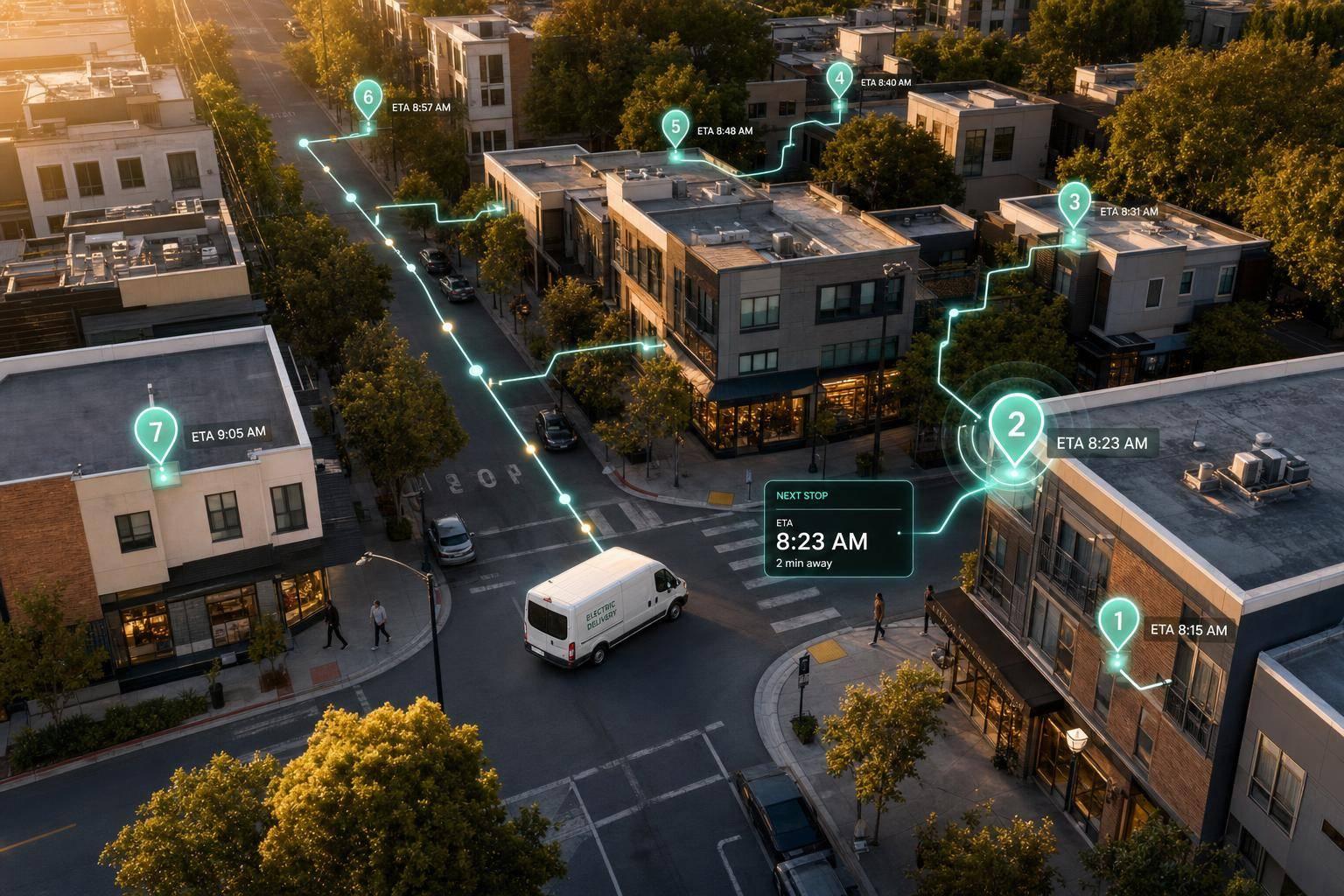
AI route optimization helps cut last-mile costs, reduce late stops, and improve first-attempt delivery success. In many delivery networks, last-mile work makes up 53% of total shipping costs and 41% of supply chain costs. When AI uses route rules, stop data, traffic, weather, and order changes together, teams can route more stops with less manual work.
Here’s the short version:
- It solves a cost problem: last-mile delivery is often the most expensive part of shipping.
- It improves route planning: AI builds routes around stops, time windows, vehicle limits, and driver hours.
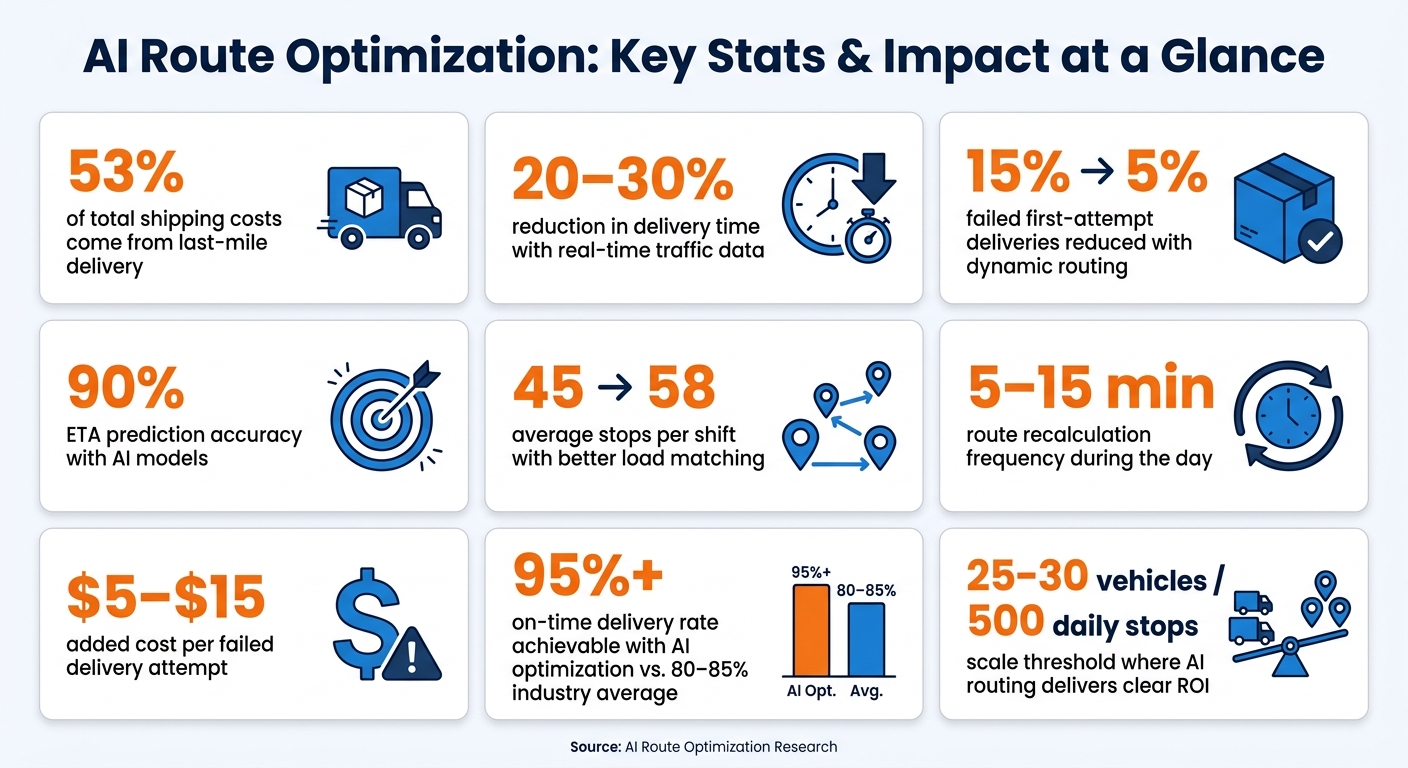
- It keeps routes updated: some systems recalculate every 5 to 15 minutes as traffic or orders change.
- It helps cut delays: live traffic data can reduce delivery time by 20% to 30%.
- It lowers failed deliveries: dynamic routing can reduce failed first attempts from 15% to 5%.
- It improves ETAs: AI-based ETAs can reach 90% accuracy.
- It supports more stops per shift: better load matching can move average stops from 45 to 58 per shift.
- It works best with clean data: even 5% to 10% of bad addresses can disrupt route plans.
- It starts to pay off at scale: many fleets see a clear business case at 25 to 30 vehicles or 500 daily stops.
If I strip it down even more, AI route optimization does three jobs:
- Builds the first route plan before dispatch
- Updates routes when the day changes
- Shows whether routing changes lower cost and improve service
This article explains the inputs AI needs, how rerouting works during the day, how teams handle driver schedules and delivery windows, and what to measure before and after rollout.
AI Route Optimization: Key Stats & Impact at a Glance
Solving the Last Mile | AI and the Delivery Revolution Transforming Logistics | Uplatz
sbb-itb-eafa320
The Inputs AI Needs to Build Better Delivery Routes
AI route optimization starts with the data behind each stop, vehicle, and rule. If the inputs are messy, the route will be too. One bad address or a missing delivery window can make a route impossible to plan. Clean inputs set the starting point, and live data helps the route stay on track as the day changes.
Core Planning Inputs: Orders, Addresses, Drivers, Vehicles, and Delivery Windows
Every optimized route starts with a solid set of fixed planning inputs. That includes GPS-verified stop locations, order details such as item size and weight, vehicle capacity limits, driver shift schedules, and promised delivery windows like 10:00 AM to 2:00 PM.
AI also looks at stop-level service times instead of assuming every drop-off takes the same amount of time. On top of that, it accounts for special handling needs, like fragile items or signature-required deliveries.
Live Data Feeds: Traffic, Telematics, Weather, and Order Changes
After the base plan is built, live data feeds help keep it usable during the day. Real-time traffic, vehicle telematics, weather, order adds, same-day cancellations, redirects, and failed attempts all shape route updates as conditions change.
Real-time traffic alone can cut delivery time by 20% to 30%. That gives the system room to adjust before one delay turns into a fleet-wide mess.
Data Cleanup Before Optimization Starts
Data cleanup isn't optional. Around 5–10% of addresses in a typical delivery dataset have geocoding errors that need fixing before routing starts.
A clean routing dataset usually means:
- corrected addresses
- removed duplicates
- standardized delivery windows
- standardized handling flags
Once that cleanup is done, AI can turn the data into workable routes.
How AI Route Optimization Works in Daily Delivery Operations
Initial Route Planning Before Dispatch
Once the inputs are clean, AI turns them into a route plan the dispatch team can actually use. Before drivers head out, the system checks thousands of route combinations to balance capacity, driver hours, stop order, delivery windows, and live road conditions. That gives dispatchers a plan they can assign fast, so loads go out on time.
This gets hard fast. Even with a mid-sized fleet, route combinations stack up quickly. That’s why the first plan matters so much. It gives the team a working baseline for the day, not a one-and-done answer.
Fresh data is a big deal here. If traffic data is stale, even the best route plan starts to look like a guess.
Re-Optimization When Conditions Change During the Day
A route built at 6:00 AM might already be off by 9:00 AM. Traffic changes. A driver gets stuck at one stop. A customer moves a delivery window. A rush order shows up out of nowhere. That’s where static routing starts to fall apart.
AI-driven routing keeps adjusting as the day moves. It recalculates every 5 to 15 minutes as live data comes in. For dispatchers and 3PL teams, that means they don’t have to rebuild the whole day by hand every time something shifts. They can step in early, before one late stop throws off the rest of the route.
If there’s a traffic incident, the system can reroute all affected drivers within 30 seconds. In plain terms, updated instructions can go out before drivers hit the backup.
ETA Prediction and Exception Management
The same live data that powers rerouting also powers ETA updates and exception alerts. AI models trained on past stop data can predict delivery times with 90% accuracy. They account for things that often slow drivers down, like building access, handling time, and the type of stop.
That matters because not all stops behave the same way. An apartment building delivery can take five times longer than a single-family home drop-off. When that happens, the system updates the rest of the route so the plan still reflects what’s happening on the ground.
Predictive ETAs help teams spot delays early. That gives them time to reroute, reschedule, or alert customers before service starts slipping. For customers, this can narrow arrival windows to 20 minutes near drop-off, which helps reduce failed first-attempt deliveries. Dynamic routing can cut failed first attempts from 15% to 5%, while adding 30 to 45 productive minutes per shift.
How AI Handles Capacity, Delivery Windows, and 3PL Routing Teams
Capacity Rules, Stop Sequencing, and Special Handling Constraints
AI sequences stops around vehicle limits, service times, delivery windows, and handling rules so each route stays executable and more likely to stay on plan throughout the day.
Driver Schedules, Breaks, and Workload Balancing
AI also helps balance workload across the fleet. Better load-to-vehicle matching can move average stops per shift from about 45 to 58. That helps cut overtime while keeping routes realistic. If conditions shift during the day, the system can reassign stops or reroute drivers fast enough to protect service.
Those same controls shape whether AI routing can scale without throwing service off track.
Where 3PL Teams Use AI Every Day
3PL teams use AI to adjust morning dispatch plans, monitor routes during the day, and review planned versus actual performance at day's end.
That creates a tight link between daily routing and performance review.
"Companies using AI for resource allocation cut last-mile delivery costs by up to 30% and achieve on-time delivery rates above 95%." - JIT Transportation
Those controls set the baseline for measuring impact and rolling out AI routing at scale.
Applying AI Route Optimization at Scale for High-Growth Brands
What to Measure Before and After Rollout
Once your routes are live, the next step is simple: prove they made the operation better.
That starts with a baseline before rollout. Without one, you can't show whether routing changes did anything at all. Track six outcomes: on-time delivery rate, cost per stop, miles per route, driver utilization, first-attempt delivery success, and daily exceptions. These metrics show whether routing is cutting day-to-day delivery friction, not just producing neater plans.
On-time delivery is the clearest benchmark. Industry averages sit around 80% to 85%, while AI-optimized operations can hit 95%+. That gap matters. Every missed delivery attempt adds about $5 to $15 in redelivery and handling costs, so even a small lift in first-attempt success can turn into serious savings.
AI routing usually starts to make financial sense once fleets pass 25 to 30 vehicles or 500 daily stops.
How to Roll Out AI Routing Without Disrupting Service
After you set success metrics, roll out AI routing in stages. A phased rollout helps you see how the system performs with live traffic, shifting order volume, and tight delivery windows - without putting service at risk.
Start with 3 to 6 months of historical data: routes, delivery times, traffic patterns, and success rates. That gives the AI enough context to produce outputs you can trust.
Then pilot the system in one dense urban zone. These routes often show 20% to 30% productivity gains because stop density is high, and traffic swings are exactly where AI tends to help most. If the pilot holds steady, expand zone by zone instead of switching the whole fleet in one shot.
Run the old and new systems side by side for several weeks. This is where the rough edges show up. You'll catch routing edge cases, and your ops team gets time to tune delivery-window logic before full launch. It also helps to connect the AI to your TMS, WMS, and ERP early so data moves cleanly across the operation.
Conclusion: Why AI Route Optimization Scales
With the system live and performance tracked, the next issue is scale.
AI route optimization turns daily delivery complexity into faster, more flexible routes. As order volume climbs, manual planning runs into a wall fast. AI can manage more stops, more drivers, and more moving parts without forcing the dispatch team to add matching overhead.
FAQs
How does AI choose the best delivery route?
AI picks the best delivery route by looking at live data like GPS signals, traffic, weather, vehicle capacity, driver availability, and customer delivery windows.
It uses machine learning to group nearby stops in a smart way and keeps recalculating routes as conditions shift, including accidents or last-minute orders. That keeps drivers on the best path and helps cut fuel use, mileage, and labor costs.
What data does AI need for accurate route optimization?
AI works best when it has a steady stream of historical and real-time data to plan routes with accuracy.
That usually includes:
- Traffic, weather, and road closures
- Customer locations and delivery time windows
- Vehicle capacity and driver performance
It also looks at past delivery records, customer preferences, and service-time patterns. The cleaner and more organized the data is, the better the system can respond when things change on the road.
Put simply, messy data leads to messy routing. Clean, structured, connected data gives the system a much better shot at handling day-to-day disruptions.
When does AI routing make financial sense?
AI route optimization pays off when last-mile delivery costs start eating into margins and order volume keeps climbing. It gives teams a way to take on more deliveries without adding trucks or labor at the same pace.
For e-commerce brands and 3PL teams like JIT Transportation, the payoff shows up in a few clear places: lower mileage, fuel, and maintenance costs, more deliveries per shift, fewer failed deliveries, and total delivery cost cuts of 20% to 30%.
Related Blog Posts
Related Articles
7 WooCommerce 3PL KPIs Teams Track

Centralized vs Decentralized Replenishment
