AI Seasonal Demand Forecasting for 3PLs

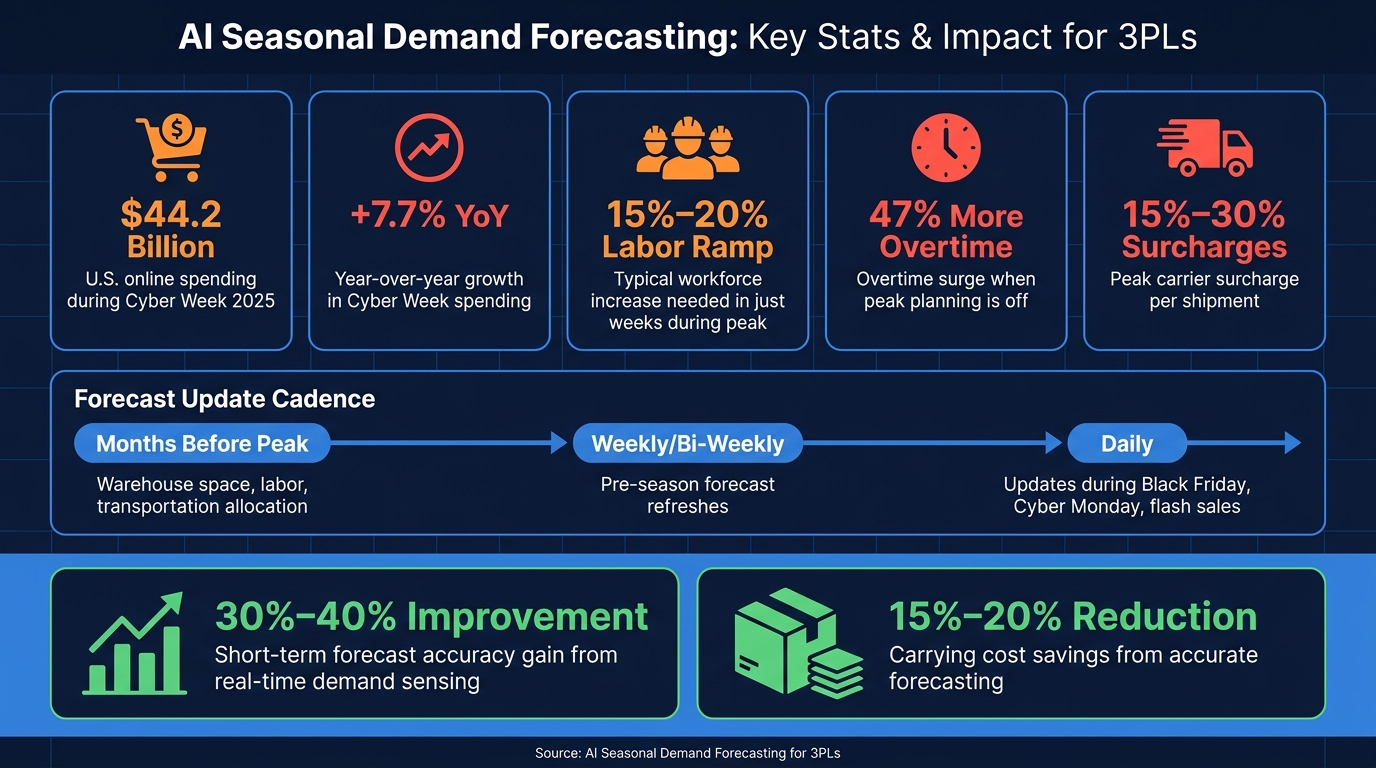
If I miss seasonal demand by even a little, the cost can hit inventory, labor, and shipping at the same time. During Cyber Week 2025, U.S. online shoppers spent $44.2 billion, up 7.7% year over year. For 3PLs, that kind of spike can mean a 15%–20% labor ramp in just weeks, 47% more overtime if planning is off, and peak carrier surcharges of 15%–30% per shipment.
Here’s the short version: I can’t rely on old averages for holiday peaks, promo bursts, or short selling windows. I need AI forecasting that updates from live sales, promo calendars, inventory, returns, weather, and warehouse limits. Then I need to turn that forecast into SKU-level moves like safety stock, reorder points, slotting, labor schedules, and carrier bookings.
What matters most:
- Static plans fall behind when demand shifts fast
- Short-life SKUs leave little time to fix a bad forecast
- Weekly refreshes before peak and daily updates during major events help keep plans usable
- SKU-level planning matters more than top-line volume alone
- Returns in January should be part of the forecast, not an afterthought
- Human overrides still matter for launches, creator spikes, and supplier issues
If I want better service and lower peak-season waste, the forecast has to change what happens on the warehouse floor and in transportation bookings before the rush starts.
AI Seasonal Demand Forecasting: Key Stats & Impact for 3PLs
Accurate AI-Powered Forecasting to Transform Demand Planning | Case Study
sbb-itb-eafa320
How AI models improve seasonal demand forecast accuracy
AI forecasting pulls together sales, promo, inventory, and capacity signals to adjust demand in real time during holiday peaks and promo spikes. It doesn't just stretch last year's numbers into this year's plan.
That's the big difference from a static spreadsheet built on prior demand. Instead, the job is to figure out which signals matter most and how often they should be updated.
Key data inputs for peak demand forecasting
Forecast quality depends on clean data that teams can share across systems. The main inputs include:
- SKU-level sales history by channel
- Expected order volumes
- Promotional calendars
- Inventory levels tracked in the WMS or by RFID
- Operational constraints
- Return patterns
- Weather risk
One more thing matters here: post-holiday reverse logistics. Returns can create a second wave of pressure in January, so that demand signal needs to be part of the forecast too.
Forecast timing: pre-season planning, weekly refreshes, and in-event updates
Q4 forecasting should start months in advance. That gives 3PLs time to allocate warehouse space, line up labor, and book transportation capacity.
From there, forecasts should be refreshed weekly or every two weeks before peak season. During major events like Black Friday, Cyber Monday, and flash sales, daily updates make more sense. Those updates then roll down to the SKU level, where teams make inventory and fulfillment calls.
Why AI outperforms static seasonal planning methods
Static planning leans on averages. It assumes this year will look a lot like last year, with some growth added on top.
AI models don't work that way. They spot when demand starts drifting from the historical baseline and adjust the forecast before that gap becomes a fulfillment problem.
Turning AI forecasts into SKU-level inventory and fulfillment plans
Aggregate forecasts tell you the big picture. But SKU-level plans are what shape storage, labor, slotting, and replenishment. That move from top-line demand to item-by-item planning is where inventory accuracy starts to get tighter.
SKU-level forecasting for hero items, seasonal bundles, and low-volume SKUs
Start by tiering the catalog. High-risk SKUs should get reviewed more often, while low-volume SKUs can stay on a standard cycle. That way, the team spends time where it counts most: on the inventory most likely to hit service levels when demand spikes.
Using AI outputs to set safety stock, reorder points, and slotting priorities
AI forecasts should feed straight into safety stock, reorder points, and slotting using WMS and RFID stock data. They should also shape warehouse slotting so extra space goes to the SKUs that need it most, and inventory sits closer to the fastest-moving picks.
If the business expects a post-holiday return surge, the same forecasting process should also leave room for reverse logistics, plus space for refurbishing or reselling returned goods.
Those SKU-level signals then help shape warehouse waves, labor, and shipment capacity.
From forecast to warehouse and transportation execution
Once AI forecasts are in place, the next move is simple: turn them into labor plans, dock schedules, and carrier bookings. A SKU-level forecast only helps if it changes warehouse and transportation decisions early enough to act.
Aligning warehouse labor, waves, and value-added services to forecasted demand
When a forecast points to a jump in order volume, warehouse managers can adjust shift schedules, extend hours, and bring in temp labor before the rush hits. That lead time matters. Without it, peaks often turn into overtime, delays, and missed ship dates.
Wave planning should match the expected order mix, not just what happened yesterday. If the model shows more kitted bundles or white-glove orders, plan for extra pick-and-pack time, more dock capacity, and staff trained for those tasks. Receiving schedules need to line up too. Inbound freight has to arrive soon enough to be received, slotted, and ready before a launch.
The same forecast also shapes carrier booking and routing.
Transportation planning for parcel, LTL, and linehaul capacity during peak periods
Parcel networks, LTL lanes, and linehaul capacity can tighten fast during Q4 and major promo events. Booking carrier capacity early helps protect service levels and pricing.
Backup planning matters just as much as the main plan. Severe weather, port congestion, and carrier backlogs are common peak-season risks. So the forecast should guide backup routing options and alternate carrier relationships before disruptions hit, not after. A nationwide network like JIT Transportation can help position inventory across fulfillment nodes, cut transit times, and keep routing flexible during peak.
Building a workable AI forecasting process with your 3PL
Forecasts matter only when they change what happens on the floor. If the numbers don't shape labor, inventory, and carrier choices, they're just numbers on a screen. Once the forecast is in place, the next job is turning it into a weekly operating rhythm.
Shared data, forecast reviews, and human override rules
Start with shared demand and inventory data. The key is timing: share it early enough for your 3PL to act, so they can lock in space, labor, and freight capacity. Connect the OMS to the WMS for live order and inventory visibility. That shared view gives both sides one source of truth and sets up better weekly forecast reviews.
During peak season, set a weekly or bi-weekly review cadence. These check-ins help teams spot bottlenecks before they turn into missed ship dates. After each peak period, run a post-event analysis to see where the model missed and what caused it. That gives you a tighter forecast next time around.
You also need clear override rules for situations the model can't read well on its own. Use human overrides for things like:
- New product launches
- Creator-driven demand spikes
- Supplier delays
Flag the model for review when forecast bias stays too high or too low over time. That keeps the forecast usable when demand shifts faster than past data can explain.
Key takeaways for 3PLs and high-growth brands
AI forecasting can improve holiday and promo planning, but only if those forecasts feed labor planning, slotting, and carrier capacity. Real-time demand sensing can improve short-term forecast accuracy by 30% to 40%, and accurate forecasting can cut carrying costs by 15% to 20%.
The value flows through one chain: demand signal to inventory plan, inventory plan to warehouse execution, and warehouse execution to transportation capacity.
FAQs
How much historical data does AI need?
There’s no fixed minimum, but seasonal forecasting usually works best with 12–24 months of order and sales history by SKU, channel, and destination. If you have 2–3 years of clean weekly data at the SKU and channel level, forecasts tend to be more accurate, especially for demand swings and promo periods.
For warehouse shift planning, plan on using at least 3 years of WMS or ERP data broken out by week, day, and shift. It also helps to keep models up to date with real-time inputs and outside signals, so they reflect what’s happening now instead of what happened last year.
When should peak-season forecasting start?
Start planning and demand forecasting 90 to 120 days before the surge. That window gives 3PLs enough time to secure capacity, plan labor, and place inventory where it needs to be.
In many cases, forecasting starts 3 to 6 months out. AI model setups should be finished 60 to 90 days before seasonal events. Core promotional SKUs should be locked four weeks ahead, and forecasts should be reviewed weekly.
How do teams act on SKU-level forecasts?
Teams put SKU-level forecasts to work by sending them into ERP, WMS, and TMS so day-to-day operations can run with fewer surprises. Planners use those forecasts to set reorder points, safety stock, and slotting priorities.
When shared with a 3PL, the same forecasts help warehouse teams pre-slot inventory, reserve carrier capacity, and line up labor with expected unit volume. Systems can also trigger internal replenishment or scale fulfillment workflows before demand spikes hit.
Related Blog Posts
Related Articles

How 3PLs Scale Low-Waste Fulfillment Networks
3PL-Brand Partnerships for Green Supply Chains