3PL-Brand Partnerships for Green Supply Chains
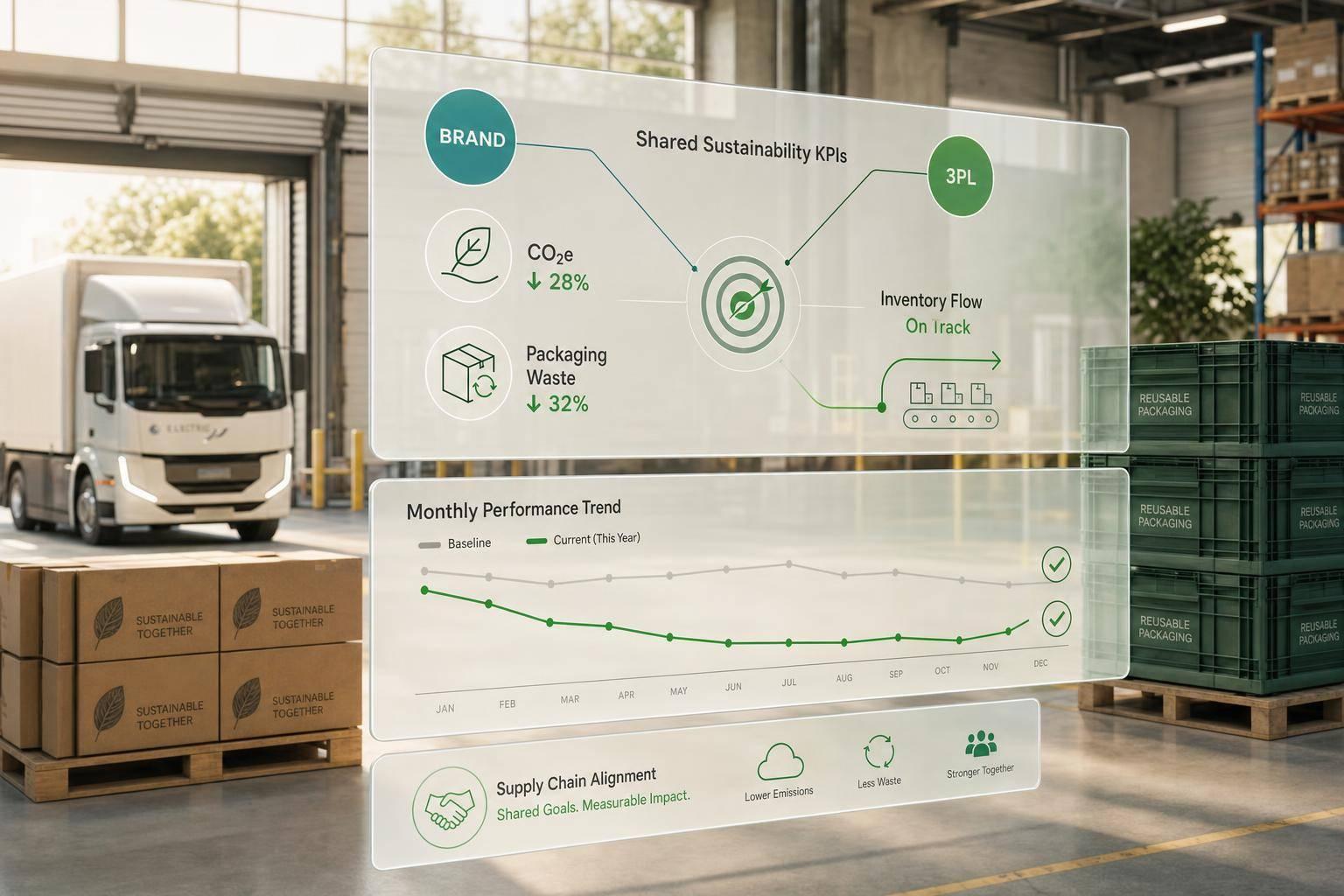
If you ship 3,000+ orders a month, a 3PL partnership only works when cost, delivery, and lower CO2e are measured together. I’d boil the article down to this: set a baseline first, pick a 3PL that can cut miles and packaging waste, agree on shared KPIs, and review results every month and quarter.
A few numbers show why this matters. Transportation makes up about 28% to 29% of U.S. greenhouse gas emissions, and last-mile delivery can drive about 32% of e-commerce CO2 emissions. That means small issues - extra miles, low carton fill, and stock in the wrong node - can add up fast when order volume grows.
If I were preparing for a 3PL discussion, I’d focus on four things right away:
- Baseline data: CO2e per shipment, packaging weight per order, damage rate, inventory turns, stockouts, and old stock
- 3PL fit: routing tools, shipment consolidation, packaging controls, and multi-node fulfillment
- Shared targets: for example, cut CO2e per order by 10% to 15% while holding 98% on-time delivery
- Review rules: one KPI format, written reporting terms, monthly check-ins, quarterly business reviews, and action plans for missed targets
At a basic level, the article says one thing: don’t treat shipping, packaging, and inventory as separate problems. They affect each other. A lighter box can increase damage. A stock move can cut storage cost but add miles. A good 3PL-brand setup tracks those trade-offs in one dashboard, with the same numbers used by both sides.
That’s the core idea behind the full article.
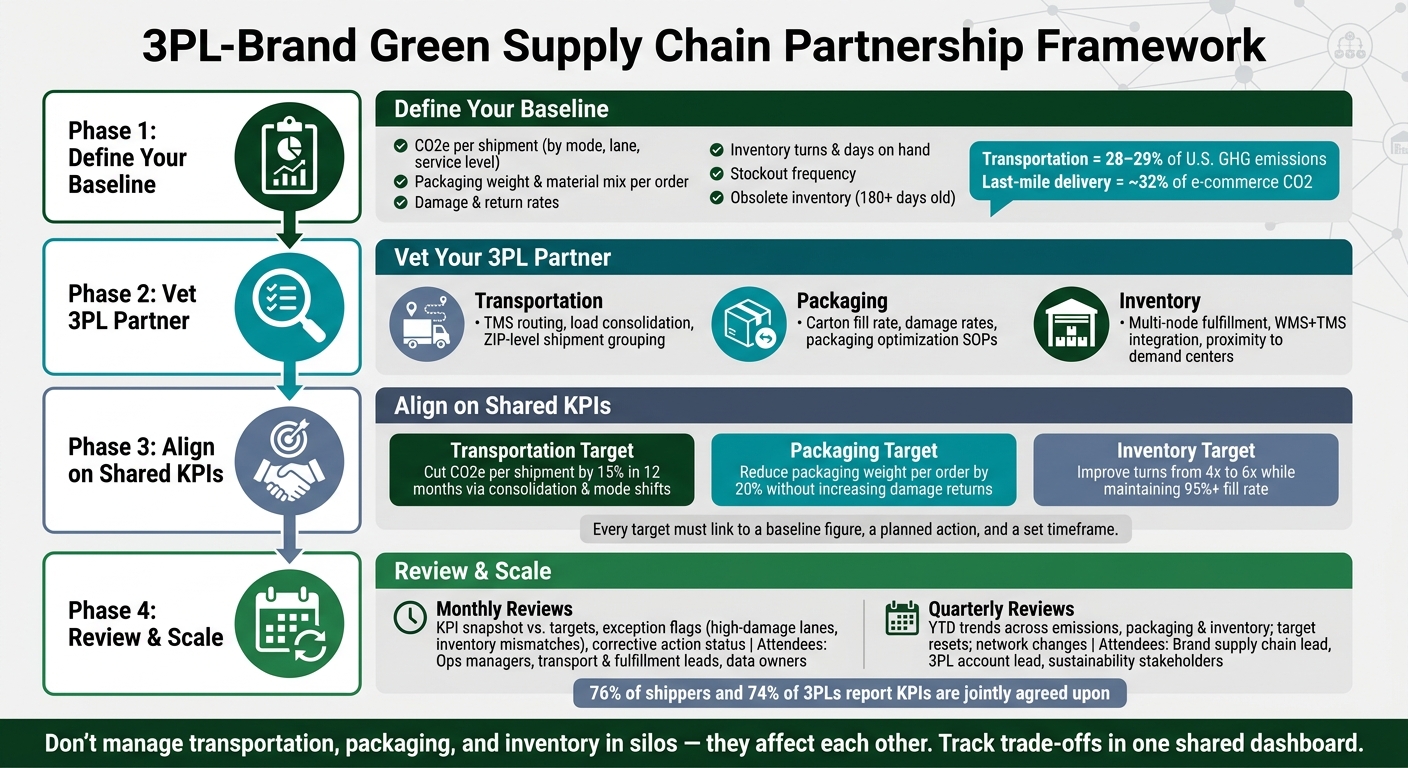
3PL-Brand Green Supply Chain Partnership Framework
Case study setup: Choosing a 3PL and aligning on green operating goals
Define your baseline before selecting a partner
Before you speak with any 3PL, get your own numbers in order first. Pull together six data points: CO2e per shipment by mode, lane, and service level; packaging weight and material mix; damage and return rates; inventory turns and days on hand; stockout frequency; and obsolete inventory that is more than 180 days old. Use U.S. units and U.S. date formats so your data lines up with domestic 3PL reporting.
This gives you a clear picture of where emissions and waste are highest. It also gives the 3PL a solid starting point instead of forcing them to guess.
Evaluate a 3PL's transportation, fulfillment, and packaging capabilities
Once you have the baseline, the next step is simple: test what the 3PL can actually do. For green operations, three areas matter most: load consolidation, route optimization, and packaging execution.
On the transportation side, ask if the 3PL uses a TMS to choose the best carriers and routes. Ask how they consolidate shipments going to similar ZIP codes or regions. Also ask for past data that shows fewer partial loads. Small gains in load factor and routing may not sound dramatic at first, but across thousands of shipments each month, they can stack up in a big way.
For fulfillment and packaging, ask for data on damage rates by account, average carton fill, and any packaging optimization work with measured results. A site visit can tell you a lot here. You can see, pretty fast, whether packaging standards will hold up at scale or fall apart once volume climbs. A provider such as JIT Transportation can support pick & pack, kitting & assembly, testing, and white glove handling during packaging rollouts.
For inventory coordination, give extra weight to 3PLs with multiple fulfillment nodes and connected WMS and TMS systems. When inventory sits closer to demand centers, average last-mile distance gets shorter. That can lower CO2e per order while helping protect fill rate and delivery speed.
That capability check gives you the groundwork for the KPI targets that come next.
Set joint targets in a kickoff workshop
Once the capability review is done, turn the baseline into shared targets during a kickoff workshop. Both sides should review the numbers together, spot the top two or three levers in each area, and agree on targets with clear deadlines.
Each target should link to a baseline and one operating change. For transportation, that could mean cutting CO2e per shipment by 15% in 12 months through consolidation work and mode shifts. For packaging, a strong target is cutting packaging weight per order by 20% without driving up damage-related returns. For inventory, move inventory turns from 4x to 6x while keeping fill rate above 95% through updated reorder points and multi-node placement. A 3PL like JIT Transportation can connect each target to specific operating changes - new routing rules, updated packaging SOPs, and inventory moved across its network - plus the reports used to track each KPI.
What makes these targets hold is traceability. Every number should connect back to a baseline figure, a planned action, and a set timeframe. Without that link, targets are just wishful thinking.
sbb-itb-eafa320
Green Supply Chain Practices | Exclusive Lesson
Shared KPIs: Emissions, packaging waste, and inventory flow
After targets are set in the kickoff workshop, both sides need one shared KPI set so they measure progress the same way. Start with the baseline and the targets from kickoff, then lock in three KPI groups: emissions, packaging waste, and inventory flow.
Transportation KPIs that track emissions by shipment
Track CO2e per shipment, miles per order, load factor, and on-time delivery. That way, emissions progress stays tied to service performance instead of getting measured in a vacuum. If a team cuts emissions but misses delivery windows, the picture is incomplete. Packaging choices then feed into the next KPI group.
Packaging KPIs tied to material use and damage reduction
Track packaging weight per order, carton fill rate, and damage-related returns. This keeps waste reduction connected to product protection. Put simply, lighter packaging isn’t enough if it leads to more damaged goods and more returns. Inventory flow rounds out the full view.
Inventory KPIs that improve flow and cut waste
Track inventory turns, days on hand, stockout rate, and obsolete inventory to spot where demand and replenishment drift out of sync. Slow turns and excess stock often lead to avoidable shipments and obsolete goods. That adds both emissions and waste across the supply chain.
These KPIs only work if both sides report them in the same format and review them on a fixed schedule. Once the KPI set is locked, the next step is deciding how often the data gets reported and reviewed.
Reporting terms and review cadence that keep the partnership on track
Once both sides agree on shared KPIs, the next move is to lock in the reporting rules that keep those KPIs steady over time. After the KPI set is set, spell out who reports what, when they report it, and the format they need to use. Apply the same rules across emissions, packaging, and inventory metrics. If those rules aren't written down, review meetings can get stuck debating format instead of looking at results.
Write reporting terms into the operating agreement
Put the reporting rules directly into the operating agreement. That means listing the data fields, calculation methods, system of record (the main reporting source), and deadlines for each KPI. Call out the three metric groups - emissions, packaging waste, and inventory flow - so each rule connects back to supply chain execution.
For emissions, state whether reporting happens at the shipment, lane, or facility level, and lock in the emissions factors used. If the methodology changes, require a side-by-side comparison for one reporting period.
Retention rules matter too. Require shipment records, packaging specs, inventory reports, and emissions workpapers to be kept for 3 to 7 years. Define data ownership up front, along with which metrics the brand can use in ESG disclosures, customer communications, sustainability reports, and investor materials. Also state whether the 3PL must review public-facing language before it is published. Assign one sustainability lead to own data requests and deadlines.
Use a monthly and quarterly review structure
A tiered cadence usually works best. Monthly operational reviews should cover the KPI snapshot against targets, exceptions such as high-damage lanes or repeated inventory mismatches, and the status of open corrective actions. Quarterly business reviews should go deeper into year-to-date trends across emissions, packaging waste, and inventory flow, along with decisions on target resets, packaging redesign, or network changes. An annual planning session can then tie sustainability goals to budget cycles and contract updates.
Monthly reviews should include operations managers, transportation and fulfillment leads, and data owners. Quarterly reviews should add the brand supply chain lead, the 3PL account lead, and sustainability stakeholders so bigger changes can be approved.
Turn missed targets into corrective action plans
Treat every missed KPI as a root-cause review. The team should determine whether the problem came from demand swings, weak cartonization rules, poor consolidation windows, or inventory misalignment. Then assign a fix with a named owner, a due date, and a metric that shows whether the fix worked.
A simple example helps. If packaging weight per order is moving up, the corrective action could be updating cartonization rules and running a pilot before making changes across the network. If emissions per shipment are climbing, the better lever may be wider consolidation windows or adjusted reorder thresholds.
Case study takeaway: Build a green supply chain partnership that can scale
Once the operating framework is set, the next test is simple: can it scale? Green partnerships don’t grow well by accident. They scale when both sides already share the same baseline, KPI set, reporting rules, and review cadence.
Things start to fall apart when teams treat transportation, packaging, and inventory as separate lanes. They aren’t. A win in one area can wipe out savings in another. For example, packaging changes might cut material use but lead to more damage in transit. Or inventory moves might lower storage costs while driving up shipment frequency. That’s why these three areas need to be managed together, not in silos.
A single dashboard, reviewed monthly and quarterly, helps keep those trade-offs in plain sight before they snowball.
Shared KPIs also turn sustainability goals into a common operating standard. And the data backs that up: 76% of shippers and 74% of 3PLs report that KPIs in their partnerships are jointly agreed upon.
For that kind of scale to work, one partner needs to connect execution, data, and corrective action. A 3PL with a nationwide network, pick & pack, kitting & assembly, testing, white glove handling, and integrated reporting - like JIT Transportation - can help turn corrective action into a network-wide process, not something stuck in one facility.
Key points to bring into partner discussions
Before the contract is signed, get these items on the table:
- Know your current emissions per shipment, packaging material weight per order, and inventory turns
- Turn sustainability goals into both green and performance targets. For example: reduce CO₂ per order by 10% while holding on-time delivery at 98%
- Bring a proposed KPI list with six to ten metrics across transportation, packaging, and inventory, with clear definitions attached
- Agree on reporting formats and reporting frequency before the contract is signed, not after the first missed target
- Set a rule for trade-offs. In plain terms, decide when you’d accept slightly longer transit times for lower emissions, or when it makes sense to spend more on packaging if it cuts damage rates and total cost
FAQs
How do I measure CO2e per order?
Integrate your ERP with your 3PL’s warehouse management system through an API so shipment-level data flows in automatically. Use standard frameworks like the GLEC Framework or ISO 14083 to keep your calculations consistent and easy to audit.
Then bring together shipment, fuel, energy, and packaging data from carrier invoices, utility bills, and order systems to calculate emissions per order. With that data in one place, sustainability dashboards can report results in real time and show how you’re tracking against your goals.
Which KPIs matter most in a 3PL partnership?
Track a mix of operational and sustainability KPIs so your team stays aligned on service goals and environmental targets.
On the operational side, keep a close eye on:
- On-time delivery: 98%+
- Order accuracy: 99.5%–99.9%
- Inventory accuracy: 98%+
- Non-delivery rate: under 2%
- 3PL-error returns: under 1%
For sustainability, watch metrics like CO₂e per order or per ton-km, load utilization, empty miles, warehouse energy use per pallet, landfill diversion, and packaging efficiency.
The key is to review these numbers through automated shipment-level data on a steady cadence: weekly, monthly, and quarterly. That way, you’re not guessing. You can spot service issues early, see where waste is creeping in, and keep both day-to-day performance and longer-term environmental aims on track.
How often should brands and 3PLs review results?
Brands and 3PLs need a steady review rhythm to stay in sync and keep performance on track.
- Weekly: check operational data and fix urgent issues
- Monthly: review KPI trends and make adjustments
- Quarterly: hold formal business reviews to assess long-term goals, direction, and broader performance gaps
Related Blog Posts
Related Articles

Demand-Driven Replenishment for Multi-Node 3PL

3PL Models Compared for Reverse Logistics Carbon