Eco-Friendly Packaging for Returns: Complete Guide
Returns are expensive, waste-heavy, and hard to run well. In 2025, U.S. ecommerce returns hit $849.9 billion, or 15.8% of all sales, and each return can cost $17 to $29 to process.
If I had to sum up the article in plain English, it’s this: use return packaging that customers can reuse, carriers can handle, and warehouses can sort without extra work. The best option usually comes down to four choices:
- Corrugated boxes for fragile or high-value items
- Paper mailers for light, low-risk goods
- Reusable mailers for soft goods with enough return volume
- Reusable totes for closed-loop networks
A few design moves matter most:
- Dual seals and tear strips for easy resealing
- Flat label areas so labels scan and stay in place
- Right-sized packs to cut dim weight, void fill, and material use
The article also makes one point clear: packaging should be tied to the full returns flow, not picked on its own. That means looking at:
- customer repack
- carrier handoff
- inbound receiving
- inspection and sorting
- repack and recycling
- total cost of ownership
For brands shipping 3,000+ orders a month, even a modest return rate can mean hundreds of inbound packages every month. So I’d treat returns packaging as a cost-control and waste-control system, not just a box or mailer choice.
A simple takeaway:
- Match pack strength to product risk
- Use resealable designs when possible
- Pilot on one SKU group first
- Track cost per return, damage rate, reuse cycles, and material waste
Here’s the short version: the best returns pack is the one that lowers total cost, protects the item, and moves cleanly through your warehouse and carrier network.
Choose Materials and Packaging Designs That Work in Reverse Logistics
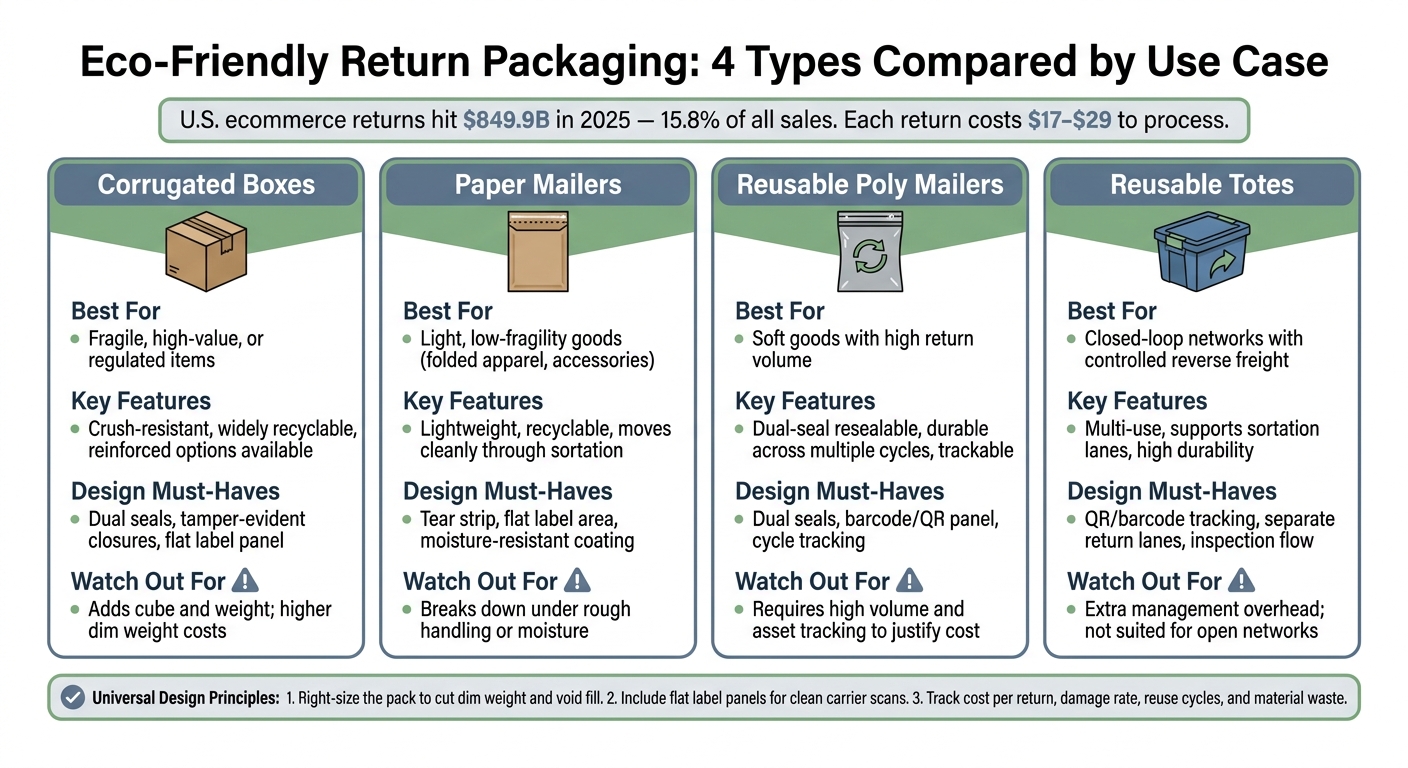
Eco-Friendly Return Packaging: 4 Types Compared by Use Case
Material Options: Recycled Paper, Corrugate, Reusable Mailers, and Totes
Returns packaging has to do more than survive the trip out. It also needs to hold up on the way back. The best choice is the material that stays efficient from the moment a customer repacks the item to the moment the warehouse receives it.
Recycled corrugate is the safest default for fragile, regulated, or higher-value products. It resists crushing and is widely recyclable. The downside is simple: it adds more cube and weight than flexible mailers. If you're paying freight on every return, that extra bulk can hit costs fast.
Paper mailers and paper-based padding fit lightweight, low-fragility items like folded apparel or accessories. They move through receiving and sortation cleanly. But they don't handle moisture as well, and they can break down under rough handling.
Reusable poly mailers make sense for soft goods, but only if the network can recover and redeploy them at high volume.
Reusable totes fit closed-loop networks with controlled storage, inspection, and reverse-freight flow. Outside that setup, the extra management work usually outweighs the upside.
One caution here: don't treat recyclable as the same thing as recovered in practice. Before picking a material, check the actual local recovery path.
Once the material is locked in, the package design needs to make returns fast and repeatable.
Design Features That Cut Waste and Speed Up Returns
A few design choices can make a big difference on both speed and waste.
- Dual seals and tear strips help customers reseal returns fast and keep the pack usable for restock or recycling.
- A flat label panel and printed return instructions cut dock exceptions and customer mistakes.
- Right-sizing has the clearest freight payoff. When the box or mailer matches the product's actual dimensions, you use less void fill, less corrugate, and less dimensional weight.
The next move is to line up those features with product risk and return volume.
How to Match Packaging to Product Risk and Return Rate
Start by segmenting products by expected return rate, fragility, and replacement cost. If an item scores high on any two of those, it should move to stronger protection and a more return-friendly design.
That usually means:
- resealable mailers for soft goods
- rigid packs for leak-prone items
- reinforced corrugate for electronics
- tamper-evident materials for regulated products
High return volume can justify stronger pack design because the labor and material savings add up fast across volume.
sbb-itb-eafa320
Build the Reverse Logistics Workflow Around the Packaging
Once you choose the pack format, the next step is to map it to every reverse-logistics handoff. Packaging doesn't sit in a vacuum. It affects labor time, carrier spend, and how much value you can get back from each return.
Customer Repack, Carrier Handoff, and Inbound Receiving
The package needs to reseal fast and keep the return label visible through every handoff. It also needs enough transit strength to prevent crushing and leakage, which goes back to the material choices made earlier.
At inbound receiving, standard sizes help dock teams sort and route items faster. When packages show up in the same formats, warehouse staff can move them into inspect, restock, refurbish, recycle, or dispose paths without extra manual checks.
That speed matters. Delays at receiving stack up fast: longer dwell time means higher storage costs, more handling touches, and a smaller window to resell items at full value. Clean handoffs make faster receiving possible.
Warehouse Handling: Inspection, Sorting, Repack, and Material Recovery
Once a return hits the dock, move it through a fixed scan, inspect, sort, and disposition flow. If teams skip steps or lean on informal judgment calls, you get inconsistency. And that usually shows up as shrink and lower recovery value.
Barcode or QR tracking links each package back to the original order. That's especially important when you're using reusable mailers or totes. You need cycle tracking to stop those assets from disappearing before they’ve paid for themselves. Without that data, reusable packaging programs lose inventory quietly. Totes drift out of circulation, mailers wear down, and the expected savings start to slip.
Separate lanes for reusable packaging also help. They keep empties moving back into circulation instead of sitting idle or getting mixed into general receiving.
Every extra day in queue chips away at resale value. Fast triage, accurate condition grading, and a clear refurbishment path for electronics, accessories, and durable goods can get items back into sellable shape before that window closes.
Recovered packaging materials like corrugate, paper padding, and poly mailers should also have a set recycling or reuse stream built into the standard operating procedure. This shouldn't be treated like a side task.
How JIT Transportation Supports Scalable Return Packaging Programs
Scaling a returns program across multiple locations or during volume spikes is where a workflow either holds together or starts to crack. A 3PL with the right setup can keep the process steady without forcing brands to build their own returns centers.
JIT Transportation supports this with transportation services for consolidated return flows, distribution and fulfillment, and returns management (RMA). For returns that need more than a simple restock, JIT's value-added services include pick & pack, kitting and assembly, testing, and white glove handling. That means items needing refurbishment or repackaging before redistribution can be processed inside the same network instead of being sent to a separate facility.
Integrated transport, RMA, and refurbishment help keep reusable packaging in circulation and cut waste.
Measure Cost, Waste, and Operational Impact Before Scaling
Once you’ve picked a pack format, don’t roll it out across the whole network on day one. Test it on a small SKU set first.
The main idea is simple: measure the new return pack against your own returns process, not industry averages. A format that looks good on paper can fall apart once it hits your receiving flow, labor setup, and 3PL network. That’s why a pilot should come before any full launch.
Key Metrics: Cost per Return, Damage Rate, Reuse Cycles, and Waste Reduction
Start with cost per return. That means the full cost of getting a returned item back through the system, including:
- Inbound shipping
- Labor minutes for inspection and sorting
- Repackaging
- Disposition costs, such as disposal
Track that number at each receiving node in the 3PL network. At the same time, watch your inbound damage rate. This tells you whether the pack format is holding up during return transit.
Here’s why that matters: if damage goes up after a material switch, any packaging savings can disappear fast. You may end up paying more through damage, shortage, and overage costs, plus lower recoverable value.
For reusable formats like totes or mailers, reuse cycle count matters just as much. If you don’t track cycles, you won’t know when attrition starts cutting into the savings you expected. Pair that data with dunnage use and reuse cycles so you can see how much return you’re getting from each asset.
How to Run a Pilot and Calculate Total Cost of Ownership
Start with an audit of your current returns data. Pull your average cost per return, damage rates by product category, and labor time per unit through receiving and inspection.
Then choose a limited SKU set. In most cases, a single product category with a steady return rate works best. From there, test one or two packaging formats against your current baseline.
During the pilot, monitor the data closely. Standardize data fields across locations so you’re comparing like with like. Track correct pack use, damage and exception costs tied to the new format, dunnage use, and labor minutes at each warehouse step. If possible, connect the pilot data to your WMS so inspection and repackaging time are captured directly instead of by guesswork.
When the pilot ends, calculate total cost of ownership. Add up:
- Material cost
- Inbound shipping and handling
- Labor
- Repackaging
- Asset loss for reusable formats
Use TCO to choose the format with the lowest net cost and the lowest damage rate at scale. Then use the pilot result to decide which pack format should move into the broader 3PL workflow.
Conclusion: A Practical Playbook for Lower-Waste, Lower-Cost Returns
After you pick materials, pack design, and reverse-logistics handling, one job remains: prove the system works at scale. Eco-friendly returns packaging isn't one isolated choice. It's a full system where material choice, pack design, warehouse handling, and measurement all need to line up. Miss one part, and the savings can vanish.
The cost to process a single return can run from 20% to 65% of the item's original value. That’s why strong brands don’t treat packaging like a stand-alone purchase. They treat it as part of reverse logistics.
First Actions to Take
Start small, but start where the waste and cost leaks show up fastest. Audit dunnage, seal integrity, right-sizing, and damage points across the return chain. That kind of review shows where waste is piling up and which materials are leaving protection gaps.
Then test one format on a single product category before changing the rest of your SKU mix. Keep your data inputs standardized across warehouse locations so your pilot results can be compared apples to apples. Track damage rates, dunnage use, and packaging compliance, and tie that data to your inventory systems where you can.
Once the pilot is finished, use total cost of ownership to decide what stays. The format with the lowest net cost and the lowest damage rate is the one to scale.
"By leveraging data insights at each stage of the product lifecycle, including product quality and packaging, businesses can identify root causes of returns and implement targeted improvements." - Thomas Borders, Vice President of Operations, DHL Supply Chain North America
The target isn’t the greenest material on paper. It’s the format that protects the product, moves well through your 3PL network, and costs less to run at scale while producing less waste along the way. The best returns pack protects the product, cuts waste, and lowers total cost across the 3PL network.
FAQs
How do I choose the best return packaging for my products?
Choose return packaging based on how your return loop actually works. Reusable packaging makes sense only when you can get containers back fast. If recovery is slow or uneven, single-use packaging may end up costing less.
Look at the total cost per shipment, not just the upfront container price. That means factoring in:
- Container cost
- Expected reuse cycles
- Loss rate
- Return freight
- Cleaning and inspection labor
- Carrier handling
From there, keep the setup simple. Pick durable, standardized designs that are easy to handle at scale. Add tracking so you can see where containers go and how often they come back. Include clear instructions so people know what to do without guessing. And make sure teams are trained for fast inspection, grading, and refurbishing, because delays in that step can eat into the savings fast.
When does reusable return packaging make financial sense?
Reusable return packaging starts to make financial sense when return rates stay VERY high - ideally 98% or more. That’s the point where most containers come back, get processed, and go out again instead of disappearing after one trip.
The math also depends on the full lifecycle cost, not just the purchase price. You have to account for the higher upfront unit cost, reverse logistics, empty-container storage, and the labor tied to cleaning and processing.
A lightweight mailer usually needs at least 4 cycles before it pays off. Heavier versions may need 9 or more.
What should I measure before scaling a new returns packaging program?
Before you scale, set a data-backed baseline during the pilot. That gives you something solid to compare against later, instead of guessing what changed and why.
Track the basics first: return rates, reuse cycles, container loss, and how each unit moves through the system. RFID or DataMatrix codes make that possible at the unit level, which is where things start to get clear.
You’ll also want to measure the numbers that hit the business directly. That includes:
- Cost per returned unit
- Resale rates
- Margin recovery
- Return processing time
- Dock-to-stock speed
- Packaging weight
- Material types for compliance and sustainability reporting
Think of this as building your scorecard early. If the pilot works, these metrics show how it works. And if something’s off, they help you spot the leak before it turns into a bigger problem.
Related Blog Posts
Related Articles

Demand-Driven Replenishment for Multi-Node 3PL

3PL Models Compared for Reverse Logistics Carbon