
Cloud-Based Returns Systems for 3PLs

Returns are a growing challenge for 3PLs, with e-commerce return rates reaching 30% compared to 8.9% in physical stores. Traditional warehouse systems often struggle with reverse logistics, creating inefficiencies and higher costs. Enter cloud-based Returns Management Systems (RMS): purpose-built tools designed to handle every step of the returns process.
Key Takeaways:
- Why it matters: Retailers lose $106M in returns for every $1B in sales. Efficient returns management can boost 3PL revenues by 10%-30%.
- What RMS does: Automates returns workflows, integrates with existing systems (like WMS/ERP), and provides real-time data.
- Core benefits:
- Faster processing (up to 50% time savings)
- Lower labor costs for returns (2-3x higher than outbound)
- Improved client satisfaction (97% of consumers prefer brands with smooth returns experiences)
- Reduced waste with better sorting for resale, repair, or recycling
- How it's different: Unlike WMS, RMS focuses on reverse logistics with tools like branded portals, automated grading, and actionable insights.
For 3PLs, adopting RMS means cutting costs, improving efficiency, and offering better services to clients while addressing the challenges of returns head-on.
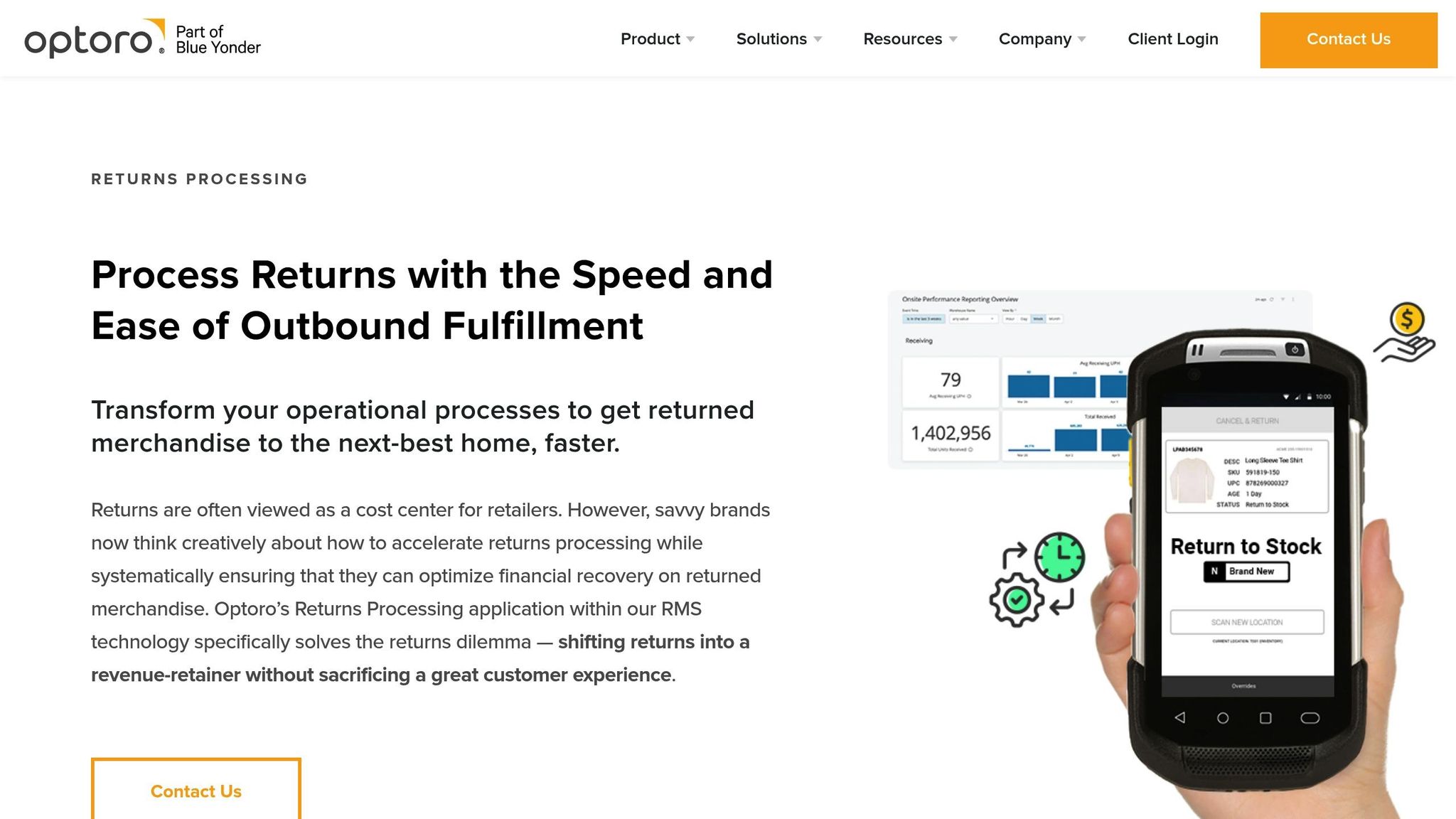
Optoro's Returns Processing Software for Retailer and 3PL Warehouses
sbb-itb-eafa320
What Are Cloud-Based Returns Management Systems?

WMS vs RMS: Key Differences in Returns Management Systems
A cloud-based Returns Management System (RMS) is software designed to oversee every step of the product return process. For third-party logistics providers (3PLs) juggling returns for multiple clients, an RMS helps manage varying policies, service agreements, and product-handling requirements seamlessly across operations.
Unlike a Warehouse Management System (WMS), which focuses on outbound tasks like picking, packing, and shipping, an RMS is built specifically for the reverse flow of goods. It handles returns initiated by customers through branded portals, assigns RMA (Return Merchandise Authorization) numbers, tracks items as they’re received, and directs them through inspections, grading, and next steps. These next steps could include restocking, repair, return-to-vendor, recycling, or disposal. Built with an API-first design, RMS platforms integrate smoothly with systems like WMS, OMS (Order Management Systems), ERP (Enterprise Resource Planning), and e-commerce platforms. This integration ensures a streamlined data flow and up-to-the-minute inventory updates - capabilities that traditional systems often lack.
How Returns Processing Differs from Outbound Fulfillment
Returns processing is a whole different ballgame compared to outbound fulfillment. While outbound shipments follow a predictable flow - pick, pack, and ship - returns are much more chaotic. Items arrive at irregular intervals, often requiring two to three times more labor and warehouse space to process. Each return undergoes grading and inspection, with decisions about its next steps depending on the product type and the client’s specific policies.
This unpredictability creates significant challenges. Outbound fulfillment benefits from consistent, planned volumes, making staffing and space management relatively straightforward. Returns, on the other hand, are unpredictable in both timing and volume, making labor planning a headache. It’s no wonder that 47% of warehouse decision-makers rank returns management as their biggest operational challenge. Additionally, outbound processes focus on tracking inventory as it leaves the warehouse, but returns require real-time updates to ensure returned items are quickly added back into available inventory. As one Product Manager at a global 3PL put it:
"Our strategic warehouse management system isn't built for returns. Our WMS treats returns as a different type of manufacturing inbound which we know is not the same workflow."
These complexities highlight why modern RMS platforms are better equipped to handle returns compared to older systems.
Cloud-Based vs. Legacy Systems
The differences between cloud-based and legacy systems boil down to flexibility, real-time data access, and ease of integration. Legacy systems often need months of custom coding to adjust workflows or accommodate new client rules. In contrast, cloud-based RMS platforms are highly adaptable and can be up and running in just a few months. They also provide centralized visibility across all warehouse locations and 3PL partners, accessible with just an internet connection. Legacy systems, on the other hand, often rely on outdated tools like spreadsheets, which lead to data silos and make tasks like labor forecasting and trend analysis unnecessarily complicated.
Here’s a quick comparison:
| Feature | Warehouse Management System (WMS) | Returns Management System (RMS) |
|---|---|---|
| Primary Goal | Picking, packing, and shipping | Managing the return lifecycle |
| Customer Portal | No | Yes (Branded) |
| Disposition Rules | No | Yes (Automated by product/client) |
| Grading/Inspection | Limited/Manual | Yes (Configurable workflows) |
| Return Reason Data | No | Yes (Actionable BI) |
| Labor Requirement | Standard | 2–3× higher than outbound |
| Integration | Core warehouse operations | API-first, system-agnostic |
For 3PLs handling returns for multiple clients, cloud-based RMS platforms simplify operations by creating standardized processes. Considering that the average retail return rate is 16.5%, and e-commerce returns can reach a staggering 30%, automation and consistency are essential. Providers like JIT Transportation are leveraging these advanced systems to streamline reverse logistics and improve overall efficiency.
Core Features of Cloud-Based Returns Systems
Cloud-based returns management systems are designed to tackle the challenges of reverse logistics head-on. These tools help third-party logistics providers (3PLs) manage the unpredictable nature of returns while ensuring smooth operations for multiple clients. By simplifying workflows, they create opportunities for operational improvements.
Workflow Automation and Process Speed
Automated dispositioning lies at the heart of modern returns systems. Instead of relying on warehouse staff to decide the next steps for returned items, the system uses pre-set rules to make instant decisions. When a worker scans a returned product, the system determines whether it should be restocked, repaired, sent back to the vendor, recycled, or discarded. This approach speeds up processing and minimizes errors.
Digital grading and inspection replaces manual assessments with standardized workflows. Workers follow consistent steps to evaluate an item's condition, reducing variability and mistakes. The system records photos, notes, and quality scores, which feed directly into decision-making processes. A real-world example? Genesco used ReverseLogix's returns technology in 2023 and saw an 80% drop in return processing time, according to Leif Revere, Director of Distribution Center Systems at Genesco.
Self-service portals simplify the returns process for customers. These branded interfaces allow customers to initiate returns, automatically generate RMA numbers, and provide all the necessary details before items even reach the warehouse. This not only keeps customers informed but also ensures 3PLs receive approved returns with complete documentation, cutting down on unexpected shipments and missing paperwork.
Directed sorting enhances the efficiency of putting items away after inspection. The system guides workers on where to place items based on their condition and next steps, reducing bottlenecks and speeding up restocking. This quicker turnaround means returned items are ready for resale faster, directly benefiting client revenue.
Overall, automated systems can cut processing times by up to 50% and double or even triple units processed per hour compared to manual methods. For 3PLs, where handling returns can require two to three times more labor than outbound shipping, these efficiency gains translate into cost savings and happier clients.
Real-Time Visibility and Reporting
Live dashboards offer instant access to returns data for 3PLs and their clients. Unlike outdated systems that rely on end-of-day reports or manual spreadsheets, cloud-based platforms provide real-time tracking for every return, from initiation to final resolution. This eliminates data silos and allows warehouse managers to monitor operations without constant manual oversight.
Proactive exception management uses real-time data to flag issues early. By analyzing over 60 operational metrics, the system identifies potential problems, such as rising return volumes for a specific client or product category. Alerts enable managers to address these issues quickly, whether by adjusting staffing or investigating root causes.
Data-driven staffing becomes more achievable with accurate, up-to-the-minute insights. Erin Johnson, Senior Returns and Vendor Compliance Manager at Genesco, explained:
"I can plan my manpower for the day or week, because all I need to do is look on ReverseLogix and it'll tell me how many returns we're expecting".
This data also reveals trends, helping 3PLs prepare for busy periods without scrambling for last-minute fixes.
Financial transparency improves with detailed reporting tools that break down costs per order and analyze profits by client or route. By knowing exactly how much it costs to process returns for each client, 3PLs can identify revenue leaks and make informed decisions about pricing and resource allocation. Efficient inventory management through these systems can lower warehousing costs by up to 30% and boost inventory accuracy by 20%. For 3PLs handling diverse client needs, this level of insight is crucial for profitability and service quality.
Integration and Scalability
API-first design makes these systems highly adaptable. Instead of lengthy custom coding, they integrate seamlessly with existing WMS, ERP, OMS, and e-commerce platforms like Shopify or NetSuite. This compatibility ensures real-time data synchronization across the supply chain.
Composable architecture allows 3PLs to adopt only the features they need. For example, they might use just the returns portal and processing module while keeping their current WMS for outbound tasks. This modular approach avoids the need for a complete system overhaul, cutting implementation time from months to weeks.
Multi-client scalability is built into the system's design. These platforms can handle returns for multiple clients, each with unique rules and requirements, without mixing data or creating manual workarounds. This makes it easy for a single warehouse to serve diverse clients efficiently.
SaaS-driven upgrades ensure the system stays current. Updates roll out automatically, so there's no need to schedule downtime or worry about compatibility issues. This keeps all users on the latest version, no matter where they are.
The financial potential is substantial. Gaurav Saran, CEO of ReverseLogix, noted:
"By offering returns management to an existing customer base, we've seen 3PL customers increase revenues 10%-30%".
This growth comes from processing returns faster, handling more clients, and offering premium services that older systems can't support. For 3PLs looking to expand their services or scale operations, cloud-based returns systems provide the tools to grow without adding significant overhead. Their modular design ensures efficient and scalable returns management for any operation.
Benefits of Cloud-Based Returns Systems for 3PLs
Cloud-based systems offer measurable advantages for 3PLs, thanks to features like automated workflows, real-time analytics, and seamless integration. These tools simplify complex returns processes, making them faster, smarter, and more efficient.
Efficiency and Cost Improvements
Handling returns is no small task - it often takes 2–3 times more labor and space than outbound fulfillment. Cloud-based systems tackle these challenges by automating tasks that once depended on manual spreadsheets and subjective decisions. For example, scanning an item can trigger predefined rules - whether to restock, repair, or recycle - removing the guesswork and reducing errors.
The time savings are impressive. At Genesco, Leif Revere, Director of Distribution Center Systems, shared how ReverseLogix technology transformed their operations:
"Processing time drops to one-fifth of previous durations, freeing resources for outbound fulfillment".
This faster processing clears up warehouse space and labor, allowing businesses to focus on more profitable outbound activities. Some companies have reported up to a 5% boost in profits after streamlining their returns operations. For 3PLs, this efficiency means lower handling costs per unit and the ability to serve more clients without needing additional infrastructure. It’s a win-win: smoother operations and better client service.
Better Client Satisfaction and Retention
Specialized returns management turns 3PLs into one-stop solutions, managing the entire product lifecycle and building stronger client relationships. This is especially valuable since handling returns in-house can be both costly and complicated.
Cloud-based systems also provide powerful analytics, helping 3PLs become strategic partners rather than just service providers. Kai Bahlman, Vice President of Warehousing at Amer Sports, highlighted this benefit:
"With reports about reason coding, we're getting better control over the process and what needs to be improved to reduce the amount of returns in general".
These insights allow clients to pinpoint why returns happen and address quality or merchandising issues. The result? Smarter business decisions and fewer returns. Optimized returns processes can even boost customer satisfaction by 15% to 25%. Faster refunds and exchanges also help 3PLs meet service level agreements and protect clients' Net Promoter Scores.
Financial and Environmental Benefits
Cloud-based systems don’t just save money - they open up new revenue streams. Gaurav Saran, CEO of ReverseLogix, explained:
"By offering returns management, a 3PL can increase its revenues by 10%-30%, which is basically the return rate".
This added income comes from services like inspection, grading, refurbishment, and recommerce. Advanced disposition rules quickly determine which items can be resold at full price and which need liquidation or recycling. Plus, these systems verify item conditions and counts against RMAs, reducing fraudulent claims.
On the environmental side, the impact is just as compelling. About 10% of all returned items end up in landfills, and only 20% of discarded textiles worldwide are reused or recycled. Cloud-based systems promote sustainability by efficiently sorting items for repair, resale, or recycling, minimizing waste. Intelligent routing cuts down transport distances, lowering emissions. Metrics like "distance traveled per returned item" and "resale percentage versus waste" help clients hit their environmental targets. For 3PLs, offering sustainability reporting not only sets them apart but also supports corporate environmental goals.
How to Implement Cloud-Based Returns Systems
Bringing a cloud-based returns system into your operations starts with a solid game plan. Success hinges on understanding your current processes, ensuring seamless tech integration, and committing to ongoing refinement.
Evaluating Your Current Returns Process
First, pinpoint the bottlenecks in your current system. Are your employees using spreadsheets, paper checklists, or relying on subjective decisions for grading returns? These manual approaches often lead to more errors and slower processing times.
Take a close look at your data visibility. Can you accurately track the true costs of returns, including labor, facility expenses, and the time it takes to process items? Establishing baseline metrics - like the average time to process RMAs or the per-item handling cost - will help you measure the success of your new system later on. Also, review your physical setup. Returns can require two to three times the space and labor compared to outbound fulfillment, so creating a dedicated area for returns can prevent inefficiencies.
Once you’ve analyzed your current process, it’s time to ensure your new system works seamlessly with your existing tools.
Connecting with Existing Systems
This is where cloud-based systems truly shine, thanks to their ability to integrate with your current tech stack. Most platforms use APIs and webhooks to connect with your WMS, ERP, and TMS. Start with a simple one-way integration where the returns system sends data to your WMS. This lets your warehouse team know what’s coming before it arrives. Once that’s running smoothly, upgrade to a two-way integration. This allows the WMS to send back grading decisions and disposition actions, enabling the returns system to automatically issue refunds or exchanges.
If your WMS or ERP already updates inventory when returns are processed, make sure to disable the 'restock' setting to avoid double counting. Also, confirm that your integration partners support API-first connections for real-time data updates. For 3PLs managing multiple clients, webhooks can be particularly helpful. For example, triggers like "Return Created" or "Label Scanned" allow you to plan labor and space needs based on incoming volumes.
With your systems connected, the next step is to deploy the solution and focus on continuous improvements.
Deployment and Ongoing Improvement
Once your processes are refined and your systems are integrated, deploy the new solution using standardized workflows and consistent training. Replace manual tasks with automated rules for grading. Set up automated triggers for updates like "item received" or "refund processed" to cut down on customer service inquiries.
For example, in September 2023, Genesco Inc., a retailer with 1,400 stores, consolidated multiple systems into a single RMS. Erin Johnson, their Senior Returns and Vendor Compliance Manager, led the project, which delivered immediate ROI. The Director of Distribution Center Systems noted that both internal and external satisfaction was evident "from day one". Another global footwear retailer saw returns processing improve by 50% to 60% after integrating their RMS with 3PL networks and NetSuite ERP, replacing an outdated SAP system.
After deployment, keep an eye on metrics like disposition cycle time - the time it takes for items to move from "received" to "available-to-sell." Reducing this time frees up capital tied up in unsold inventory. Use analytics to spot patterns in return reasons and fine-tune your processes. For 3PLs managing multiple clients, ensure your system can support unique SOPs for each retailer on the same platform.
Measuring Returns Management Performance
Tracking key metrics is essential for identifying operational strengths and pinpointing areas that need improvement. Without proper analytics, the complexity of returns lifecycles can increase by 10%-42%. The focus here is on assessing both operational efficiency and financial impact to make smarter, data-driven decisions.
Key Metrics for Returns Management
Start by monitoring process speed metrics to evaluate how quickly returns are handled. For example, track the average time it takes to process return merchandise authorizations (RMAs) step-by-step - from the moment an item arrives at your facility to when it re-enters sellable inventory. Another crucial metric is disposition cycle time, which measures how fast returns are moved to resale, recycling, or disposal. Shorter cycles mean less working capital tied up in unsold goods.
On the financial side, focus on understanding the per-item handling cost, which includes facility expenses, labor, and shipping. To get a full picture of returns costs, calculate the total cost of ownership. This involves adding together costs like COGS, shipping, labor, and disposition, then subtracting any resale recovery. Additionally, measure the resale percentage and recycled product ratios to evaluate waste reduction efforts. This is especially important given that about 10% of returns typically end up in landfills.
| Metric Category | Key Performance Indicator | What It Measures |
|---|---|---|
| Process Speed | RMA Processing Time | Time from receipt to final disposition |
| Financial Impact | Per-Item Handling Cost | Total labor, facility, and shipping costs per unit |
| Inventory | Disposition Cycle Time | Speed from return to resale or disposal |
| Sustainability | Resale Percentage | Recovery rate and waste reduction effectiveness |
These metrics build a foundation for deeper insights, which advanced analytics tools can help uncover.
Using Analytics for Better Operations
When integrated with existing systems, these metrics and analytics can significantly improve returns management. Real-time data allows teams to quickly identify and address issues. A Director of Distribution Operations for a global retailer shared:
"We have really robust reporting that's relevant to many teams throughout the company. The credit team uses ReverseLogix for reporting; the customer service team relies on it to see whether returns have been processed; even our manager who oversees our 3PL partner uses ReverseLogix for insight".
Analytics also help identify root causes of returns by tracking reason codes and return rates by SKU. For instance, if a particular product is frequently returned due to sizing issues or defects, sharing this data with clients can help resolve these problems. Additionally, visibility into incoming return volumes makes staffing more efficient. Erin Johnson, Senior Returns and Vendor Compliance Manager at Genesco, noted:
"I can plan my manpower for the day or week, because all I need to do is look on ReverseLogix and it'll tell me how many returns we're expecting".
This kind of actionable data drives continuous improvements, whether it’s optimizing staffing, refining processes, or enhancing client communication.
Conclusion
Cloud-based returns management systems are now a cornerstone for 3PLs tackling the challenges of today's e-commerce-driven logistics world. As highlighted earlier, the hurdles of managing returns are considerable, making reverse logistics a critical area for improvement.
These modern systems bring measurable financial and operational benefits. For 3PLs with established clients, implementing returns management can drive revenue increases of 10%-30%. Additionally, they cut labor costs, speed up processing, and boost inventory accuracy to as much as 99%.
But the advantages go beyond just operational efficiency. Cloud-based systems transform returns into a competitive edge. They allow 3PLs to offer value-added services like refurbishment, repackaging, and secondary market management. This not only strengthens client relationships but also aligns with sustainability goals by streamlining the recovery and handling of returned goods.
Unlike older systems designed primarily for outbound logistics, these platforms provide real-time integration, automated workflows, and scalability to meet changing client demands. This makes them a strategic upgrade for any 3PL looking to refine their returns processes.
To remain competitive, 3PLs should assess their current returns operations, integrate cloud-based solutions with their existing systems, and embrace advanced technologies. At JIT Transportation, we leverage these cloud-based tools to optimize returns management, delivering efficient, dependable, and scalable logistics solutions that help our clients succeed in a demanding market.
FAQs
How fast can a cloud RMS go live in a 3PL warehouse?
A cloud-based returns management system (RMS) can usually be up and running in a 3PL warehouse in just a few weeks to a few months. Thanks to the adaptability of cloud technology, the setup and integration process tends to be much faster than with older, on-premises systems. This streamlined approach makes it easier to get operations moving without lengthy delays.
What data should sync between an RMS and my WMS/ERP?
A cloud-based Returns Management System (RMS) works best when it integrates seamlessly with your Warehouse Management System (WMS) or Enterprise Resource Planning (ERP). The key is syncing essential data like return authorization details (such as RMA numbers), return orders, inventory updates, inspection results, and disposition statuses - whether items are restocked, repaired, or disposed of.
By aligning shipment details, reasons for returns, and processing statuses, you can maintain accurate inventory records, reduce errors, and streamline financial reconciliation. This kind of synchronization keeps operations running smoothly and efficiently.
Which returns metrics best prove ROI for a 3PL?
Key metrics that showcase the ROI of a 3PL in handling returns include return processing time, costs, resale percentage, and key performance indicators like return rate and return-to-refund time. These figures provide insight into how efficiently returns are managed, the level of cost savings achieved, and the impact on customer satisfaction. Together, they paint a clear picture of the value a returns management system brings to the table.
Related Blog Posts
Related Articles
7 WooCommerce 3PL KPIs Teams Track

Centralized vs Decentralized Replenishment
