
Collaborative Supply Chain Metrics: A Study

Modern supply chains thrive on collaboration, where businesses share data, align goals, and track performance using clear metrics. This approach minimizes disruptions, improves efficiency, and ensures accountability across partners. Key takeaways include:
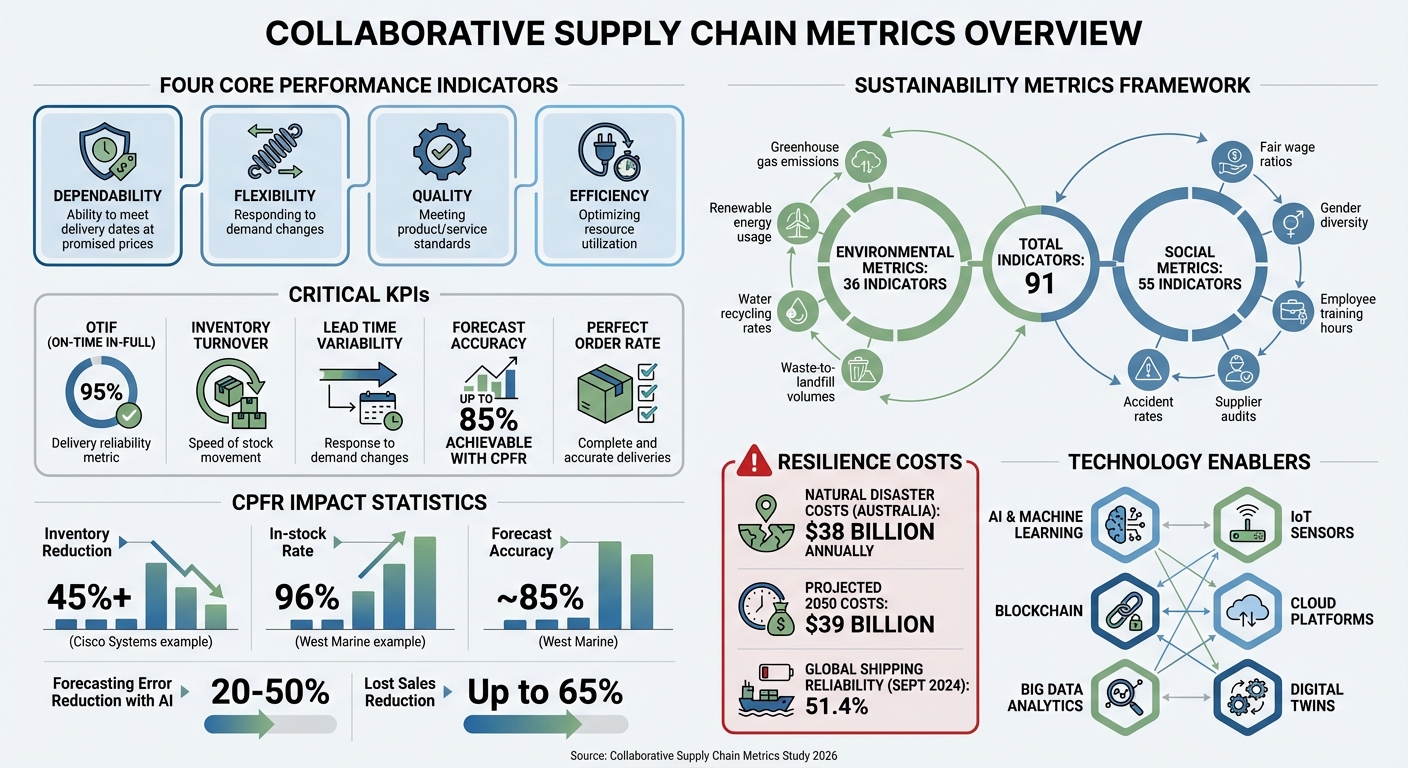
- Metrics Matter: Dependability, flexibility, quality, and efficiency are core indicators for evaluating partnerships.
- On-Time In-Full (OTIF) delivery rates and inventory turnover are critical for reliability and efficiency.
- Technology’s Role: Tools like AI, IoT, and cloud platforms enhance data sharing and forecasting accuracy.
- Sustainability Focus: Companies now track greenhouse gas emissions, fair wages, and supplier audits to meet environmental and social goals.
- Resilience Metrics: Resistance (handling disruptions) and recovery capability (bouncing back) are becoming central to supply chain evaluation.
Collaboration frameworks like CPFR (Collaborative Planning, Forecasting, and Replenishment) and governance committees ensure smoother operations and shared accountability. By focusing on shared goals and leveraging advanced tools, businesses can achieve stronger, more reliable supply chains.
Key Collaborative Supply Chain Metrics and Performance Indicators
Metrics that Matter: Supply Chain Collaboration
sbb-itb-eafa320
Core Metrics for Collaborative Supply Chains
Collaboration in supply chains thrives on clear metrics that measure how well partners perform. These metrics turn broad objectives into measurable results, making it easier to spot problems early on. Research highlights four key indicators for evaluating collaborative supply chain performance: dependability, flexibility, quality, and efficiency. The tricky part is balancing metrics that measure the overall network's success (network-level KPIs) with those that assess individual contributions (actor-level KPIs). Together, these metrics lay the foundation for assessing how well partnerships function across the supply chain.
Primary KPIs for Measuring Partnership Performance
The most important metrics focus on reliability and financial outcomes. On-Time In-Full (OTIF) delivery rates are a critical measure of reliability, showing whether shipments arrive as promised and in the correct quantities. As one study notes, "Dependability is the ability to meet delivery dates at promised prices". Efficiency metrics like inventory turnover reveal how quickly stock moves through the system, while lead time variability highlights how well partners respond to demand changes. Financial metrics, such as cost savings and ROI, demonstrate the value of partnerships by lowering overall system costs.
Shared KPIs are essential for collaborative networks, as they reflect joint efforts. To ensure consistency, partners should agree on how these KPIs will be calculated, set target values, and define how often they’ll be measured. Tools like the Balanced Scorecard can help map these metrics to specific business goals and show the relationships between them. By aligning on shared KPIs, partners create a strong foundation for collaboration, which will be explored further in later sections.
Supply Chain Visibility and Forecast Accuracy
Visibility across the supply chain is critical for avoiding the bullwhip effect, where minor demand changes snowball into massive inventory fluctuations due to poor communication. Collaborative planning frameworks allow partners to align their operations, improving forecast accuracy and reducing inefficiencies.
Better forecast accuracy leads to more efficient use of resources. It minimizes the need for excessive safety stock while maintaining high service levels. When partners synchronize their planning, production, and replenishment processes through Collaborative Planning, Forecasting, and Replenishment (CPFR) frameworks, they reduce forecast errors and streamline replenishment schedules. The success of these efforts depends on robust Transaction Processing Systems and Management Information Systems, which ensure timely and accurate data sharing across the network. Beyond the technical aspects, trust and cooperation between partners play a crucial role in fostering effective information exchange.
Sustainability Metrics in 2026
By 2026, environmental and social responsibility will take center stage in supply chain metrics. A comprehensive framework identifies 91 sustainability indicators, including 36 environmental and 55 social metrics. Key environmental measures include greenhouse gas emissions, renewable energy usage, water recycling rates, and waste-to-landfill volumes. Companies also evaluate eco-friendly practices like product recyclability and green packaging at every stage of the supply chain.
On the social side, metrics track areas like fair wage ratios, gender diversity, employee training hours, accident rates, and supplier audits for human rights compliance. The triple bottom line - people, planet, and profit - guides these measurements. To avoid risks related to environmental or humanitarian violations, companies should evaluate not only their own sustainability efforts but also those of their suppliers. Technologies from Industry 4.0, such as Blockchain, IoT, and Big Data, now enable real-time monitoring of sustainability metrics across complex supply networks.
Collaborative Planning, Forecasting, and Replenishment (CPFR)
Understanding CPFR
CPFR, which originated from a 1995 pilot project between Wal-Mart and Warner-Lambert, is a framework that allows trading partners to collaborate on planning and share real-time data. This collaboration helps improve demand forecasting and production scheduling.
The framework operates on three levels: Strategic, focusing on alliances; Managerial, for coordinated forecasting; and Operational, handling routine tasks. For CPFR to work effectively, certain factors are crucial: trust between partners, reliable information and communication technology (ICT), and high-quality data. Additionally, formal agreements are necessary to address discrepancies in forecasts. Without these foundational components, CPFR implementations often fall short of their potential.
When these processes align, they not only simplify operations but also open the door to major performance improvements, as explored below.
How CPFR Improves Metrics
CPFR has been shown to drive measurable improvements in both financial and operational performance. Studies reveal that it enhances metrics like sales, gross margins, inventory turnover, asset turnover, return on assets (ROA), and return on sales (ROS). For example, Cisco Systems managed to cut inventory levels by over 45% through collaborative planning, while West Marine achieved a 96% average in-stock rate and improved forecast accuracy to nearly 85% using CPFR methods. These examples highlight how synchronized planning can lead to tangible performance gains.
A key strength of CPFR lies in its ability to create a unified view of demand across the supply chain. Incorporating AI into CPFR further amplifies its impact, reducing forecasting errors by 20–50% and cutting lost sales due to product shortages by up to 65%. By aligning planning efforts, partners can more reliably meet goals like on-time, in-full (OTIF) deliveries and improved inventory turnover, boosting overall network performance.
Modern CPFR practices are now enhanced by cloud platforms and AI tools, offering real-time visibility and automated exception handling. These advancements are especially valuable for logistics providers. For instance, JIT Transportation has adopted these advanced CPFR techniques to optimize transportation scheduling, improve inventory control, and enhance overall supply chain efficiency.
Shared Accountability and Governance
Collaborative supply chains thrive when partners take joint responsibility for outcomes. Research highlights that shared accountability helps bridge information gaps between partners, fostering the trust essential for meaningful collaboration. Achieving this requires well-defined agreements on roles, measurement standards, and ways to address issues.
However, buyers and suppliers often view governance through different lenses. A study of 150 matched buyer-supplier pairs revealed a key insight: buyers see formal contracts and trust-based relationships as complementary, while suppliers tend to view them as alternatives. This disconnect can hinder collaboration unless both sides create clear, mutually accepted frameworks. One effective solution is setting up formal committees to ensure shared accountability.
Setting Up Governance Committees
Governance committees play a critical role in monitoring performance, resolving disputes, and keeping both parties aligned with shared objectives. They strike a balance between enforcing accountability and allowing flexibility.
Data from over 1,000 electronic components suppliers shows that alignment becomes increasingly important in complex, interdependent relationships. In such cases, governance committees act as a vital platform for addressing issues early and adapting strategies based on real-time insights.
Successful committees often adopt a dual-focused governance model, which aims to drive both innovation and cost efficiency. This approach acknowledges the need to balance competing priorities in supply chain partnerships. As management consultant Bernhard J. Angerhofer explains:
Alignment may be achieved through a performance trade-off balancing strategy.
This structure naturally encourages the adoption of integrated tools for unified performance tracking.
Using Balanced Scorecards for Performance Tracking
Inter-enterprise balanced scorecards take this governance model further by tracking shared metrics across organizational boundaries. These scorecards provide transparency and a unified framework for evaluating performance. Key metrics often include total cost of ownership (TCO), perfect order rates, and other indicators relevant to both parties.
When suppliers align their metrics with the priorities of major customers, performance discussions become more streamlined. Research from La Trobe University supports this, finding that:
The performance priorities of large customers play a role in shaping suppliers' management control systems.
This alignment simplifies communication and establishes a shared language for evaluating outcomes.
For logistics providers like JIT Transportation, balanced scorecards offer a practical way to measure collaboration with manufacturing and retail partners. By tracking metrics such as on-time delivery rates, inventory accuracy, and order fulfillment speed, all stakeholders gain clear insights into how well the partnership is functioning and where improvements are needed.
New Trends in Collaborative Supply Chain Metrics
The concept of shared accountability and balanced scorecards in supply chains is evolving as businesses adapt to a changing global landscape. In 2026, supply chain partnerships are being reshaped by factors like geopolitical instability, climate challenges, and shifting global value chains. Traditional safety stock metrics are no longer enough. Instead, companies are focusing on metrics that evaluate two critical aspects: the ability to handle disruptions (resistance) and the speed of recovery after those disruptions (recovery capability).
A major shift is underway, moving from relying on inventory buffers to emphasizing operational flexibility. Instead of merely stockpiling goods, businesses are now measuring how quickly they can reconfigure operations. As Jiang Hu and Jiangming Ma noted in Systems Journal:
"Supply chain digitalization enhances its resilience through three channels: information transparency, collaboration efficiency, and resource flexibility."
This highlights that resilience isn’t static - it’s a dynamic process that requires ongoing monitoring and adjustments to remain effective.
Metrics for Building Resilience
Modern supply chain metrics focus heavily on two key dimensions: resistance (absorbing shocks) and recovery capability (returning to normal operations quickly). One example is Technological Capability Symmetry (TCS), which measures whether supply chain partners have aligned digital tools and systems. When companies differ in their digital maturity, collaboration can falter. On the flip side, high TCS fosters stronger partnerships and reinforces resilience.
Another innovative approach is the use of reconfigurability indices. These indices track how easily a supply chain can adapt to changes, whether from market fluctuations or disruptions. Metrics like resource flexibility - how quickly assets and production can be reallocated - are also gaining traction.
The stakes are high. Natural disasters alone cost Australia around $38 billion annually, with projections reaching $39 billion by 2050. Globally, shipping schedule reliability plummeted to just 51.4% in September 2024. These figures underline the urgency of adopting metrics that go beyond simple delivery timelines.
Technology-Driven Metrics and Tools
Advanced technologies are playing a key role in reshaping how risks are measured and managed in supply chains. For instance, Large Language Models (LLMs) can now analyze unstructured corporate data to generate detailed Supply Chain Risk (SCR) indices using zero-shot prompting. This provides a more nuanced view of risks compared to older methods.
Technological tools are often grouped by their functions. Resource-oriented tools, such as IoT and Big Data, focus on improving data visibility and preprocessing. Meanwhile, action-oriented tools like AI, blockchain, and cloud platforms use that data to enhance coordination and make predictions. AI is particularly effective at identifying supply and financial risks, while automation helps businesses adapt during technological disruptions.
Another emerging metric tracks the integration of supply chain expertise with IT and AI skills. J. Frank Li of the University of British Columbia observed:
"The accumulated stock of such human capital - especially supply chain–AI hybrid skills - enhances supply chain resilience through geographic diversification and multi-sourcing of suppliers, while reducing the need for large inventory buffers."
This underscores that resilience isn’t just about technology - it’s also about having skilled personnel who can bridge the gap between supply chain operations and digital tools.
For logistics providers like JIT Transportation, these innovations are game-changing. IoT sensors enable real-time shipment tracking, while AI predicts potential delays, giving partners the transparency they need to handle disruptions effectively. Digital twins - virtual models of physical supply chains - are another tool that allows companies to simulate "what-if" scenarios and test responses before crises hit. Together, these advancements strengthen collaboration by providing actionable insights and reinforcing shared accountability.
Conclusion
Collaborative supply chain metrics create a shared foundation that aligns partners with common objectives, driving efficiency, reliability, and scalability across the entire network. As one study aptly states:
"In modern business, competition is no longer between organizations, but among supply chains."
The research explored throughout this study - particularly the CPFR framework - provides a clear path for turning collaboration into measurable outcomes. These strategies represent a major shift in supply chain operations, helping to reduce issues like the bullwhip effect and improve forecast accuracy through synchronized decision-making and shared information.
But metrics alone aren't enough. Their success depends on mutual trust, strong executive support, and technologies that allow real-time data access. Effective KPIs should focus on collective achievements rather than isolated performance. This broader perspective helps partners lower total costs and align efforts from long-term planning to daily operations.
As highlighted earlier, integrated technologies and open data sharing are critical to these metrics. For logistics providers such as JIT Transportation, tools like tracking systems, AI-based forecasting, and transparent data platforms enable the collaboration modern supply chains demand. When all partners operate with the same information and follow a unified strategy, they can better handle disruptions, use resources efficiently, and deliver consistent performance.
FAQs
Which KPIs should partners share vs keep internal?
In collaborative supply chains, it's crucial for partners to share key performance indicators (KPIs) that promote transparency and alignment. Examples include delivery performance, operational metrics, and quality indicators. These shared metrics help build trust and improve coordination among all parties involved.
At the same time, certain KPIs - like strategic financial data or proprietary process efficiencies - are best kept internal. Keeping these private protects competitive advantages. By sharing only the KPIs that are relevant to the partnership, companies can strike the right balance between effective collaboration and safeguarding sensitive information.
How do you standardize OTIF and inventory turnover across partners?
To improve OTIF (On-Time In-Full) and inventory turnover, it's crucial to create shared systems for measuring performance that align with common goals. Start by adopting standardized definitions, clear protocols, and ongoing improvement methods. Studies show that aligning metrics with the priorities of supply chain partners and using tools like a collaboration index - tracking practices such as information sharing - can make a big difference. This approach promotes transparency, minimizes inconsistencies, and strengthens coordination throughout the supply chain.
What’s the best way to measure resilience and recovery?
To evaluate supply chain resilience and recovery, it's essential to track metrics that reveal how well a system can handle disruptions, adjust to challenges, and bounce back to normal operations. Some of the most telling performance indicators include on-time delivery rates, fulfillment percentages, and time-to-recovery. These metrics offer practical insights into the system's performance. Pairing them with network analysis can further highlight weak points and monitor recovery efforts, ensuring a comprehensive understanding of the supply chain's ability to respond to unexpected events.
Related Blog Posts
Related Articles
7 WooCommerce 3PL KPIs Teams Track

Centralized vs Decentralized Replenishment
