
How to Communicate Shipping Delays During Holiday Rush
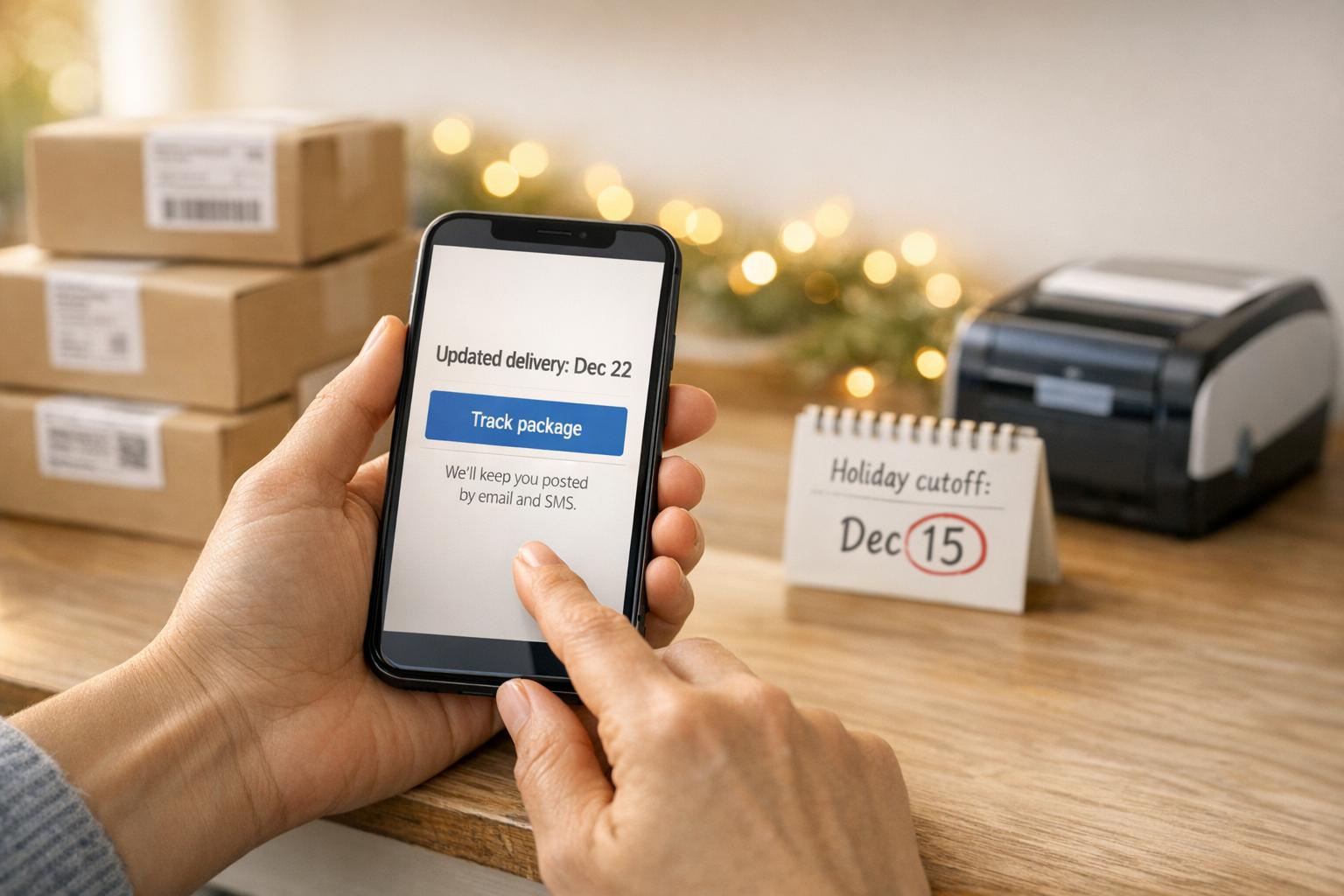
Holiday shipping delays can frustrate customers, but clear communication keeps trust intact. Here's how you can manage delays effectively:
- Plan early: Secure inventory and partner with multiple carriers months ahead to avoid last-minute issues.
- Set expectations upfront: Share realistic shipping timelines and holiday cutoff dates clearly on your website and checkout pages.
- Notify customers immediately: If delays occur, send prompt updates via email and SMS with specific details and revised delivery dates.
- Offer solutions: Provide compensation like discounts, refunds, or free shipping upgrades to retain customer loyalty.
- Use automation: Tools like SMS alerts and branded tracking pages ensure customers stay informed without overwhelming your support team.
- Leverage data: Analyze past shipping trends to anticipate delays and adjust timelines accordingly.
Will Your Package Arrive by Christmas? Holiday Shipping Deadlines 2025
sbb-itb-eafa320
Plan Ahead for Holiday Shipping Delays
Getting ahead of holiday shipping challenges can make a big difference in keeping your customers happy. With shipping volumes jumping by about 33% during the holiday season, the key is to prepare early. This means locking down your inventory and partnering with reliable carriers well before the rush. Waiting until November? That’s asking for trouble.
Stock Inventory Early and Partner with Multiple Carriers
Start by looking at your sales data from last October through December. This will help you figure out which products fly off the shelves and which ones linger. For your bestsellers, aim to keep 30–60 days’ worth of safety stock on hand.
When it comes to ordering, don’t cut it close. Place orders 8–12 weeks in advance to account for lead times and any hiccups. If your products come from overseas, you’ll need to act even sooner. For example, air freight from China should be ordered by early November, while sea freight should be locked in by September to ensure delivery by December. And don’t forget the essentials - stock up on packaging supplies like boxes, tape, and bubble wrap well ahead of time to avoid shortages or price spikes.
Relying on just one carrier during peak season is risky. Spread out the load by working with at least two national carriers and one or two regional ones. If managing multiple carriers feels overwhelming, consider using a third-party logistics provider like JIT Transportation. They offer pre-optimized carrier networks, scalable warehousing, and strategically located fulfillment centers to get your products closer to your customers. To secure space and availability, finalize carrier partnerships by late summer or early fall.
Once your inventory and shipping plans are in place, use past data to fine-tune your delivery timelines.
Use Historical Data to Predict Delays
Your historical shipping data is a goldmine for understanding potential delays. Review last year’s performance, especially around Black Friday and Cyber Monday. Instead of relying on advertised shipping speeds, calculate the actual delivery times. For instance, if a carrier claimed 3-day delivery but consistently took 7 days, adjust your checkout page to reflect a 7–10 day window. On average, domestic holiday shipments face delays of 2–5 business days, while international orders can be held up by 7–14 days due to customs.
Take a close look at your entire fulfillment process. Break it down step by step and note where volume spikes caused slowdowns in the past. Also, track your “Where Is My Order?” (WISMO) support tickets from previous seasons to identify when customers start getting anxious. Use this information to set internal order cutoffs that are 24–72 hours earlier than your carrier’s deadlines. To play it safe, add an extra two days of transit time around major holiday dates to account for unexpected delays.
Set Customer Expectations Before Delays Happen

2025 Holiday Shipping Cutoff Dates for Major US Carriers
Preparing early for the holidays is just one part of the equation; setting clear expectations with customers is equally important. Proactively addressing potential delays can make a huge difference in how customers perceive your brand. Here’s why it matters: 40% of shoppers avoid brands after experiencing just one delay, and a staggering 90% will abandon a brand if delays aren’t explained.
Being upfront about timelines not only safeguards your reputation but also encourages action. When customers know exactly when they need to order, they’re more likely to follow through. Consider this: 35% of shoppers won’t complete a purchase if delivery times seem too long, and 68% check the returns page before buying.
So, how can you set the right expectations? Use clear messaging, like cutoff dates, visible notices, and updated FAQs, to keep customers informed.
Announce Holiday Order Cutoff Dates
Start spreading the word about shipping deadlines at least six weeks before the first major carrier cutoff. Make these dates impossible to miss - place them on your homepage, product pages, cart, and checkout screens. Be cautious with your estimates; for instance, if a carrier promises delivery by December 22, tell customers December 20. This gives you a buffer for unexpected delays.
Turn your cutoff dates into a marketing opportunity. Add countdown timers and send "last chance" email reminders to create urgency. Be specific about the difference between ship dates (when the item leaves your warehouse) and delivery dates (when it arrives). For even better accuracy, tailor your deadlines to the customer’s location and selected shipping method during checkout.
Here’s a quick look at major U.S. carrier deadlines for Christmas delivery in 2025:
| Carrier Service | Cutoff Date for Christmas Delivery |
|---|---|
| USPS Ground Advantage / First-Class | December 17 |
| USPS Priority Mail | December 18 |
| FedEx Ground (5-Day Shipping) | December 17 |
| UPS 3 Day Select | December 19 |
| USPS Priority Mail Express | December 20 |
| FedEx 2Day | December 22 |
| UPS 2nd Day Air | December 22 |
| UPS Next Day Air | December 23 |
| FedEx SameDay | December 24 |
To ensure customers don’t miss these deadlines, reinforce them with on-site notices at every step of their shopping journey.
Add Notices to Product Pages and Checkout
Make sure shipping deadlines are visible throughout the shopping experience. A sticky banner at the top of your site can keep this information front and center without disrupting browsing. On product pages, include specific alerts for items that might face supply chain issues to provide targeted updates.
At checkout, offer real-time shipping speeds and estimated delivery dates. This clarity not only improves cart conversion rates but also builds customer confidence. As Shopify highlights:
“Communicating shipping speeds at checkout to your customers improves cart conversion, provides clarity and transparency, and increases confidence”.
Keep in mind, 32% of customers will abandon their carts if delivery estimates seem too long.
Update FAQ Sections with Shipping Information
A dedicated "Holiday Shipping" section in your FAQ can address common questions about deadlines, expedited shipping, and return policies. Link this FAQ in order confirmation emails to reduce the volume of inquiries. Be thorough - cover specific cutoff dates for different shipping tiers, tracking processes, return windows, and steps to take if a package is delayed or lost.
Provide context for potential holiday setbacks, such as increased carrier volume, labor shortages, or severe weather, to help customers understand the challenges. Transparency like this fosters trust. As OneSignal puts it:
“Being transparent and specific with predictions around which items you expect to have issues with is a best practice... it ultimately adds to your brand credibility and instills trust”.
Alert Customers Right Away When Delays Occur
When delays happen, especially during busy holiday seasons, quick communication is essential to maintain customer trust. Customers expect to be informed promptly - ideally within 4–6 hours of identifying a delay. In fact, 90% of customers want immediate updates when their order status changes, and only 17% will stay loyal if retailers remain silent during shipping issues.
Here’s the upside: clear and timely communication can make a huge difference. A transparent approach can retain 84% of customers after a shipping problem. Acting quickly with updates sets the stage for effective follow-up communication.
Send Prompt Alerts with Clear Reasons
When notifying customers, include key details: an apology, the reason for the delay, a revised delivery date, a remedy (like a discount or free shipping), and a tracking link. Avoid vague phrases like "as soon as possible" - instead, give a specific timeframe, such as "December 22–24".
Explain the cause of the delay clearly, whether it’s due to weather, carrier backlogs, or high order volumes. This level of transparency strengthens trust. Acknowledging responsibility, even for third-party carrier delays, can boost customer retention by 31%.
Tailor your remedy to the severity of the delay. For example:
- A 1–2 day delay might warrant free shipping on the next order.
- A 6+ day delay or a missed holiday deadline could call for a partial refund of 20–30%.
Choose the right communication channel based on the length of the delay:
- For 1–2 day delays, email is sufficient.
- For 3–5 day delays, use both email and SMS.
- For delays longer than 6 days, prioritize SMS followed by email.
During the holiday rush (November 20 – December 24), combine SMS and email to reach as many customers as possible.
Use Automated Systems for Quick Notifications
Managing communications during peak periods requires automation. Tools like OneSignal, EasyShip, LateShipment.com, and Square can send updates quickly across multiple channels. These systems ensure regular updates every 24–72 hours, depending on the urgency of the delay.
SMS is particularly effective for urgent alerts, boasting a 98% open rate, while email works well for detailed explanations and formal documentation. During peak times, send updates every 24 hours; otherwise, adjust to every 48–72 hours. Always include a direct tracking link so customers can easily check their order status without logging into a portal.
Regular updates are crucial - 83% of shoppers expect consistent communication about their orders, and during the holidays, customers check tracking an average of 4.6 times per order. By automating these alerts, you can reduce customer inquiries and strengthen their loyalty.
Use Multiple Communication Channels
Effectively managing shipping delay notifications means using a mix of communication methods. Relying on just one channel can leave some customers in the dark, as everyone has their preferred way of staying informed. For detailed updates, email is ideal, while SMS and push notifications are better for grabbing attention quickly.
To tailor your approach, match the urgency of the delay to the communication channel. For minor delays of 1–2 days, an email alone usually suffices. When delays extend to 3–5 days, combining email with SMS ensures better visibility. For major delays, such as those lasting 6+ days or missing key holiday delivery dates, start with SMS - thanks to its impressive 98% open rate - and follow up with an email for more details. During busy times, sending both SMS and email simultaneously can maximize your reach for time-critical updates. This multi-channel approach helps reassure customers and minimizes confusion.
Send Detailed Updates Through Email
Email is your go-to for providing a clear and thorough explanation of delays. It’s the perfect place to outline what happened, share a new delivery timeline, include tracking links, and mention any compensation being offered. To keep it effective, make sure to include the most important details - such as the cause of the delay, the revised delivery date, and a tracking link - within the first 150 words.
Interestingly, more than 94% of consumers see transactional messages, like order confirmations and delay updates, as a crucial part of their holiday shopping experience. Furthermore, over 75% expect these updates within five minutes. Email gives you the space to deliver this essential information in a professional and accessible way that customers can revisit whenever needed.
Send Quick Alerts via SMS and Push Notifications
For urgent updates, SMS and push notifications are unbeatable. With SMS boasting a 98% open rate, it ensures your most time-sensitive alerts are seen right away. Push notifications, on the other hand, deliver instant updates to smartphones, reinforcing the email messages you’ve sent.
SMS is particularly useful for critical updates, like delays affecting holiday gift deliveries or notifications about low inventory. It’s also great for reaching customers who might not have immediate internet access. Just keep these messages strictly transactional - avoid mixing in promotional content to maintain their focus and purpose.
If your company has a mobile app, you can also use it to enhance these notifications with additional features.
Enable In-App Messaging for Order Tracking
A mobile app adds another layer of convenience by offering real-time tracking through in-app messaging. This allows customers to check their order status without leaving your branded environment, avoiding the generic experience of carrier tracking pages.
In-app notifications can significantly reduce "Where is my order?" (WISMO) inquiries - by as much as 60–70% - which is a huge help for customer service teams during peak seasons. You can also use these messages to alert customers about potential delays before checkout or suggest substitute products when necessary. After resolving a delay, a quick in-app survey can gather feedback on which communication methods worked best, helping you fine-tune your approach for future situations.
Keep Customers Updated and Offer Solutions
Once you've sent out proactive delay alerts, the next step is to keep customers in the loop and offer actionable solutions. Regular updates and clear communication can turn a frustrating delay into an opportunity to build trust. Considering the average shopper checks their order status 4.6 times before it arrives, providing real-time updates not only reassures customers but also reduces support inquiries.
Share Order Tracking Links and Regular Updates
After sending out initial alerts, consistent updates and easy-to-access tracking information are key to maintaining trust. Branded tracking pages can keep customers engaged with your platform while offering real-time updates. Setting up a multi-stage notification sequence - like "Order Shipped", "Out for Delivery", "Delay Alert", "Delivery Attempt", and "Delivered Late" - helps manage expectations. Including a tracking link and updated delivery date in these notifications can make a big difference.
Mira, a content creator at LateShipment, highlights the importance of clear communication, especially during high-stress periods:
"Holiday shoppers reward brands that communicate first, fast, and clearly especially on delays and last-mile changes." – Mira, Content Creator, LateShipment
Automating notifications at the first sign of a delay is another way to stay ahead. Include worst-case delivery estimates and actionable options like "Manage Delivery Options" or "Contact Support" to empower customers. If updates fall short, offering timely compensation can help ease frustrations.
Offer Compensation to Acknowledge Delays
Acknowledging delays with a proactive gesture can go a long way in retaining customer loyalty. Statistics show that 40% of shoppers would stop buying from a brand after just one shipping delay, and 90% of those who don’t receive an explanation are unlikely to return. Offering compensation demonstrates that you value their time and business.
Some effective compensation options include:
- Discount codes (e.g., 15% off): Encourages repeat purchases and future loyalty.
- Shipping refunds: Provides immediate financial relief for the inconvenience.
- Shipping upgrades: Offers faster delivery at no cost to show commitment.
- Product alternatives: Recommends similar in-stock items to resolve inventory-related delays.
- Local pickup options: Helps bypass carrier delays for nearby customers.
| Compensation Type | Primary Benefit |
|---|---|
| Coupon Codes | Encourages future loyalty and repeat business |
| Refunds | Provides immediate financial resolution |
| Shipping Upgrades | Demonstrates commitment to speed despite setbacks |
| Product Alternatives | Resolves inventory delays with immediate options |
Work with Scalable 3PL Providers
Partnering with a reliable 3PL (third-party logistics) provider is essential for managing high-volume surges and minimizing delays. During peak times like Black Friday and Cyber Monday, package volumes can overwhelm providers without strong infrastructure. A dependable 3PL offers carrier diversification, allowing you to pivot if one carrier faces delays, and provides real-time data to keep customers informed.
For example, JIT Transportation offers scalable solutions with a nationwide network, advanced technology, and flexible capacity to handle peak-season demand. Their strategic warehouse locations enable two-day ground shipping for most customers, while pre-packaging or kitting items before the busy season reduces processing times.
When evaluating a 3PL partner, request data on their performance during past peak seasons (e.g., the last two to three Q4 periods). Ensure their Warehouse Management System integrates seamlessly with your platform to avoid manual errors. Also, factor in both the 3PL's handling time and carrier transit times when providing delivery estimates, adding a buffer for holiday congestion.
Conclusion
Handling holiday shipping delays effectively requires a mix of early preparation, clear communication, and practical solutions. By setting expectations ahead of time, you can reduce customer concerns and foster trust, even when issues like carrier delays are out of your hands.
Proactive planning goes hand-in-hand with consistent communication. Use all available channels to keep your customers in the loop, turning potential frustration into loyalty by showing you care about their experience.
When delays happen, transparency is non-negotiable. Address the issue promptly and offer compensation - like discount codes, shipping refunds, or upgraded delivery options - to demonstrate that you value your customers’ time. Research shows that 90% of shoppers are unlikely to return if delays are ignored, but 77% are happy to shop again with retailers who resolve issues quickly and provide fast shipping.
Strong logistical support is another pillar of success. Partnering with a dependable 3PL provider such as JIT Transportation can make all the difference. With a nationwide network, strategically located warehouses for two-day ground shipping, diversified carrier options, and extras like pre-packaging and kitting, you’ll be better equipped to handle peak-season surges and minimize processing times. These strategies not only help you manage delays but also turn them into opportunities to strengthen customer loyalty.
FAQs
What should I say in a delay message to customers?
When informing customers about a shipping delay, it's crucial to be clear, timely, and understanding. Make sure your message includes the following:
- A direct acknowledgment of the delay.
- The updated estimated delivery date.
- A message that shows your dedication to resolving the situation.
For instance: "We’re sorry for the delay. Unexpected circumstances have caused a change in your order’s delivery schedule. It is now expected to arrive in [X] days. We appreciate your patience and are working hard to get your order to you as soon as we can."
How often should I send shipping delay updates?
Proactively sending updates about shipping delays is key to maintaining customer trust. Anytime there's a change in the shipment's status - whether a delay is identified or anticipated - make sure to notify your customers. At the very least, provide an update when the delay is first confirmed and follow up periodically if the issue continues. Clear, regular communication eases uncertainty and helps ensure a smoother experience for your customers, even during setbacks.
When should I use a 3PL like JIT Transportation for holiday rush?
If your business anticipates a surge in demand during the holiday season, partnering with a 3PL like JIT Transportation can help you navigate the challenges of peak shipping times. With access to scalable solutions, advanced technology, and a broad carrier network, JIT Transportation can manage increased volumes, streamline routes, and keep your customers happy. This approach ensures your operations stay on track and deliveries remain dependable during this busy period.
Related Blog Posts
Related Articles

8 Ways 3PLs Handle Seasonal Workforce Swings

Marketplace API vs EDI for Fulfillment
